welcome back before the break we talked about uh the way in which International Court's Jurisdiction is constructed and also about their composition uh and I want to move on to talk about some uh new developments in the field of international courts uh some new features that we are evidencing but also some of the the new challenges that courts are confronting so so traditionally International courts were uh courts uh that were available for states to uh to resolve their disputes which goes very much um hand inand with the state Centric uh characteristics of the international legal
system so states were the subject of international law other entities individuals Etc uh were objects of protection but they didn't really have uh rights including procedural rights but this of course is changing and it is changing because international law is changing uh and because we have seen that states are often suboptimal enforcers so for in enforcers of international law so for instance in the field of Human Rights we've mentioned this in the unit on human rights um States rarely Sue one another in court because of human rights violations that have no uh immediate relevance for
the uh suing state so State a would not Sue State B for violating the rights of citizens of State B unless something very dramatic happens which means that human rights law would be chronically under enforced so the way the Europeans have dealt with it is by creation institutions initially a commission of Human Rights eventually a court of human rights which could deal with cases that originate not from States but actually originate from individuals and of course individuals have a much greater uh have much greater propensity to bring cases that affect them individually and therefore uh
as long as the court the European Court of Human Rights was a court that only dealt with Interstate CA with cases brought by States or even court cases brought by the the the commission the European commission it dealt with u about a thousand cases in 40 years once the court has opened its door it's now dealing with 40,000 cases every year so the numbers have increased significantly as a result of the loosening of the right of standing uh before the court another example of uh of uh um a Judicial institution that operates at the international
level that also is not really only about States uh is the court of justice of the European Union which cannot only heere cases between states and there are very few cases of that nature it can only bring here like the European Court of human rights cases brought by individuals but what's interesting about this court is that the cases brought by individuals are not cases against states there is an indirect Avenue of preliminary rulings which could also uh eventually a case brought by an individual against a state in a domestic court can eventually end up before
the court of justice of the European Union but the the the citizens of the European Union can bring cases against uh the institutions of the European Union so against the the the European Council against the European commission against the European Central Bank so it's not only about um upholding the rule of law for States it's also upholding the rule of law Visa international organizations another illustration of this expansion of the scope of the international judicial system is the Rome statute establishing the IC which we mentioned before actually none of the parties uh to proceedings before
the ICC are typically States the parties to proceedings before the IC would be the prosecutor the prosecutor is an international agent it is he or she are um a public uh public servant who are working on behalf of the International Community maybe representing the2 uh3 State parties to the Rome statute but sing certainly not a single state needs to be involved and even the complaint doesn't need actually to originate from a state I mean the complaint could orig as we have seen from the security Council it could originate from a state but it could also
originate from any source and the under certain conditions the prosecutor can what is called proot on on his or her own initiative bring a case against uh the defendant who is again not a state but rather an individual so what we are seeing is really a process by which International courts are shifting from being Interstate courts to being much more diverse courts of the International Community or of uh uh International courts of a universal or Global reach another area where we are seeing an expansion of the field of uh International uh dispute settlement as far
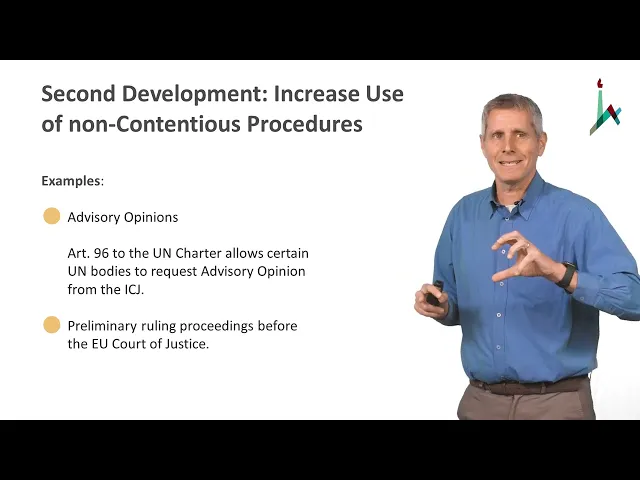
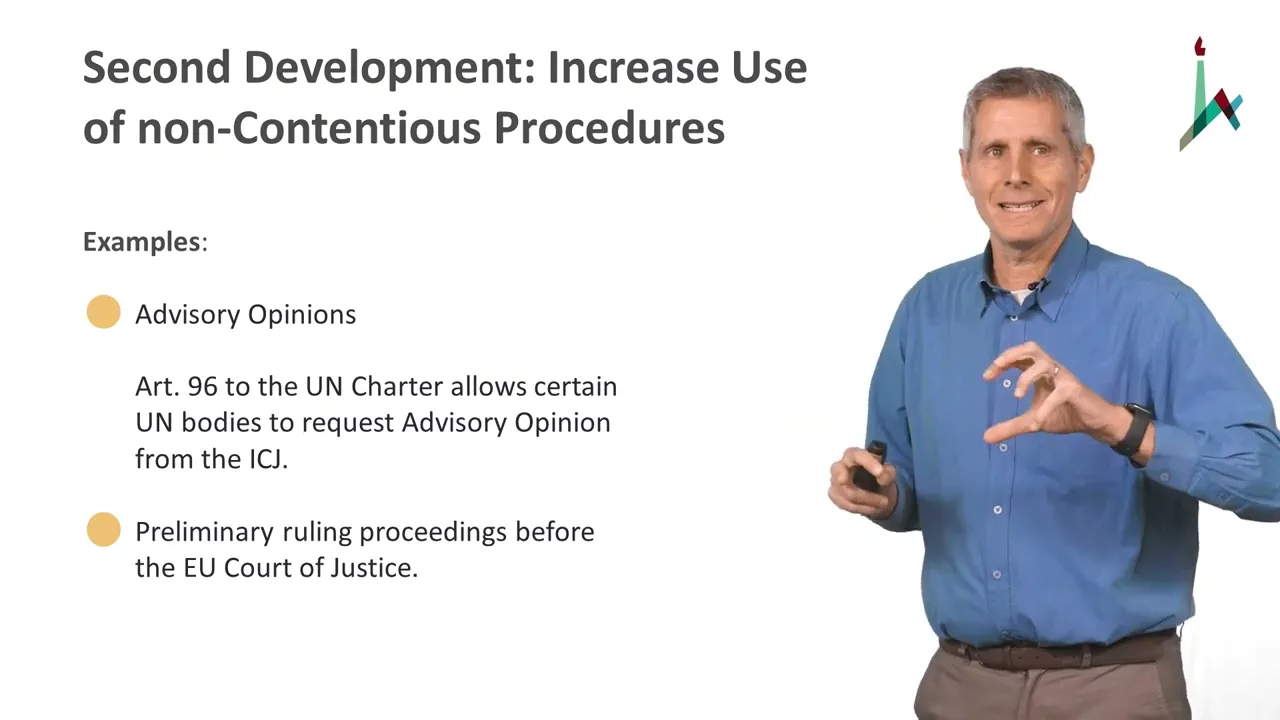
as it relates to International courts is the increasing use of procedures which are not contentious in nature so it's not a case brought one against by one State against another state or even by one individual against um one organ of the European Union but also the use of more imaginative or more flexible procedure such as the use of advisory opinions which is something that often you do not find within domestic institutions but here in the life of uh International courts this is quite an important Avenue because uh International courts are not only there to resolve
disputes they are also there to um uphold the law and they're also there to provide legal guidance and in the life of uh also the legal of Nations but also the United Nations we have seen in many cases the the political organs of the United Nations they required some legal guidance as to what does international law say about a specific issue which could be about um a specific normative proposition are legal are nuclear weapons legal under international law or not or about a specific um or about legal aspects of a specific conflict such as the
construction of a wall in in the Palestinian territories or the um refusal of uh what is the legal status of the chagos islands which are in contention between great United Kingdom and mauricius and on these although these are issues which raise a dispute the purpose of advisory proceedings are not to resolve the dispute but rather to provide legal guidance to the political organs of the United Nations that would allow them to uh adopt policies which take cognizance of the legal dimensions of the disputed hand uh and in this regard uh we the charter in article
96 does allow the general assembly the security Council and some other mandated specialized agency to ask uh to ask the court of legal opinion and this has been done a number of dozen of times in the history of the Court we also see some imaginative and flexible procedures in other contexts one context which I briefly alluded to before is the preliminary ruling proced proceedings which exist before the European Union um court of justice uh where uh a case which which arises within a domestic legal system but has an EU Dimension So within a domestic case
a question relating to the law of the EU has arisen what the domestic court can do or sometimes is required to do is to stay the domestic procceedings and refer the question for preliminary preliminary ruling to the court the court ISS issues the ruling the case then goes back to the domestic court and it is decided on the basis of the preliminary ruling so this is actually a very sophisticated mechanism that that creates a sort of um a Machinery uh comprising both of domestic courts uh and the court of justice of the European Union both
playing uh a certain part in the resolution of a specific case but the contribution of the uh of the court is a very narrow contribution is to provide an interpretation on a specific issue that has arisen in domestic litigation another development that we are seeing in this world of international courts and tribunals is the growing uh tendency to create appellate bodies so uh if um in domestic systems it's quite common for an individual who is unhappy with a legal decision to take it to the next level in international law this is traditionally not been the
case uh Interstate arbitrations or uh proceedings before the international court of justice cannot be appealed uh but uh the more the system evolves and the more you have uh litigation uh the more there are questions that arise in different for instance panels under the dispute settlement mechanism of the WTO uh and if those panels uh point in different directions uh States could actually uh be in a bind because again the purpose of modern international dispute settlement as applied by International courts is not only to resolve specific disputes but also to Pro provide General guidance about
the state of the law and for this um some level of harmonization needs to be introduced and this is what domestic systems do through introduction of appeal processes uh and sometimes actually the uh appeal is given or accorded or not afforded on the basis of the question of whether uh lower courts are have generated inconsistent case law so that kind of reasoning has influenced the drafters of the WTO agreements when they have formulated the dispute settlement understanding Annex which uh which governs the work of the um of the of the panels and and the Appellate
body so the idea is that there will be an appet body that would harmonize uh the different decisions of the different panels and and provide certain um uniformity to the case law of the WTO I should know that this appellate body um is under considerable political pressure in recent years largely from the United States which sees it as a two activist in in in its orientation and being too ready to read in new obligations upon State parties uh but by and large it this is considered as a good idea and there are thoughts about replicating
it also within the the the trade and investment sorry in the International Investment Arena uh with regard to uh the European Convention of on human rights we have seen that the great reforms that the convention has undergone in the late 1990s towards the end of the previous Century also Al included the uh establishment of a two uh of a two-level um uh set of panels so a case in the European convention on human rights that goes to the court would typically be heard by a seven judge panel but the case could be uh then referred
to another uh rehearing uh it's not an appeal but actually another another uh instance which will reconsider the case uh before a grand chamber of 17 judges which is another illustration of the stronger push to get it right and to create higher degree of uniformity in the application thisa in this case of human rights law uh another issue where we are seeing an increased interest in the in the work and life of international courts has to do with the question of um enforcement of judgments uh international law is notoriously uh known known for its um
um limited degree of Effectiveness the fact that there are weak mechanisms of enforcement um the icj for instance IT issues its decision but uh in order to enforce the decision parties have to go to the security Council and this has almost never happened uh partly because of the abuse use and abuse of the veto Power by the security Council so um if Ukraine uh Ukraine has recently obtained um an interim provisional measure decision against the Russian Federation its ability to enforce this is quite limited and this remains to a large extent one of the Achilles
heels of the system um there are other bodies that have been created more modern bodies that are more uh sensitive to this problem uh and have developed ways uh to render their decisions uh more um implementable more enforceable so for instance under the WTO we have seen this in the beginning of of this unit uh when uh when the panel and the appell body have decided that the European Union had violated the WTO agreements on the issue of the beef hormones they did authorize the United States to impose trade sanctions on the EU until they
change their policies so this is one set of enforcement which is one form of enforcement which is actually quite effective and another example we are seeing within the European Union treaty the treaty on the functioning of the European Union we are seeing uh um a pro a process by which the court of justice of the European Union can actually impose a fine on the state on a state that have violated its decisions and the political organs of the European Union would then go on to uh Implement that fund that fine uh another example the convention
on the settlement of investment disputes which I've alluded to before does provide quite interestingly that an award that is issued by exit the international center for the settlement of investment disputes would be deemed by any member state in the Convention as if it was rendered by its own courts so if um an investor is winning a decision against a state not only can that can that investor try to uh basically enforce that decision within the state it the investor could actually go to any state in the world in which the state has assets and try
to enforce that judgment against that state so we have seen a system of international courts that is growing in its powers growing in its uh becoming more imaginative more flexible uh more present in international life in international politics um what are the downsides of these developments let me briefly address them or what are the problems the challenges that this system uh handles so one challenge is that is really not the system we have an assortment of Institutions that are generating decisions they have very limited degrees of formal coordination between them and there is a significant
likelihood that one Court could decide a case in ways which are fundamentally different from the way in which another court has has decided and this is really not um not a um just an imaginary problem this is a problem that has actually Arisen on a number of occasions one prominent example uh we have seen is around the events in the in the Balkans in the in the early 1990s the the war in Yugoslavia the former Yugoslavia and specifically the question of what is the relationship between the Serb State and the uh and the Serb Rebels
or the Serb militants within the territory of Bosnia it's a question which has significant legal implications because if um the militants are the long hand of Serb then the conflict is really between the two states of Serbia and Bosnia and one set of laws apply if they are not the long hand of Serbia if Serbia does not control these militants then the conflict within within Bosnia is a non- international armed conflict to which another set of laws apply we have seen the international criminal Tribunal for the former Yugoslavia apply a test a legal test which
is called overall control to assertain whether Serbia is respons ible for the activities of the militants and this is in a case called Tadich uh um which uh uh resulted in the application of the laws of international armed conflict to the situation at hand but then we have seen the international court of justice eight years later in 2007 reach exactly the opposite decision holding that Serbia does not have legal responsibility for the specific acts of the militants because the proper legal standard is not overall control but a more stringent effective control standard and this is
of course something which creates uh a lot of consternation in international law and the ilc which is the UN agency responsible the body of experts which is responsible for the development and codification of international law has issued uh in 2006 a report on the fragmentation of international law highlighting the problem of fragmentation and making some specific recommendations as to how this problem could be minimized inter Alia by using the notion of Lex specialis so coordinating between different legal regimes and also attempting to interpret one legal Norm in the light of other applicable legal Norm but
clearly the problem has not uh disappeared over and Beyond the problem of fragmentation however there are other problems which I will briefly uh discuss uh that afflict the world of international adjudication uh they could be divided into two uh categories one are problems of legitimacy the other are problems of Effectiveness so legitimacy has to do uh first and foremost with the question of selectivity I mean this is relevant particularly in courts such as the international criminal court that does uh have a rather broad jurisdiction some of which can be exercised on a discretionary basis so
uh the prosecutor of the Court can decide propri motto on his or her own initiative to handle cases that have Arisen within the the the state parties to the uh to the within the state parties to the Rome statute and as so far has has made these selections uh these selections have been quite criticized in that they have focused quite extensively on cases emanating from the African continent I should say that some of the reason for this perception is that there have also been referrals of cases by States uh and by the security Council involving
the African continent but the uh the the bottom line is that there is an appearance of excessive focus on the African continent of course questions of selectivity were also raised when the prosecutor try to step outside the African continent for instance bring a case in involving the Israeli Palestinian conflict and then Israel has argued that this is also impermissible selectivity so so this has to do both with the function of the court but also to some extent with the activation uh by political bodies of international court so the the process of referrals or request for
um advisory opinion from the icj is also susceptible to criticisms of uh of uh selectivity another legitimacy problem has to do with what is called uh the Democratic deficit that is that courts especially in Europe are uh entrusted with the significant powers to decide over interpretation of human rights to decide over the interpretation and application also of uh of of uh econom of laws governing Economic Policy increasingly to interfere in matters relating to immigration policy and this has been viewed by some states uh as being um in conflict with their Sovereign right and Sovereign interest
and in a way um uh a pro process which is uh shifting responsibility and power from elected politicians in inside states to unelected judges outside States and the criticism against this process is one of the reasons that has been cited for brexit the decision of the United Kingdom to withdraw from the European Union and shield itself thereby from the uh Decisions by the court in Luxembourg the court of justice of the European Union I should say that the UK is also often very upset with Decisions by the Strasburg Court the court uh the European Court
of human rights for similar reasons and then there are allegations and concerns about politicization of processes the fact that judges are sometimes too activist or adopt reasoning that is not convincing for states is often translates itself to accusations of Judges playing politics and stepping outside uh the four corners of the law and this again uh raises concerns about the legitimacy of the process I mentioned before the concerns that uh the United States has uh with regard to the WTO dispute settlement body and actually it is sanctioned That Body by refusing to consent to the appointment
of Judges effectively uh resulting in the shutting down of that uh of the functioning of that body we have seen in other contexts also in Africa the shutting down of a Regional Court uh where it is issue decision which were politically unacceptable to the state so the interplay between between judicial activity and politics remains heavily charged and serves as the basis of legitim legitimacy criticism then on the other side we have a set of problems which are not totally unrelated and they have to deal with the effectiveness of Courts uh with the compliance with their
decisions which even for the best courts uh like the European Court of Human Rights we are seeing serious problems of compliance about 50% of the decisions are not implemented in the first 5 years after they were rendered uh in some courts the record is even less uh saver and then we are seeing a process a political backlash against courts where states are unhappy with their general direction we've seen African States threatening to withdraw from the IC because of its alleged bias against African States and uh we are also seeing um States being able to uh
limit the power of Courts limit the resources available to courts in ways which exacerbate their effectiveness problems so for instance within the UN system uh of adjudicating individual complaints we are seeing a growing backlog of communications because simply the states that are parties to a treaty like the iccpr are not providing the human rights committee which serves as a quasi judicial body with the necessary resources that are required to process the hundreds and hundreds of cases that it receives every year we have reached the end of uh this unit uh I hope uh you have
been able to uh to follow this with some interest and I look forward to continuing a discussion of other topics soon