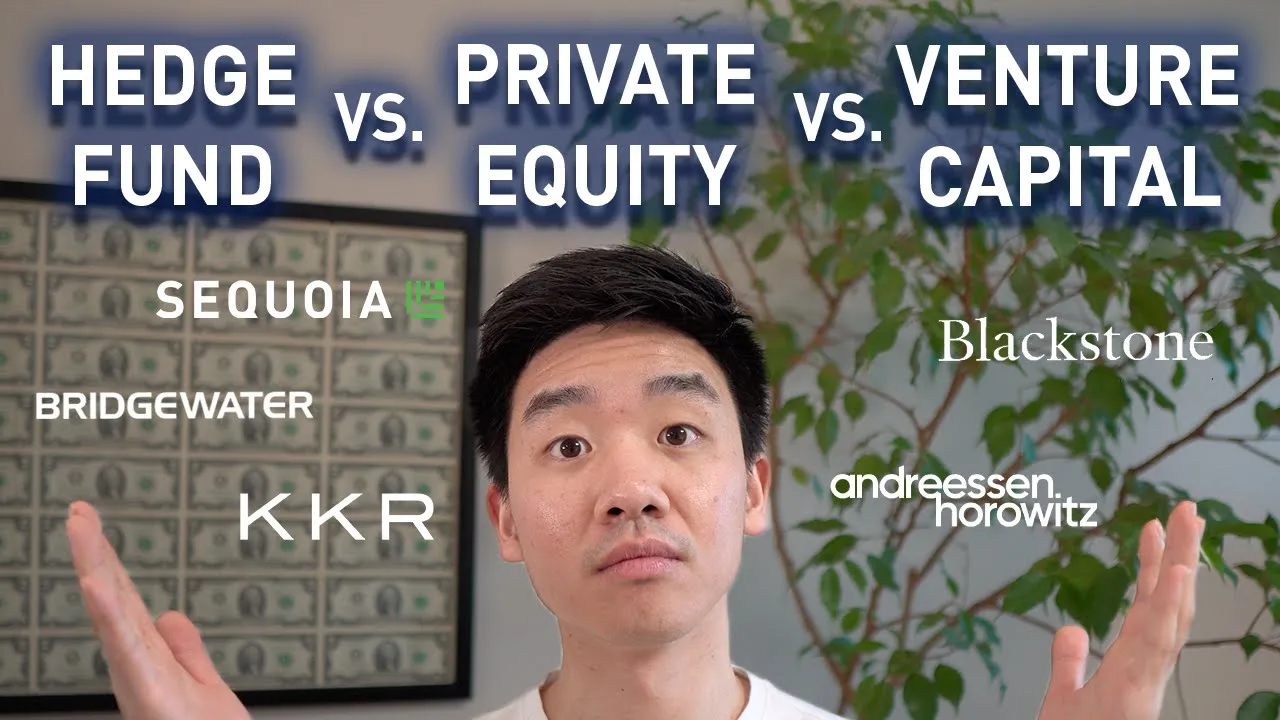
in the finance world the hardest industries to break into are collectively known as the buy side and these include hedge funds private equity and venture capital these three industries are usually shrouded by mystery but i'm gonna try to shed light on the buy side and in case you're new to the channel as a bit of background my name is ben and i used to work at jp morgan as an investment banker for a few years and so i used to look into these spaces a lot myself because i considered going into the buy side and
i also have a lot of friends in the buy side as well so i spoke with a bunch of them and out of all my friends in banking i'm the only weird guy who's just making youtube videos but anyway i digress in today's video i'll first be going over what you do in each of these fields i'll then go over the hours and lifestyle next into compensation and lastly how to break in and some tips on how to figure out which field is right for you two quick things before i get started first i want
to let you know that today's video is a brief overview into each of these fields and so i'm going to do deep dives into each of them later on let me know down in the comments which one you'd like me to do first and second shout out to the sponsor of today's video financial edge for helping make this video possible and stay tuned for a giveaway announcement with financial edge alright so jumping straight into it let's first talk about what you do in each of these fields first i do have to add the caveat though
that depending on the funds that you join and what kind of strategy it has your experience and what you do will be pretty different than what i explained today or it can be and so today i'm giving broad generalizations and so just think that i'm giving you a big picture overview with that said starting in alphabetical order hedge funds focus on investing in public financial securities like stocks fixed income assets options commodities futures and more hedge funds also have a wide variety of strategies like you see here but given that there are so many i'm
going to really just focus on long short fundamental hedge funds since they're the easiest to understand at a long short hedge fund you're looking deep into public companies by digging through financial statements speaking with management teams reading industry reports to establish a market view keeping up to date with economic and market news to form a macro view and building financial models usually on a quarter to quarter basis as a more junior hedge fund analyst you're typically given a small universe of companies to cover let's say somewhere between 10 to 20 companies and your job is
to focus on doing research to suggest which companies to invest in and which ones to avoid depending on the firm you might also have some free reign or it may even be your job to think of new investment ideas that fit your fund's strategy then as you grow more senior at a fund you're given a portion of the fund's overall portfolio to manage and so while you're still continuing to diligence companies you won't be digging into the weeds as much and you'll also be more and more in charge of relationships with investors and fundraising lastly
here is a snapshot of some of the top hedge funds in the world which you can pause to take a look through next up is private equity and pe investors really focus on one type of transaction called the leveraged buyout or lbo in simple terms an lbo involves funding the acquisition of a company with debt aka leverage hence the term leveraged buyout and then making operational improvements to the business paying off as much debt as possible through the company's cash flows and then exiting that business through an m a sale or ipo ideally at a
higher valuation to ultimately earn a return on investments there are a few important implications with the lbo the first is that pe investors are long-term investors because it takes a lot of time to really operate and improve a company and so typically each investment will be exited on average in about five years the second is that pe investors are extremely deliberate and do very very thorough diligence in a company because not only are they acquiring 100 of the equity they're also funding the purchase with a bunch of debt the third is that pe investors are
always looking to buy more established companies that have stable cash flows rather than investing in hot tech startups which are usually burning cash and are unprofitable in terms of your day-to-day pe investors primarily focus on building financial models which are usually lbos writing investment memos that present the market view potential returns and risks conducting due diligence on potential investments through lots of phone calls with management customers and industry experts supporting portfolio companies sourcing new companies to invest in and fundraising as a more junior pe investor your time is focused on responsibilities one through four here
while as a more senior pe investor you're focused more on three to six lastly here is a snapshot of some of the top private equity firms in the world most of which you may not have heard of before if you're new to finance by the way before we move on to venture capital you're to notice the lighting is changing as i'm filming this video because the sun is coming up and i was working pretty hard on this video so we'd really appreciate if you could smash that like button to help support the channel for venture
capital vc investors really help entrepreneurs build their businesses from the ground up in three primary ways the first obvious way is through funding and vc investors provide huge injections of capital that help companies hire talent and scale their operations the second is by providing insight the best vc investors have been around for decades and have seen a lot of companies come to the pipeline and so vc investors can be great sounding boards for entrepreneurs especially during the toughest of times third is by providing a strong network the best vc firms are extremely well connected and
can help entrepreneurs with things like recruiting top talent or making introductions for key business relationships because venture capital involves investing in the super early stages of a company the industry is a super high risk high reward industry and usually in vc your top few investments will make up for tens to hundreds of poor investments and this really is not an exaggeration as for what you do vc investors spend their time sourcing new companies to invest in reviewing lots and lots of pitch decks from founding teams conducting due diligence on potential investments supporting portfolio companies networking
with entrepreneurs and other industry professionals and fundraising junior vcs typically spend more time on numbers one through three here while the more senior vcs really spend time doing all of these responsibilities but not as much of the grunt work with the diligence and they're also having lots and lots of meetings with entrepreneurs and lastly here is a snapshot of some of the top venture capitals in the world for you to take a look at by the way if you're interested in trying to break into the buy side whether it's in the short term or long
term one resource i highly recommend are the courses on financial edge the company's founder alistar is literally the instructor who taught me and hundreds of other analysts during my summer training at jpmorgan and he's this british guy who has a really really great good-natured personality and cares a lot about being a good teacher financial edges instructors trained the analysts at the top four banks who paid tens of thousands of dollars and you can get the same lessons for just a few hundred dollars so i think it's really worth it you can also learn about accounting
modeling and a whole lot more to help you break into investment banking and or the buy side and on that note financial edge has courses like the investment banker and a private equity course that focuses on lbo modeling and financial edge is giving away one of these two courses to three winners all you have to do is follow rare liquid and financial edge on instagram and leave a comment down below on why you'd like to win and financial edge will announce a winner one week later on january 19th you can also use my code rare
liquid 25 to get 25 off and so if you want to purchase from financial edge you can find the link down in the description below and if you buy and win the giveaway then financial ed will just simply refund you all right now moving on let's now go into the hours and lifestyle now in terms of hours it's really hard to give anything besides a rough estimate for the buy side because you're gonna have some chill weeks where things are pretty manageable and then you're gonna have some really really crazy weeks where work just consumes
you but with that said roughly speaking for private equity you work around 65 hours a week on a normal week and then you would work 80 to 90 hours a week when you're working on a live deal and this could go on for many many weeks for venture capital around 60 hours is more normal while 70 to 90 hour weeks are also possible particularly when you have multiple fundraising rounds going on at hedge funds 60 hour weeks are more normal and these hours could extend to 70 to 80 hours during busy times like earnings season
which happens four times a year now a lot of people on the buy side came from investment banking backgrounds and a lot of them usually say that the buy side is a lot more intense and stressful and so even if you're working less hours than you would in banking the hour by hour that you put in is a lot more intense because you're actually putting capital at risk so for example in investment banking you might have a small error in the model or a typo in the client presentation but most things can be forgiven and
as long as your bank earns fees that's pretty much it and that's all you really care about on the other hand on the buy side at a hedge fund you could lose a huge portion of your portfolio pretty much in a matter of minutes or hours in a private equity firm you're purchasing 100 of a company and in venture capital you're investing in a highly highly risky startup and so as you can imagine being on the buy side is pretty intense and you really have to know what you're doing and that's why it's so hard
to break into these industries because they really hire the best of the best because a lot of money is being put at risk and so there's a ton of responsibility the benefit to all this is that you have more interesting work my friends who work in the buy side all previously have banking backgrounds and they always say that banking involved a lot more transactions where you didn't really have to put a lot of thinking into everything that you did while for private equity hedge funds and venture capital you have to really focus and do some
serious thinking and so with that more challenging work you just grow and develop more as a professional and so the benefit of the buy side like i said is more interesting work next up let's go into everyone's favorite part compensation just like ours compensation on the buy side varies a ton depending on the firm that you join and where you live so take all the numbers i'm about to show you with a grain of salt with that said in general you make the most at a hedge fund but your compensation will be dependent on how
the fund performs each year so it's also the riskiest you make the second most in private equity which is actually a job with a lot of job security especially when you move up and have a solid reputation also by the way carry is short for carried interest which in simple terms you can think of as a percentage of the fund's overall returns in venture capital you get paid the least especially at the lower level positions but if you're at a good firm you'll earn a ton through carry if your firm is investing in the right
startups honestly in terms of compensation if you join any of these industries for long enough you're gonna be making more than enough money so i think what's really important is actually figuring out which industry is best suited for you that's a good segue into the next part of the video which is how to break in and how to choose starting with hedge funds the vast majority of hedge fund analysts break in from investment banking equity research or private equity and that's pretty much it for private equity the most common way people break in is through
investment banking while a small number of spots are available to mckinsey bain and bcg consultants and i've also seen some undergrads go straight from college as well lastly for venture capital there is a pretty broad range but the absolute most surefire way is to be a founding member of a successful startup which lets you skip a lot of the lower levels at most vc firms but other common ways include investment banking management consulting and industry jobs that make you an expert in an industry such as product management or engineering let's next talk about how you
can choose which field is right for you by focusing on three pros and three cons for each field hedge funds are great for those who first and foremost love the public markets which is a huge must you also enjoy a more predictable work schedule since you don't work on transactions and if you're at the right firm you'll have little if any weekend work and lastly if you want to make a lot of money as fast as you can hedge funds are really the way to go for the cons you often get pigeonholed when working at
a hedge fund because you become an expert at a specific strategy or industry so exit ops are limited especially since you're not building any operational experience second the hours are predictable but the stress level is extremely high because your investments could turn sour at any moment and lastly compensation is volatile and heavily linked to fund performance moving on private equity is great for those who want to dive super deep into the weeds of a company as an investor because you're often buying 100 of a company second there's a heavy emphasis on improving the operations of
a business if that's what you're looking for and lastly you have the most flexible exit opportunities where you can go pretty much into anything after pe for the cons work life balance is the roughest especially when live deals are going on second you're typically looking at mature and relatively boring companies that honestly no one else really cares about and i'm sorry but it's usually true and lastly the pe world is getting increasingly competitive and returns are shrinking which is an overall headwind on the industry last but not least for venture capital this is the industry
for you if you live and breathe startups but you don't really want to start one yourself because you're typically going to be looking at the hottest newest exciting companies vc is also great if you're a people person and enjoy forming relationships and by the way this doesn't mean you have to be an extrovert lastly vc is great for those who want to look at a broad range of companies without the weight of fully being responsible for operations since you own a portion of a company for the cons the first is that you have to have
a ton of patience given that if you invest early enough you may not see returns until 7 to 10 years later second exit opportunities are pretty much limited to other vc or operational roles in specific industries and lastly your compensation is on the lower side out of these three buy side fields and it's also really difficult to make partner so it's often said that it's best to make vc your last job rather than your first alright so that concludes the video let me know what you guys thought down in the comments below and by the
way if you're interested in breaking into banking or finance i am selling my resume and cover letter bank which got me into jpmorgan and i'm also selling a resume and cover letter guide which compiles all of the tips i've gained from being the uc berkeley jp morgan recruiting captain for a few years and lastly if you are interested in the financial courses at financial edge i highly encourage you to check them out and with that said thank you so much as always for watching hope to catch you in the next video thanks and peace out
[Music]