I have no doubt: our great-grandchildren will see cities in the Venus atmosphere! Nowadays, there's a lot of talk about exploring Venus with large aerostats floating in its upper atmosphere. Well, few might remember, but 39 years ago, in a sort of anticipation of the future, someone had the idea - and succeeded!
- to explore the clouds of Venus with a pair of balloon probes. This someone was Vladimir Alekseevic Serebrennikov, the chief designer of the Vega mission at the time, which was launched from Baikonur in 1985 with a dual objective: to explore Venus and then head towards Halley's Comet. Taking advantage of a particular condition where Halley's Comet would be close enough to Venus, Serebrennikov designed and built a pair of probes, named Vega 1 and Vega 2, intended to skim Venus's atmosphere and release two helium-filled balloon probes, each 3.
6 meters in diameter, before proceeding towards the comet. The balloons drifted westward, carried by the wind at a speed of about 70 meters per second. The sensors on the two aerostats continued to operate and transmit data for about three days until, after covering a distance of more than 11,000 km, communications ceased.
It is unknown how long the balloons continued to travel after the final communication, but one thing is certain: the balloons released by Vega 1 and Vega 2 were the first human-made objects to fly in the sky of another planet, measuring at an altitude of 53 km an average pressure of 535 millibars and an air temperature of 30°C. Let's repeat it once more. .
. all this was achieved almost 40 years ago, greatly anticipating what has now become a concrete possibility for planetary colonization: building floating communities in the atmosphere of Venus! This extraordinary video will help you understand how much is real and how much is science fiction in a project that is putting Venus back at the center of our dreams of conquest and exploration.
Step out of the shadows, Venus, your time has come! For many decades, we have basked in the belief that Mars would be the first planet to explore in our solar system. The red planet Mars certainly seems to offer the most Earth-like environment of any place in the solar system, and it is closer to Earth than any other place, except Venus.
The ideal place to land. . .
But perhaps we haven't paid much attention to the downsides of settling so far from home. We've also ignored recent discoveries about the toxic sands of the red planet (its surface contains a toxic mix of oxidizing chemical compounds that intense ultraviolet radiation would transform into powerful bactericides, capable of killing any living organism in a short time). Not to mention the problem of surface radiation, or the minimum 260 days of cosmic radiation that will bombard (and could seriously damage) the astronauts' brains during the journey.
Looking closely, Mars is far from the perfect place. . .
quite the opposite! But what if there was another option? What if there was a planet you could travel to in about half the time?
A planet that is increasingly full of mystery and, due to the strange nature of orbital dynamics and slingshot maneuvers, is already a mandatory stop on the way to Mars? And what if we didn't set foot on this planet - thus avoiding all the rhetoric of "colonization" and "conquest" (words that are being widely reconsidered in an era where we are tearing down statues of Christopher Columbus) - but instead floated above its cloud layer? Today, it is unlikely that Venus would be perceived as a dream destination for aspiring space tourists.
As revealed by numerous missions in recent decades, rather than being a paradise, Venus is a hell. Roughly the same size as Earth, its surface is tormented by temperatures that would melt lead, pressures 90 times higher than Earth's, and clouds of sulfuric acid suspended in an atmosphere of carbon dioxide and nitrogen driven by winds reaching 300 kilometers per hour. Beneath the blinding blanket of clouds that perpetually covers the planet, little light reaches to illuminate the high volcanic mountains and vast plateaus.
It's all true. . .
this planet is a hellish world of infernal temperatures, surrounded by a toxic, corrosive, and frighteningly "heavy" atmosphere. . .
These conditions have made surface missions extremely brief: the Soviet probes Venera 5 and Venera 6 were crushed by high pressure while still 18 km above the surface. Subsequent landers like Venera 7 and Venera 8 managed to transmit data after reaching the surface, but even these missions were short-lived, surviving no more than an hour on the surface. Venus, needless to say, is completely covered by clouds composed of corrosive sulfuric acid and sulfur dioxide vapor; moreover, water, in any form, is almost entirely absent.
The atmosphere lacks molecular oxygen and is primarily composed of carbon dioxide, which triggered a massive greenhouse effect a billion years ago, depriving it of the possibility of giving rise to any form of life. In short. .
. there's enough to make us reconsider the almost "terrestrial" landscape mischievously offered by Mars as a true paradise. .
. but what if we ignored the surface of Venus and focused only on the upper part of its atmosphere? By pure coincidence, and thanks to the Vega mission of 1985, it was discovered that in the upper part of Venus's clouds, there is a layer where the temperature and pressure are similar to those on Earth.
This has led some scientists to discuss the possibility of colonizing the upper atmosphere of Venus, building "cities designed to float at about fifty kilometers altitude. " "Before proceeding, be sure to leave a like for the algorithm and subscribe to our channel by clicking the bell. This will encourage us to do better and you'll never miss ANY of our weekly videos!
" At 50 kilometers above its surface, Venus offers atmospheric pressure and gravity conditions only slightly lower than what we experience every day here on Earth. The temperature ranges from 0°C to 45°C, the atmospheric pressure is practically identical, while the gravitational force is 90% of ours. In comparison, Mars has a "sea level" atmospheric pressure less than one-hundredth of Earth's and gravity just over a third.
What is more important, especially compared to Mars, is the amount of solar energy reaching Venus and the amount of protection Venus has from radiation. The amount of radiation an astronaut would be exposed to in Venus's atmosphere would be "more or less the same as if they were on Earth," while on Mars, unshielded astronauts would be exposed to radiation levels of about 0. 67 millisieverts per day, which is 40 times more than what is absorbed on our planet; this would force them to bury their habitats several meters below the surface to minimize exposure.
Regarding solar energy, Venus's proximity to the sun means it receives 40 percent more than we get here on Earth and 240 percent more than what we would see on Mars. Putting all these numbers together, one can only conclude that the upper atmosphere of Venus is "probably the most Earth-like environment in the solar system. " But we're not saying anything new.
. . As early as 2003, NASA had developed a plan for the colonization of Venus that involved installing airships in the Venusian atmosphere.
As absurd as this plan may seem, one that even the mind of Elon Musk might not take seriously, we are still within the bounds of science: colonizing the clouds of Venus could indeed be much simpler than living among the radiation of Mars. Simply put, a balloon filled with an atmosphere of oxygen and nitrogen would act as a lifting gas, allowing people to live inside the envelope. Going outside would be possible for short periods (minutes) by wearing just an oxygen mask, although for safety reasons, a sealed suit would be necessary as low levels of sulfur trioxide would damage the skin with prolonged exposure.
In reality, things are a bit more complicated. . .
The entire project involves the use of a special vehicle called Havoc (High Altitude Venus Operational Concept), a spacecraft that, once it reaches the planet, would be able to transform into an airship and station itself at an altitude of 50 kilometers from the surface. At this position, Venus's atmosphere would still provide enough radiation protection to create a comfortable environment for astronauts, who would also be safe from the dangerous acid clouds, with atmospheric pressure and gravity comparable to those on Earth and temperatures around 30-50°C. The module envisioned by NASA researchers could be built today using existing technologies, although it would still take a couple of decades to develop.
According to NASA's plans, Havoc could allow a crew to station on Venus for about a month, taking a total of 440 days for the journey (110 to reach Venus, a month of stay, and then 300 to return home). A long period, but still shorter than a mission to Mars, which would require between 650 and 900 days. If everything goes smoothly, a second mission could be sent, but this time the crew would stay in the atmosphere for 30 days.
The fourth phase then involves a year-long stay in the atmosphere, leading to the fifth and final phase, which envisions a permanent human settlement. As for the airship, which would become the explorers' home, for robotic exploration, a prototype about 31 meters long, solar-powered, and filled with helium is being considered. To accommodate the crew, the idea is to set up airships about 130 meters long.
The top of the airship would be covered with more than a thousand square meters of solar panels, with a gondola underneath for instruments and, in the crewed version, a small habitat and the ascent vehicle, to be used to return to Venus's orbit and then home. The airship would enter Venus's atmosphere inside an aeroshell at 7,200 meters per second. In the next seven minutes, the aeroshell would decelerate to 450 m/s and deploy a parachute to slow down further.
At this point, things would get wild. The aeroshell would fall away, and the airship would begin to unfold and inflate while continuing to fall through the atmosphere at 100 m/s. As the airship became larger, its lift and drag would increase to the point where the parachute would become redundant.
The parachute would be jettisoned, the airship would fully inflate, and (if everything went as planned) it would float gently to a stop 50 km above Venus's surface. The airship will have a payload capacity of 70,000 kilograms. Of these, about 60,000 kg will be carried by the ascent vehicle, a two-stage winged rocket suspended under the airship.
When it's time to return home, the astronauts would enter a small capsule at the front of the rocket, detach from the airship, and then re-enter orbit. There, they would rendezvous with their transit vehicle and bring it back to Earth's orbit. The final phase is the rendezvous in Earth's orbit with a final capsule (probably Orion), which the crew will use to return to the Earth's surface.
Understandably, the thought of cloud cities supported by balloons might give chills to those not accustomed to handling common physics concepts. What if the balloons got punctured? No worries!
Since there is no significant pressure difference between the inside and outside of the breathable air balloon, any tears or punctures would cause the gases to diffuse at normal atmospheric mixing rates rather than an explosive decompression, giving time to repair such damage. Moreover, humans would not need pressurized suits when outside, just breathable air, protection from acid rain, and in some cases, low-level heat protection. The project is still in its very early stages of development, and it is not certain that NASA will decide to actually implement it.
It's a matter of politics and funding. Needless to say, from this concept of an exploratory mission, technicians and scientists soon began to imagine a near future where, little by little, a chain of large aerostats could be put together. .
. so much so that Geoffrey Landis, a NASA researcher in the field of planetary exploration and science fiction writer, wrote that. .
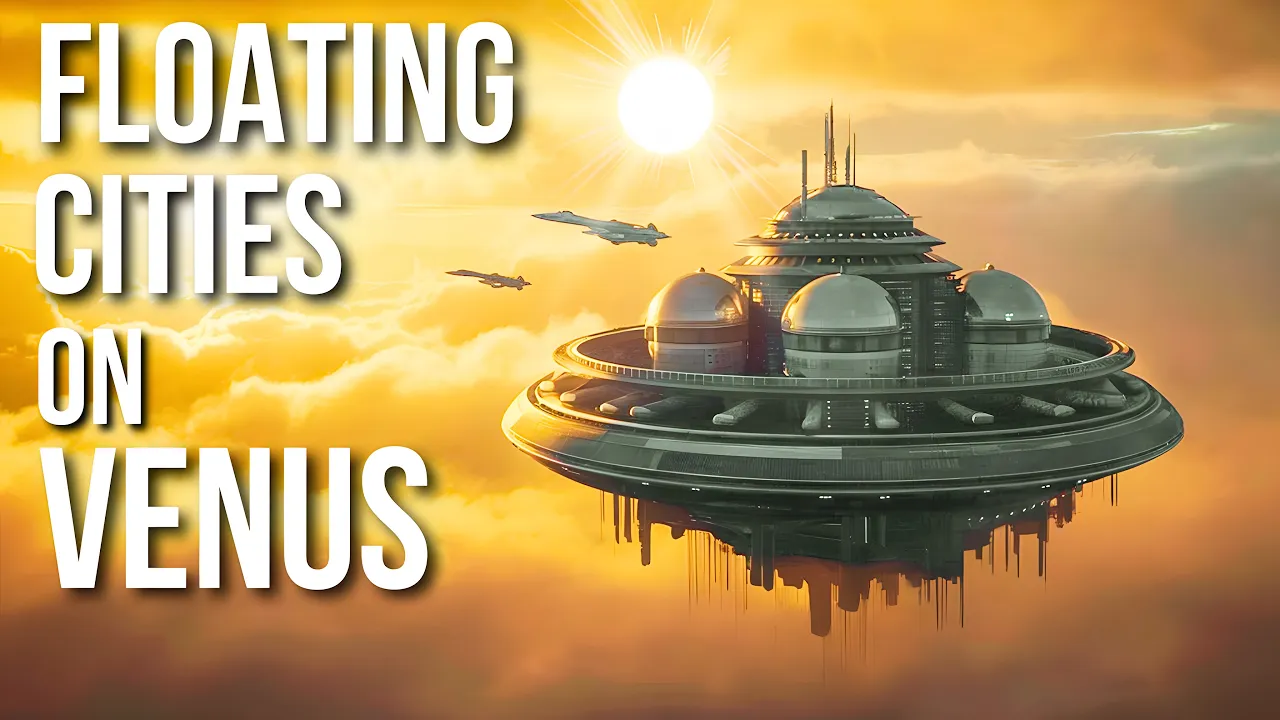
. "Huge domes filled with oxygen and nitrogen will float in the heavy air of Venus. Geodesic structures with sintered graphite struts and transparent polycarbonate coating synthesized from Venus's atmosphere itself: each dome a kilometer in diameter capable of easily lifting a hundred thousand tons of city.
. . a city of spiral buildings and golden domes, with vast open spaces and elaborate gardens.
" All this, of course, will not happen tomorrow, or even in ten years. It is a scientific dream that will concern our descendants, but it is not too bold to define it as much more feasible than the much-vaunted colonization of the Martian surface. .
. What do you think? Which dream do you believe will come true first and with more success in the coming decades, Mars or Venus?