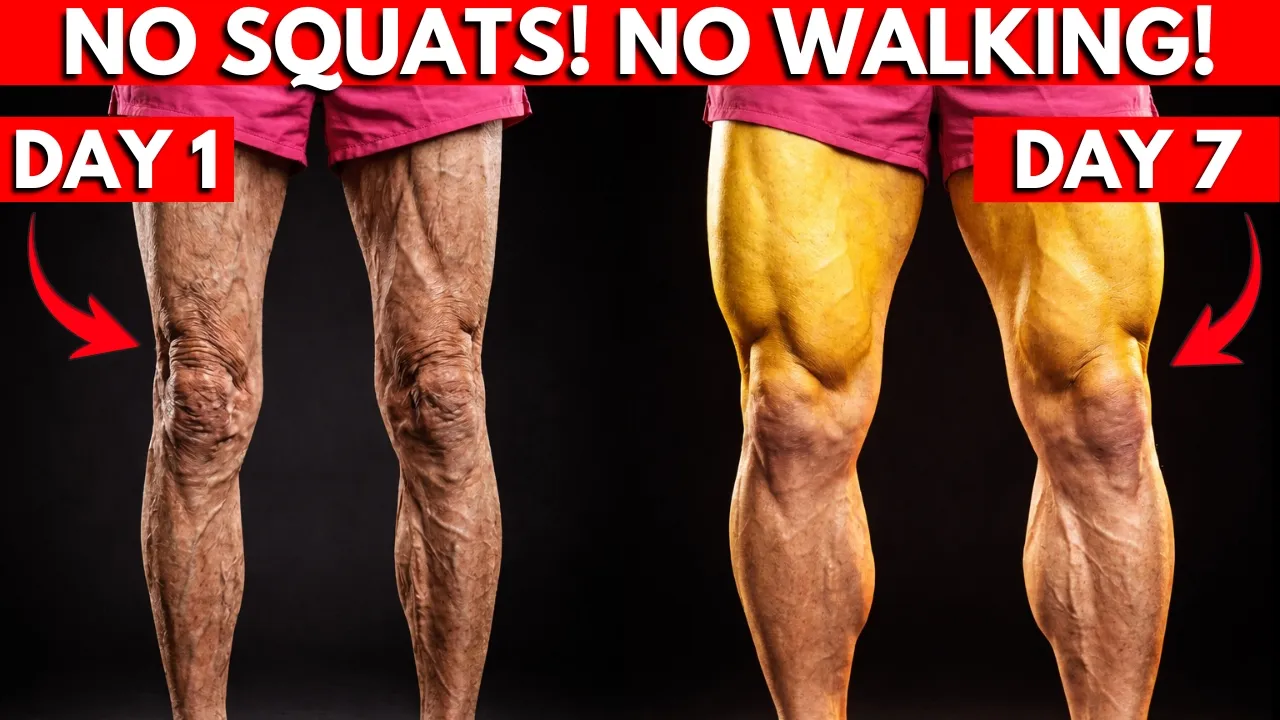
You do push-ups every day. Your chest looks bigger. Your arms feel strong.
You feel like you are in good shape. But then you stand up from a chair and your hands immediately grab the armrest. You have to use momentum just to push yourself up.
That moment right there is the truth most people choose to ignore. You think that is just age. It is not.
That is silent muscle loss. After 60, your body can lose close to 5% of muscle mass every year if you are not training the right way. And the worst part?
It does not disappear from your arms first. It hits your legs. The one foundation that keeps you standing, walking, and independent.
This is not about looking strong. This is about holding on to your freedom. The freedom to walk without fear of falling.
The freedom to stand up without needing help. The moment your legs weaken, your independence starts to disappear with them. Today, I'm going to show you just four exercises, but they can completely change how you age.
Before we begin, comment your age and where you are watching from. I want to know who I am helping on this journey. Exercise one is sit to stand.
This is the most important movement you are going to do and it is not just an exercise. This is a life skill. You already do this every single day, but most people do it wrong.
You drop into the chair with no control. Then when it is time to stand, you lean forward and push hard with your hands. That is not strength.
That is compensation. That is weakness showing up in real time. Clinically, this movement is one of the strongest predictors of independence in older adults.
If you cannot stand up without using your hands, your lower body strength is already declining. And once that starts, it accelerates. Now do it the right way.
Sit on a firm chair, not too soft. Your feet flat on the ground about hip width apart. Bring your feet slightly back so your heels are under your knees.
That position matters. It gives your legs a mechanical advantage. Sit tall first.
Do not collapse your chest. Now lean your torso forward slowly like your nose is moving toward your toes. Not rounding your back, just hinging forward.
You should feel your weight shift into your feet. From here, press your feet firmly into the ground. Push through your heels and midfoot, not your toes.
Start to stand up slowly. No momentum. No rocking.
Your hips and knees extend together. Keep your chest controlled as you rise. At the top, stand fully upright.
Do not rush back down. Sit back the same way. Hips go back first, then bend your knees, lower yourself slowly.
Control the descent. Do not drop into the chair. If you can, do this without using your hands.
If you need your hands, use them lightly, but do not rely on them. Over time, reduce that support. That is your progression.
Aim for about 10 to 15 controlled repetitions per set. Slow reps. Every single one under control.
That is how strength is built. This is not about comfort. This is about control.
When you use momentum, you are avoiding the exact muscles that keep you independent. If this movement is weak, everything else follows. Your walking becomes unstable.
Your balance declines. And sooner than you expect, you will need help just to stand up. That loss starts here.
Exercise two is horse stance. This one looks simple, but it is not. You lower your body and you hold.
That is it. No movement. No distraction.
Just you and your own body weight. Stand with your feet wider than shoulder width. Toes slightly turned out.
Keep your chest up, your back straight. Now slowly bend your knees and sit your hips down like you are lowering into an invisible chair. Stop when your thighs are working hard, not when it feels comfortable.
Hold that position. At around 20 to 30 seconds, your legs will start to shake. That shaking is not failure.
That is your muscles turning back on. That is exactly what you want. Keep your knees tracking over your toes.
Do not let them collapse inward. Keep your weight centered, not shifting side to side. Breathe.
Stay controlled. Do not stand up the moment it gets uncomfortable. This builds real strength.
Not flashy strength. The kind that keeps your joints stable. The kind that keeps you balanced when you step, turn, or catch yourself.
You are training endurance in your legs. You are training control in your knees. You are building the ability to hold your own body up without collapsing.
Most people avoid this because it burns fast. But that burn is the signal. That is where the change happens.
If you cannot hold your own body in place, you will not control it when you move. And that is where falls begin. Not when you are walking, but when your body cannot stabilize itself.
Start with 20 to 30 seconds. Build up to 45 seconds, then 60. Stay low.
Stay controlled. This is not about ego. This is about control.
Exercise three is glute bridge. This is where most people go wrong because they ignore it. Weak glutes force your lower back to do all the work.
That is where a lot of chronic back pain actually begins. Not in the spine, but in muscles that stop doing their job. This is how you do it.
Lie flat on your back on the floor. Bend your knees. Feet flat about hip width apart.
Bring your heels close enough that you can almost touch them with your fingertips. Arms relaxed by your sides. Now press through your heels and lift your hips up toward the ceiling.
Do not rush it. Lift slowly until your body forms a straight line from your shoulders to your knees. At the top, stop.
Hold for a full 2 seconds. This is where most people fail. They go up and down too fast.
They never actually engage the muscle. You need to squeeze your glutes hard at the top. Not your lower back.
Not your hamstrings. Your glutes. Think about tightening them as if you are trying to hold something between them.
That is the level of contraction you need. Then lower yourself down slowly. Do not drop.
Control the descent all the way back to the floor. Aim for 10 to 15 controlled repetitions. Every rep with a pause at the top.
If you are doing this correctly, you will feel your glutes working deeply. Not your back. If you feel it in your lower back, your form is off and you need to reset.
Strong glutes take pressure off your spine. They stabilize your hips. They make your walking smoother and more controlled.
Ignore this and your back keeps paying the price. Train it properly and your body starts to move the way it was designed to. Exercise four is calf raise.
Small muscle, but critical. When you slip, when you lose balance, the first reaction comes from your calves. Not your arms.
Not your upper body. This is your first line of defense. Most people never train it properly, then wonder why they feel unstable when they walk.
This is how you do it. Stand upright. Feet about hip width apart.
If needed, lightly hold onto a wall or a chair for balance, but do not lean on it. Now slowly rise up onto your toes. Push through the balls of your feet until your heels are as high as you can get them.
At the top, stop and hold for a full 1 second. Feel the contraction in your calves. That squeeze matters.
Then lower your heels back down slowly. Full control all the way to the bottom. Let your heels drop enough to feel a stretch, but do not collapse.
No bouncing. No using momentum. The moment you start bouncing, you are no longer training the muscle.
You are cheating the movement. Aim for 15 to 25 controlled repetitions. Slow up.
Hold. Slow down. Every rep deliberate.
If this muscle is weak, your steps become unstable. Your reaction time drops and your risk of falling increases fast. Train it properly and you give your body a chance to catch itself before it is too late.
This is the part most people do not want to hear. You can do all four of these exercises every single day. Perfect form.
Full effort. But if the rest of your lifestyle is off, almost all of it gets wasted. If you are not eating enough protein, your body has nothing to rebuild muscle with.
After 60, your body becomes less efficient at using protein, which means you need it even more, not less. If you are sleeping under 6 to 7 hours a night, your muscles are not recovering. Growth does not happen during the workout.
It happens when you sleep. If you spend most of your day sitting, your body keeps shutting those muscles down. You are undoing the work as fast as you are trying to build it.
That is the reality. After 60, muscle loss accelerates faster than most people expect. But here's the other side of it.
Your body can still respond. It can still rebuild. But only if you train it the right way and stay consistent.
So keep this simple. Three days per week. That is enough.
Each session 10 to 15 minutes. Do all four exercises. Slow.
Controlled. No rushing. And here is your challenge.
Seven days. No skipping. No shortcuts.
Every rep controlled. Pay attention to what changes. Notice how you stand up.
Notice how you walk. Notice how your legs feel in the morning. In just 7 days, you will feel a difference if you do this right.
Now make it real. Comment I'm start today. You do not need more exercises.
You need the right ones and you need to do them consistently. That is the difference. Miss one session, you do not just miss a day.
You delay your progress for an entire week. That is how fast your body responds at this stage. Delay this for a few months, and you are not losing weeks.
You are losing years of strength, and getting that back is much harder than maintaining it right now. This is not about motivation. This is about a decision.
You are deciding day by day whether you stay independent or slowly become dependent on others. It is that simple. So, make it real.
Comment I'm start today, your age, and where you are watching from. Like, subscribe, and share this with someone who needs it.