So you’re considering becoming a priest or entering a religious order. That’s, awesome. As far as I’m concerned, there is no better life in the entire world.
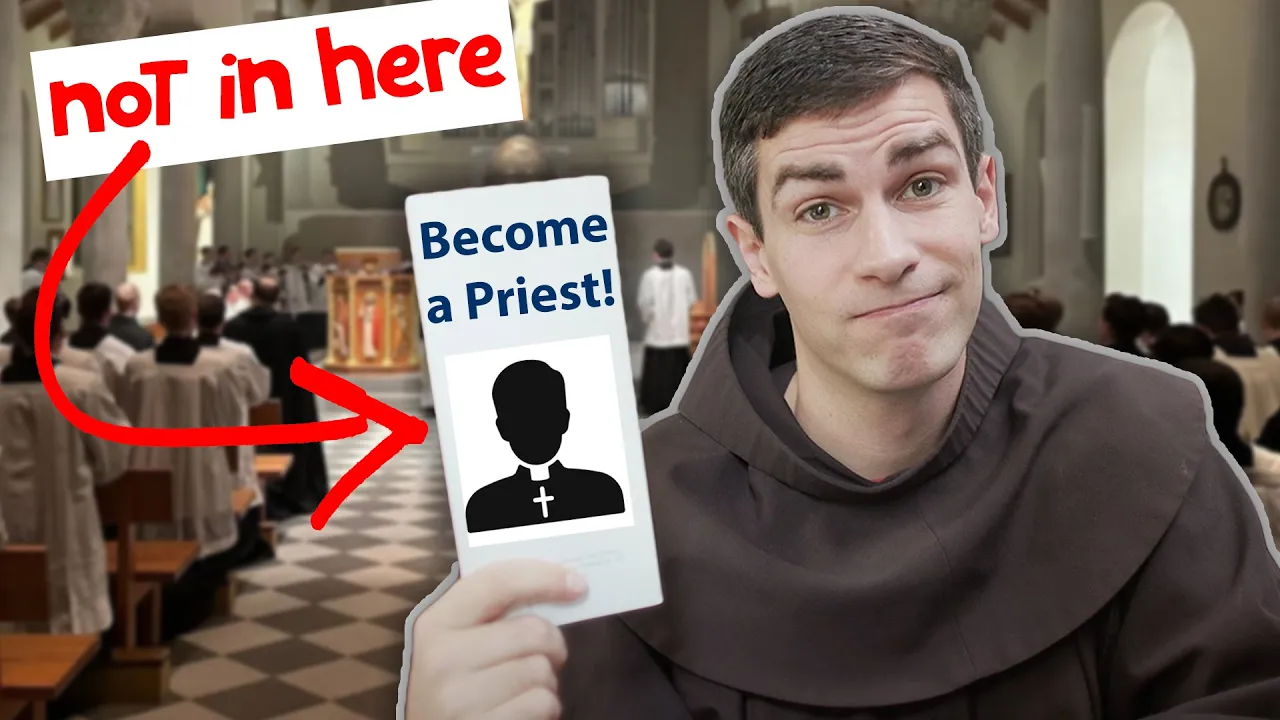
At the same time… there are some things you should probably know before jumping in. At this point, you’ve probably seen us at our best. We give out pamphlets of happy people laughing.
We show videos of holy people praying. We invite you to join us at the most exciting parts of our ministerial lives. And all of this is true.
It’s not fake, not a show, not a bait and switch. We are happy, holy people making a difference in the world. Sometimes.
The reality is, as with ANY life, what we show publicly does not represent the whole story. There are many aspects of our life that don’t fit nicely into a brochure, challenges that we don’t like to talk about with discerners because we’re afraid to scare them away. But I don’t think that’s wise.
I want people who know what they’re getting into and are prepared for the challenge, rather than people who are shocked and scandalized when they arrive. And so, in the most unorthodox of vocation videos you’ll probably ever see, here are 10 secrets, scandals, and challenges about religious life that vocation directors will never tell you. Number 1: Not everyone is a saint, or even trying No one is perfect or without sin, not even priests or religious, so the fact that we have good days and bad days shouldn’t shock anyone.
I don’t think that anyone enters this life expecting to be surrounded by the holiest of people at all times. And yet, there is an expectation when you join this life that even though people sin, they would be trying their best not to and that they were in religious life for the right reasons. Sadly, this is not always the case.
You will find in the first few years of formation that some people enter because they’re trying to escape poverty, because they’re running from something in their past, because they’re afraid and don’t know what else to do, or just have no idea why they’re there. You will find that there are men and women who have been living this life for thirty years who lost their vocation somewhere along the way and are just going through the motions. They may show up to prayer and meals, they may go out and serve others, but in their hearts there’s no passion at all.
Sometimes, you’ll even find people who don’t even come to prayer, don’t engage with others, and push the boundaries of what they can get away with. This is sad, but this is the reality of any communal living, religious or not. And if the happiness of your vocation is dependent on how well others live up to your standards, you are going to struggle.
There is no perfect community, and this may actually be it’s biggest blessing. Number 2: You are in charge of your vocation and formation. The Franciscans like to remind new members that the primary formator of every friar is actually the Holy Spirit.
While it is true that you will have superiors and teachers who are there to nurture your vocation, they cannot do the work for you. You can get the best advice in the world, but unless you’re willing to follow it, nothing is going to change. And that’s if the system around you is even well put together.
Some formators and formation programs are fantastic, while others are a little more in flux or even chaotic. If you want to grow in holiness, look to your formators and do all that they tell you, but don’t expect any human to have all the answers or a perfect path because no human will ever know exactly what’s in your heart or what you’re dealing with. Ultimately, it is up to you to pray, to seek the answers, to challenge yourself.
No one is more responsible for your soul and your salvation than yourself. Take initiative, and put the work in. Number 3: Celibacy won’t “fix” anything on its own As religious, we are required to remain both unmarried and chaste, not seeking relationships and refraining from any sexual activity.
I hope that’s not a surprise to you… we definitely put that in the brochure. It’s an obvious challenge for some, but for others, it’s a gift, an opportunity to love more purely and to devote yourself to others. Which is wonderful, but simply joining religious life will not guarantee that you are chaste, nor will simply repressing your feelings make them go away.
If you have unresolved sexual problems—may they be excess lust, same sex attractions, or experiences of abuse—if all you do it take a vow of chastity, they’re going stay unresolved. Too often, people enter religious life believing that it will be a magical fix for their vice or trauma. Just focus on Jesus, follow rules, and all the pain will go away.
Push all the feelings down and everything will be fine. As we have seen way too many times, this is not the case. Unless you deal with the issue, heal your wound, work at growing in virtue, whatever you suppress is going to find its way out eventually, often in the most unhealthy of ways.
We don’t want that. Not for you, and not for the Church. Number 4: Community life can be lonely.
A lot of people join community life because they are dissatisfied with their social lives in the world and are seeking deeper intimacy with other like-minded individuals. That’s great. At our best, this is exactly we can offer.
Unfortunately, though, the same advice from number 3 applies here: there are no magical fixes in community life. Simply joining a religious community will not guarantee intimacy. Sometimes, the community is dysfunctional.
We’re human, it happens. Sometimes, the community just isn’t the right fit for you. Not everyone fits with every Order.
And sometimes, there might be something for YOU to work on. Chances are, if you struggle to make connections with people, develop intimacy, or even carry a conversation in the world, being surrounded by other people is not going to make any of that go away. If you want to build real relationships, simply being in community is not enough—you have to work on your own ability to socialize.
Number 5: If you don’t compromise, you won’t survive A common trait for people who become priests and religious is a strong moral compass. Especially for Catholics with all our rules and rituals, we have a tendency to set a fairly high standard. Which is great.
But as I’ve indicated in each of the points so far, living with other people necessarily means facing less-than-ideal conditions. There are going to be people with different opinions, at different stages of life, with different needs. Add this to the fact that we’re all sinners and not always rational, and I can guarantee you that you are going to face situations where you’re going to be asked to do things that you don’t want to do.
Little things, like eat food you don’t like or pray at a certain time of day you don’t prefer, but also big things, like different styles of worship, different spiritualities, different expectations for living together. There are definitely situations with clear right and wrong answers where you may want to fall on your sword, but that comes at a cost. If you always fight others or separate yourself from the community in order to be right, eventually you’re going to realize that you’re not actually a part of a community at all.
There is a tension between being “right” and being “together. ” Sometimes, if you want have a community, you’re going to have to learn how to swallow your pride and do things you don’t want or fully agree with. That’s life.
Number 6: There is a major generational divide in most communities Much like the rest of the world, the Catholic Church has swung back and forth over the past century, developing cracks and fissures in what was once a much more homogeneous culture. The issue is far more complicated that I can explain in a few short paragraphs, which is why I’ll be devoting an entire video sometime soon to this topic, but I can speak in generalities here. For men and women formed in the 1970s, 80s, and 90s, there is a high emphasis placed on creativity, individual expression, personal freedom, and pastoral care.
In some ways, they are reacting to world before them that was overly strict and followed rules without a deep sense of spirituality or relationship. For men formed more recently, there is a much greater emphasis placed on orthodoxy, obedience, reverence, and tradition. In many ways, they are reacting to the explosion of individualism and confusion that arose in the world in the 1970s, which sacrificed the distinct aspects of our life to fit in with the culture.
Again, a major over-simplification, but you can see how both sides have good values, and how those values can lead to misunderstandings and conflicts. My hope for those entering religious life today is twofold: that they feel confident enough to stand up previous generations where necessary, asserting the values that will lead to much needed reforms… while at the same sympathizing with the challenges they faced, accepting the faith they had and still have, and even praising the goodness they sought to accomplish to keep the faith alive, even if it wasn’t always successful. There is a reason that they value what they do, and there is a benefit to the Church in their wisdom and experience.
Recognize that you probably don’t want to imitate everything you see in older generations, but you don’t want to ignore it either. Number 7: You will have a crisis of faith at some point Probably the worst one of this list but also the most important to talk about because I’ve seen it in so many, and I’ve felt it myself. The reality is that there is a big difference between being a lay person and being a priest.
Not better or worse, just a different life when you’re an insider. It’s sort of the “seeing how the sausage is made” sort of dilemma. Before you went back into the kitchen, you could enjoy your meal for its flavor and presentation; now that you’ve seen the ingredients, it’s just a different experience.
Sometimes this means realizing that your heroes aren’t as heroic as you thought. You see father preaching in the pulpit, sister serving the poor down the street, and you look up to them as untouchable… And then you share a house with them and you see that they leave messes, have anger issues, can be selfish at times, and are generally just a lot less angelic and far more human that your previous image of them. That’s tough.
Sometimes it’s with the Church itself. As a divine institution, you may have fallen in love with its sanctity, how it is a driving force for good in society, providing the Eucharist and feeding the poor through the ages… And then you attend a staff meeting. You encounter Church politics.
You realize that when you have to celebrate multiple masses a day for a couple years that the mystery can wear down a little and a sense of tediousness can creep in. That’ll mess with you. The reality is that the Church is as much a human institution as it is a divine one.
God may be at its head, but the human experience fills the day to day tasks. At first, this can leave us in crisis, realizing that things are not as clean and ordered as we thought, but with time, a new faith takes its place, one that is stronger than before because it is able to see God not only in the perfect but in the mess as well. Number 8: Much of this life is ordinary and mundane When people say that they want to be a priest, it is because they want to help people on the road to conversion, to celebrate the mass, to watch parishioners grow up in faith and see the Church flourish.
No one ever says they want to be a priest because they love capital campaigns or responding to emails. While the best part of our lives are absolutely sublime, they are not the only things we do. There are a lot of ordinary, mundane tasks that we have to take care of to make it all work.
Not everything we do is the life-changing work of saving souls. What I tell people is that it’s great to love what we do at our best, but if this is going to work out, you have to at least find some enjoyment in what we do at our most mundane. You don’t have to LOVE emails or staff meetings or fundraisers, but must you find a way to enjoy a bit of it, to at least see it as worthwhile.
This is not unique to religious life, it is the case with all professions. Surgeons spend far more time out of surgery than in it. Police officers do a lot of paperwork.
Teachers spend as much time in preparation and grading as they do with their students. As you discern, my hope is simply that you would consider the non-glamorous side of what we do and see if that’s something you can learn to love about it. Number 9: You’re not going to feel like you’re making a difference for years Again, people join this life because they want to make the world a better place.
They become priests and religious because they want to teach the faith, comfort the sick, feed the poor—basically, to become more like Jesus in life and ministry. The problem… is that we’re not ready to live the life and ministry of Jesus immediately when we enter. Prayer is difficult as first and takes much practice.
Teaching can’t be done without learning first. The people of God need well-formed leaders, which requires a lot of work on ourselves before we can help others. Just as St.
Paul left the world for a few years before he started preaching, entering the seminary to religious life necessarily means taking some time to develop before we’re ready to be real ministers. We need school, personal development, prayer, experiences, challenges—all of it comes before we’re sent out to do anything. For the friars, at least, almost no ministry at all is done in the first two years.
Even after that, our main focus is on school, not helping other people. For those training to be priests, it’s at least 5 or 6 years before you’re able to preach at mass, hear confessions, or provide any meaningful pastoral care. That’s a long time to wait, and it’s easy to grow impatient.
You’ll spend the first years of this life doing things that are unlike the rest of your life… but they are necessary. You can’t give what you don’t first possess, and so we must be patient, and we must be thankful for the opportunity to grow. And finally, number 10: The Challenges… are the best parts This has not exactly been the greatest list.
If you weren’t considering religious life before, this video certainly didn’t make it more appealing, and for those who were, it might have even dampened your enthusiasm a bit. Which, on the one hand, good. This life is not for everyone.
It’s for the strongest and the most committed. We don’t need people becoming priests or religious simply because they couldn’t think of anything better to do or because they’re hiding from the world—we’re the marines, the elite forces of the Church, not the safety school. On the other hand, I don’t want people to leave this video thinking that this life is just something to be endured.
Sure, there are a lot of challenges, it is not always perfect or ideal, but that’s actually what makes it so wonderful. I like to say that religious life challenges me to love more deeply and it makes me a better Christian. In the world, I could be friends with whoever I wanted and ignore who every I didn’t want; I surrounded myself with only those people who brought me happiness.
And as a result, I surrounded myself with those people who brought me comfort, not holiness; people who were like me and liked me. But that is not the kingdom of God. That is not the life of the Church.
It’s certainly not how Christians are to go into the world. Living with people who are different from me, who see the world in ways that I do not, forces me to realize that I am not perfect and that God works in many and varied ways. Community life reveals to me not so much the sins of the world, but my own sins and limitations, reminding me how much work I have to do.
How can we expect to be a person who loves everyone, lives humbly, shows mercy and patience, and endures heartache if we only surround ourselves with people we like, who never challenge us or cause us strife? For me, the greatest parts of this life, the times I feel myself growing in holiness and closer to God, is when I learn to love someone whom I do not like, when I reconcile with a brother who hurt me or whom I hurt, when I am thankfully forced to compromise because I didn’t realize I was actually wrong in my convictions until I had to listen to another’s opinion. It is the brothers that annoy me that make me holier.
The ones who challenge me that make me better. The ones who surprise me with their hidden grace that remind me that I still have a lot more work to do. Religious life is not easy and it’s almost never want I want it to be, but I wouldn’t want it any other way.
If you’re looking for a challenge, desire to be holy, and want to give your whole life to God, maybe this is the life for you.