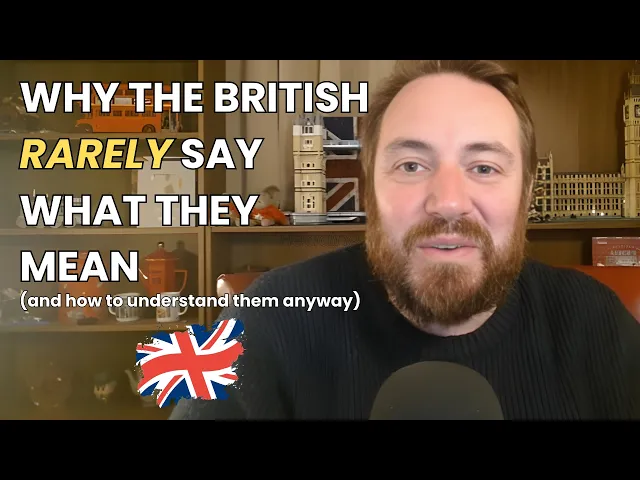
One of the most common questions students ask me is: why don't British people say exactly what they mean? But the truth is, we do. We just sometimes don't use the words that you're expecting to hear.
The British are famous for understatement, politeness, and what I call a kind of linguistic camouflage — saying things indirectly, often to avoid sounding rude, pushy, or overemotional. And that's what we're talking about in this lesson. Now, this lesson is going to be the first in a series of five lessons.
This series will be called *Why the British Say It That Way*. In this lesson, we're going to unpack why the British speak the way they do. We're going to talk about the psychology behind British politeness — how it shapes everyday expressions.
And most importantly for you, we're going to talk about how to decode the message behind the words without overanalysing, guessing, or just going completely crazy. If you want to learn even more about this lesson, there’s a free PDF that you can download in the description below to help you go deeper into what we’re talking about. But first of all, I just want to say hello, you wonderful people.
Welcome to English Right Now — that’s this channel. My name is British English teacher Roy. I've been a teacher of English for around 15 years and I've worked in some of the most prestigious schools in London and Cambridge, and even worked for the BBC with BBC Learning English.
Over all that time, I've got grey hairs these days — I'm getting older. But during that time, I've helped thousands of students just like you to understand a modern British RP accent, learn how to pronounce things with that accent, understand slang and idioms that we use — genuine, real-life English — and of course, understand the culture. Because, in my opinion, a language is always more than words — it’s culture.
Before we continue, and before we really start getting into the idea of the cultural code behind being indirect, one thing I will say is that you will never hear me say that being indirect is better than being direct, or vice versa. I'm never going to say that being direct is better than being indirect. What I always say, though, is that if you are in an indirect culture, being indirect is clearly going to make your life a little bit easier.
Likewise, if I'm in a direct culture, I need to become more direct. And I think the old expression *when in Rome* always comes to mind. Even across the UK, there are parts that are slightly more direct than others — it even occurs within the country.
But on the whole, the British in general are quite indirect. As I say, there is some variation, but in general, when we're looking at the grand scheme of things across the world, British people do tend to be quite indirect. To understand how British people communicate, we have to understand one core idea: we communicate in a more indirect fashion — but the idea is still the same.
If you go to a culture where somebody can say, "That's awful," that’s absolutely fine if it’s direct. But if somebody in an indirect culture says, "Mmm… it’s not the best," they’re still saying it’s awful — they’re just using different words. And it’s the words and the tone that we really need to understand.
The next thing we need to talk about is the cultural code behind being indirect. To understand how the British communicate, we have to understand one core idea: politeness is a form of armour — a social protection. Now, I've talked a lot about the concept of face on this channel, but just to give you a quick recap: face is this idea of the respect and honour of others.
This is where we get expressions like *to lose face* and *to save face*. If something or someone causes you to lose face, it fundamentally embarrasses you. And if something or someone helps you to save face, it stops you from becoming embarrassed.
Two linguists I often talk about are Brown and Levinson, and they explain this beautifully in their theory called Politeness Theory. They talk a lot about this idea of face — that everyone has two types of face: positive face and negative face. And no, just because the word is “negative”, it doesn’t instantly mean you’re depressed or sad.
It’s something slightly different. Positive face is the need to be liked and appreciated — to be loved. Negative face is the need for autonomy — the idea of not being imposed upon.
Of course, both of these factors are present in every culture. But in some cultures, negative face is more dominant, and in others, positive face. In British culture — surprise, surprise — negative face dominates: the need to be autonomous, not imposed upon, not forced to do something, not put into an uncomfortable position.
This idea of negative face dominates British culture. And then, to appease negative face or positive face, we have different politeness strategies. For example, negative politeness strategies protect negative face.
So this lesson is all about making this concept simple. We’ve said that negative face is dominant — the need for autonomy and not being imposed upon. British people will go out of their way — we will do the utmost — not to make people feel uncomfortable or put any pressure on them.
So how do we do that? Well, we speak quite softly, indirectly, and with a lot of what linguists call mitigation — little words and phrases that smooth the edges. I've talked a lot about this on the channel.
We tend to avoid extremes. Too much enthusiasm could feel embarrassing. Direct confrontation could feel quite rude.
Even our famous sorry isn't always about guilt — it's a social lubricant. Instead of saying sorry to genuinely apologise, it can mean I see you. I acknowledge the situation.
I don’t want tension between us. It's about maintaining this sense of balance. So indirectness — it's not about deception.
It’s diplomacy. It’s how we keep our social life smooth, especially in a culture where restraint and self-control are admired. Now let's look at how this plays out in real language.
We've talked about the theory — the idea that we don't want to impose on someone, that it would be rude to feel like we are pressuring somebody to do something — but let's look at it in real language. We're going to talk about 16 expressions that often sound quite simple but carry layers of social meaning. First up, we have *That’s brave*.
Now, it sounds complimentary, but that pause — the little hesitation — is everything. That’s… um… brave. Usually, what we mean when we say it like that, with that pause, is that’s a terrible idea or I think you’re absolutely insane.
It’s a form of polite criticism in disguise. That pause signals disagreement without confrontation. And a lot of these have variations.
So maybe you're in a meeting and somebody makes a proposal and you say, Yeah, that’s quite a… um… well, it’s quite a brave proposal. I’m trying to signal that maybe you’re being a little bit more courageous than you are actually thinking this through properly. Therefore, I am actually telling you this is a terrible idea — but I’m using nice words to let you know how I feel, without actually saying that’s an absolutely dreadful idea — spending the budget on that would be terrible.
Listen again for that pause. There is a fundamental difference between saying, Wow, he’s really brave, which sounds quite genuine, and Yeah, that’s… um… certainly brave. Number two is *Not bad*.
This is a classic. Not bad means good. And depending on the tone of voice, it can actually mean really good or surprisingly good.
So if I eat something and go, Yeah, that’s not bad, — listen to that voice. That’s classic understatement. Now, I’ve had a problem with this in the past.
My father-in-law is from Brazil and he said, Are you having a nice walk? and I said, Yeah, it’s not bad. He heard the words quite literally and said, No, it’s good — it’s good to walk.
And I said, Yeah, I know — it’s not bad. The thing is, in British culture, direct praise could sound a bit over the top, so we tone it down. And ironically, not bad is pretty high praise.
Now, be careful again with your tone of voice. If you say, It’s not bad, that sounds like it’s just about okay — I’ve paused, there’s a kind of downbeat tone. But if I say, Wow, yeah, that’s not bad!
— that means it’s surprisingly good. I’ll give you an example. I went on holiday, I tried snails — I had never eaten snails before — and I said, Yeah, actually, it’s not bad.
If a British person says, *It’s a bit chilly, isn’t it? * it probably means I’m freezing and please close the window. Now, this idea of that question tag at the end — isn’t it?
— it’s getting you involved, it’s encouraging you to respond. And if I’ve highlighted that I’m a little bit cold, even though I’ve used words like bit or a little bit or slightly cold, isn’t it? — you could look at me and see that I’m cold.
You will see that I’m freezing. I’ve highlighted that I am indeed cold, and now the onus is firmly on the other person. It would be completely unreasonable, after highlighting that I am cold, for another person to go, Well, I’m not — I’m not shutting the window.
Within this, there is a request that is hidden — but it’s almost not a request. It’s kind of asking somebody to do something that would be unreasonable to reject. And that’s another key part of indirectness.
Rather than saying, Hey, shut the window, which is probably a bit rude — and you would be well within your right to say, No, you’re rude — if I make it quite polite with a bit of hedging, like the words a bit and that question tag isn’t it? it makes it sound like small talk, but I’m putting the social cues out there. I’m giving you a polite hint of what I want you to do.
*We should get together sometime* or *We should meet up at some point*. This is what linguists call phatic communication. It’s language that maintains social bonds without literal intent.
So if a British person says, Oh yeah, we should definitely meet up at some point, it doesn’t actually mean they want to make a plan. It’s probably saying, I’ve really enjoyed your company, and who knows — maybe down the line, I’d be open to it. But there’s not a distinct plan there at all.
How do we know the difference? Well, if I say, We should meet up at some point — like, what are you doing next week? Are you free on Thursday?
Are you free on Friday? or Do you fancy going to the cinema with us? that is a question — that is a direct offer because there’s more information.
But simply saying, Yeah, we should get together sometime, is kind of smoothing over and showing that everything is okay in our social circle. It’s more about placating the other person and maintaining that social harmony — it’s ending an interaction gracefully. Which comfortably brings us on — or uncomfortably, for some people — to *I might join you later*.
This is a non-committal response that leaves a bit of space for people to seem like they’re changing their mind later on. I said seem like because there’s something really important to say. If you invite me to the pub and I have no intention of going, or I’m worried that I might not be able to at some point, I’ll probably respond with I might join you later.
Why? Why, if a British person has zero intention of going, or thinks they probably can’t, would they ever give this kind of response? Well, first of all, immediately responding with a negative could seem like I haven’t really considered your offer — and that could seem a bit rude.
Likewise, if I completely 100% agree and then find out that I can’t, that also seems a little bit rude, because I’ve already agreed and then suddenly I’m changing my mind. So this kind of expression leaves a bit of space for both sides to save face. Now, as I say, I might join you later — a lot of people say it means I’m not coming, but it could mean I’d like to, but I’m not entirely sure if something else is happening and I don’t want to commit without actually discovering if there is something else.
But there is so much about this single expression that teaches you how British people respond. *That’s interesting* is another one that causes a bit of confusion. Again, this depends totally on tone.
If I’m a bit more animated — Wow, really? That’s interesting! — then maybe I am genuinely interested.
But if it’s quite flat — Well… that’s… interesting — it probably means I disagree, but I really don’t want to discuss it further. You’ll hear this especially in meetings or polite debates. This phrase creates psychological distance before introducing a counterpoint — it’s disagreement without direct conflict.
So: Yeah, that’s interesting, but potentially we might need to look at it in another way at this point. I think the best thing to say about finding something interesting is that we genuinely show interest: Wow, really? Seriously?
No way! — rather than actually using the words That’s interesting. And if it’s really flat, it means I have no interest whatsoever in what you’re saying — or I just disagree completely.
*Sorry, could you possibly* basically means please. We soften requests often by starting with an apology. I know this sounds really, really weird, but sorry is kind of saying I don’t want to disturb the social equilibrium.
It reduces the imposition by using an apology word right at the start, and it satisfies the other person’s negative face. Sorry, could you possibly close the window? — sorry here is empathy; it’s reducing imposition.
I’ve realised that by asking you something, there might be a mild imposition. So it’s definitely not about guilt or apologising for something you haven’t even done. I've done a whole lesson about the word fine, but quite commonly, when somebody says It’s fine, especially if it’s quite clipped — It’s fine!
— wow, tone really reveals the truth with this one. It’s fine, especially when it’s said through tight lips or a quick breath — It’s fine. It’s fine.
Especially getting that kind of fine, fine, getting your teeth involved there — it basically means it’s not fine. It’s not okay in any way, shape, or form, but I’m not going to argue. If I’m a bit lighter with it — Yeah, no, no, no, it’s fine, it’s fine, almost like it’s a bit of a surprise, particularly with that little bumbling element like Yeah, no, abs— no, it’s absolutely fine, — it probably means it’s closer to genuinely being okay.
But if it’s very, very flat — Yeah, it’s fine — it’s probably passive displeasure wrapped in a little bit of courtesy. Let me know as well in the comments below which one of these phrases is your absolute favourite, and let me know which ones you’re going to start using — which ones you hate. I’m sure you have some.
A lot of people on social media joke about how bad British people are at leaving conversations or ending conversations. And this — this is a classic. Quite commonly, you’ll see people, if they’re sitting down, slap their legs like Right!
And that word right introduces that something big is going to happen — I have an announcement — and then we’ll start saying something like Right, well, I’d, uh, I’d better let you get on then, or I suppose I’d better be off then. But this one — Right, well, I’d better let you get on — is an absolute classic. And while it sounds like pure respect, this basically means I am ready to end this conversation.
This is a polite exit strategy. It’s an indirect closure. It signals a form of respect for the other person’s time.
We make it sound like we’re doing you a favour by ending the conversation — and who knows, possibly we are — but basically, in a nutshell: Right, well, I’d better let you get on, or some variation of it like I’d better let you get back to it or I’d better let you get on with your work, or something like this, fundamentally means I am ending this conversation — or I’m certainly trying to — but I want to show you respect on the way out. *It’s not quite what I had in mind* may sound like a completely innocent phrase, but it could actually cause British people to panic, because this means I don’t like it. In the workplace, criticism is softened through understatement.
Not quite allows the speaker to reject without sounding too harsh. So, if you’re in a meeting and you make a proposal and I just think it’s awful, I might say, It’s not quite what I had in mind. And this word quite sounds like it’s very, very close to being right — but quite possibly not.
I’m just putting that in there to make it sound a little less harsh. The key to understanding an expression like this is to kind of ignore those hedging words and just hear It’s not what I had in mind. In other words, It’s not what I wanted.
Don’t get too distracted by words like quite and a bit. *I’ll bear that in mind* is another one that’s really important to consider the tone. If you go to your boss and give them an amazing idea, or you ask for holiday, and they quite flatly just say, Okay, yeah, I’ll, uh, I’ll bear that in mind, that probably means they disagree and they won’t act on it — but they are acknowledging you.
This phrase gives social recognition while quietly, discreetly discarding the suggestion. It is a polite dismissal. *Oh, speak to the boss*: I think I’ve got a great idea for the next marketing campaign.
— Oh yes, what is it? — and then I explain my idea, and they go, Yeah, cool, okay, I’ll, um, I’ll bear that in mind. Delivered quite flatly, it probably means it’s already forgotten about.
*With the greatest respect* usually means I completely disagree — or basically that I think your idea is stupid, or maybe even that I think you are stupid. It’s quite a formal hedging expression that actually signals the opposite of respect. With the greatest respect or With all due respect, especially if delivered with a little bit of venom, is a warning that criticism is coming.
Now, as I said, quite commonly we will speak quite softly, so we may say, Look, with the greatest respect, I think it’s not the best idea I’ve ever heard. But those four words signal that something is coming — and it’s going to be something that you probably don’t want to hear. *You must come over sometime* is another example of a polite gesture and not a real plan.
It’s a form of sort of empty invite — and it’s a phrase that maintains friendliness without actual intent. Again, if somebody says, Oh, you must come over sometime, this means they’re open to the idea of you being more present in their life — they’re open to the idea of you one day coming to their house or indeed spending more time with you — but they are not, with this phrase, making a real plan. If a British person is going to make a real plan, they will make a real plan by saying, What are you doing on Saturday?
Are you free next week? So something like this is just designed to be friendly and maintain that kind of social balance. *That’s quite good* totally again depends on how it’s said.
If it’s said with a bit of enthusiasm — Well, yeah, that’s quite good — it probably means that it’s pretty good. But quite commonly, we’ll say That’s quite good to mean It’s okay — not great. How was your food?
Okay? — Yeah, it’s… it’s quite good. Especially with a little pause and a little hesitation, like the words are a little bit difficult to say.
In British English, quite often downgrades the meaning. If a British person says, You know, it’s quite good, it’s lukewarm praise. It’s okay.
It’s acceptable. *I don’t want to be a bother, but…* basically means I need help — I need assistance. A bother here — we’re using it as a noun — means a nuisance.
It’s a pre-emptive apology. We start with deference to reduce the feeling of intrusion. Now, of course, we could say, I don’t want to bother you — that’s fine, that’s another example.
But fundamentally, what we’re doing with expressions like this is saying, I really respect your autonomy. I respect your space, and I don’t want to annoy you or become an irritation — but I really do need your help. This is politeness theory in action.
I don’t want to be a bother, but could you tell me where the toilets are? I don’t want to be a bother, but could you tell me which platform the train is leaving from? Now, I’ve given you a couple of examples out in the world, but this would possibly be slightly too formal speaking with people in a train station.
This is quite common at people’s homes — if we go over and we really need some favour or help: I don’t want to be a bother, but could I leave my suitcase here for a couple of hours? Now, we’re possibly aware that this isn’t the biggest inconvenience — we’re not asking them for something major — but we’re already pre-empting that we realise it may be a minor inconvenience. And if you hear a British person say, *It’s probably nothing*, what it probably means is I’m actually quite worried, but I don’t want to panic everybody.
I don’t want to make a big fuss. This is a reflection of the British stiff upper lip. Downplaying emotion is a way of showing self-control and consideration for other people’s comfort.
It’s probably nothing, but I did just see somebody run outside, and I don’t know whether or not they’re meant to be there. So I’m actually quite worried that somebody is potentially breaking into your house, but I don’t want to panic everybody — I don’t want to cause alarm. So, It’s probably nothing, but there seems to be a guy out there trying to climb onto your window.
Now, all of those 16 examples are about one thing: managing social discomfort. We make language softer not because we’re being evasive, but because in British culture, respecting people’s social boundaries and respecting face — not imposing — matters sometimes more than clarity. Now, not in every situation.
I’ve talked about this before — about when British people do become direct — because in certain situations, like an emergency or when we’re really annoyed, then yes, we will become more direct. But remember when I say that politeness is key — it’s a way to stay polite while expressing ourselves indirectly. And we are saying exactly what we mean.
But how can you respond? How can you respond to this naturally? If you’re learning English, this idea of us not saying exactly what we mean can feel really confusing at first.
So here’s how to handle it naturally, without overthinking. First of all, listen for the tone and the timing. Tone of voice always reveals intent.
If somebody says That’s fine quickly and looks away — it isn’t fine. Yeah, that’s fine — that isn’t fine at all. Oh yeah, yeah, that’s fine.
— open face, happier face, the pitch is a little bit higher — then that is genuinely fine. But me saying, Yeah, it’s fine — is not fine. And likewise, with a pause — if I pause before saying something is interesting, then I probably don’t think it’s interesting and I probably disagree.
That’s… um… interesting. And the key idea is basically when in Rome. If I go to a direct culture, I’ll become more direct.
And if I’m in an indirect culture — or even in an indirect situation — then I’ll become more indirect. And I think matching the level of politeness is a real key point. Mirror the tone.
Overly direct responses could feel confrontational. Overly soft responses could feel or sound evasive. So balance is key.
Despite me talking about how indirect the British are, we are not the most indirect in the world. If you are overly soft and overly indirect, then it may sound — just as — it may potentially sound evasive. So, match the tone of the person you’re speaking with.
But to give you some natural British alternatives to some direct expressions: Instead of saying *No, that’s wrong*, you could say, *I’m not sure that’s quite right*. — it says the same thing. Instead of saying *I can’t do that*, you could say, *I’ll see what I can do, but I can’t promise*.
— it shows intent, but it highlights that there are no guarantees. And instead of saying *I don’t like it*, you could say something a bit more like, *I’m not sure that’s quite for me*. Notice how those three examples keep the conversation calm and respectful, but still communicate clearly — if you listen for the words.
Ignore those words like quite and maybe or I’m not sure, and listen for it’s not right. I’m not sure it’s quite right basically means I don’t think it’s right. When a British person says *no promises*, it’s lowering your expectation, because I don’t want you to think that I’ve got this under control.
And if I say, Yeah, it’s not really for me, or I’m not quite sure it’s for me, then I’m highlighting that, yeah, maybe it’s not to my taste — but who knows, some other people may like it. The third point I would say is: use humour and light irony. Humour — especially self-deprecating humour — is a safe way to express honesty in British culture.
It releases tension without offence. If you can make a joke about yourself, then people will realise that you don’t take yourself too seriously and that you accept you’re not better than everybody else. But of course, don’t be too savage — don’t overly attack yourself — otherwise, that sounds like you have low self-confidence.
And don’t worry — in another lesson in this series, we’ll talk more about humour and irony. Another key point I would say is: understand context. With friends, banter and irony are fine, but you might not want to engage in that too much in the office.
Being more measured or composed in the office can work. And with strangers, don’t get overly friendly too quickly. Maintain politeness, but also stay a bit reserved.
The principle is always the same: maintain the social balance. Maintain and protect social comfort. When you start listening beyond the words, British English becomes much easier to navigate.
You’ll hear tone, timing, and hesitation as part of the grammar — it’s like invisible punctuation of politeness. Remember that indirectness is cultural — it’s not about deceit. Politeness is designed to protect both parties’ face.
Understatement is the national language of emotional control. And context defines how direct you can be. If there’s an emergency, absolutely don’t become indirect — tell everybody there’s an emergency.
Context is everything. Once you recognise the patterns, you stop taking phrases literally. So the next time somebody says, Yeah, it’s quite good, you’ll know they mean It’s okay — but not brilliant.
And in the next episode of this series, we’re going to look at another classic: *We must do this again sometime* — and we’re really going to analyse what’s going on behind that phrase. Remember, there’s a free PDF that you can download, and I hope you’re looking forward to the next episode in this mini-series. But check out that PDF — it’s free and it’s got lots more information.
Thank you very much for watching, and I'll see you in the next lesson.