hi today we're going to be looking at a very interesting theory called leadership exchange theory and this theory is interesting because for a lot of people this causes the lights to come on and they can understand why they've had some good successes or some miserable failures in different work situations they've been in so it's going to be a good theory that helps explain some of the things that you might already have experienced but it's also a good theory because it also gives you ways to to move forward in organizations both as a subordinate as and
as a leader now let's talk about leadership leader member exchange theory now the abbreviation for leader member exchange theory is lmx uh kind of a acute way of abbreviating leader member exchange and well usually it's just called lmx because it shortens the title a lot there now lmx is different than the other theories that we've been looking at so far because it views leadership as a process and so what it's doing is it's focusing on the interactions between a leader and subordinates it's not something it's not saying that leadership is predicted by the leader or
by the subordinate but by the interactions that they have now this is in contrast to some of the other theories that we've looked at some theories that we've looked at have focused on the characteristics and behaviors of leaders the um the people with authority such as the trade approach skills approach and the style approach that was all focused on the characteristics and behaviors of the person with positional power other theories that we've looked at focus on the characteristics of the follower and the context things outside of the leader and that included situational leadership contingency theory
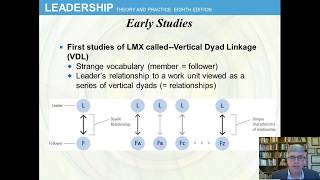
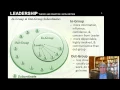
and path goal theory this theory is focusing on the interactions between the leader and subordinates now in its simplest form the the lmx looks at what they call vertical dyads and the linkage between vertical dyads we uh um in this diagram l is the leader in fact there's only one leader this l is the same person but as the leader goes from subordinate to subordinate subordinate a subordinate b all the way to how many ever subordinates uh um uh are under the the leader there's exchanges and so there's um interactions between the first subordinate and
there's a set of interactions between the the second and between each subordinate there's a set of interactions that kind of define the uh the relationship or the vertical dyad linkage now these interactions may be what we call high quality or low quality good or bad the way that we'd like them to be or maybe sub optimal and so what we can do is that we can look at all of these uh uh vertical linkage dyads and say that aha the leader has really good exchanges with subordinate a um when the leader talks to subordinate a
um subordinate a benefits and ben and when the subordinate a benefits to or talks to the leader um interacts with the leader the leader benefits and so we're giving plus three to each arrow and same thing with subordinate b subordinate c also they all have real positive uh relationships and the leader forms a trusting relationship the the leader likes the subordinates the subordinate tends to like the leaders uh they're open to influence from one another they're they're good relationships however there's other subordinates that things don't go as well with these are subordinates x y and
z the leader and the subordinate in this case they're just kind of neutral interactions the leader does what he or she has to do and the subordinate responds with what he or she has to do there's no real mutual benefit going on things are kind of defined by the contract that exists between them and here we've got zeros as their kind of neutral interactions now we could also say sometimes there's negative interactions and enter when the leader interacts with the subordinate the support says oh no not again i don't want to avoid them or the
same thing when the subordinate acts the leader the leader might say oh i'd rather avoid them too and what we can do with these different uh uh the way when we look at the the quality of relationships there's some people that have a good relationship with the leader and in this model this is called the leaders in group and the people that don't have the high quality exchanges with the leader are called the um the out group now they're all they all have the same um the the same superior the same leader the same boss
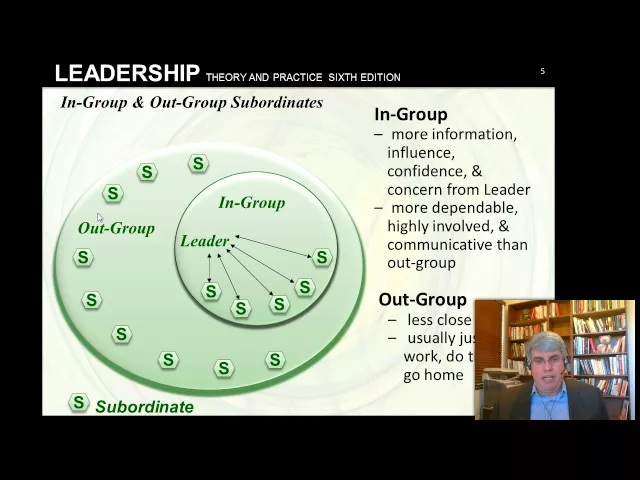
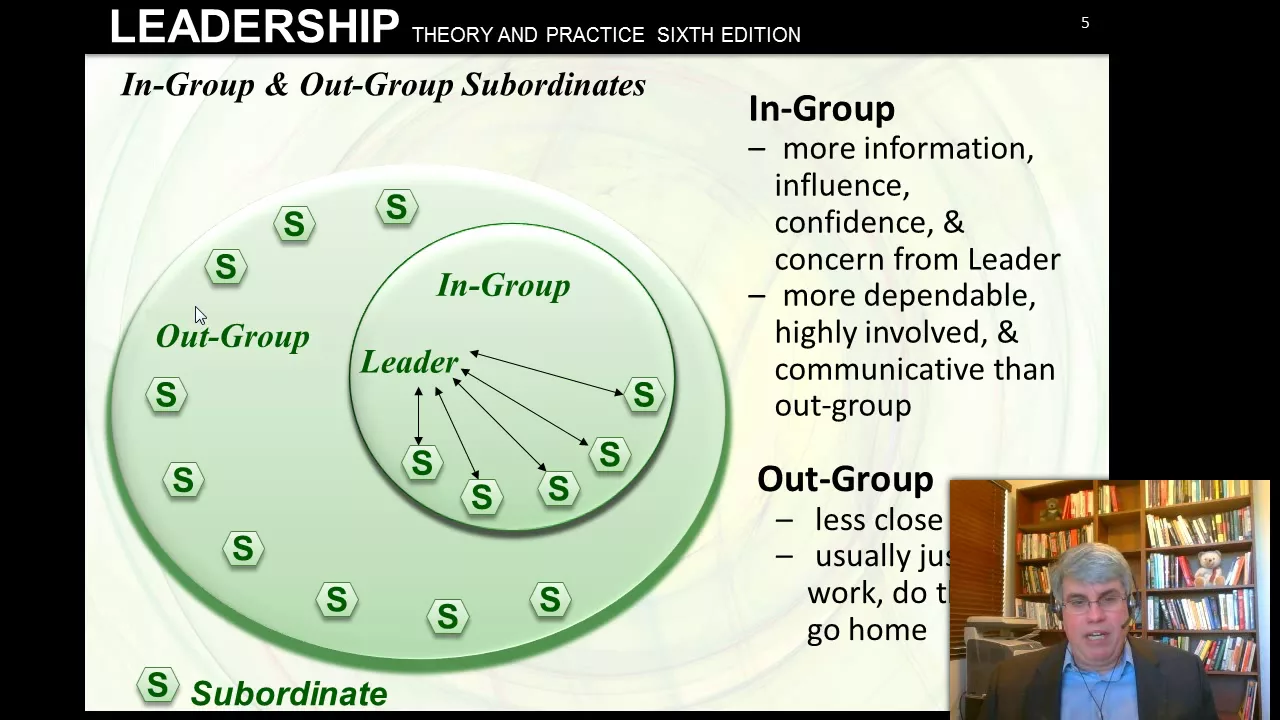
but the boss has better relationships better exchanges with some people than other now if you think about it you've probably seen that happen in real life now this isn't saying this is what's supposed to happen it's just saying this is what happens is that there's this in group that the leader is close to and then there's the out group that the leader is not close to here's a here's another way of looking at the n group and the outgroup here we've only got we've got the one leader and we've got a bunch of subordinates they're
all around here and the leader that has the who has real positive frequent encouraging interactions with a uh one group we're considered the in group the others he has less interaction with it's less positive they're less close they just come to job get come to work to get their job done the leader gives them the minimum amount of information this is the out group now for the n group they've got they're closer to the leader they've got more information there's greater confidence the leader the leader has more confidence in in them um they it turns
out that research indicates that this in group is becomes more dependable more involved in work more communicative than the people in the uh out group and so the idea of lmx is that there's all these positive things that happen from being in the leaders in group the leader needs to try to get everybody in his or her in group so when when the leader can have the high quality positive exchanges with uh other people they come into uh his or her in group and research has shown that there's a lot of things that happen when
they have these high quality positive exchanges with their leader there's less employee turnover there's more the there's more positive performance evaluations there's higher frequency of promotions so like it's like everybody benefits from these uh positive exchanges there's greater organizational commitment more desirable work assignments better job attitudes just like everybody's happier when there's these positive uh leader member exchanges the the subordinates that have the positive uh exchanges get more attention and support from the leader greater they participate more in uh the work that they're doing they're more engaged and they even have faster career progress they
they're the ones that are going to be the next um generation the next uh the ones most likely to get promotions and so there's because there's a result this is a result of these exchanges between the leader and subordinate as a two directional thing it's not just dependent on the leaders also depended on the subordinate we can say that these exchanges are leadership making it's not just what the leader does it's not just what the membership the member does but leadership occurs when these exchanges uh um these positive exchanges positive beneficial exchanges occur that's uh
so we can say that uh these this is uh leadership making so how does uh lmx theory uh work how can you apply it first of all prescriptively describing what should happen this means that leaders should try to nurture high quality exchanges with all the subordinates they shouldn't just say oh this is my end group that i like i'll have high quality exchanges with them the leader should try to get everybody into his or her in group and rather than concentrating on differences like oh these are good workers these are bad workers the leader needs
to focus on ways to build the trust and respect with all subordinates resulting in the entire network becoming the the end group so that's the goal is to get everybody into that in group that trust that hard working group that's committed to the same goals and that's mutually beneficial to one another in their interactions now this can also be used diagnostically if you're in some situation you can kind of evaluate what the future holds for your situation um you can look at your the interactions that you're having with your uh um superior and find out
kind of what your future uh is likely to hold in store for you so we can say the quality of subordinates interactions with their supervisors indicates the likelihood of their advancing in the organization if you've got a supervisor that you're not close to that's not paying much attention to you that doesn't seem to trust you there's a good chance that you're not going to go very far in the organization but if you have a supervisor that you're close to that you have positive exchanges with that there's a lot of this trust um that's a good
predictor that uh things will uh uh you'll have a um the your the promotion is is more likely than than not so some of the strengths of this theory is that first of all it kind of like validates our experience of how uh people within organizations relate to each other we've had this experience where it's like oh it's a disaster with that person no matter how much i try they're not going to like me or trust me um yep that happens it takes two people to form uh to bring a person within an n group
and if there's one person that doesn't want to be want the other person to be in that in group uh it'll be impossible for the one person to uh do it by himself or herself and so these in groups and these out groups exist and you you might have experienced that um this is another strength of lmx it's the only leadership approach that makes the the dyadic relationship between the two people the center of the leadership process and the lmx theory points to the importance of communication in leadership we haven't talked too much about communication
but in lmx it's this question of positive communication positive interactions between the two people that predict uh how much leadership will be given and how well the the goals of the organization will be accomplished another strength is that there's been a lot of solid research on how the practice of lmx is related to all these organizational outcomes there's it's uh fairly easy to study and we get lots and lots of information about how it really does uh work now there's always criticisms uh one of the criticisms of this theory is that it inadvertently support inadvertently
supports the development of privileged group in the workplace it appears to be unfair and discriminatory discriminatory by saying that all there's in groups and out groups but that's not what the theory is trying to promote it's just saying hey this is the reality look at this nobody that uses this theory thinks that having an out group is a good idea the goal is to bring everybody from the out group into the in group and another issue is the accurately measuring the quality of the leader membership exchanges questions question there's doubts that exist like how do
you actually do this and also another difficulty is ways to improve uh the the the exchanges is not really clear especially if one person isn't willing to make the effort so i find lmx to be extremely useful for analyzing different situations and i hope you do too