You're losing sales, not because your product sucks, but because your emails aren't doing their job. If you're tired of hearing email marketing is dead, then let me hit you with some hard truth. It's not dead, it's just misunderstood.
So today, I'm going to break down for you the entire process of building an email funnel that actually sells. So by the end of this video, you'll know how to get the right people on your list, win them over, and gently guide them towards saying yes to whatever you're offering. The product, the service, Of course, it really doesn't matter.
Are you in? Cool. Now, let's do it.
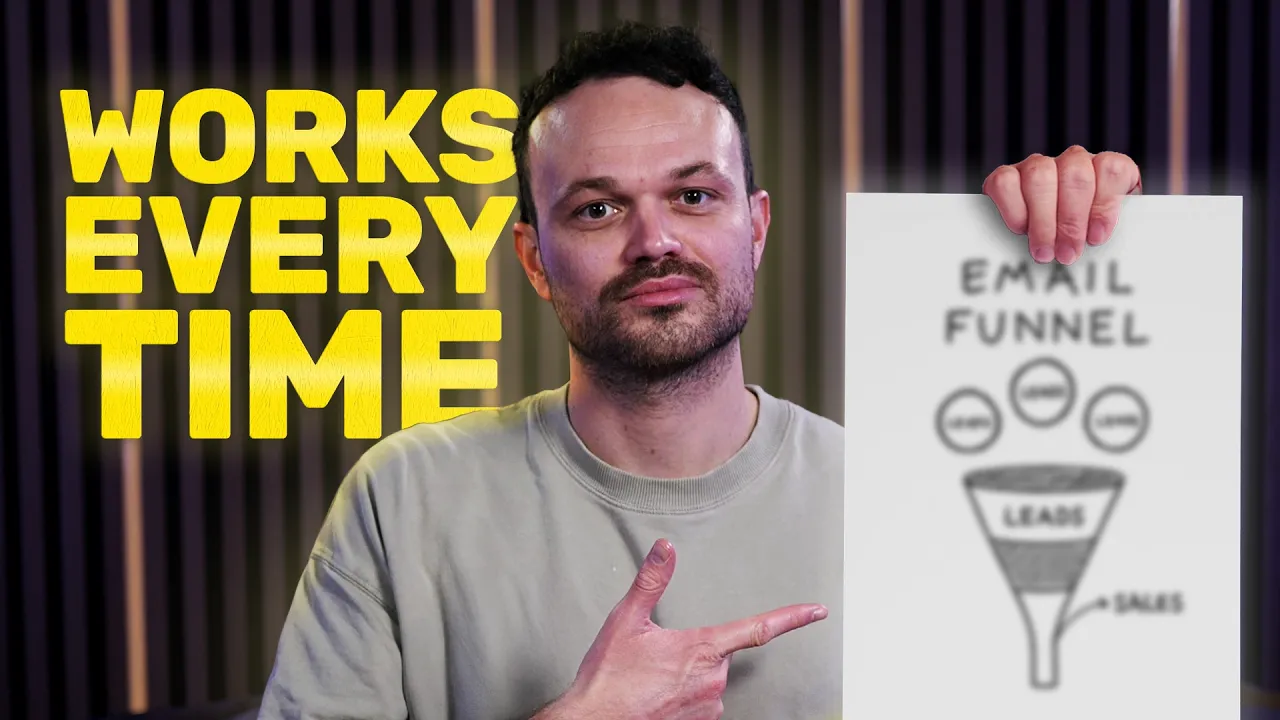
Let's start with the basics. What even is an email funnel? Simply put, it's just a step-by-step path where you build the emails that guide people from Who's this?
To take my money. That's it. You're showing up with value at every stage of their journey and making it really easy for them to say yes to what you offer.
Let me paint you a picture. Let's say someone finds your blog post or social media ad. That is the start.
They click through to your site and see something valuable, maybe a free checklist, a cheat sheet, whatever. They give you their email and bang, they're in your funnel. Now, your job isn't to just blast them with buy now emails right out of the gate.
Your job is to guide them through a few key steps. First, welcome them in. Then, you show them that you understand their struggles.
You give them useful stuff. You build a bit of trust. Then, when the timing's right, you make your offer.
As you see, it's a journey. In the case where you're thinking, Yeah, but does this stuff actually work? Spoiler alert.
Yes, it does. And not just for big name businesses. Get this.
There's this jazz music Foundation called Alex Terrier, who used an email funnel to promote his online music course and pulled a 19% email signup rate. Do you want another example? I'll give you another example.
There's Landcafé, a boutique coffee brand who literally make 54% of their sales through two email funnels built from simple educational content. And if that's not enough, then just do a quick Google search for email sales funnel case study and see how many businesses have gotten their entire success through sales funnels they built over email. That's what we're building today.
And next, I'll show you the first and most important piece, how to get the right people into your funnel from the very start. This might sting a little, Well, but if your email list isn't converting, then the problem isn't your writing. It's probably your audience.
Hars truth? Maybe, but it's the truth. You could have had 100,000 people on your list and still hear crickets.
Why? Because they're just not the right people. So what you're going to do about it?
You stop chasing vanity numbers and start attracting people who have the problem you solve or who want exactly what you offer. Here's how. Create content that speaks to their pain points.
Use lead that solve a specific problem, and make sure it's specific. So instead of 10 marketing tips, go for something like, The three-part welcome email script that tripled my online course sales. And finally, put your sign-up form where the right people see it.
There's this guy, right? He's called Ian Brodie, and he helps service-based business owners with lead generation. Now, he writes blog posts, and they're nothing fancy, but here's the smart part.
About 60% of the way down his blog posts, he offers a free blueprint titled, Discover the fastest, most practical approach to winning clients. Well, I don't know about you, but if I was into that niche, then I'd definitely be clicking. All right, you've got the emails.
Now what? This is where most people blow it. They just jump in and start selling straight away.
Don't be that guy. Before you even think about pitching, you need to warm them up, really warm them up. Your job is to turn cold leads into hot buyers, and you do that by being helpful, genuinely helpful.
How do you do that? It's not complicated, but it does require a bit of consistency and some strategy. Let's break it down.
First of all, send emails that solve their problems. I know you'd probably want to rather talk about the product and your cool new features, but for now, they just don't really care. Just give away your best stuff for free and make them say, If this is the stuff I'm getting for free, then imagine the stuff I'll get when I'm paying.
But don't just throw random content at them. You got to know what they care about. The only The way to do that is to ask, listen, and stalk them ethically.
Use tools like BuzzSumo to find top-performing content or answer the public to see what questions they're asking, and Facebook groups to hear their unfiltered rants. That's what content agency owner, Victor, here did. He literally asked people in a group, What would make you submit a contact form?
And guess what? The responses helped him write the perfect piece that spoke directly to them. That's how you build trust.
You listen first and then you speak. Okay, now comes the fun part, selling. But of course, it's not just as simple as just selling.
There's an art to this, and you need to learn it. While creating helpful content helps you build relationships and trust, your subscribers may still start having questions once you ask them to draw out their wallets and buy something from you. It's at this point that you need to know how to make compelling offers, and here's how to do that.
Prepare to write a series of at least five emails that you'd send out over five days. Make sure your first email in the series focuses on a specific nagging customer problem. Show them what benefits your offer will have for them, and in your next email, give them compelling reasons to buy what you're selling.
And then give them a reason to buy it now in each of those emails. Here's how these four selling your offer elements play out in real life. Sales Copywriter Tori Reid did this perfectly.
She ran an eight-day email campaign selling her an email profits template. The first email, bold subject line. It was small problems, and it hooked attention fast.
Inside that email, she zeroed in on one of the biggest pain points, writing emails that convert. She teased her product and led them to a video where she explained how it could help. Then over the next days, she sent out emails with the results her past clients had gotten from her course.
Each email had one testimonial, and here's one of them. By day seven and eight, she pulled out the urgency cards. Warning, last chance emails that told readers the offer was about to disappear.
And that's how you do it. You walk them through the emotional journey, you tackle objections, you share proof, and you nudge them to take action now. Side note, if you're using Get Response, which I highly recommend, you can actually set this entire sequence up with automation.
Preschedule your emails, add tags based on behaviour, and even set conditions like, If they didn't open email 3, resend the tweaked version 24 hours later. This takes the pressure off you and makes sure the funnel keeps working even in the background while you focus on bigger things. Pretty cool, I know.
I'll link you to everything below. All right, this part's short, but it's critical. If you've done all the hard work, got the lead, built the trust, pitched like a champ, but your checkout process sucks, you've just lost the sale.
Here's what you need: clean, simple checkout pages and multiple payment options as well, okay? No weird redirects or broken links. Again, if you're using a platform like GetResponse's conversion funnel, you're golden because it works with PayPal, Stripe, Square, and all the big players, which basically means zero headaches for you and your customer.
Remember, the smoother the process, the higher the conversions. Don't give them a reason to bounce. Now, here's the real kicker.
Even after doing all of this, many people still don't get the sales. Why? Because they think of the email funnels as a set it and forget it magic trick.
Well, spoiler alert, it's not. The truth is, the best email funnels are tested, tweaked, and optimised constantly. You have to pay attention to open rates.
Are your subject lines trash? Click rates. Is your content even engaging?
Conversion Are your CTAs clear or confusing? Your funnel is a living, breathing thing. If you treat it like a one-time setup, it'll just die on you.
That's it, guys. That's all I have for you today. Now you know what a fully functioning, optimised email sales funnel is.
Go, go free, run free, and put it into action. Like, subscribe to the channel, and happy marketing.