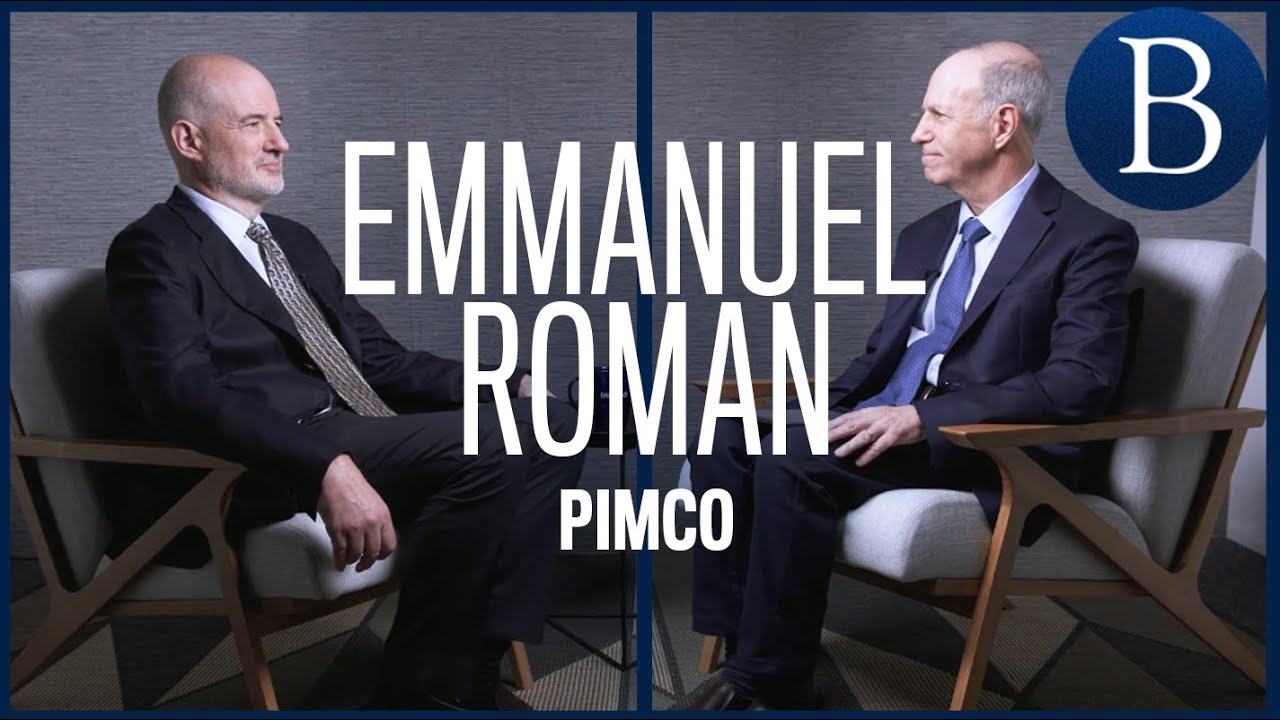
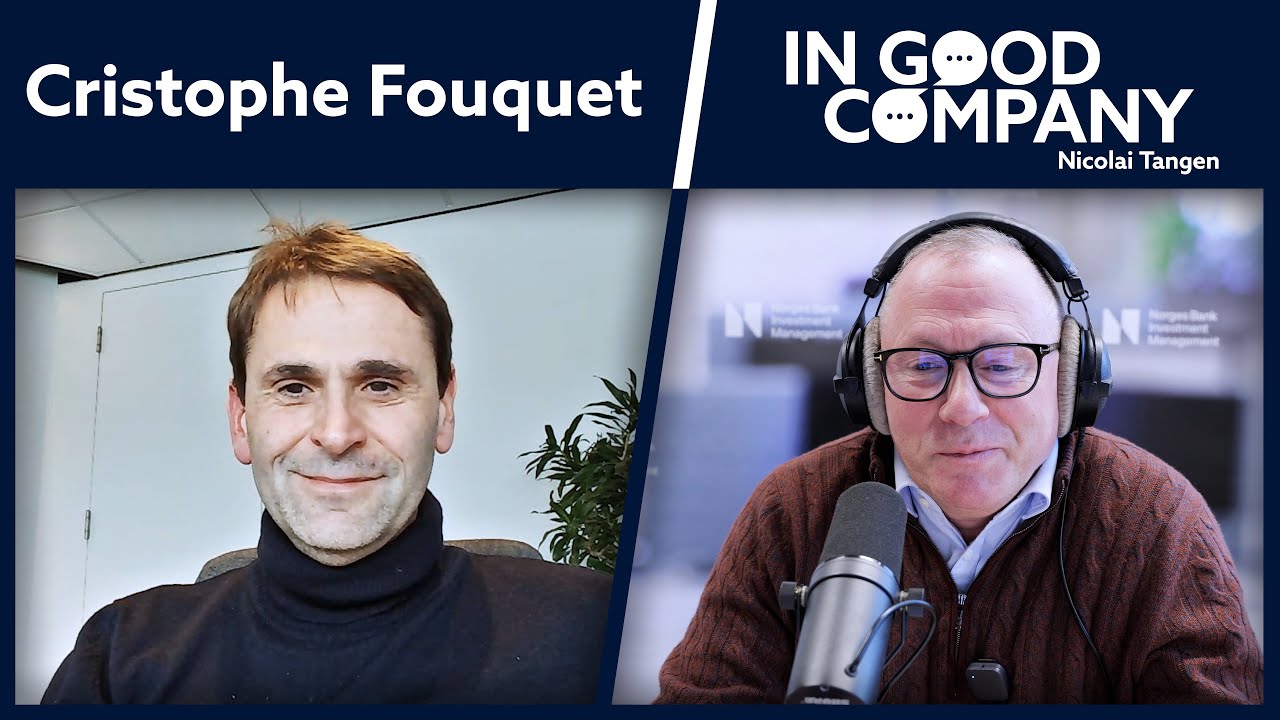
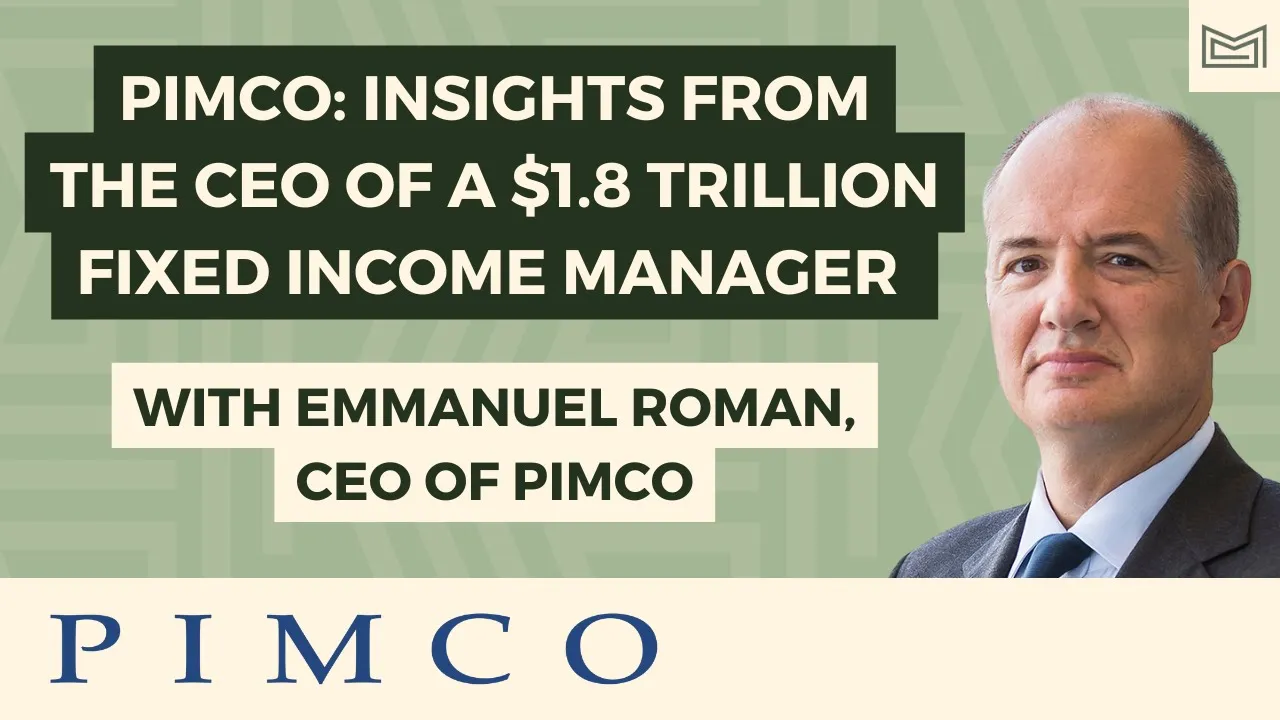
if you were a European and have spent the majority of your career in the UK it might seem very logical choosing to move to a destination which has 277 sunny days a year particularly as o Bleak January envelops us here at London but you may only make that move if you were offered a really significant role such as the opportunity to be the CEO of one of the world's largest fixed income managers the $2 trillion Powerhouse that is pinco so from Newport California where it's 7:30 in the morning and I'm told it's raining Emanuel RMA
good morning and welcome to the mmat podcast good morning nice to see you well you've also just told me that this is the first podcast you ever done so I'm doubly thrilled that you're here today that's right that's right I was I was always hoping I would get interview on one of this football podcast but it hasn't no one has asked me to do so so this is the first one well as I have found out you're an Arsenal support so maybe you'll get a chance at the end of this season but we might come
back to that um mdy before we discuss Pimco and the outlook for the many segments which exist Under The Heading of fixed income could we laser in on you for a moment I see that you and I who had never met until a few minutes ago were both born in August 1963 I have to ask you which day in August 27 okay so it's a few days after me therefore I am your senior so glad we so you were born in Paris I read your parents were both artists and you elected to study mathematics just
share with us what your thinking was at the time it was a very different world my my father was a big intellectual and I knew nothing about Finance but I knew that being an artist was not a very wise choice so I thought I should try to get a job where I could actually earn a living and I thought I would end up teaching in a university or something similar and you know life took a different turn uh but I grew up with a house full of books we had no car we had no TV
we had no radio uh my father listened to a lot of classical music it was very different wow and in a good way yeah and you studed the University of Paris and you do your MBA in Chicago and I just wondered what did each of those experi expences arm you with Paris was a strange place because if you remember I started college in 1981 and in 1981 was the beginning of the presidency of FR Mito the first socialist president in the fifth Republic and very quickly he managed to nationalize all the banks and for 11
months have quite a left-wing some would say crazy economic policy and then the Frank became so weak and they had to raise rate so much that things Chang and they Chang quickly with Jac delore who just passed away becoming Finance Minister and they had to learn how to balance a budget and all of these things so so what I remember is sort of looking at what was happening in the economy and saying this is all crazy now there were a lot of you know really good things about the presidency of miton but Economic Policy was
not one of them and then it became pretty mainstream by 1982 and it became you know sort of a center left um kesian economic policy and that that was the end of it but that's probably the the the memory that I have that I have back in my mind and then in 1986 um the bador government Unwound the whole thing and privatize you know all the banks and all the the big company again so it was a total run trip yeah yeah yeah Bou perhaps is the term is it the French French Economic Policy under
biton completely turned around but then you get your American Education as a masters at Chicago the great again a great mathematical but it's not what happened it's not what happened happened is I went and I thought about doing a PhD and then I stumbled into Goldman Sachs by by sheer luck I didn't know what govern sex was but uh they offer me a job and I thought you know why not I'll do it for one or two years and you know go back and finish a PhD at Chicago and you know government Saxon had to
be a really good place and instead of a couple of years I stay there for 18 years years GLG though what what what again what was the what was the particular if there was something particular you took from that it was a very different world uh I went there because I was friend uh with uh the G and the L Noam godsman and Pi L we had all worked together at common sex and uh there were some things to work on uh we went uh public at the height of the market in June 2007 on
the NYSC and and then live to regret it uh during the whole 2008 and and 2008 was incredibly tough uh we were we had a 20% ownership with Leman and we we got uh banged up with the lemon bankruptcy and to this day it is my most excruciating business experience and and and and we had to unwind a lot of exposure we had um The netting didn't work quite the way we thought it was going to work between uh various entities and and and in 20 2008 turned out to be survival and then the business
got better and then by uh 2010 uh we merged with Man Group and then things uh were smooth sailing after that you joined Pimco and you know I think it be fair to say that your expertise had been in equities and alternative slightly less in fixed income so I suppose that as I as I sort of had studied you the question was first of all what Drew you to this opportunity but equally what did they think you offered well I think you had a situation where they needed a new CEO I had done some fixed
income in capital markets and they needed someone who could work with the investment team and I met my partner Dan Iverson who's the CIO and I think we saw the world very much the same way we both went to the same university University of Chicago and why does it matter it matters because we think that markets are more or less efficient so when you talk about Alpha and gener generating Alpha we both sort of have the same view why do we think we can make money and what's our Edge and what's our Edge given our
size and I think we saw the world in a very very similar way and we thought we would make a good team it turned out to be even better we we great friends and and it's been an absolute pleasure to work with him and and before I came to do this podcast we were brainstorming about various topic but it's been super successful um and I mean I think for me I had been at man very happy the phone call came out of nowhere and I wanted to see whether I was good enough to run a
big money management company in the US and I very much like the people that I met and so I I made the decision to go I had never been to Newport Beach before and it's been seven Great years so some sometimes things things work out well that's that's really nice to to understand that Journey so Spotlight on Pimco just give us a quick recap on Pimco size assets offices people so we are all over the world our main locations are Newport Beach atin New York London Munich and then Asia where we have Hong Kong Singapore
Japan Australia we manage the latest number that we have published is north of $ 1.8 trillion dollar and we do fixed income and what I mean by fixed income is everything from Government Bond to corporate to high yield to bank loans to Munich to private credit to real estate and we offer uh different product in different region and we have a footprint in both institutional and Retail which is roughly equal and of course uh Pimco was well known because of Bill gross and was founded I think once again by accident on the west coast of
the US 53 years ago as a spinoff from Pacific Life and Pacific life is a sleepy Mutual company in California and then you know there was a clear first mover Advantage I think Pimco benefited from being the first really really serious fixed income investor manager but we have critical size and I think we have an unbelievable depth of professional we benefited I think from being different and from having the same investment process for 53 years where we have an investment committee and decisions are made at the top and there's a macro View and I think
all portfolio have to follow certain numbers of guidelines well we're going to get into the alpha the process the opportunities in a minute but I'm not sure any of us who have been in the industry for a while even acknowledging that central banks had already deviated from the Orthodox Playbook could have envisaged the yield drought that persisted for so long until 2022 and we went from yield drought to a flash flood and you said last year I think there will be a tidal wave of money coming and I wondered how far has that tidal wave
moved maybe the best way I have to explain this is to to basically point out the fact that given the level of short-term rates there's an enormous amount of money in cash and people sitting in cash look at expected return and maybe the easiest way I have to explain it is to take the American example so if you look at earnings price earnings what you can look at the US Stock Market I think a reasonable Target for long-term return from here for the S&P 500 is 8% and so 8% per anom and so if you
look at fixed income fixed income if you look at the carry on corporate bond mortgages and what you can get running a fixed income portfolio you get very close to this level and so you have a strange situation where you can earn as much money on an expected return basis in fixed income then you gain in equity and that doesn't happen very often and so all of a sudden fixed income becomes incredibly attractive and and and and that's really what's Happening Here of course I don't have a crystal bll in terms of the flow of
funds but expected return Drive flows and drive the flow for the industry and people look at what's happening here and just say you know two years ago I could invest and earn two and a half to 3% now I can do 8% it looks attractive and I think you'll see this playing for the whole of 20 um 24 and of course I mean if if if inflation is higher than expected and so if we get the macro framework wrong and shortterm rates keep on going up then it may be a different um story but it's
not the central case and I think the most likely scenario is inflation will get under control and shortterm rates will be lower a year from now yeah was interesting because I was looking at some data ahead of um making a talk at oord University tomorrow and uh 100 Years of data show S&P returns normally at n and a half% so hair cutting them to eight given that by many measures they are expensive would seem possibly quite well disposed quite an optimistic scenario but as you say no crystal balls and many of us have been tripped
up too many times by high level forecasts uh pimco's always been associated with seeking and achieving Alpha tell us a little bit about where you specifically are most excited we are in a very Target Rich environment and I always say when you go fishing it's better to go in a pond where there's a lot of fishes because irrespective of skill it's going to be much easier to catch fish and it's exactly what's happening so the fixed income Market is is is is really good and cheap in many ways and there's things to do and you
have a Confluence of event that makes it attractive so mortgages for example are really attractive a lot of people need to fund themselves in real estate and so lending money in real estate given the fact that banks are not involved right now is going to be really attractive when you think of all the banks that need to improve the capital situation and need to sell big portfolio of assets that will be a trend where it will give us and other people a chance to buy cheap assets because there's a seller and the seller for regulatory
reason needs to sell and it goes on and on and and I always say the fact that Banks need to sell to deliver is good for us it's good for us because there's big portfolio for sale we can extract premium pricing we find a way to trench the portfolio and at the end of the day it contribute to the alpha for our investors and and and I think that's quite a straightforward process and given your Capital rich and the banks are forced into you know this deleveraging and there's dis intermediation for the one of a
better word um would you actually like to see more stress for example in the commercial property Market as as we go through this this process because that would create more opportunity or do you think that the process actually will be uh less turbulent than some would think well I think I'll give you two example to kind of contrast this so if you if you if you're a British bank for example and you have a big us operation the US makes it difficult for you and they makes it difficult because they trap your capital in the
US and they regulate all banks the same and don't give you enough credit for your situation in London and I can make the exact same argument about Frankfurt or Paris and so what these Banks need to figure out is how much Capital they want to have in the us and whether it gives the shareholder a proper return on Equity there's no stress it's a matter of capital optimization and whether you want to have less or more capital in the US and I think that leads to one or two things either you're happy to have capital
in the US in which case you're going to run higher Capital ratio with the funding that goes with it or you would say you know what maybe I don't need all this balance sheet in the US and I ought to sell some of it to some of my competitors and it can be mortgages it can be credit card it could be loans it could be many different things and that's an opportunity for people like like us then at the other end of the spectrum you clearly have a fairly tense Market in commercial real estate but
there's a refund going on where people who borrow money very cheaply will need to refinance the debt because there's not enough transaction and what you will see is a cost of funding going from 4% to double digit funding and if if there's a chance for us to land at a double digit return at 50% loan to value to Big commercial real estate players if we pick carefully the sector if we do our homework if we understand bottom up the dynamic of the market is probably a very good opportunity and so the debt side in real
estate for example ought to prove to be quite exciting and there's a lot to do this thing correct you have a very good vintage and then Banks slowly but surely come back the market improves people refund themselves rates go down and then all of a sudden the excess return rebalance itself understood so let's move to the world of private debt as you know the allocations to private equity and to private debt climbed in the absence of yield um there's a lot of debate about private debt and a lot of debate about the shadow banking system
um and I just wonder whether you could answer two questions that intrigue me and I sit on a couple of investment committees so we look at we look at the world of private equity and we look at the fact that marks so the mark to Market is a uh is a slow process is a progress that lags real prices how should we think about the marking process of private debt I think you could you should ask question to your manager and extract the answer you feel like I mean we we manage so much public money
that for us the market price dictate how we Mark the r rest of our security and that's the way it is and by definition our returns will be more volatile because we Mark the market if you take to The Other Extreme private Equity are much slower to Mark the position and I think that's that's has been well studyed and it's part of the attractiveness for people to invest into private Equity that is a slow moving train but what really matters is the underlying volatility of the portfolio and the reality is things are moving they're moving
up they're moving down think of VC for example VC was the dotting investment of everyone in the US until the end of 2021 and now no one wants to hear about it and what's pretty clear is at the end of 2021 VC was marked too high based on Hope and based on comparable and how much has been repriced what people own what weight should be marked I think it's a big question mark and I don't know the answer but for us it's very straightforward so when we think about private debt and those who are allocating
to it how do you answer the you know the the question of should one be expecting to hold it to maturity and what sort of uh premium liquidity premium should you be seeking to harvest it's a very good question I would I would think that you need to hold it to maturity and so you need the right lockup um to be able to do it and you you will have a portfolio of debt with a synthetic rating of doubleb wig doubleb usually better Covenant and depending on how much risk you want you will have a
return ranging from right now 9% to 13 to 14% if you do more opportunistic lending and more distress situation and I think if you look at the granular detail of the various investment opportunity one has there's also a lot in what we call Specialty Finance equipment leasing for example is one where there very few people doing it you can land at double digit return it's not as it's not only lending to private Equity there's many different ways to do this you can buy royalty you can buy music right you can buy uh stream of cash
flow you can buy Life settlement there's a lot of things to do right now and what I think we we hope to be able to do is to look at all of them and say on a comparative basis this is really exciting and this is less so and I I think one has to be super selective and not be boxed into one area of the market because sometimes they get overcrowded but there's a lot to do yeah and I quote you when you said a few months back we think the opportunity take risk is quite
good and I think it was Howard Marx who course said that the worst loans are made in the best of times and now we flip that on its head so I understand if you're provider of capital it's a it why it might be a Target Rich environment which leads me back to the passive versus active issue we had black rock on a few months ago who of course were Keen to articulate the benefits of the world of passive in fixed income and yet the evidence is apparent that the more managers are able to outperform their
benchmarks in the fixed income world than if they're active managers how do you think about the active passive debate in fixed income I think it's a remarkably clear picture active fixed income management beat The Benchmark and I find really very little reason to buy passive fixed income and I I would like to tell you we are the only one beating the Benchmark unfortunately we're not and the reality if you take a step back is equity The Benchmark is simple the bigger the company the bigger the weight in the index so your will own if you
have a Vanguard in X fund you will own a lot of Apple a lot of Microsoft a lot of Amazon in a way from a capital Theory standpoint it does make sense you own the big company in the economy flip that on its head the fixed income a will have the exact reverse problem it will own the big exposure in company that have a lot of debt that's problem number one so to start with the Benchmark is a very different Benchmark which makes far less sense than the equity Benchmark that's Point number one point number
two is take take a company like Boeing for example which is in the news boing has literally 200 different bonds outstanding so one doesn't have to own the boing bond which is in The Benchmark one can actually all day long look at relative value of buying debt versus the one in the Benchmark and essentially being able to pick Penny by constantly looking at improving Returns the third option one has is there's a very liquid CDs Market than what can use either on indices or on single name sometimes the basis is rich sometimes the basis is
cheap one can go from one to the other there's a lot of Penny Nickel Dime to pick here in terms of improving performance and and you see exactly that and so no it doesn't make any sense for me to invest passive in fixed income got it um Emerging Market debt I find is talked about a lot less in certainly in the money managing Community where I where I travel how do you approach M debt given that the world is growing and capital is you know needed everywhere oh I think I think it's um you know
when I think of the attractive opportunity right now em em local debt is attractive and we have a big footprint uh there's a lot to do um there's a lot to do in South Africa there's a lot to do in Brazil there's a lot to do in Mexico um and actually we've seen quite a bit of interest from clients and flows of people adding to em exposure and and and you know the problem with em in fixed income is it it Encompass a lot of different things um so it's it's Asia of course but it's
also Latin America and and and and Eastern Europe and so on and so one needs to be careful about how you define it uh but there's clearly a lot to do and you know don't try to time it just sit on it and earn the carry of the local Bond and the local debt you look at Brazil for example or Mexico I mean those are exciting places and remember in fixed income all you want is you want your money back you don't have to decide who the winner in the local economy are going to be
you have to make a judgment about the curve you need to make a judgment about inflation you need to make a judgment about the central bank and you need to make a judgment about the currency so I know you're running this you know significant fix inome business and we'll talk about pen con business but as you step back you've been in this business for a long time we've seen imbalances at a at a country level that have been that have dwarfed anything we've seen before you know the US is near full employment it's put interest
rates up the economy still seems to be in in okay shape and yet it's running these huge deficits and if you look at the Congressional budget office forecast and the rest debt to GDP continues to rise inexorably with no obvious Solutions um and I think I'm right in saying or maybe it was Neil Ferguson who' said that the debt service cost this year is going to ex defense spending outlays um do you sit back and worry how this all ends of course of course and and and and when you think of a a super secular
framework the reality is the deficit level versus economic activity are too high and there will be a time where there will be budget constraints and less spending and higher taxes and the speed at which it unfold and how it all happen uh is open to u to debate but the reality is the level of Interest payment is not sustainable I think all of us all of us had to learn from the Japanese experience where essentially Japan has been able to run with a very high level of debt to GDP for a very long time keeping
rates very very low and was a very difficult demographic U pyramid uh and I think that has surprised most of us in terms of how much you could run um as a deficit but the us at some point in time uh will will have issue and I think Janet Yen said it very well you never know when it's going to be an issue but at some point in time it will be an issue at some point in time the market will say it's too much so let me just pause on Japan a because we might
be getting some yield back so I'd like to hear your thoughts on on it but isn't the flaw in that Japan live with that high debt to GDP number one it was financed domestically essentially and number two they're the largest creditor nation in the world so they have a cushion which the US once had but which disappeared a long time ago but the US has the benefit of being the only investable Market in large side so I always say when people said say to me you know China wants to put the money into into the
Euro or into trade agreement with Saudi Arabia and so on it's all fine but the size is the minimal versus the amount of money they need to put in a liquid currency where you can invest and take your money out the dollar is the only real Reserve currency where you can trade in very big size and the Euro hasn't fulfilled its mission in terms of liquidity and in terms of being able to be a place where people feel comfortable to put large amount of money and and and so the fact that the US has a
privilege being the reserve currency should not be lost on anyone and that has been a major competitive Advantage for many decade and and I think our friend Neil Ferguson would say the exact same thing it is a great competitive advantage and the only one who has a chance to to be a reserve currency over the next 50 years is China and whether they decide to let the remain be float or not is a big political question because with free float comes also the lack of Capital control and that's that's a big if and of course
it was your fellow Frenchman late Frenchman jarda who talked about that exorbitant privilege somewhat somewhat annoyed but let's stay with Japan yields have with glacial progress inched up but the currency is as cheap as it's ever been versus purchasing power parity how are you thinking about Japan well we like we like the Yen and uh and it's moving at a glacial uh space so it's one of those trade where on on every possible model the yen is cheap uh but it's it's not working cheapness is one of the one of the factor it's not the
only one from a portfolio construction standpoint it makes sense to have some Yen but timing is is is uncertain and of course it has a big negative carry uh for a dollar investor and of course for a European investor uh but you know currency can be cheap for a long time ultimately when they become too cheap they tend to revert to the mean yeah so let's put that Spotlight back on Europe um it was interesting because we've had uh on the show uh zavier H who you probably know is Rand on the stock exchange and
he more than no I sat I sat next to him at Gman Sachs of course well I didn't realize that well he was one of our early guests and I think that if ever you wanted to listen to the criticism of Europe's Reliance on Bank funding and debt finance and the lack of equity financing and that playing out in the lack of entrepreneurialism he made it and that was perhaps we had Nicholas dufor of the BPI on as well and uh so we've had uh we've had a couple of French people very seriously um talk
about the if you if you the reasons underpinning this eurosclerosis now you sit on the west coast you work for an American firm I know your parentage is aliance so it's German but but what do you reflect on what is needed I won't say is it possible what is needed to energize Europe as you look at globalization and you look at Outsourcing this is not a positive sign for the labor force in Europe who I think face two threats one globalization but also the rise of AI and robotic where everything else being equal there will
be less job rather than more in certain sector which have been big provider of jobs in the past you look at France for example there are far too many jobs in the state where people where the state remedy the lack of innovation in the private sector and essentially become de facto the big employer if you look at England um pre- brexit I think there was a very decent chance for London to become as important to the Global Financial Market markets as New York is post brexit it's of course quite difficult and people had to move
jobs in irand on the continent for a variety of regulatory reason where for most of my career London was the perfect place to work that's a cost that's a net cost to a country so you need to have a business model where you say how do I compete on a global platform Germany had the middle stat where they build great product they sold to China whether it was Cars whether it was engineering whether it was chemical that's what Germany did France what does France do they do Luxury good product remarkably well and then they have
a few National Champion is that a real business model not clear so let's just invert that we' talked about the target Rich environment as an investor in the US as you look across Europe and UK you've had the same or similar rises in rates and and refinancings beginning happening right now how uh how excited are you about that investing landscape I think the UK has provided amazing trend for the right and the wrong reason uh and there was a lot to do in the currency and in the rates and every time uh you have political
change there's plenty of freedom in terms of uh of investing either long or short in various part of the of the curve and the currency I think what the one thing that the rise in rates has has given us is relative value across country you know do we think it makes sense to have 10e rates in the UK being higher than the us or vice versa does it make sense to have 10e rates in Europe versus the UK where they are and so on and so forth and so we have a very big Global footprint
in terms of global fund where investors want to have an allocation to the global bond market there's a lot of relative value trades to be done and that that you know if you asked me two years ago there wasn't much to do now all of a sudden there's a lot to do and so you know the government is in place in the UK there may be a new labor government in the notto distant future that will give rise to a lot of things to do same in Europe uh I you know I I think I
think we're gonna have a hands full uh over the next two years and you know in a good way I would say I read in one of the pieces that you had authored that you were extremely constructive on ai's ability to help your business I just one you could explain why you are excited we are giant consumer of data and it's it's it's data which are numerical it's print it's words it's images and we take all this data and we try to fit them into a framework where we make investment decision and the reality is
is AI and deep learning have a way to synthesize data in a better way than the human brain and in a faster way and better data more organized data more curated data gives an edge and remember we we do a lot of things for example in commodity where there's a whole tree of data that don't necessarily come to mind where there's natural gas there's geographical risk there's shipping there's political risk now in terms of of shipping for example all of these things come into the picture and having an ability to collect them very quickly is
definitely a plus it makes our business more efficient it gives us a lower cost of trading and it goes on and on and on and I I really think like what keeps me awake at night is being able to invest enough and be able to put enough money so that my process becomes better and my Alpha becomes better day after day after day and practically with this enormous Paradigm Shift which is a words two words often overused but in this case it does appear to be absolutely right how do you implement the potency of that
AI across your teams what are the steps that you have so far taken make it a top priority for the firm as a whole I own it have task force have specific project uh in terms of success in terms of being able to being able to be more productive you know I always say all of us 20 to 30% of our job is really a total waste of time like think of your own life right like you look for a phone number you look for an email you look for an image and so on and
you look for it and you know you're looking at out look and you get frustrated and so on I just think that was the right tool we're gonna make everyone much more much more productive in terms of their day-to-day job and happier because the part of the job that they don't really like is going to disappear remember the days where you would go and try to go to Dorset in 1981 you would have a map you would get lost you would take three wrong turns then you would finally arrive in a terrible mood saying this
you know map is totally useless I cannot believe I went there and so on now you'll go straight there in a place you never been you'll just put the address that's the beauty of Google Map and I think a lot of this is going to happen a lot of things that now we take for granted and that the younger generation never had to exper experience is going to be a big Improvement in terms of work and in terms of leisure think for example of of of your car okay you're going to be able to have
a better version of Siri a better version of driess car a better version of Amazon Prime where you're going to be able to dictate more complicated sentences in terms of what you want and the computer being able to find it so that leads us to culture because as alluded to your friend running a Californian company owned by a German insurer Alliance I think his market cap is 100 billion euros so you've got an interesting series of inflections how do you think you manage and get the best of the culture where you are and also having
a parent um that is a German parent and we know that tonic efficiency is great but it does things differently so it is's a total Chinese war between what we do and what the commat in Munich uh uh uh you know is um look culture is really very it's a very strange concept I I I think the I think the English language has won the war and I remember London as being a place that everyone wanted to go to because they wanted to be part of a community and it didn't really matter whether you were
Italian French German Norwegian you would come to London and I think good comp companies are like this hopefully there's a broad area of people from all part of life who wants to come to Pimco want to strive here wants to succeed and want to contribute and what I'm hoping for my investors is that the experience of that my investors have in terms of performance is exactly that that they get the sum of everyone working in sync and delivering the right product and the right performance but it needs to be a culture where everyone feels welcome
and anyone can succeed here and one day run the firm you could ask me why I think diversity really matter and why we want to have different people because the reality is you look at the world totally differently if you're 25 versus when you're 60 like us and you want different people you want people who bring a different view of life and and and and and are willing to contradict you and and you need to have a culture where people can can feel like they're part of of an organization who's willing to listen to them
yep I think that's well expressed um I'm going to ask you some general questions as we move towards the end and in fact one is from a former colleague of yours Aiden McGreevy and he said that he' noted and read that you did the preface to Victor Hagar's book The Missing billionaires and he said what advice would you give to investors looking at the longtime Horizon and wishing to hand down wealth intergenerationally given it's proved so difficult for so many families it's a very funny uh so I know I've been friend with Victor for you
know 30 years and that's why I preface the book but you know the the this idea is that the vender family had an enormous amount of money before the first world war and you will be remiss 100 years later to find any vendil with a significant of money and Victor do some back of the envelope computation and essentially shows that somehow the money disappear most likely because they invested it pretty poorly so I think the lesson the lesson from from for me in terms of of how to think about long-term investing is one have the
right asset allocation and the right risk two I'm a big student of Behavioral finance and so don't over trade and have principle in terms of how to rebalance your portfolio where you can think about the amount of risk you take and don't subject your portfolio to your own stress when things are difficult and they bound to be difficult three carefully look at Cost don't buy any individual security trust managers with your money and I I think every study shows that direct investing leads to pretty mediocre results so I think Victor quite carefully think about risk
and that's a whole other topic in terms of what's the right risk level what can happen to your life um how do you think about real estate how do you think about your life expectancy how do you think about you spending all of these things I think the book developed really well and I I I will not do justice in terms of summing up the book but but it's actually quite a technical book but quite a quite a a very good book well we'll put it on the show notes and and actually I was since
you just were talking about um allocations I was reminding somebody the other day which dates me it's an old expression which is the fixed income allocation in your portfolio should equate with your age you know what it's there was this principle which I I don't think it's quite right but it's a good proxy that that that you should have inequity 100 minus your age so it's the same thing right so for us it would be 40% inequity 60% in fixed income and and I think I think the premise is that as you get closer to
retirement you want more cash flow and less volatility because your human capital is less valuable and I I I think that makes sense got it um a few very general questions I know because I have read that you are fascinated with wine um and as I said to you one of my great early jobs was working at Stags Lea in California if you were to serve one American wine to president macron and one French wine to President Biden what would they be I would um I would serve to president mcon a 1974 marus Vineyard and
it's Californian wine before modern Californian wine and before California became really hot and the Californian wine industry is unfortunately a story about global warming and the fact that they make this incredibly heavy wine because they don't have much uh much of a choice because it's just just too hot and that will happen to France and it's happening in ChatOn of deap for President Biden um I would serve him a shaton of dap I really really like shaton of dap and I would pick Rayas which is my favorite wine yes I have to say even though
it would upset zavier role who of course is running his own running his own Vines and has pulled his irrigation out so the vines can go down and down to get to the to the Deep uh the deep water holes and uh and and lower the alcohol Al so he argues I I you know I agree so two uh two final questions a lot of students listen to our podcast around the world what advice would you give to a young person thinking about joining the world of finance that they will have a wonderful experience and
that what one needs to think about is how to build first human capital don't worry too much about how much you get paid join a company who wants to invest into you learn as much as possible ask question because the reality is your brain at 22 23 24 25 is so plastic in a good sense of the term that this is when you learn an enormous amount and it's harder to learn lateer in life than it is to learn now and so I think that getting the right training getting the right organization getting the right
friends in the company is incredibly important that's why I'm very ambivalent about young people joining startup because it's not clear to me they learn M much from the peers and the noise and the volatility of a startup is such that once in 100 it's the best place ever to have worked for but in a lot of other cases maybe the learning curve hasn't been as steep as it would have been in a more regimented and more Professional Organization that's good I'm not sure in 120 interviews that anybody's actually offered exactly that advice so so thank
you now I also note you're a very generous um donor to a number of Charities lunchbox leing America the global food banking Network how do you think about prioritizing or or or focusing on one charity given that there are always so many worthy causes I I I was incredibly influenced by by Peter Singer the philosopher and John RS and the fact that we have a moral obligation to the one who are the most in need and the reality is you have five million people dying of hunger in the world that reson a lot with me
I can do something about it uh it doesn't mean it's it's a better place to give money than giving money for cancer or um or giving money to other worthwhile charity but giving is important and spending time in terms of making sure the money is well used is is an absolute must and I do think from a selfish standpoint it makes your life better that I told you before we started this this podcast that my wife is South African and we feed 100,000 kids in South Africa that's the good news the bad news is there's
another four million we should be able to feed and South Africa is a triple B rated you know issue it's not the worst place on Earth but the system is beyond dysfunctional and and there's many people who need help and they need help because they got the bad draw in the distribution and you know I can leave you with one one concept which is very dear to my heart is our generation has been incredibly lucky we had a great bull market in equity and in fixed income we saw no war to speak of and yes
we did see a pandemic but for the most part it's been a pretty smooth ride we should all realize that it's not the case if you're in Ukraine it's not the case if you've been in Uganda it's not the case if you've been in Bangladesh is not the case if uh you've been in part of uh of the Middle East and that is a fact of life and so all you can do is remember that and remember how lucky we've been and that luck has a lot to do with outcome yeah and my final question
is is that in my research of course I discovered that you must be a Serial Optimist because you support Arsenal yes we do need a center forward um and I I'm a Serial I'm a Serial Optimist but my dear friend Howard Davis uh is a man city supporter and I I just told him two days ago that I conceded uh the premise ship to Man City because I think they're going to go from strength to strength and I I it's difficult it's difficult to build a scenario where we can be a better team but you
know what it's a very happy uh it's a very happy uh experience to love football and it's a great Melting Pot and I truly truly miss English football being in a stand my partner Andrew BS the the the norch supporter from um father to son and you know it takes a great skill to be a knowledge supporter because you go up you go down and Arenal is a happier experience so so look I am going to sum up as uh as I do um and I've taken a number of things away from this number one
is that you are justifiably excited about the universe of opportunities existing Under the Umbrella that is fixed income with yields that compete you know uh by your uh computation s with equities um that's number one number two that there is no doubt in your mind that active management of fixed income has the edge over passive and I think that's very clear um and as one thinks about intergenerational wealth and preservation thereof is that thinking about the right risk not over trading and thinking about costs are three elements to a strategy that are often overlooked um
and so with that I'm going to St Manny if we do meet that 1974 Martha's Vineyard I've not had and I'm just hoping you have a few bottles somewhere that you may want to share one with me but you have to come to California you won't travel oh go that's right well look thank you so much for being here today for having me all content on the money ma podcast is for your general information and use only and is not intended to address your particular requirements in particular the content does not constitute any form of
advice recommendation representation endorsement or Arrangement and is not intended to be relied upon by users in making any specific investment or other decisions guests and presenters may have positions in any of the Investments discussed