engineers labored to build another computational device a machine which would directly influence the design of all future computers America was a powerhouse producer of war implements but by 1943 there was a critical shortage of a surprising component of the war machine firing tables for artillery pieces firing tables allowed Gunners to correctly aim their guns in different ranges altitudes temperatures and wind conditions human computers frantically worked mechanical calculators to produce charts but they had a hard time keeping up during World War two there were a lot of guns coming off the assembly line there were a
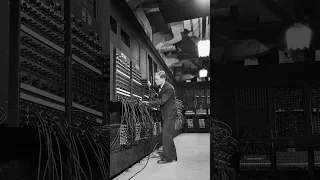
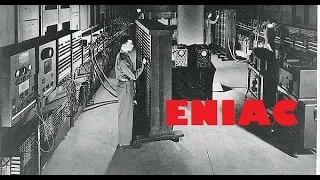
lot of firing tables to be calculated it was a really big job and was slowing down the delivery of guns to the front to solve the problem John Mauchly a physicist from the University of Pennsylvania proposed building a giant electronic computer that can figure charts in minutes not hours the army desperate for a device to help them win the war reluctantly committed to the proposed cost of half a million dollars mark Lee and a brilliant graduate students in electrical engineering presper eckert set to work constructing ENIAC the electronic numerical integrator and computer many times larger
than Colossus nothing close to eating AK had ever been conceived nearly 100 feet long and weighing 30 tons it contained almost 70,000 resistors 10,000 capacitors 6,000 switches and 18,000 delicate vacuum tubes vacuum tubes burn out just like light bulbs in a machine that contained 18000 vacuum tubes at least one had to be replaced every few minutes after 2 years of intense work the team completed ENIAC 3 months after the Japanese surrender although it wasn't finished in time to help win the war ENIAC was a marvelous machine it could perform up to 5,000 additions 357 multiplications
and thirty eight divisions every second the interesting thing about the ENIAC was that it had a general-purpose capability it could be reconfigured to solve other problems and there was never any problem finding work for the ENIAC to do all the armed services clamored for time on the machine industrial customers at university researchers wanted it so it was kept busy right into the 1950s by far the most complex machine of its time Eenie act still lacked many of the qualities of a modern computer its memory was very primitive I could only store a maximum of 20
10 digit decimal numbers it had to be laborious ly rewired each time it was pro and couldn't make logical decisions based on its calculations but any AK had proven that computers could be constructed just before the end of the Second World War John von Neumann an advisor to Eckert and Mauchly zinyak project wrote a paper that was to greatly affect the next stage of computer design von Neumann possessed a photographic memory and was one of the principal scientists involved in the Manhattan Project von neumann's paper delineated the structure of the modern computer it was to
have a processing unit a controlling unit memory input and output but most importantly in the evolution of computers it would hold its programming internally in its memory internally held programs give computers their power and versatility because an internal program can modify what it does based on data or the results of computations von neumann's paper proposed a machine that truly had a general-purpose capability in this paper he described the attributes of the computer I would ought to be organized logically that is it needed to have a central processor where the calculations would be performed needed to
have a memory where the program and data would be stored needed to have an output unit and input unit of some sort he laid out the logical plan the map for a computer and pointed the direction for the future the idea for storing programs internally was the last key to developing the true general-purpose computer but whether it was von neumann's idea has long been hotly debated Eckert and Mauchly who had worked with von Neumann claimed they formulated internal programs as a natural part of their work building ENIAC although they couldn't stop and incorporate the idea
into the machine however Eckert and Mauchly warrant included his authors in the paper they felt they had been betrayed but realizing the computer might find itself useful in the business world Eckert and Mauchly formed their own computer company they set to work on a machine they called the universal automatic computer