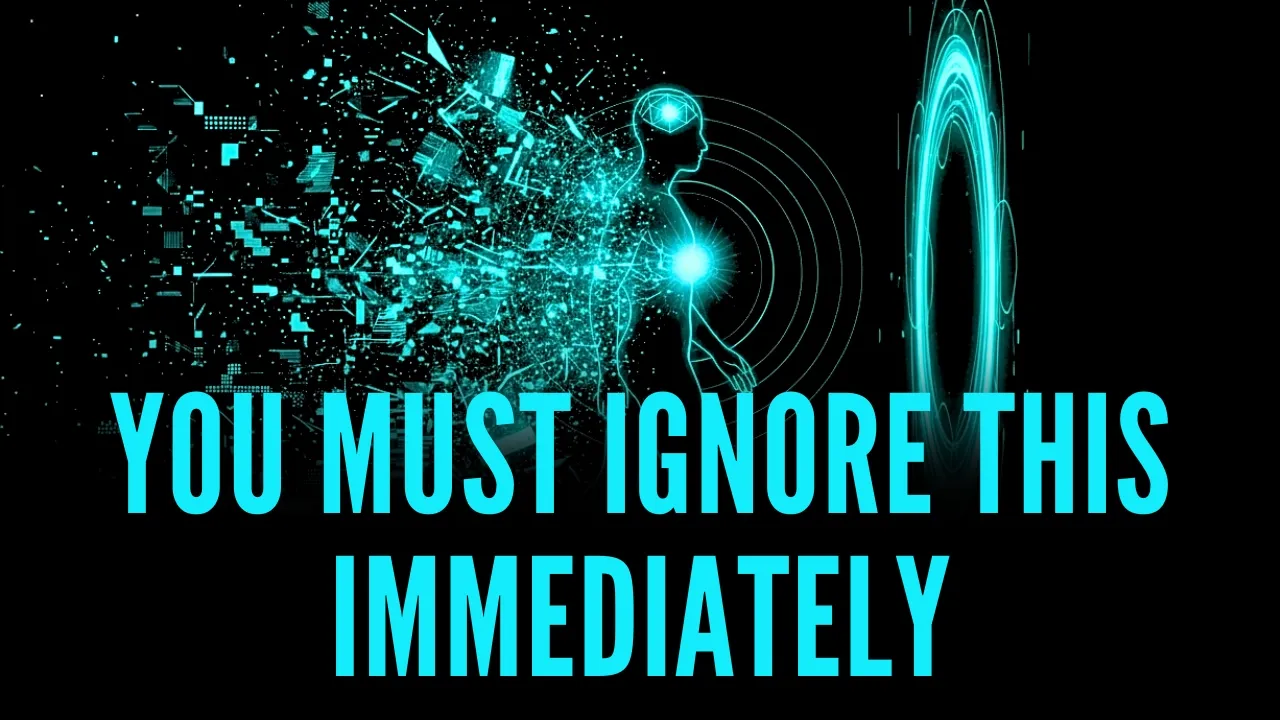
There is a very specific moment when your reality begins to change but almost no one notices when it happens because the instant you decide to ignore a single thing your mind begins to access a completely different reality. The real question is what exactly do you need to ignore for this to happen? Most people think change begins when they learn something new, when they try harder or when they adopt another Technique to improve their lives. So they keep searching for the next method, the next idea, the next strategy that promises transformation. But the shift that opens
the door to a higher quantum reality rarely starts by adding something new. It usually begins when you stop giving your attention to something that has been shaping the way you see the world for years. Something so common, so familiar that most people never question it. And the moment you Understand what that is, the way you interpret reality begins to change in ways that are both subtle and powerful. Many people believe their reality stays the same because they simply haven't found the right technique yet. They assume that if they visualize more clearly, meditate longer, or repeat
the right affirmations, something will eventually shift. So, they keep adding more methods, more information, more effort. But the real obstacle is usually Much quieter than that. There is an invisible filter operating inside the human mind and most people go their entire lives without realizing it exists. This filter constantly decides what is real, what is possible, and what deserves your attention. The strange part is that this process happens automatically. You are not consciously selecting most of the things you accept as reality. Your brain is making those selections in the background. Every Second your senses receive an
overwhelming amount of information, sounds, movements, colors, sensations, memories, predictions, emotional signals. If your brain tried to process everything equally, you would quickly become overloaded. So the mind developed a survival strategy. It filters. It keeps what appears familiar. It ignores what seems irrelevant. And most importantly, it highlights what confirms what you already believe. This is where The invisible trap begins. Because once the brain forms an internal model of how reality works, it begins protecting that model. Not because it wants to limit you, but because stability saves energy. Predictability feels safe. So if your internal assumptions quietly
say things like, "This is just how life works." Opportunities don't really appear for people like me, nothing truly changes. Your brain begins organizing your perception around those ideas. You may Walk into a space filled with possibilities and only notice the few details that confirm what you already expect. A new idea may appear in front of you, but your mind dismisses it before you consciously recognize it. A conversation may contain an opportunity, but the filter removes it from your attention before it has any impact. And the most fascinating part is that this happens so quickly that
it feels like reality itself is fixed. But what you Are actually experiencing is a curated version of reality. One that your mind quietly reconstructs every day. This is why people often feel stuck even when they are genuinely trying to change their lives. They read new ideas. They adopt new habits. They attempt to think differently. But the filter interpreting reality remains the same. So the external world keeps being processed through the same internal lens. The result is subtle but powerful. Even when New possibilities appear, they are minimized, ignored, or interpreted in ways that fit the old
narrative. And this is where the idea of a different quantum reality begins to make sense. If reality is partially shaped by observation, as certain interpretations of quantum physics suggest, then the way the mind filters what it observes becomes extremely important. Not because thoughts magically control the universe, but because perception determines which Aspects of reality you're able to interact with. Two people can live in the same environment and experience completely different worlds simply because their minds are filtering different signals. One person sees obstacles everywhere. Another sees openings. One notices confirmation of limitation. Another notices signs of
movement. Both are technically observing the same environment, but they are not interacting with the same reality. The Invisible problem is not that opportunities do not exist. The real problem is that the mental filter often prevents them from even entering awareness. And once a pattern becomes strong enough, the mind begins recreating it automatically. Each day becomes an extension of the previous one. The same reactions appear. The same interpretations return. The same emotional responses repeat over time. This repetition creates the impression That life itself is locked into a fixed structure. But what is actually fixed is the
filter. If you want to see how powerful this mechanism is, notice something simple. When someone buys a new car, they suddenly begin seeing that same model everywhere on the road. The cars were always there, but the brain only started highlighting them once the mind labeled them as relevant. Reality did not suddenly produce more cars. Attention simply changed its filter. Now Imagine how this same mechanism affects the way you interpret opportunities, risks, relationships, creativity, and the direction of your life. The mind is constantly deciding what deserves attention and what should remain invisible. And this is where
many people unknowingly move in the wrong direction when they try to raise their consciousness. They assume the solution is to add more mental control, more effort, more techniques, more ways of Forcing the mind to behave differently. But what if accessing a different quantum reality is not about adding more mental activity at all? What if the real shift begins when something is removed instead? Because sometimes the greatest transformation in perception does not come from forcing new thoughts into the mind, but from understanding what the mind has been automatically protecting all along. One of the most common
mistakes people make when they try to Raise their consciousness is believing that the process requires adding something to themselves. More knowledge, more techniques, more control over their thoughts. At first, this idea seems logical. If you want to evolve, you assume you must accumulate new tools. So, people begin collecting practices the same way someone might collect instruments in a workshop. Meditation techniques, breathing methods, visualization exercises, affirmations, Mental routines. Each new method promises to unlock a higher level of awareness. But after some time, many people quietly notice something frustrating. Despite all the effort, their inner experience has
not changed as much as they expected. They may feel moments of calm during meditation, brief motivation after listening to inspiring ideas or temporary clarity when they focus on positive thinking. Yet once they return to daily life, the same Reactions appear again. The same worries return. The same doubts surface. The same interpretations of reality repeat themselves. This creates a silent confusion. People begin to wonder if they are doing something wrong, if they are not disciplined enough, or if they simply have not found the right method yet. But the real issue is often much simpler. Most people
approach consciousness as if it were something that needs to be constructed, when in Reality, it functions more like something that needs to be uncovered. Imagine a window covered with layers of dust. One strategy would be to bring in more light sources to illuminate the room. Another strategy would be to remove the dust from the glass. Both approaches aim to improve visibility, but only one actually reveals what was already there. Raising awareness works in a similar way. The mistake happens when people try to force the mind to Become something new instead of recognizing the patterns that
are already shaping their perception. For example, someone may try to maintain positive thoughts all day. They repeat phrases that sound empowering and attempt to suppress anything that feels negative. On the surface, this seems like progress. But internally, another process is happening. The mind begins to fight itself. Part of the brain tries to maintain a controlled narrative while Another part continues generating the same old interpretations based on past experiences. The result is tension. Instead of expanding awareness, the person becomes exhausted trying to manage every thought. This is why many people feel mentally drained after attempting to
stay positive for long periods. They are not expanding consciousness. They are policing their own mind. What is rarely discussed is that awareness does not Grow through force. It grows through observation. The moment you stop trying to control every thought, something subtle becomes visible. You begin noticing the patterns that were previously running automatically. The mind's habits, its fears, its predictions about the future, its assumptions about what is possible. And once you start seeing those patterns clearly, their influence begins to weaken. This is where the connection With a different quantum reality becomes interesting. In physics, observation changes
the behavior of certain systems. At the microscopic level, particles behave differently depending on how they are observed. While human consciousness does not control the universe in a magical way, the principle still offers a powerful metaphor for how perception shapes experience. When you constantly try to add more mental effort, your attention becomes narrow and tense. You Are trying to manufacture a new reality instead of noticing the invisible mechanisms that are already shaping the one you live in. But when observation becomes calm and curious, the mind starts revealing something important. Many of the limits you assumed were
part of reality are actually habits of interpretation and habits can change. The shift toward a new quantum reality rarely begins with a dramatic moment. It usually begins with a quiet realization. The mind has been repeating the same interpretations for years without being questioned. Once you see this, something interesting happens. Instead of fighting thoughts, you start watching them. Instead of forcing positivity, you begin noticing how certain ideas immediately trigger doubt or resistance. Instead of trying to manufacture belief, you observe how quickly the mind rejects possibilities that do not match the past. And this observation alone begins
Loosening the structure that kept perception fixed. But there is an even deeper detail hidden inside this process because the brain itself was designed to protect familiar patterns even when those patterns limit what you are able to see. Understanding this detail reveals why changing perception can feel difficult at first. Even when you begin observing your own mind more clearly. There is a small but powerful detail inside the human brain that quietly Shapes the way you experience reality. Most people never notice it because it operates automatically beneath conscious awareness. Yet, this mechanism influences what you see, what
you ignore, and even what you believe is possible in your life. Your brain is designed to save energy. Although the brain represents only a small portion of the body's weight, it consumes a significant amount of energy every day. Because of this, it constantly looks for Ways to become more efficient. One of the ways it does this is by turning repeated experiences into patterns. Instead of analyzing every situation from the beginning, the brain builds shortcuts. These shortcuts allow it to recognize familiar situations quickly and respond without spending too much mental effort. At first, this ability is
extremely useful. When you learn how to drive, for example, every movement requires attention. Your mind monitors The mirrors, the steering wheel, the pedals, the road signs. Everything feels slow and deliberate. But after some time, those actions become automatic. The brain compresses the process into patterns so you can drive without consciously thinking about every detail. This same mechanism operates in every area of life. Your brain creates patterns about relationships, work, money, opportunities, risk, and even about who you believe you are. These Patterns become mental shortcuts that help the brain predict what will happen next. But here
is where the distortion begins. Once the brain forms a strong pattern, it starts favoring information that confirms that pattern while quietly ignoring information that contradicts it. This process happens so smoothly that you rarely notice it. Imagine two people hearing the exact same comment from a colleague. One person interprets it as criticism. The other hears it as Helpful feedback. The words were identical, but the interpretation was shaped by the internal patterns already stored in the brain. The mind is not simply observing reality. It is constantly interpreting it through the lens of past experiences. This means that
much of what feels like objective reality is actually filtered through expectations the brain formed long ago. And because the brain values efficiency, it prefers familiar interpretations over New ones. Familiar interpretations require less energy. The brain already knows how to process them. New possibilities, on the other hand, require effort. They force the brain to reconsider its predictions. They introduce uncertainty. From a survival perspective, uncertainty is uncomfortable. So, the brain subtly resists it. This resistance is one of the reasons people often feel that life keeps repeating itself. The same types Of situations appear. The same emotional reactions
return. The same outcomes seem to follow similar patterns. But often the external world is not repeating itself as much as the brain is repeating its interpretations. When the mind expects limitation, it scans the environment looking for evidence of limitation. When it expects difficulty, it notices every sign of difficulty. When it believes change is unlikely, it quickly dismisses signals That suggest something new might be possible. Over time, this creates a closed perception loop. The brain predicts a certain type of reality. It then notices evidence that supports that prediction. That evidence strengthens the prediction and the cycle
continues. This is why two individuals can live in the same environment and still experience completely different lives. Their brains are highlighting different aspects of the same world. When people Begin exploring ideas about a different quantum reality, they often imagine something mystical or distant. But in many ways, the doorway to a different experience of reality begins with something far more practical. It begins with understanding that the brain is not a neutral observer. It is a prediction machine. It is constantly trying to anticipate what will happen next based on what has happened before. This ability helps us
survive, but it can Also quietly limit what we allow ourselves to see. Because if the brain already believes it knows how the story ends, it stops looking for new directions. And the most fascinating part is that this process is not fixed, the brain is capable of adapting. Scientists call this ability neuroplasticity, which simply means the brain can reorganize its patterns when new experiences or new forms of attention Appear. But for that to happen, something important must shift first. The automatic interpretation of events must slow down just enough for awareness to notice it. When that space
appears, you begin to see how quickly the mind labels situations as good or bad, possible or impossible, safe or risky. What once felt like unquestionable reality begins to reveal itself as interpretation. And when that happens, a new kind of Choice becomes available. You begin to see that the mind has been reacting to certain signals automatically for years. Fear appears before curiosity. Doubt appears before exploration. Old conclusions appear before new questions even have time to form. This is usually the first moment when people realize something important. The mind is not only filtering reality, it is also
reacting to those filters emotionally, often without being aware of it. And This reaction creates a familiar feeling that many people experience when they try to think differently, but somehow feel pulled back into the same patterns again. There is a subtle moment that reveals when someone is ignoring the wrong thing in their attempt to change their life. It usually appears when a person is trying very hard to think positively to stay motivated or to maintain a sense of certainty about the future. On the surface everything seems Correct. The person is focusing on improvement, learning new ideas
and making an effort to shift their mindset. And yet inside there is tension. A quiet resistance keeps appearing. You may recognize this feeling. You try to hold a positive thought about the future, but another voice in your mind immediately questions it. You attempt to imagine a new possibility, but doubt appears almost instantly. It feels as if part of your mind is moving forward while Another part is pulling you back. Many people assume this means they are failing at controlling their thoughts. They believe they simply need more discipline. So, they try harder. They repeat affirmations with
more intensity. They push away negative thoughts more aggressively. They attempt to replace every doubt with a positive statement. But the tension usually grows stronger. The reason is simple. They are trying to silence the wrong signal. When someone Attempts to suppress every uncomfortable thought, they are often ignoring the surface reaction instead of observing the deeper pattern that produced it. The doubt itself is not the true obstacle. It is only a signal pointing to something happening beneath awareness. Imagine a smoke alarm going off in a house. One strategy would be to remove the batteries so the noise
stops. Another strategy would be to find out what is creating the smoke. Trying to Force positivity often works like removing the batteries. The noise disappears temporarily, but the source remains untouched. This is why the first sign that you are ignoring the wrong thing is the feeling of internal conflict. Part of your mind tries to move toward a new possibility while another part quickly brings your attention back to what feels familiar and safe. This reaction is not random. Your brain has spent years building Patterns based on past experiences, predictions, and interpretations of reality. When a new
idea appears that does not match those patterns, the brain immediately evaluates it. If the idea feels uncertain or inconsistent with what the brain already believes, it triggers caution. This caution often appears as doubt, skepticism, or discomfort. But instead of observing this reaction with curiosity, most people immediately try to eliminate it. They label it as negativity. They try to push it away so they can maintain a more positive state of mind. Ironically, this reaction hides the very information that could help them change. Because doubt often reveals the exact place where the mind is still attached to
an old interpretation of reality. If you pay attention, you may notice that certain types of possibilities trigger stronger resistance than others. Some ideas feel exciting and natural, while others Immediately create tension. That tension is not proof that the idea is impossible. More often, it simply means the brain has not yet built a pattern that includes it. When people begin exploring the idea of experiencing a different quantum reality, they sometimes imagine that the process requires eliminating all negative reactions. They think a higher level of awareness means constant certainty, constant confidence, constant clarity. But real awareness works
differently. It allows you to notice your reactions without immediately trying to correct them. When doubt appears, awareness does not panic. It becomes curious. It asks quiet questions. Why did that thought trigger resistance? What expectation did the mind just protect? What interpretation of reality is hiding beneath this reaction? These questions reveal the deeper structure of the mind. And when that structure becomes visible, The internal conflict begins to soften. You no longer feel the need to fight every thought. Instead, you start recognizing patterns that were previously invisible. This is an important turning point because the goal is
not to control every thought that enters your mind. The goal is to understand which signals deserve your attention and which ones are simply echoes of old conditioning. Many people spend years trying to silence thoughts That were never the real problem. They attempt to eliminate symptoms instead of recognizing the system that keeps recreating them. Once you begin observing these reactions without immediately rejecting them, you start discovering something surprising. The mind is constantly trying to validate its current understanding of reality. It wants confirmation that its predictions are correct. And this constant search for validation is one of
the biggest Reasons why people struggle to step into a new experience of reality. One of the main reasons most people never manage to access a new reality is surprisingly simple. They keep asking the present moment for permission to believe in something different. At first, this seems completely reasonable. The human mind is trained to trust what it can see, measure, and verify. We grow up learning that evidence comes first and belief comes after. If something is not Visible in the current circumstances, the mind quickly assumes it is not real yet. But this habit quietly locks perception
inside the boundaries of what already exists. When people try to change their lives, they often look at their current situation as the main reference point. They observe their finances, their relationships, their opportunities, their past results. Then they ask themselves a silent question. Given what I see right now, what is Realistically possible? The answer almost always stays close to the present conditions. If the current situation feels limited, the expectations for the future become limited as well. If the present seems uncertain, the mind predicts more uncertainty ahead. Without realizing it, the brain begins using today's evidence to
define tomorrow's possibilities. And this is where the trap forms. Because when the mind demands proof before allowing belief, it Ends up recreating the same reality over and over again. The brain scans the environment looking for signals that confirm its current model of the world. When it finds those signals, it strengthens the model even further. The cycle becomes self-reinforcing. You expect certain outcomes because they match your current reality. You notice evidence that confirms those expectations. That evidence convinces you the expectations were correct. And Slowly the mind builds the impression that reality itself is fixed. But what
is actually fixed is the interpretation of the present moment. Many people who explore ideas about personal transformation believe they need to convince themselves that a different future is guaranteed. They try to create certainty through visualization or positive thinking. When the external world does not immediately reflect those expectations, frustration appears. They Look around and see the same conditions still present, the same environment, the same challenges, the same unfinished goals. At that point, the mind often concludes that nothing is really changing. But what is rarely understood is that a shift toward a different quantum reality rarely begins
with visible proof. In fact, it often begins when someone stops treating the present moment as the final authority on what is possible. The present is not a finished Statement about your life. It is simply a snapshot of patterns that have been repeating up until now. Those patterns may feel solid, but they are not permanent structures. They are the result of thousands of small decisions, interpretations, and reactions accumulated over time. When those internal patterns begin to shift, the external results often take time to catch up. But the mind struggles with this delay. The brain prefers immediate
Feedback. It wants confirmation that a new direction is working. When that confirmation does not appear quickly, it begins pulling attention back toward the familiar story. You might notice this happening in subtle ways. A new opportunity appears, but the mind quickly questions whether it is realistic. A new idea about your future feels exciting for a moment, but then the brain searches your past for reasons why it might fail. This is the mind Trying to protect its current model of reality. It is not doing this to sabotage you. It is doing it because uncertainty requires energy and
the brain naturally tries to minimize energy use. Familiar predictions are easier to maintain than completely new ones. But this protective mechanism becomes a barrier when someone wants to experience a different trajectory in life. Because the moment you require your current circumstances to validate a new Possibility, you limit your perception to what those circumstances already contain. The mind keeps looking at the same evidence and drawing the same conclusions. And this is why many people feel as though they are standing at the edge of change without ever fully crossing into it. They sense that something more is
possible, but they continue measuring that possibility against the reality that already exists. In doing so, they unknowingly reinforce The same structure they are trying to move beyond. A different experience of reality begins to appear when this habit starts to loosen. When someone becomes willing to observe the present moment without allowing it to define the boundaries of the future. This is the point where science and spirituality begin to touch an interesting idea. Because in certain interpretations of quantum physics, reality does not fully settle into a single outcome until Observation occurs. The act of observing plays a
role in how potential becomes experience. There is a moment in this exploration where something interesting happens. The conversation about reality stops being divided between science and spirituality and the two perspectives begin to touch the same question from different directions. For a long time, these two worlds seemed completely separate. Science focused on measurement, observation, and repeatable Experiments. Spiritual traditions focused on inner experience, awareness, and the relationship between perception and reality. One spoke the language of laboratories and equations while the other spoke through introspection and philosophical insight. Yet when modern physics began studying the behavior of matter
at extremely small scales, researchers encountered something unexpected. At the quantum level, the universe does not behave like A fixed machine made of solid objects. Instead, it behaves more like a field of possibilities. Particles do not always exist in a single defined state. Under certain conditions, they exist as probabilities, multiple potential outcomes that have not yet settled into one final result. What makes this even more fascinating is that the act of observation appears to play a role in how those probabilities become a Specific outcome. In simple terms, before measurement occurs, a quantum system can exist in
several possible states. When the system is observed or measured, those possibilities collapse into one measurable result. Physicists are careful about how they interpret this phenomenon. It does not mean that human thoughts magically create the universe. The mathematics of quantum mechanics describes interactions between systems and measurements in ways that Are still being explored. But the principle itself introduces a powerful idea. Reality at its most fundamental level is not always fixed until interaction occurs. For many people, this concept echoes something that spiritual traditions have suggested for centuries. Not in a mystical or supernatural sense, but in a
practical observation about human perception. The way we observe the world changes the experience we have of it. Our Expectations influence what we notice. Our beliefs guide our interpretations. Our attention highlights certain signals while ignoring others. The world we interact with is shaped at least partially by how our awareness engages with it. When people hear about the idea of a quantum reality, they sometimes imagine that it means the mind can instantly control physical events. That interpretation often leads to unrealistic expectations and Disappointment. But the deeper connection between science and inner awareness is more subtle. Quantum physics
suggests that potential exists before outcomes become defined. Human perception determines which aspects of reality enter awareness and which remain unnoticed. Together, these ideas point towards something important. The world may contain more possibilities than our current perception allows us to experience. Our brains filter Information continuously. Out of millions of signals surrounding us, only a small fraction reaches conscious awareness. This means the reality we experience is already a selected version of a much larger field of information. When someone begins shifting their attention, questioning old assumptions, and observing their thoughts more carefully, something begins to change. The mind
becomes less rigid in how it interprets events. Situations that once Seemed completely defined begin to reveal multiple interpretations. What previously looked like a closed door might reveal a hidden alternative. A challenge that once looked permanent may start to look temporary. An event that once triggered fear might begin to invite curiosity instead. Nothing supernatural has occurred. The external world may be exactly the same as it was before. What changed is the way the mind interacts with it. This is where the Idea of a different quantum reality becomes practical rather than theoretical. When perception loosens its grip
on fixed interpretations, the mind becomes capable of noticing possibilities that previously remained invisible. Opportunities often appear quietly. New ideas emerge in small moments of clarity. Conversations reveal directions that were previously overlooked. None of these things require the universe to Suddenly transform. They only require awareness to become less restricted by its usual filters. The interesting part is that this shift does not require forcing the mind to believe in something extraordinary. It begins with something far simpler. It begins with questioning the assumption that the present moment represents the final version of reality. When that assumption weakens, the
mind stops reacting to every event as if it were absolute. Situations that once felt Definitive begin to feel more open. Interpretations become flexible. The brain starts exploring possibilities instead of immediately closing them. And that is where one simple but powerful adjustment begins to matter. Because if perception has been conditioned to treat current evidence as the ultimate truth, then accessing a different experience of reality requires learning to stop giving that evidence so much authority. At a certain point in this journey, the Shift becomes surprisingly simple. After exploring the mind's filters, its patterns, and the way it
protects familiar interpretations, a single question begins to emerge. If perception keeps recreating the same experience of reality, what exactly needs to change first? The answer is not another belief. It is not a new technique. And it is not the elimination of every negative thought. The shift begins when you learn to ignore one Specific thing, the immediate evidence of your present circumstances. This idea can feel uncomfortable at first because the mind has been trained to treat the present moment as the ultimate proof of what is true. If something is not visible now, the brain assumes it
is not real yet. If a result has not appeared yet, the mind often concludes that it probably will not. But this habit quietly traps perception inside the boundaries of what already exists. Your Current circumstances are not a final statement about reality. They are simply the visible result of patterns that have been repeating until now. Every decision, reaction, and interpretation from the past has contributed to the situation you see today. When the mind looks at the present and treats it as absolute proof, it unintentionally locks itself inside those past patterns. Imagine trying to walk in a
new direction while constantly staring at The place where you started. Your body may be moving forward, but your attention keeps pulling you back to the same reference point. This is what happens mentally when people try to create change while continuously measuring their progress against their current evidence. Someone begins imagining a new possibility for their life, but then they immediately look around and say, "But that's not what my life looks like right now." The present Moment becomes an argument against the future. Over time, this habit becomes automatic. Every new idea is evaluated through the same question.
Does my current reality confirm this? If the answer is no, the mind becomes skeptical and withdraws its attention. But this reaction prevents the brain from exploring possibilities that have not yet become visible. When people talk about stepping into a different quantum reality, they sometimes think it Requires intense belief or mental force. In reality, the shift is much quieter than that. It begins when the mind stops giving absolute authority to the evidence of the present. This does not mean denying what exists. It does not mean pretending circumstances are different from what they are. Ignoring the immediate
evidence of the present simply means refusing to treat it as the final version of reality. Instead of asking what does my current situation Prove is possible, the mind begins asking a different question. What possibilities exist beyond what I am currently seeing? This subtle shift changes how attention works. When the brain is no longer forced to confirm the present, it begins scanning for new signals. Ideas that once felt unrealistic start to feel worth exploring. Opportunities that previously seemed irrelevant start entering awareness. The mind becomes curious Instead of defensive. This change may seem small but it has
powerful effects over time because attention is not passive. What you consistently notice influences the decisions you make, the risks you consider, and the conversations you engage in. When perception expands, behavior naturally begins to follow. Instead of reacting to the present as if it were fixed, you begin interacting with it as something still unfolding. The present moment Becomes information, not limitation. And when this shift stabilizes, something interesting begins to happen inside the mind. The automatic emotional reactions that once appeared instantly start slowing down. Situations that previously triggered frustration or fear begin to feel more neutral. The
brain is no longer rushing to defend the old interpretation of reality. It is observing. This observation creates a small but powerful space between what Happens and how you interpret it. In that space, something new becomes possible. The mind is no longer forced to repeat the same reaction it used in the past. Instead, it begins exploring new meanings, new responses, and new directions that were previously hidden by the weight of current evidence. And as this space grows, people often notice an unexpected effect. The world around them has not magically transformed. Yet, their experience of events begins
to Shift in subtle ways. Situations that once looked like obstacles start revealing alternative paths. Conversations begin leading to opportunities that previously would have gone unnoticed. small coincidences start appearing not because reality suddenly changed but because perception is no longer locked into a single interpretation of what is happening. When someone begins to loosen the grip that the present moment has on their Perception something unexpected starts to happen inside the mind. At first the change is almost invisible. Externally life may look exactly the same. The same environment, the same responsibilities, the same daily routines. Nothing dramatic announces
that a shift has occurred. Yet internally, a quiet transformation begins unfolding. The mind stops reacting automatically. For most people, perception operates like a reflex. Something happens and the brain Instantly assigns a meaning to it. A message arrives and it is interpreted as good or bad. A delay occurs and it is labeled as a problem. A challenge appears and the mind immediately predicts a negative outcome. These reactions are fast, almost mechanical. But when you stop treating your current circumstances as the final definition of reality, this automatic reaction begins to slow down. The brain no longer rushes
to interpret every Event as confirmation of an old pattern. Instead, something new appears. Space. This space may only last a few seconds at first, a small pause between what happens and the meaning you assign to it. But that pause changes the entire dynamic of perception. Without the pressure to immediately confirm what the present seems to show, the mind becomes more flexible. Situations that once felt final begin to feel open. Events that once triggered frustration begin to look Incomplete rather than permanent. In other words, the brain starts treating reality as something still unfolding. This shift has
a powerful effect on the way attention works. Before the mind was constantly scanning the environment to confirm what it already believed. If the expectation was limitation, attention searched for signs of limitation. If the expectation was difficulty, the brain highlighted every signal that reinforced that story. But when the mind releases The need to validate the present moment, attention becomes exploratory instead of defensive. The brain begins asking different questions. Instead of asking, "How does this confirm what I already know?" It begins asking, "What else could this mean?" This question opens perception in ways most people rarely experience.
Small details that previously seemed irrelevant start becoming visible. Conversations reveal possibilities that were once ignored. A Challenge that once looked like a dead end may begin to show a hidden direction. None of these things require the external world to suddenly transform. The opportunities were often already present. The difference is that the mind was previously too committed to a fixed interpretation to notice them. This is one of the most practical ways to understand the idea of a different quantum reality. It does not mean that the physical world instantly rearranges Itself according to your thoughts. Instead, it
means that when perception becomes less rigid, the field of possibilities you are able to interact with expands. Your attention becomes capable of noticing paths that previously remained invisible. Over time, this produces subtle but meaningful changes in behavior. When you see more possibilities, you make different decisions. You ask different questions in conversations. You become More willing to explore directions that once felt unrealistic. These small shifts accumulate. A conversation leads to an unexpected idea. An idea leads to a new action. An action leads to a different experience. And gradually the external world begins reflecting these internal changes.
What once felt like coincidence often starts appearing more frequently. Opportunities seem to appear at the right moment. Encounters with people lead to surprising connections. Situations that once looked difficult suddenly contain useful information. From the outside, it can feel almost mysterious. But the mechanism behind it is often very simple. Your mind is no longer locked into a narrow interpretation of reality. It is interacting with a broader range of possibilities that were always present but previously filtered out. This is why many people describe the early stages of personal transformation as if life Suddenly became more dynamic. It
is not necessarily that reality changed overnight. It is that their perception began allowing new outcomes to enter awareness. And the most interesting part is that this shift continues deepening. Because once the brain experiences this flexibility, it begins realizing something important. Many of the meanings it assigned to events in the past were never absolute truths. They were interpretations created in a Specific moment based on limited information. When this realization becomes clear, the mind begins questioning its own conclusions more often. Situations that once triggered immediate certainty begin to invite curiosity instead. Instead of assuming that an event
has a single fixed meaning, the brain starts recognizing that interpretation itself is a choice. And this is where a very small mental experiment can begin changing the way You perceive everything that happens around you. There is a very simple mental experiment that can begin changing the way you experience almost every situation in your life. It does not require special training, long meditation sessions, or complex techniques. In fact, its power comes from how small and subtle it is. It begins with a single question. Whenever something happens that immediately feels negative, limiting or discouraging, Pause for a
moment and ask yourself, what if this is not the final reality? At first glance, this question may seem almost too simple to matter. The mind is used to reacting quickly, labeling events almost instantly. Something goes wrong and the brain quickly concludes that it is a problem. something unexpected appears and the mind assumes it is an obstacle. These interpretations happen so fast that we rarely question them. But the moment you introduce that Small question, something changes inside the brain. Instead of locking into the first interpretation that appears, the mind hesitates. That hesitation is small, but it
creates space. And that space is where perception begins to transform. When the brain believes it already understands what an event means, it stops exploring alternative explanations, it treats the situation as closed and moves on. But when you ask whether the event might not represent The final reality, the brain becomes curious again. It begins looking for additional possibilities. Imagine receiving news that disrupts a plan you are counting on. The automatic reaction might be frustration or worry. The mind quickly predicts consequences and begins constructing a negative scenario. But if in that moment you introduce the question, what
if this is not the final reality? The interpretation softens, the situation Has not changed, but your relationship with it has. Instead of reacting as if the event defines the outcome, you begin seeing it as a moment within a larger process that has not finished unfolding. This shift may seem small, yet it changes how the brain processes information. When the mind stops assuming that the first interpretation is the correct one, it begins scanning for new signals. It notices details that were previously ignored, it becomes open To possibilities that would normally be dismissed. This is one of
the practical ways a person begins interacting with what can be described as a different quantum reality. Not because the physical world suddenly changes, but because perception stops collapsing every situation into a single meaning. Just as quantum systems contain multiple potential outcomes until measurement occurs, many situations in life contain multiple interpretations until the mind Settles on one. Most of the time, the brain chooses the interpretation that matches its past experiences. It prefers familiar conclusions because they feel predictable. But when you interrupt that automatic process with a simple question, the mind becomes less rigid. You begin allowing
the moment to remain open. This openness has a powerful psychological effect. Instead of immediately entering stress or resistance, the nervous system relaxes Slightly. Curiosity replaces certainty. And when curiosity appears, attention begins moving differently. The brain starts observing rather than reacting. This change may reveal opportunities hidden inside situations that once looked negative. A delay might create space for a better decision. A rejection might redirect attention toward a more aligned path. A mistake might reveal information that prevents a larger problem later. None of these Possibilities become visible if the mind immediately concludes that the situation is purely
negative. By asking whether the event represents the final reality, you prevent perception from closing too early. You allow the moment to remain unfinished, which gives the brain time to explore alternative directions. Over time, this small habit begins reshaping how the mind interacts with uncertainty. Situations that once triggered fear become invitations to observe more Carefully. The unknown stops feeling like a threat and begins feeling like an open field of possibilities. As this mental flexibility grows, people often notice that their reactions become calmer and more deliberate. They are no longer pulled instantly into the emotional momentum of
every event. Instead, they develop the ability to pause, observe, and choose their response. This ability gradually changes the entire tone of daily life. Moments That once felt overwhelming become manageable. Challenges that once looked final begin to feel temporary. The mind stops assuming that what is visible in the present represents the complete story. And as this perspective stabilizes, something even quieter begins to unfold inside the person. Their internal state starts shifting in ways that are not immediately dramatic but deeply meaningful. The change does not necessarily appear as sudden Excitement or intense motivation. Instead, it emerges as
a quieter form of awareness, one that operates with less tension and more creative freedom. As this practice begins to settle into your daily perception, a quieter transformation starts taking place inside you. It is not dramatic. It does not arrive with a sudden burst of emotion or a feeling that everything has changed overnight. In fact, many people almost miss it at first because the Shift happens in a very subtle way. What begins to change is the place from which you respond to life. Before most reactions came directly from habit. Something happened and the mind immediately interpreted
it based on past experiences. If a situation resembled something that had previously brought stress or disappointment, the brain quickly assumed the same outcome would repeat. The emotional reaction followed instantly. But once you stop treating every event as the final version of reality, the mind slowly stops reacting with that same urgency. A different kind of internal posture begins to appear. Instead of reacting automatically, you begin observing first. This observation may last only a few seconds, but it changes the entire dynamic of your inner world. The mind becomes less dominated by its old patterns and more interested
in understanding what is actually Happening in the present moment. You begin noticing your thoughts as they arise rather than being carried away by them. A doubt appears, but instead of immediately believing it, you see it as a signal produced by the mind. A worry surfaces, but instead of assuming it predicts the future, you recognize it as one possible interpretation among many. The thought is still there, but it no longer defines the whole experience. This creates a feeling of internal Space. Inside that space, your awareness begins operating with greater flexibility. The brain is no longer rushing
to defend a fixed interpretation of events. It becomes capable of holding uncertainty without immediately trying to resolve it. This may sound simple, but it represents a profound shift in how the mind functions. For most of human history, the brain has evolved to eliminate uncertainty as quickly as possible. In ancient environments, Hesitation could be dangerous. Interpreting signals quickly helped people survive. As a result, the mind developed a strong preference for immediate conclusions. But in modern life, this same tendency often creates unnecessary tension. The mind tries to finalize every situation instantly, even when the full picture has
not yet unfolded. When you begin allowing events to remain open for a moment, the nervous system gradually relaxes. The brain no Longer feels the need to control every possible outcome. Instead, it becomes comfortable observing how situations develop over time. This is where many people begin to feel as if they are operating from a different level of awareness. Not because they have gained special knowledge, but because they are no longer trapped inside the first interpretation their mind produces. This internal freedom changes how you move through everyday situations. Conversations feel less pressured because you are not constantly
predicting how they must end. Challenges feel less overwhelming because they are no longer treated as final conclusions. You begin interacting with life more creatively. Creativity does not only belong to artists or inventors. At its core, creativity is the ability to see more than one possibility in any situation. When the mind stops collapsing every experience into a Single interpretation, this creative capacity naturally begins to grow. And with it comes a surprising side effect. Many people report noticing more coincidences, more unexpected opportunities, and more meaningful encounters once their perception becomes less rigid. Situations that once seemed ordinary
start revealing connections that previously went unnoticed. A conversation leads to an idea that changes the direction of a project. A Random meeting introduces someone who later becomes important in your path. An unexpected delay creates space for a better decision to appear. From the outside, these moments may look like luck or coincidence, but often they are simply the result of a mind that is now able to recognize possibilities it once filtered out. When perception expands, reality appears richer because more signals are entering awareness. This is one way people begin experiencing what Can be described as a
different quantum reality. The world itself has not necessarily transformed, but the range of possibilities you can interact with has widened. Your attention becomes more sensitive to patterns, timing, and opportunities that once remained invisible. Over time, this silent shift strengthens. The mind becomes less reactive, more observant, and more comfortable navigating the unknown. Instead of constantly defending the Past, your awareness starts participating more actively in the unfolding of the present. And when this way of seeing reality becomes natural, something important becomes clear. Accessing a new experience of life was never about controlling every thought or forcing the
future to match a specific vision. It was about understanding where your attention goes and recognizing how that attention shapes the possibilities you are able to see. Real change rarely Begins with controlling the world around you. It begins with something much quieter. The moment you stop treating your current circumstances as the final definition of what is possible. Throughout this journey, you may have noticed that the mind constantly tries to confirm what it already believes. It searches for evidence, repeats old interpretations, and turns temporary situations into permanent conclusions. But the moment you loosen that habit, Your perception
begins to open. You stop reacting automatically and you start observing more carefully. And in that space, something powerful happens. New possibilities that were always present begin to appear. Not because reality suddenly changed, but because your attention is no longer trapped inside the same filter. That is the doorway to a different quantum reality. If you made it all the way to this moment, write this sentence in the comments. Reality Is not finished yet. This lets me know you stayed with this message until the end. And if this idea resonated with you, take a moment to watch
one of the videos appearing on your screen right now. If you want to keep exploring how perception shapes the reality you experience, that next video will take this understanding even deeper.