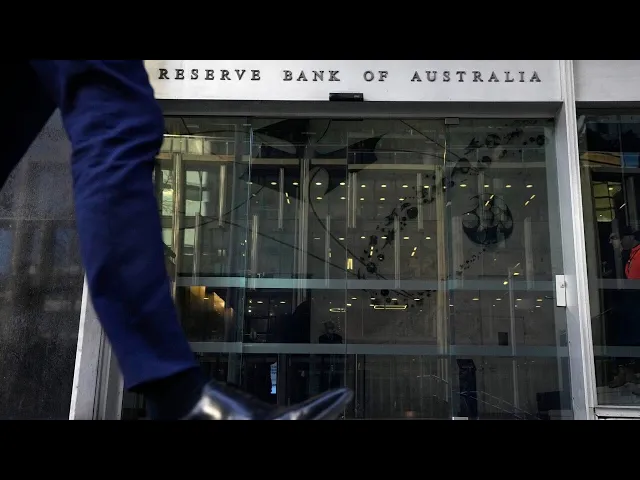
well as I told you as we go to where the government is guillotining multiple bills through the houses of Parliament to ensure the last day of the sitting year brings through as much legislation as it physically can among those bills a $22 billion Future made in Australia policy and as important changes to the reserve banks Charter that will see a separate board created to decide on interest rates now Keem Watcher of The Reserve Bank is the Commonwealth Banks head of Australian economics Gareth Ed who joins me now uh Gareth the governor of The Reserve Bank
actually Happ to be speaking at the Ceda annual dinner tonight so we just might get a little bit of something out of out of the governor perhaps yeah look as coincidence that she was down to uh to speak tonight and then this bill's actually gone through today um you would imagine that if it's not covered explicitly in the governor's speech she will be asked in the question and answer to aine on the changes that are coming in terms of the new The Establishment or the creation of a Monet from your point of view this has
been stuck in Parliament does it actually matter terribly much as to whether there's one or two BO of The Reserve Bank it comes down to who's actually on the board itself if the monetary policy board is just made up of the current board members then we're not really thinking anything's going to be too different next year other than the fact that um we'll get published unattributed votes after each meeting and is that a good thing do you think that's healthy I think so um it'll give us a sense of how close or not the board
is on any particular meeting to potentially moving rates if they don't move rates because if we see that you know there's division within the board over what they think should be the appropriate policy move then we would get a sense of how close or not the board might be to moving but if for example the the UNP unattributed votes came in 90 then we know the boards you're in complete agreement over the current stance of monetary policy okay the other thing that happens tomorrow is the latest economic growth figures for the previous quarter come out
now you're suggesting at the moment 4% growth for the quarter 1.1% for the year as we've been hearing this is anemic growth the the average growth is around about 3% over the very long run for Australia so Australia's not growing terribly much does that have any influence on where the reserve Reserve what the Reserve Bank does next well the the the national accounts which are coming out on Wednesday of next week are going to give us an update on Q3 GDP and the RBA is expecting a set of figures which shows that the economy went
backwards again in terms of output on a per capita basis and we've been that way now for the past eight n months that is a natural response to having monetary policy at a restrictive but that's very hard for politicians of course because even though we're not in an official recession as you point out these numbers out next Wednesday I should have been corrected myself what what happens there is that that is the mood that is the feeling of the population and whether the Reserve Bank should be responding to that rather than responding to the actual
economic data around employment and also around inflation yeah look that's right and and what what's uh been the case over the last 6 to n months in particular is that the private economy hasn't hasn't grown at all in fact the only growth that we've had in the economy has come through on the on the public side I mean the message really from the GDP data has been the overall economy is growing but it's not keeping up with growth in population so the share of the P that each individual is getting effectively has been contracting now
we don't think that's going to be the case as we move through 2025 if rates start to come down and E economic growth starts to pick up but that's the place that we've been in now for the best part of the last 18 months or so and it has felt like a a squeeze for the average household so there's a squeeze on the average household and what the Reserve Bank seems to be waiting for is either a core inflation to come down we saw monthly inflation where core inflation has gone up now whether that's real
when the quarterly data comes out another matter but then if you really sort of bring this all back together again you actually go and say that the um that the important not accelerating inflation rate of unemployment so this is called NAU which they look at you're saying that the Reserve Bank is got this set too high now if that's the case then arguably they there is an argument for them to start cutting interest rates sooner rather than later rather than trying to wait for the unemployment rate to go out to 4 and a half% maybe
if they've got that number wrong they should actually have a case for going much earlier yeah look it it could be the case here that that non inflation adjusted rate of unemployment the Naru is actually lower than the rba's implied profile suggests which is that an unemployment rate of around 42% which is almost half a percentage point above where it is currently is about the level of unemployment that generates inflation consistent with the inflation Target now we think that unemployment rate is closer to 4% that will give you inflation within the target so this is
the sense of where is Full Employment isn't it that's really what we're talking about here exactly right the reason we don't quite know where it is is pre pandemic the unemployment rate was around 5% and that was too high because wages growth was too low and we had inflation below the target we came out of the pandemic the economy boomed unemployment went all the way down to 32% that was too low because at one point wages growth was running above 4% that's clearly not consistent with the inflation Target but as the unemployment ratees been trending
up what we've seen is that wages growth has been coming down if you look at the last three quarterly prints on the wage price index they've come in a 8% growth on the quarter so we're running now at an annualized wages pace of about 3 and a/ qu% now that's about where you want it if you've got an inflation Target of 2 to 3% and that's occurring with an unemployment rate of around 4% so I think it makes a pretty strong case that that level of unemployment that we can run in the economy is probably
around where it is now not much higher I tell you it's a fascinating thing and we'll come back and do this again because all of these things are interlined including the way the Reserve Bank sets interest rates Gare there always good to chat to you your time