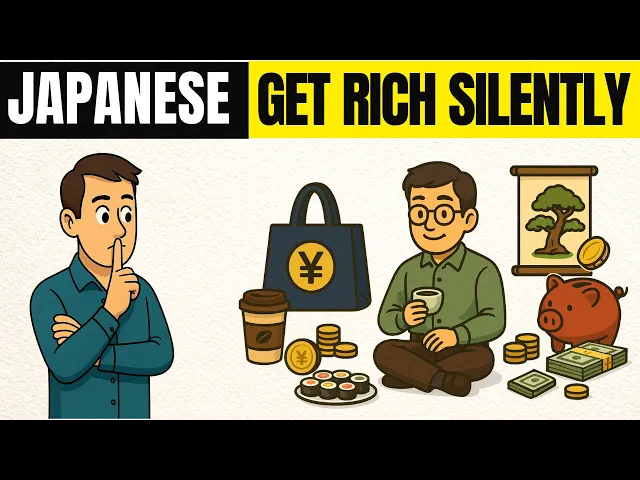
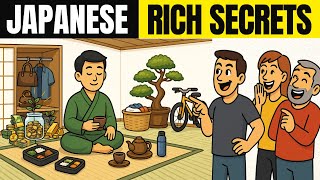
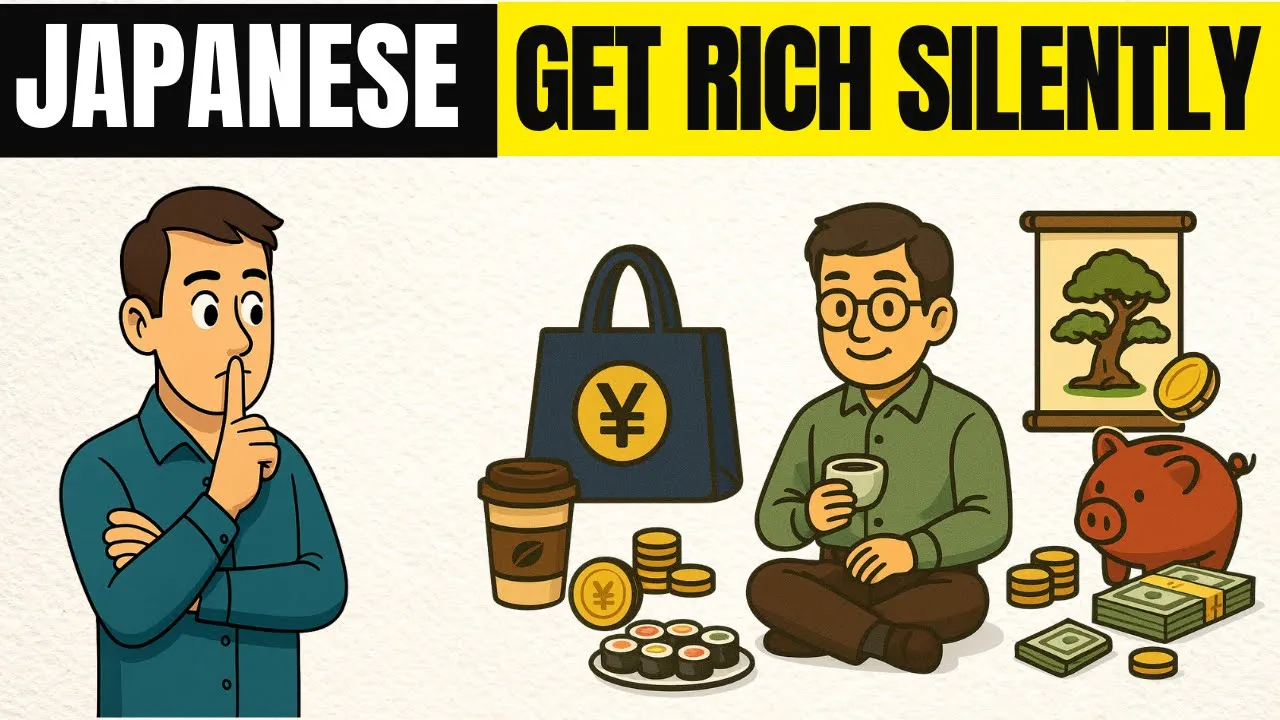
You know what's wild? Japan has more millionaires per capita than almost any country on Earth. But you'd never know it.
No Lambos, no flexing, no Instagram posts showing off wealth, just quiet, [music] invisible wealth building for generations. Meanwhile, Americans are constantly stressed about money, [music] working harder, making a decent income, but somehow always broke paycheck to paycheck despite doing everything right. Here's the difference.
Japanese culture hides wealth and builds silently. Western culture shows wealth and stays [music] broke. Same planet, completely different approaches, wildly different results.
And here's what blows my mind. These aren't secrets. They're simple daily habits anyone can start today.
No luck required, no stress involved, just nine practices that help Japan rebuild from literal ashes into an economic [music] powerhouse. Stick around because I'm breaking down all nine habits and the last one, it completely changed how I think about money. If you're tired of the loud broke lifestyle, hit subscribe and comment quiet wealth.
If you're ready to start small changes today, drop [music] kaizen. Now, let me show you the first habit that changed my entire relationship with money. Number one, kakeo, the mindful money journal.
All right, first habit. It's called CABO, [music] and it's been around since 1904. Basically, it's a household financial ledger where you write down every single expense by hand.
Yeah, I know what you're thinking. There's an app for that. But here's the thing.
[music] There's something about writing it down that hits different. Most Americans have no idea where their money goes. Seriously, ask someone where their paycheck went and you'll get, "I don't know.
It just [music] disappeared. Subscriptions. They forgot about impulse purchases that seemed small.
Door Dash orders that add up to more than their rent. The money vanishes into a black hole. Cakeo forces you to face reality.
You write every purchase in four categories. Survival stuff like rent and groceries. Optional stuff like that streaming service you haven't used in 6 months.
Culture stuff like books and experiences. and extra stuff, which is basically why did I buy this? Studies show people who write down their expenses spend 15 to 20% less automatically, not because they're restricting themselves, [music] because they're aware.
There's an ancient saying, the palest ink is better than the best memory. When you write it, you see it. When you see it, you can't unsee it.
And that's when you [music] change it. This isn't about feeling guilty or depriving yourself. It's about consciousness.
You're not becoming a penny pincher. You're becoming aware of unconscious spending. That's a massive difference.
[music] Kakibbo asks four simple questions. How much money do I have? How much do I want to save?
[music] How much am I spending? And here's the big one. How can I improve?
Not how can I be perfect? [music] How can I improve? That's the whole game.
Here's what you do tonight. Buy a small notebook. Not fancy.
just a notebook. Don't use an app. [music] The act of physically writing matters.
For the next 30 days, write down every single purchase. [music] Everything. The coffee, the parking, the random Amazon order at 2:00 a.
m. Categorize it into those four buckets. Review it weekly.
Here's a story that'll hit home. A woman I know started CABO after years of where did my money go? First month, she discovered 400 bucks going to subscriptions.
She completely forgot about another 300 on impulse coffee and lunches. 200 on apps and [music] digital purchases. She didn't even remember downloading.
She didn't cancel everything immediately. She just became [music] aware. 6 months later, $4,000 saved without feeling deprived.
A year later, $10,000 emergency fund. [music] Same income, different awareness. Awareness is the first step to wealth.
You can't fix what you can't see. Write it down. See the truth and change the pattern naturally.
But that's just tracking spending. [music] What I'm about to say is what makes the real difference because seeing where money goes is step one. [music] Step two is about stopping the leak.
Most people don't even notice. Number two, Modi, the art of no waste. So, let's talk about waste.
Americans waste 30 to 40% of the food they buy. Let that sink in. You're working hard for money.
buying groceries and then throwing nearly half of it in the trash. That's not a food problem. That's a wealth problem.
Then there are clothes. Wear something once or twice, donate it or throw it away. Something breaks, it's cheap, I'll just buy new.
[music] This disposable everything mentality is a wealth leak nobody talks about. But the Japanese, [music] they have a word for it, motini. There's no perfect English translation, but it basically means regret over waste and respect for resources.
[music] It's not just environmental, it's deeply financial. Every grain of rice matters. Every item has inherent worth.
Wasting something [music] is disrespecting both the resource and your money. This comes from Buddhist philosophy. Everything has value.
When you waste something, you're not just throwing away an item. You're throwing away the money you worked for, the resources that created it, [music] and the potential use it still had. Nobel Prize winner Wongari Mathi actually popularized this term globally, [music] calling it the spirit of Minai.
Here's the math people don't do. $5 meal you didn't eat, that's $5 burned. $50 shirt worn once, $50 wasted.
Add up your monthly waste. Food, clothes, items replaced that could have been repaired. Most people, [music] hundreds of dollars monthly, literally in the trash.
The Japanese approach is simple. Buy [music] quality, use completely. One good item used a 100 times beats 10 cheap items used once each.
Maintenance over replacement. Creativity and repurposing. It's not about being cheap.
It's about respecting what you have. Here's [music] what you do this week. Before buying anything, ask, "Will I use this completely?
" Before throwing anything away, ask, [music] "Can this be repaired, repurposed, or donated? " For a food meal plan, use leftovers and [music] actually eat what you buy. For clothes, wear what you own at least 30 times before buying new.
[music] For items, repair first, replace last. Now, calculate your monthly waste. Food you threw away, purchases sitting unused in your closet with tags still on.
items you replace that could have been fixed. That number, that's your wealth leak. [music] Plug it.
Guy I know cleaned out his garage and found $2,000 worth of tools he [music] bought and never used. The closet had $3,000 in clothes with tags still attached. Kitchen gadgets unopened.
Total waste. Over $8,000 in purchased items were never used. He started Motioni practice only buy after a 30-day waiting period.
use it completely before buying more. A year later, he saved 6,000 just from not buying things he'd waste. Previous waste became future wealth.
Wealth isn't just what you earn. It's what you keep and use fully. Waste [music] is theft from your future self.
Respect resources. Build wealth naturally. Wait, there's something you need to pay attention to because avoiding waste saves money.
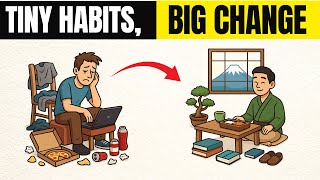
But this next habit, it actually creates money through tiny daily actions you won't even notice. Number [music] three, Kaizen, small daily improvements. Here's where Americans get it completely wrong.
We want overnight success, the dramatic transformation. I'm going to completely change my life starting Monday, and then Monday comes, we try to do everything at once, burn out by Wednesday, and we're back to the same habits by Friday. Sound familiar?
The Japanese have a different approach. It's called Kaizen, [music] continuous small improvement. This isn't some trendy self-help concept.
This is the philosophy that made Toyota the world's most valuable [music] car company. This is how postw World War II Japan rebuilt an entire economy from literal rubble. Not with massive dramatic [music] changes, with tiny improvements daily forever.
[music] Here's the math that'll blow your mind. If you get 1% better every single day, you're not just 1% better at the [music] end of the year, you're 37 times better. Compound improvement.
But here's the flip side. If you get 1% worse daily, [music] you're nearly at zero by year's end. Small changes aren't small, they're everything.
[music] James Clear popularized this in atomic habits, but he straight up borrowed it from Japanese Kaizen [music] philosophy. The guy didn't invent anything. He just translated ancient wisdom for Americans who think we need to reinvent the wheel.
Applied to money, this is ridiculously simple. Save five bucks more today than yesterday. Cut one unnecessary subscription this week.
[music] Increase your income by a tiny amount monthly. Automate one financial task. That's it.
Not dramatic, not overwhelming, not temporary, just sustainable, tiny improvements. Here's your Kaizen money practice. Week one, save $10 automatically.
Not 100, not 50, 10. Week two, make it 15. Week three, 20.
Increase $5 weekly until it becomes completely normal. Start so small you literally cannot fail. One tiny habit example, make coffee at home instead of buying it.
Five bucks daily times [music] 365 days equals $1,825 yearly. Invest that at 8% for 20 years. You've got $91,000.
One tiny change equals 6 figures. Tell me small changes don't matter. The woman I know couldn't save enough, so she saved nothing.
Zero. Started Kaizen with $1 daily. Week one, she had $7 saved.
That's nothing, she thought. [music] But she kept going. Month one, 30 bucks.
Month six, she built up to $10 daily. [music] Year 1,2500 saved. Year two, increased to 15 daily.
5 years later, $35,000 emergency fund started with a single dollar. Kaizen compounded it into financial security. Tiny changes sustained beat massive changes abandoned every single time.
Progress isn't [music] perfection. Better beats perfect. Start small, stay consistent, watch it compound.
But that's just the mechanics of improvement. [music] Here's what drives those improvements. Because without purpose behind the actions, nothing sticks.
Number [music] four, eeky guy. Purpose-driven work. Let's talk about why Americans are broke despite working 40 plus hours weekly.
Most people work jobs they absolutely hate just for the paycheck. No fulfillment, high stress, [music] counting down to Friday, starting Monday morning, then spending all weekend dreading Monday. That's not living.
That's slow death with a 401k. [music] And here's the kicker. When you hate your work, you spend money to cope.
Retail therapy, expensive vacations to escape, stress eating, going out constantly because home reminds you that tomorrow is Monday. The golden handcuffs get tighter. [music] You can't leave because your lifestyle requires the income.
You're trapped. The Japanese have this concept called eeky, your reason for being. It's the intersection of four things.
What you love, what you're good at, what the world needs, and what you can be paid for. When all four overlap, that's your eeky guy. That's why you get up in the morning.
In Okinawa, one of the world's blue zones where people live past 100 regularly, they don't even have a word for retirement. You don't retire from your eeky guy. You do it until you die happily.
And here's what's crazy. Studies show people with purpose spend way less on coping mechanisms. [music] When you love Monday, you don't need retail therapy to survive it.
[music] Let me paint two pictures. Wrong path. High-paying job.
You hate you earn well. You hate Monday through Friday. [music] You spend money to cope with the stress.
You never have enough to quit because your lifestyle matches your income. You're trapped in a well-paid prison. Right path aligned work.
[music] Maybe you earn less initially, but you love the work. You don't need to cope spend because there's nothing to cope with. Lower stress means less stress spending.
You build wealth from satisfaction, not consumption. Here's how you find your eeky guy. What do you love doing?
[music] What are you naturally good at? What does the world actually need and what can pay you? The overlap is your answer.
Start a side hustle in that area. Build it while keeping your day job. Transition when you're ready.
Guy I know made 80,000 in corporate. Hated every second. Retail therapy every weekend.
500 plus monthly. Vacations to escape 5 grand yearly. Stress eating another 300 monthly.
Total coping costs over 11,000 yearly. Bound is eeky guy teaching part-time. Made 45,000 first year.
Coping spending dropped to nearly zero. [music] Lived happier on way less. Year three making 60,000 doing what he loved.
Saving 15,000 yearly. previous life made 80,000 saved [music] nothing miserable daily purpose reduces spending when you love Monday you don't need to medicate the pain with [music] purchases fulfillment is cheaper than coping do you see anything unusual the answer is right here because purpose-driven work reduces stress and spending but Japanese philosophy goes even deeper into finding beauty in what you already have number five wabishabi embracing imperfection Here's what social media has done to us. We scroll through perfectly curated lives, perfect houses, perfect cars, perfect everything.
And then we look at our own lives and think, "Not good enough. " So what do we do? We spend endless renovations upgrading cars that run perfectly fine, replacing furniture that's still functional, chasing this Instagram worthy perfection that doesn't even exist in real life.
The Japanese have a completely opposite philosophy. It's called wabishabi. Finding beauty and imperfection.
Aged wood has character. Cracked pottery tells a story. Simple, imperfect, [music] incomplete.
That's where real beauty lives. It comes from Zen Buddhism and traditional tea ceremonies where a simple, slightly imperfect bowl is considered more valuable than an ornate, perfect one. Applied to your stuff, game changer.
You don't need a perfect house. You don't need the newest car. You don't need a flawless wardrobe.
What do you have? It's enough. That scratch on your table isn't a flaw.
It's character. That older car isn't an embarrassment. It's a reliable friend with history.
That simple house isn't inadequate. It's enough. Let me show you the contrast.
The American mindset says your house must be perfect, so you're constantly renovating. While Bisabi says your house has character, no renovation needed. [music] American culture says your car must be new and flawless, so you're always upgrading.
[music] Wabishabi says, "Your older car has charm. Keep driving it. " See the difference?
One bleeds money constantly. The other builds wealth naturally. Here's what you [music] do.
Look at what you already have through a wobbishabi lens. That scratch on the table, it's from your kid's homework. That's a memory, [music] not a defect.
That faded paint, it shows your house is lived in and loved. that older car, it's proven reliable. That's valuable.
Stop upgrading [music] things that don't need upgrading. And honestly, cancel Pinterest, HGTV, and Instagram if [music] they make you feel like what you have isn't enough. Comparison is the thief of contentment, and contentment is literally the foundation of wealth.
A couple I know spent 30,000 on a kitchen renovation because theirs was outdated. Finished it. Looked at their neighbors new kitchen.
Felt outdated again. Spent another 15,000 on updates. Still not satisfied.
Total burned. $45,000. Then they discovered Wabishabi.
[music] Our kitchen works perfectly. The wear shows it's lived in. The imperfection is character.
Stopped renovating completely. That 45 grand invested it would be 120,000 20 years. They chose acceptance over perfection.
built wealth instead of chasing impossible standards. Perfection is expensive. Contentment is wealth.
The pursuit of flawless is the enemy of financial freedom. What you have is enough. Find the beauty there.
Stop spending there. But accepting enough [music] stops the bleeding. What's behind it is what will startle people because there's a Japanese health habit that accidentally builds wealth while making you healthier.
Number six, Harahachi Buu. The 80% rule. All right, let's talk about American portion sizes.
They're absolutely ridiculous. We eat until we're stuffed, uncomfortable, unbuttoning our pants at the table. We consume everything in front of us because I paid for it.
[music] Meanwhile, we're spending a fortune on food, feeling terrible, and creating health problems [music] that cost even more money. It's expensive in multiple ways. The people of Okinawa, who happen to be the longest lived people on Earth, have this practice called harahachi buu.
[music] It means eat until 80% full. You stop before you're completely stuffed, just comfortably satisfied, not still hungry, not uncomfortably full, just enough. Science backs [music] this up.
Eating 80% naturally reduces your food costs by 20%. Better health means lower medical bills down the road. Less consumption means less spending and living longer.
You compound wealth for more years. It's a financial win across the [music] board. But here's where it gets really interesting.
You can apply this 80% rule to everything, not just food. You don't need 100% of your wants satisfied. 80% satisfaction equals 100% enough.
And that 20% gap between what you want and what you actually need, that's where wealth lives. Financial Harachi Buu looks like this. Don't spend your entire paycheck.
Leave 20% untouched. Live on 80, save 20. It creates automatic wealth building without feeling deprived.
[music] You're still satisfying most wants. You're just not chasing that last 20% that costs the most and delivers the least. Here's your action plan.
Practice the 80% rule everywhere. Eat smaller portions. Boom.
You just save 20% on food costs. Spend a maximum of 80% of your income. By 80% of what you think you need, you'll realize the other 20% was just wants disguised as needs.
Stop at 80% satisfied and fight the urge to hit 100. That 20% gap compounds [music] fast. Food budget of 500 monthly becomes 400.
Save 1,200 yearly. [music] income of 50,000 live on 40,000 save 10,000 yearly [music] resist 20% of your purchases save thousands more yearly add it up man I know I ate out until completely stuffed every meal felt terrible spent 800 monthly started harachibu stopped at 80% full ordered less food better physically restaurant bill dropped to 500 monthly [music] saved 3600 yearly just from eating less. Plus, he lost $30.
Medical costs dropped by 2,000 annually. Total savings $5,600 plus better health, plus more energy got him a promotion. One habit created multiple compounding benefits.
[music] Enough is enough. The last 20% costs the most and delivers the least. [music] Stop at 80 and everything.
That gap is where wealth, health, and happiness actually live. It sounds simple, but the hardest part is what's about to be told next. Because consuming less creates wealth.
But what about maintaining what you already have? That's the next level most people never reach. Number seven, common endurance and selfdiscipline.
Let's be real about American culture for a second. [music] We want everything right now. Instant gratification is our default setting.
Treat yourself has become a legitimate financial [music] strategy. Can't delay pleasure even 5 minutes. Buy now, pay later is everywhere.
Amazon deliver same day. We have zero tolerance for any discomfort whatsoever. The Japanese have this concept called it means enduring difficulty with patience and dignity.
Not suffering, persevering. It's the ability to sit with discomfort without immediately medicating it with a purchase. And this trait, it's literally the difference between wealth and poverty.
Here's what's crazy. After World War II, Japan was destroyed. Entire cities leveled, economy obliterated.
You know how they rebuilt? Pure gammon. The entire nation practiced collective delayed gratification, saved aggressively, built slowly, persevered through discomfort, and became an economic superpower.
Remember the Stanford marshmallow experiment? Kids who could wait 15 minutes for two marshmallows instead of eating one immediately. Those kids became more successful adults.
More wealth, better health, happier lives. One single trait predicted everything. The ability to wait.
[music] That's gammon. Applied to money, it's simple but powerful. Want something?
Wait 30 days. Feeling uncomfortable financially? Sit with it.
Don't fix it with spending. [music] Have a desire to buy? Practice common.
Let it pass. Most desires fade completely if you don't act on them immediately. This is the exact opposite of Amazon's one-click buying, which is designed to eliminate Gmen entirely.
[music] Here's the move. Add stuff to your cart instead of buying. Let it sit there.
Review your cart once a month. Delete 90% of it. Boom.
Gin just saved you thousands without feeling restricted. Your action step is straightforward. [music] Implement the 30-day rule starting today.
Before any non-essential purchase, wait 30 days. Add it to a wish list. Sit with the desire without acting.
90% of those desires will completely disappear. [music] The 10% that remain, those are actually important. Buy them.
Then [music] the gin muscle strengthens over time. The first week is difficult. The first month [music] gets easier.
The first year becomes completely natural. And you just saved thousands by simply waiting. [music] A woman I know saw something she needed, bought it immediately, and repeated the cycle daily.
debt grew to $15,000. Discovered Gmen and started [music] the 30-day rule. First month, she wanted 20 different things.
Waited. 30 days later, still wanted [music] two things. Completely forgot about 18 of them.
Bought those two. Saved [music] money on 18 impulse purchases. Kept practicing for a year.
Debt gone, savings growing, same income, different discipline. Gman transformed her entire financial life. [music] The ability to wait is the foundation of wealth.
Instant gratification is expensive. Delayed gratification compounds. Discomfort is temporary.
Debt is permanent. Practice gin. Build fortune naturally.
Don't jump to conclusions because what comes next can change your perspective completely. Discipline saves money. But what happens when things actually break?
The Japanese have a beautiful answer that turns breakage into art. Number eight. Kinsukaroy.
repair with gold. Americans throw stuff away like it's our job. Something breaks, eh, it's broken, buy a [music] new one.
We're on this replacement treadmill that never stops. Disposable culture isn't just wasteful, it's bleeding you [music] dry financially. But nobody talks about it because buying new is so normalized.
The Japanese have this art form called kinsukuroy, also known as kinsugi. When pottery breaks, instead of throwing it away, they repair [music] it with gold. With actual gold lacquer, the repaired piece becomes more beautiful and more valuable than the original.
The philosophy, breakage and repair are part of the object's history, not the end of its usefulness. This applies way beyond pottery. Repair your clothes instead of replacing them.
Fix appliances instead of buying new. Maintain your car instead of upgrading. Restoration over replacement.
It's not just philosophical, it's massively economical. Here's what kills me. The average American replaces things that still [music] function perfectly.
Out of style doesn't mean broken. New model available doesn't mean your old one is dead. [music] Marketing has convinced us to replace ourselves constantly.
Japanese culture says use it until it's truly done. Massive [music] financial difference. Let me break down real costs.
Repair jeans 15 bucks. New jeans 60. You just saved $45.
Repair an appliance, maybe a 100. New appliance, 600. [music] Savings, 500.
Maintain your car properly, 2,000 over 5 years. Buy a new car, $40,000. Savings: $38,000.
The math is screaming at you. Here's what you do. Something breaks, Google how to repair plus the item.
Try DIY first. YouTube University has a course on everything. [music] If it's beyond your skill level, get a repair quote before buying new.
Usually repair costs 20 to 40% of replacement. [music] Choose repaired 90% of the time. No, we calculate your annual replacement spending.
How much did you spend on stuff that could have been repaired? That's leaked wealth. Plug that leak.
Build wealth instead. Man's laptop died. $200 for repair or $1,200 new one?
He [music] thought, "It's old anyway. Might as well upgrade. " Bought new.
6 months later, I needed a $300 repair on the new one anyway. Realized he could have repaired the old one twice for the cost of the new. Started practicing kinsukuroy.
Repaired shoes 40 versus 120 new. Fixed the dryer 100 versus 800 [music] new. Patched his jacket 20 versus 200 new.
Year of repairs, $400 spent. It would have been 2,000 in replacements. Saved 1,600.
Same stuff. Better wallet, less waste. Repair celebrates history.
Replacement chases perfection. History is cheaper and more beautiful. [music] The broken thing repaired has more character than the perfect thing replaced.
Wait. The most important part is in the following story. Because all these habits work together, but there's one final principle that ties everything together and makes [music] it all sustainable.
Number nine, Shogunai, acceptance of what cannot be changed. All right, final habit. And honestly, this might be the most important one because it ties everything else together.
[music] It's called shogunai. It means it cannot be helped. And before you think that sounds defeist, hear me out.
It's the opposite. [music] It's not giving up. It's strategic acceptance.
Americans stress about everything they can't control. The economy, inflation, [music] other people's success, where we started financially, past mistakes. We carry [music] this weight constantly.
And you know what we do with that stress? We spend money trying to feel better. Retail therapy, stress shopping, keeping up with people who don't even care about us.
It's exhausting and expensive. [music] And here's the vicious cycle. We stress about things beyond our control.
Spend money to cope with the stress which creates more financial stress which makes us spend more. Round and round until we're broke and miserable. [music] The Japanese approach is completely different.
Accept what you cannot change. Say shogunai. It cannot [music] be helped.
And release it. Then pour all your energy into what you can actually control. Your habits, your choices, your discipline today.
That's where power lives. Here's what you can't control. Where you started financially, your past mistakes, other people's advantages, their inheritance, the economy, inflation rates, market conditions, your parents' wealth or lack of it.
Shogunai, it cannot be helped. Stop wasting energy there. Here's what you can control.
Today's spending, today's savings, today's habits, today's choices, today's [music] discipline. Whether you practice KBO tonight, whether you stop wasting tomorrow, whether you implement Kaizen this week, that's your power. Stop comparing yourself to others.
Their income shogunai, their inheritance, shogunai, their head start shogunai. Your discipline controllable. Your habits controllable.
Your future completely controllable. Here's your practice. [music] Make two lists right now.
First list, everything you can't control about your financial situation. past mistakes, others advantages, economic conditions. Write it all down.
Then say Shogunai and release every single item. Second [music] list, everything you can control. Your daily spending, your savings rate, your habits, your choices.
Pour all your energy there. A woman stressed constantly about not being where others were financially. Spent all her energy comparing, feeling behind, stress shopping to cope.
600 monthly on stress purchases. started practicing shogunai. I can't change my past.
I can't control others I can control today. [music] Stopped comparing completely. Stopped stress shopping.
Focused only on daily habits she could [music] control. That $600 monthly is redirected to savings. Year 1 7200 saved.
[music] Year three, $25,000 in the bank. Same income, different focus. Shogunai freed her from the comparison trap.
Money followed naturally. Accept what you cannot change. [music] Control what you can.
All wealth is built in that controllable space. Comparison [snorts] is theft. Stress spending is expensive.
Peace with your path is free. [music] Choose Shogunai. Build wealth quietly.
Look, here's everything in one breath. Nine Japanese habits that build quiet wealth. Kako makes you aware of every dollar.
Motina eliminates waste you didn't even notice. Kaizen compounds tiny improvements daily. Ikiguai reduces stress spending through purpose.
Wabishabi brings contentment with what you have. Harahhachi Buu creates that critical 20% gap. Gman builds the discipline to wait.
Kinsukaroy celebrates repair over replacement. Shogunai focuses energy where it matters. No luck needed.
No stress required. Just ancient wisdom applied to modern life. This week, [music] pick one habit.
Just one. Start ridiculously small. Cakeo, buy a notebook [music] tonight.
Modernai, audit your waste this weekend. Kaizen, save $1 today. Don't try all nine at once.
That's the American way and it fails. [music] Master one, add another next month. Comment on which habit you're starting.
Type the number one through nine. Already doing if you practice these [music] quiet wealth. If this is your new path, hit subscribe if this changed how you see money.
[music] Tell me what video you need next. Deeper cockibbo breakdown. practicing gammon in Amazon culture or kinsukuroy for beginners.
[music] Japan built wealth from literal ashes using these habits. You don't need a catastrophe to start. [music] You just need one choice today.
Choose awareness over ignorance, discipline over impulse, contentment over comparison. Quiet wealth isn't loud or flashy. It's patient, [music] disciplined, invisible until one day it's completely undeniable.