hi guys welcome back so let's use the notion of nash equilibrium the best responding and and find the nash equilibrium of these three simple games well they are simple partly because we can represent these games as a matrix form and so finding nash equilibrium is uh probably the easiest later we are going to look at games where the players have infinitely many strategies in this case finding nash equilibrium is going to be a little bit more involved all right but let's go step by step so let's first understand how we find the nash equilibrium in
these simple games so the first game i'm gonna look at the battle of the sexes game so they're two players and each player has two actions so how do we find the nash equilibrium remember nash equilibrium is a strategy profile where each player best responds uh his or her opponent you can make the analysis in two different ways one you can just select a strategy profile for example here there are well by the way for this specific example i'm going to look at only pure strategies so you can select strategy profiles in this game there
are four of them b b b o o b and then o o right and then check if each player is best responding his opponent or not okay alternatively you can just do it on the uh metrics uh which is to be honest much easier and and probably a time saver so but let me do both at least for this example so here given that i have four strategy profiles which one of those are nash equilibrium meaning which one of those are regret free once they learn that bb is the outcome is any of the
players will regret out of this choice well player one is going to say look you played b and i played b all right and so i got two if i had picked o instead i would i would have got zero so you know what given that you played b uh thank god i played b because uh otherwise i would get zero so you know what as player one i'm not going to regret my choice symmetrically player two once he learns that he's her opponent selected b she's gonna say well by selecting b i actually got
payoff one otherwise if i if i uh you know uh played if i had played oh i would get uh i would have got zero so therefore uh thanks god i did not play o and so i don't regret my choice so everybody is basically best responding his opponent all right so therefore this is a nash equilibrium well clearly once you look at this game clearly player two would like to get this two rather than one right but once again the nash equilibrium is asking whether you regret the finalized outcome or not or whether you
best responded your uh your opponent's strategy or not don't forget that okay so once again knowing the limitations of nash equilibrium is very important well what about bo however well bo is not nash equilibrium why is that well once i learned that we played bo as player one remember we played i played b you played o uh so i got zero is this the best i could do well actually if i had selected o instead i would get one so i'm not best responding you see what i mean so therefore my choice of b given
that you selected o is actually cause me some regret i should have played o because that maximizes my payoff so therefore player 1 is not best responding player 2 and hence this is not nash equilibrium what about player 2 does he best respawns you don't really have to look at it as long as one player is not best responding that means this strategy profile is not nash equilibrium because remember the definition of nash equilibrium it says every player best responses his or her opponent with symmetric arguments ob is also not nash not nash equilibrium and
oo which basically ends up one and two outcome is a nash equilibrium okay so this is how we basically uh do it alternatively what we can do uh just on the uh metrics you can find the best response of each player so let's suppose player two plays b alright so if she plays b what is the best response the best action for player one it's clearly b because b is bringing two payoff o is bringing zero payoff so i'm going to underline two because i just wanted to say b is the best response to b
all right this is why i underlined two now what if instead she plays oh opera well in that case what i know is that oprah is the best response to oprah because if if he plays b he's gonna get 0 not 1. so therefore i'm going to underline one just to indicate that oprah is the best response to oprah okay you got the idea now what i'm going to get uh what i'm going to do i'm going to do exactly the same thing for player one so let's suppose player one played b what is the
best response for player uh two well boxing is gonna bring her one payoff oprah is gonna bring her zero payoff so obviously boxing is the best response because one is higher than zero so i underline one again just to indicate that boxing is a best response to boxing symmetrically what if the first player is selected oh the opera well in that case the boxing is going to bring zero payoff the opera is going to bring two payoffs so clearly opera is the best response so i underlined two just to indicate that opera is the best
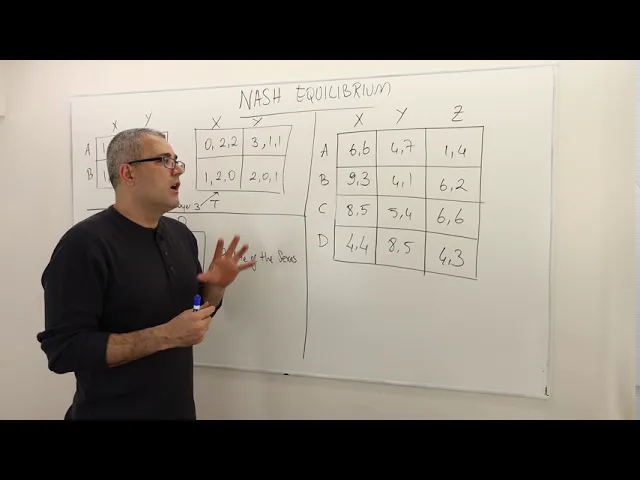
response to opera so whenever i have underlined two of those numbers that means player one best responded player two and player two best responded player one so that's the definition of nash equilibrium so this outcome and this outcome these are nash equilibrium outcomes and hence bb and the 0 are the nash equilibrium strategy profiles and these are the corresponding outcomes okay so let's jump to well the second game is slightly more complicated because uh player one has four x strategies player two has three strategies but i'm gonna use the second approach so i'm going to
underline the numbers just to indicate uh what the best response of each player is so here if the second guy by the way it really doesn't matter whether you start from the second guy or from the first guy the analysis will not be different the outcome of the analysis will not be different so if the second guy selects x what is the best response for player 1 is it a is it b is it c or d well obviously b because nine is higher than all the other numbers okay so i underline nine just to
indicate b is the best response to x however if the second guy selects or plays y what is the best response for first player is it d c b or a clearly d because 8 is higher than the other numbers so i underline 8 just to indicate d is the best response to y and then finally if player two plays z the best response is d or c or b or a well six is higher than everything else so i underlined the six uh indicate that c is the best response to z but what about
this six right i mean this six is also higher than everything else except this one but they're equal so does that mean that b is also best response exactly so b is also best response to z so i underline both those sixes because both b and c are best response to z alright so i'm done with finding best response of the first player now i'm gonna find the best response of the second player so what if player 1 plays a what is the best response for player 2 is it x is it y is it
z well clearly y so on underline seven however if the first guy selects b well the best response is it x is it y is it z clearly x so therefore i underline 3. by the way i found one nash equilibrium outcome b x the nash equilibrium strategy profile is a nash equilibrium there might be others let's see remember in this game for example there are two nash equilibrium all right so here what if player 1 plays c is it the best response is it x is it y is it z clearly z so you
know what i got another nash equilibrium which is c z is also a nash equilibrium with a different outcome six six and then finally if player one plays d what is the best response is it x is it why is it z well it's y clearly so you know what i found a third nash equilibrium which is d y is also in nash equilibrium all right so that's it these are the only three nash equilibrium in pure strategies later we're going to talk about mixed strategies but forget about them for a moment so these are
the only nash equilibrium in pure strategies of this game and this is exactly how we find uh the nash equilibrium by the way just to make a remark most of the times the first time learners students when they make this best response analysis on the metrics the confusion they have is like you know the first numbers always belong to the first player the second numbers always belong to the second player sometimes students mix them up and so unfortunately they end up the wrong nash equilibrium so this is a serious mistake the second problem sometimes students
for example says what if player a1 plays a but instead of comparing the second numbers the student compares the first number all right but don't forget the first numbers do not belong to the second player and in fact you should be comparing the second player's payoffs so therefore again this is a serious mistake so these are sort of two common mistakes when finding nash equilibrium be careful all right and then the third and the final example that i have let me clean up some space because we already talked about those well this time i don't
have two players but i have three players i nevertheless can represent it in a matrix form so player one is the role player selecting a or b um this is also a or b sorry and player two is the column player selecting x or y and then player three is the matrix player he's she is selecting w or t all right okay so how do we find the nash equilibrium all right so now it's even more important to understand what payoff refers to what player the first payoff refers to first player the role player the
second payoff refers to column player and then the third payoff corresponds to the matrix player so therefore when i compare this one so how should i should i compare this one with three um never because player one's choice is never between x and y all right so therefore his choice is between a and b so therefore if i compare one i'm gonna compare this one with this one all right however for player two if i compare this one i need to compare it with this zero because his choice is between x and y not between
a and b so i can't compare one with two or one with this two all right because he's not selecting between this matrix versus this metrics and five sorry finally when i compare this one for the third player i can't say this i can't compare this one with zero because once again player three is not choosing between x and y i can't compare this one with this zero because again player three is not choosing between a and b well then what number should i be comparing this one with well it is this two that you
should be comparing it's not this zero or one or one but it has to be this two where player one is still playing a player two is still playing x only player three is selecting whether w and get one or t and get two all right so that's very very critical guys all right so now i'm going to do let's suppose the best responding player two is playing x what is the best response for player 1 is it 1 or i'm sorry is it a or is it b well both of them are giving the
payoff 1 so that means both of them are in fact best response very good what if player 1 i'm sorry player 2 plays y it is the best response a or b well clearly 3 is higher than 0 so a is the best response so i underline a 3 just to underline that a is the best response to y alright well what if player 3 has played t instead of w so we're in this matrix and player 2 selected x again what is going to be the best response for player 1 is it a or
b so this decision is different than this decision obviously because the payoffs are different well clearly it's the the best response is b because one is higher than zero so i'm going to underline this one and then finally for player two if he plays y what is the best response for player one is it a or is it b well clearly a because three is higher than two so i underlined three all right i'm done with player two now i'm gonna best response for player one so let's suppose player one has selected a all right
and player three selected w okay well in that case what is the best response for player 2 is it x or is it y well clearly x so therefore i underline this one well good what if player 3 selected w but player 1 selected b instead of a what would be the best response for player 2 is it x or is it y well clearly x because 2 is higher so i underline this number finally not finally but once player 3 instead plays t and player 1 plays a what is the best response for player
2 is it x or is it y well it's x so therefore i underline two and once player 1 plays b and player 3 plays t what is the best response for player two is it x or y well clearly x because it brings higher payoff so i underline two just to indicate that x is the best response to b and t all right now what i'm gonna do well let's suppose player one and two selected ax all right so okay so ax here ax here what is the best response for player three is it
one i'm sorry is it w or is it t well it's clearly t because two is giving higher payoff so for that reason i underline this number very good well now i'm done with ax i'm going to do this bx all right so bx here bx here what is the best response for the third player is it uh is it w or is it t well both of them are gonna bring him zero payoff so that means both of those actions are strategies i'm sorry are actually best response so i'm going to underline both of
those just to indicate both w and t are best response uh by the way i found my first and second well i mean at least two nash equilibria here let's discuss this later maybe we have more i don't think so but so what if player one plays a and the second plays y a y so the best response for player three is it w or is it y well it's y and finally b y so the best response is it the is it w or is it t well they both are gonna bring the third
player path of one so both of them are best response so here one nash equilibrium is payoff is this guy and the other nash equilibrium payoff is this guy so there are two nash equilibrium strategy profile one of them is b x w and the other one is b x t the order is important be careful the first player strategy the second player strategy and the third player strategy with the corresponding payoffs one two zero and one two zero exactly the same payoffs very well is there any other nash equilibrium no for example this is
not a nash equilibrium why not well look here uh if this is the outcome the the second and the third player will say okay i actually did my best but the first guy he's going to say shut i should have played something else why is that so well because this strategy profile is what a x t right so given that the second player and the third player is playing x and t what is the best response for player one is it a and get zero or is it b and get one clearly it's b so
zero i mean is is going to cause regret he should i mean the player 1 is going to say i should have played b rather than a so this is not regret free outcome in that sense and therefore this is not nash equilibrium so it's important that in a nash equilibrium strategy profile every player is best responding meaning if if i'm selecting if i'm sort of searching for nash equilibrium all the numbers uh should be underlined all right if one of them is not underlined that means that player wasn't best responding and hence that strategy
profile cannot be nash equilibrium all right okay very good so this is the i mean these three examples are basically uh i mean normally gives the idea of what nash equilibrium is and next we are going to talk about some more complicated examples more complicated because we cannot draw the metrics form and so visualizing what's best response or what's not is slightly harder but they're very important part of understanding the concept of nash equilibrium so it's coming up next