Hey everyone. Thank you so much for joining me. And welcome to my classroom and my whiteboard.
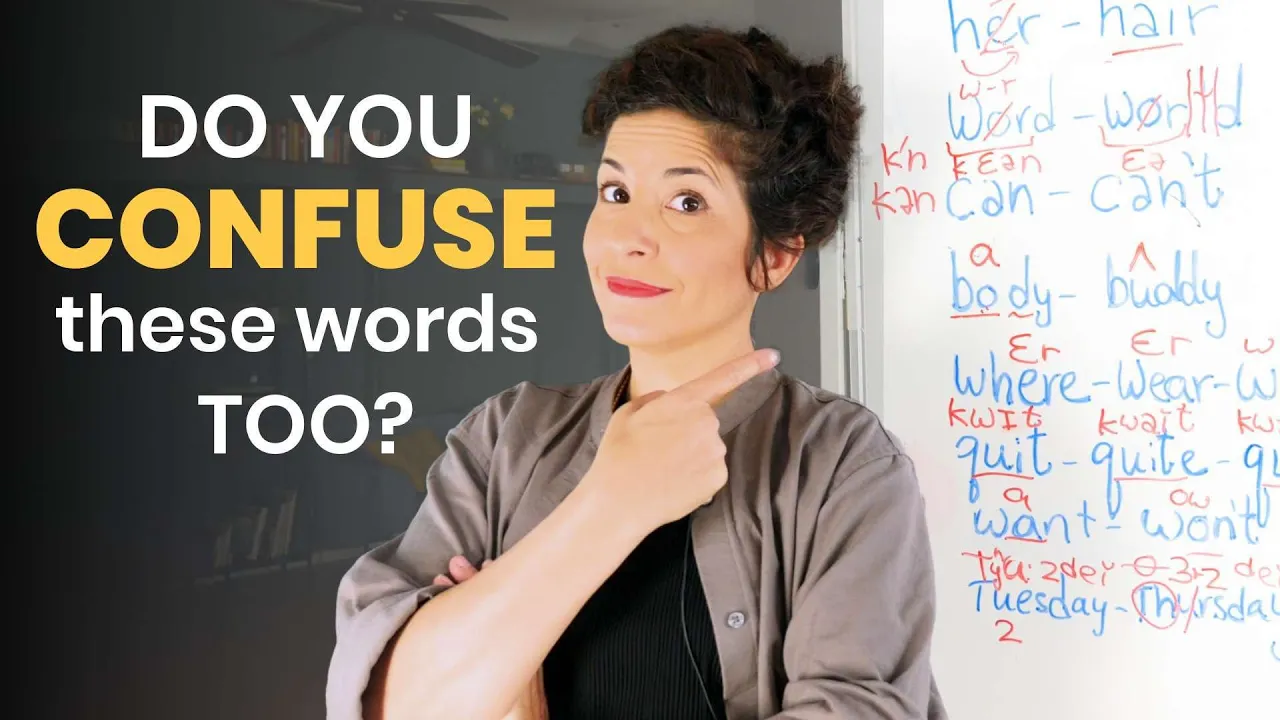
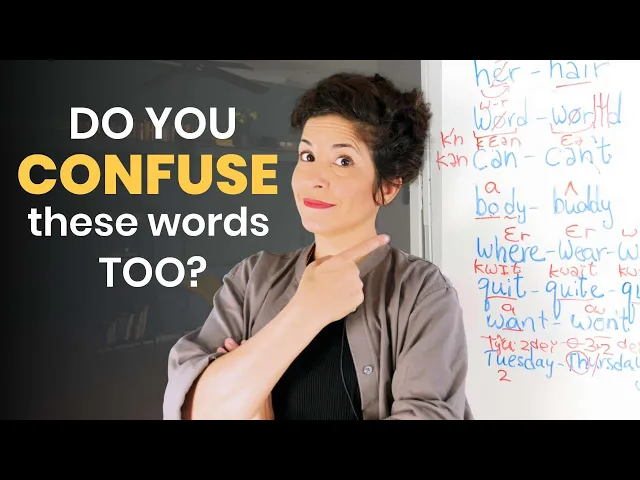
I love my whiteboard. As you can see on the board, we are going to talk about confusing pairs. And I actually asked my students what were the most confusing pairs that they struggle with, and they gave me a long list of different pairs.
So I selected the most common ones and what I believe to be the most confusing ones. And here they are on my whiteboard. Now, of course, there are more confusing pairs in the world, and specifically in English, but we're gonna start with these.
By the way, if you are new to my channel, then hello, my name is Hadar. I'm a non-native speaker of English. I'm a pronunciation and fluency coach.
And I'm here to help you speak English with clarity, confidence, and freedom. If you want more resources to help you master your English, then check out hadarshemesh. com or subscribe to my channel.
All right, let's begin with the first pair. The first one is 'her' versus 'hair'. Now, first of all, let's talk about the distinction between the two.
'her' has a stir sound, 'hɜr'. So you actually don't hear the vowel letter here. You transition from the H to the R directly - 'hɜr'.
And this is 'hair'. Hair. Here, you can hear the 'ɛ' sound.
It's an R diphthong where you pronounce a full 'ɛ', and then you transition to the R - 'hɛr'. Now, the reason why it's confusing is first of all, this is more challenging where you actually eliminate the vowel - 'hɜr'. But also because of the spelling: you have the letter E there.
So you would assume, especially people who come from languages where the spelling is phonetic – what you see is what you hear, in English that's not the case. And this is why you expect to hear an 'ɛ' sound, but there isn't. 'her' versus 'hair'.
The next one is 'word' versus 'world'. The good news is that the beginning is exactly the same word, and here's where it gets interesting. The O is not pronounced: 'w-r'.
So just like here, H to the R - 'hɜr', here we wanna transition from the W to the R directly: wɜr. 'wɜrd'. Say it with me: 'wɜrd'.
So, from the W, you round your lips - 'w', and then you transition to the R - 'wɜr', there is no O in the middle - 'wɜr'. So the word 'word' has that W-R transition and then a D - 'w-rd'. Here, you also have a dark L - an L that is produced in the back of a throat, there is a lot of tension.
Here at the root of the tongue 'w-rl' and then a 'd' - 'w-rld'. The reason why it's confusing is because a lot of times people don't get to the L and then they pronounce the word 'world' as 'word' so the L is not fully pronounced. You wanna imagine as if there are three Ls here - 'w-rlll' and then pop the D - 'w-rllld'.
Let's compare: word - world. Take your time with the L until you're certain that you're pronouncing it, and then get to the D: word - world. Good.
Let's move on to the next one. Here we have the words 'can' versus 'can't'. 'can' versus 'can't'.
Now, this pair is challenging on so many different levels, but I'm gonna explain the difference between the two, so pay close attention. This word is a 'k' sound, then the 'æ' as in 'cat', and then 'n': k-æ-n. But when the 'æ' as in 'cat', which is an open front vowel sound, appears before an N, what happens is that this changes a little bit to an 'ɛ' sound and then something like a schwa - 'kɛən'.
So you hear a transition from the K to the N through an 'ɛ' sound - 'kɛən'. However, this word is often reduced. When it's unstressed in a sentence, it's not pronounced 'kæn' as in, "Yes, we can" - in this case, it's stressed.
Usually, it's pronounced as 'kɛən': I can do it. I can go there. I can think about it.
I can: 'kən'. So actually, what you hear is a very short, small sound between the K sound and the N - 'kən'. So this is how you pronounce this word, the positive 'can': 'kæn' or 'kən', stressed and unstressed.
This word is never reduced. So even if it's unstressed in a sentence, it's always going to have the pure vowel in it. And here we have again the 'æ' as in 'cat' that because of the N actually changes to 'kɛən', 'kɛənt'.
Now I really pop the T here and that is perfectly fine- 'kɛənt'. So if you wanna be clear, just pop the T at the end - 'kɛənt'. But you might struggle with hearing the difference because sometimes native speakers might not pop the T.
The T after an N at the end of a word is usually a held T. And especially after an N, it almost feels like you are just stopping the N abruptly. Listen: can't, can't.
'can', the stressed form, 'can'. 'can't'. It just, it's just a little more nasal, and the N stops abruptly.
And that is the representation, the phonetic representation of the T at the end. Again: can - can't, can - can't. But if you're just starting out and if you don't have a lot of experience with pronunciation work in English, please, please, please just pop the T at the end - can'T.
A lot of native speakers pronounce it like that with a pop T, it is perfectly fine and you'll feel a lot more clear. Okay? But when you're hearing people, expect to hear that nasal sound - 'can't' - when you hear the negative form.
Also, when you hear the pure vowel, it is more likely that it's the negative form rather than the positive form, because this is usually reduced. "I can do it" - "I can't do it". "I can do it" - "I can't do it".
Okay? Now, of course, if you feel more comfortable, it is perfectly fine to say "I cannot", "I cannot do it", okay, if you wanna be clear. "I can't do it".
"I can't do it" - with that nasal stop. And "I cannot do it". It's all good as long as you express your thoughts clearly in what you can or cannot do.
All right. The next one is 'body' versus 'buddy'. Okay?
Sometimes it's okay to confuse it, sometimes it's not okay to confuse it, depends on the context. So, 'body' has the 'ɑ' as in 'father' sound - 'bɑdy'. So you need to drop your jaw - 'bɑ', and take your time, this is the primary stress - 'bɑdy'.
Now, you may hear this, but the D is like a flap D, so it sounds more like a 'ɾ' sound - 'bɑɾy'. Now, it's okay to say 'bɑDy' with a strong D, but if you're, again, more experienced and more advanced in your practice, you can also think of the D and make it like really light, like a light tap 'bɑɾy'. Some of you may also wanna think about it as a flapped R sound - 'bɑɾy', 'bɑɾy', okay?
So even though there is an O here, it's not 'bo', it's 'ɑ' - 'bɑɾy', 'bɑɾy'. Okay. "The body of work".
Or, "You have a strong body". Body. This is 'buddy', 'buddy'.
'ʌ', 'ʌ' - this is a 'cup' sound. A 'cup' sound, also known as the stressed schwa. This is the schwa that we talked about.
But a 'cup' is always stressed. The jaw is a bit more open, the tongue is a little higher for the 'cup' - 'bʌ', 'bʌddy'. 'body' - 'ɑ', the mouth is open.
'buddy'. body - buddy. body - buddy.
body - buddy. Now you. Very good.
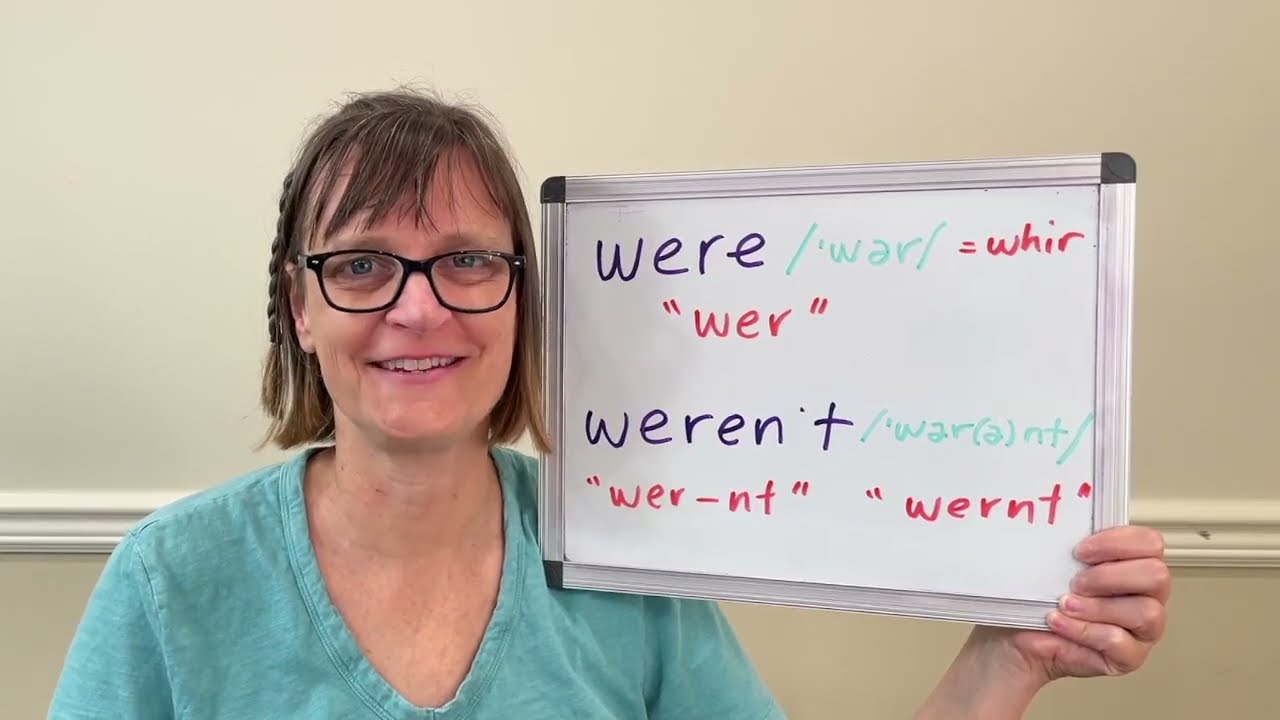
Okay. Let's move on to 'where', 'wear', and 'were'. 'where', 'wear', 'were'.
These are homophones, so they're pronounced the same. I deliberately put both of them here together so that it clarifies all confusion, but here we have the 'ɛr' diphthong, just like we have here: hair - where. hair - where - wear.
"What are you going to wear? " And "Where are you? " wear - where - hair.
And this is not 'wɛr', even though we have the letter E here, it's reduced just like in this word - 'her'. So here we're gonna transition from the W to the R - 'w-r'. That's it.
'wɜr'. If it helps you, you can think about it as if you have a 'u' sound here: 'wur'. where.
where - were. So transition from the W to the R - 'wɜr'. where - wear - were.
Does this sound familiar? 'wɜr' - word. 'wɜr' - world.
Can you hear the similarities? This word 'were' is inside the word 'word', you just add a D at the end. And you just add an LD at the end - world.
Okay? It's all patterns. Okay.
This triplet is often confusing because it really looks the same, except for the E, obviously, right? And this is what makes it confusing. Now these three words have completely different meaning.
So this is 'quit'. Quit. "I'm going to quit my job".
Quit. So we have a 'k' sound, a 'w' sound, an 'ɪ' - 'kwɪ', and then a 't' - 'kwɪt'. Now, I pronounced it as a held T, so it's an abrupt stop of air: quit, quit.
Now, of course you can pop the T, it's all good: quiT, quiT. Whether you pop it or you hold it, both are fine, we're focusing on the vowel here. Quit.
This is 'quite'. "That is quite interesting, my friend". Quite.
The beginning is the same - 'kw', but instead of 'ɪ', you have 'aɪ' as in 'my'. 'kwaɪ'. 'kwaɪt' - and then again a T: 'kwaɪt' or 'kwaɪT'.
quit - quite, quit - quite. Good. And lastly, we have 'quiet'.
The beginning is the same. You gotta be quiet to hear the difference between those words. 'kwaɪ', just like here, 'kwaɪ'.
But here it's 'kwaɪt', and here it's 'kwaɪ' and then there's another syllable here - 'ət'. That's a schwa sound. [It's not very clear].
That's a schwa sound, and then a T - a held or a regular T, two syllables. One syllable, one syllable, two syllables. So we need to hear that distinction.
Now, here is something interesting that happens. When you transition between the 'kwaɪ' and the 'ət', right, when you transition from here to here, what happens is that you hear an intrusive sound. The transition of the tongue from the 'aɪ', the front vowel, to the neutral vowel, the schwa, gets the tongue to pronounce a 'y' sound.
It's called an intrusive sound. So, thinking about this 'y' sound as in 'yes' might help you pronounce it better. So actually I'm gonna write it like this: 'kwaɪ-yət', 'kwaɪ-yət'.
Quiet. Quiet. "You have to be quiet".
Or, "Don't be quiet about it". Quiet. Do you hear the held T?
But you can pop it: quieT. Quiet. Quit.
All right. Here we have 'want' versus 'won't'. want - won't.
And yes, I am popping the T, I have a lot of words with Ts here. 'want' has the 'ɑ' as in 'father' sound. 'wɑnt'.
If you keep it very closed - [want], [want], what will happen is it's going to sound very similar, so be mindful of it. 'wɑnt'. If you don't wanna pop the T, this is how it's going to sound: 'wɑn'.
This is 'won't', 'won't' - will not. won't. Or 'won't', long 'oʊ' as in 'go'.
So this is what we're focusing on right now. want - won't, want - won't, want - won't, want - won't. Very good.
Lastly, we have Tuesday versus Thursday. Tuesday. Tuesday or T(y)uesday, I'm gonna pronounce both options.
This is a strong T sound, and actually it's an aspirated T, so it feels like it has a little bit of air there: t(h)u, t(h)u. And then you have a tense 'u' sound. Let's delete this for now.
'tuz' with a 'z'. 'tuz'. Some people might even pronounce it as a 'ch' sound - 'chuz', it's up to you: 'chuzday' or 'tuzday', with a tense 'u'.
You can also add a 'y' sound - 'tyu', perfectly fine. However you wanna pronounce it, you do you. 'tuz', make sure it's a 'z', and then 'dei' - 'tuzdei'.
Here, we don't pronounce the 'u' sound, there is no 'u' sound. Here there is an 'u' sound - 'tu', like the number two. Here, it's 'thɜr': we have a 'th' sound, voiceless 'th', this is the phonetic symbol.
And then it's a 'stir' sound, so we transition from the 'th' to the R - 'thɜr', just like in 'her' or in 'were'. 'thɜr' - a 'th' to the 'r'. 'thɜr'.
And then a 'z' sound - 'thɜrz', I'm gonna write the R here cuz it's an R-colored vowel, it's a 'stir' sound, 'thɜr'. 'thɜrz-dei'. Tuesday - Thursday.
All right, let's have a quick review. her - hair. Now you.
word - world. can - can't. Or can - can'T.
body - buddy. where - wear - were. Let's do it again: where - wear - were.
And now: quit, quite, quiet. quit - quite - quiet. want - won't, want - won't.
Tuesday - Thursday. Tuesday - Thursday. All right, my friends.
That's it for today. Let me know in the comments which one of those pairs is the most confusing one for you. And also if you have any additional pairs that you struggle with, write them in the comments below as well so I can make another video answering or explaining those pairs just like I did today.
All right. Thank you so much for joining me today in my classroom. And that's it, I hope it's easier.
If you like this video, hit like, and subscribe. And you can also sign up for my email list to get my weekly lessons to your inbox every single week. Just go to hadarshemesh.
com and sign up. That's it. Have a beautiful, beautiful rest of the day, and I'll see you next week in the next video.
![Recipe vs. Receipt? 🤔 [how to pronounce] | American English](https://img.youtube.com/vi/7CvggmnAjoM/maxresdefault.jpg)
![How to Pronounce the Light L /l/ and Dark L [ɫ] in English](https://img.youtube.com/vi/46_JQbfEtjM/maxresdefault.jpg)
![Similar English Vowels? Here’s How To NOT Get Confused! [Minimal Pairs Guide]](https://img.youtube.com/vi/2-p40nbLHik/maxresdefault.jpg)