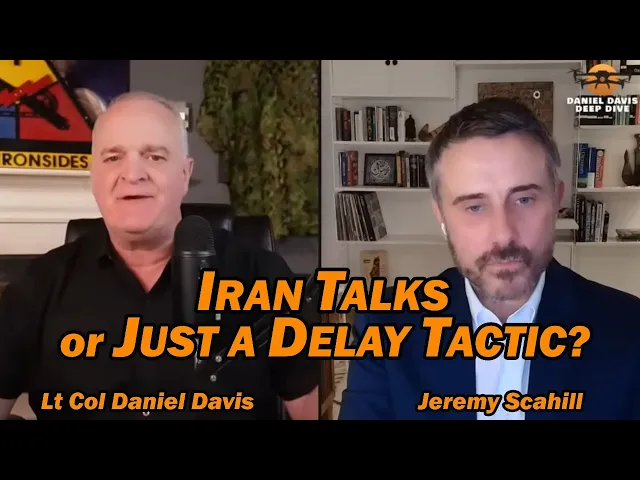
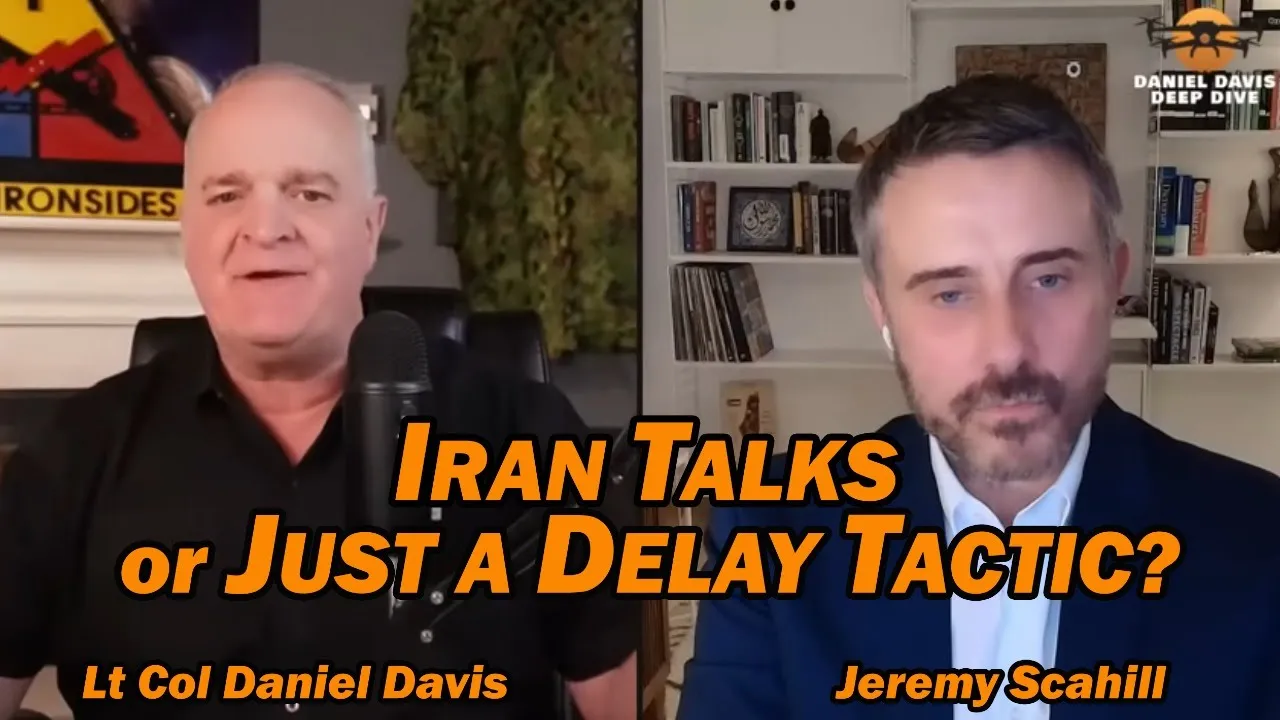
President Trump deactivates his ultimatum. He was going to bring the hammer down at about 7:45 p.m. Eastern time in the US today. He this morning said, "No, actually, we're not going to do that." Is that evidence that there's a potential diplomatic breakthrough? Is it just a delaying tactic to build up more combat power to try and strike Car Island, for example, or is President Trump just in a box and he can't figure out how to get out of it, so he decided to just buy himself more time? All of these things we're going to discuss
today and we couldn't have anybody better to discuss it today than with Jeremy Scill uh who is a journalist at Dropside News and as it turns out just before we came on the air you have some breaking news on this very topic. Can you tell us what you have learned about where the Iranians are saying about Trump's change? Yeah, I mean, you know, to put it really short and to use Trump's uh own favorite term, they're saying it's fake news. Um, Daniel, what I' what I've heard from speaking to senior Iranian officials is that over
the past two weeks, the United States has reached out uh repeatedly, Steve Witoff has been sending text messages to Iranian officials, including the foreign minister, asking the Iranians to engage in talks. And the Iranians, uh, I'm told, uh, debated how to even deal with this. And they they literally ghosted Steve Wickoff. They did not respond to him. When we reported that last week, the White House went nuts. They denounced uh Drop Site News accusing us of engaging in uh America last behavior. Uh said we were abhorrent and then they went and they spun a story
to Axios saying that it was actually the Iranians that had been begging President Trump to speak. And and so, you know, this this kind of played out over the the past few days. And what Iranian sources were telling me, Daniel, is that through a series of uh intermediary countries, including Turkey, Pakistan, Egypt, and also some Gulf countries, there have been a series of messages passed on to the Iranians by the United States, where according to Iranian officials, these third party intermediaries have said that the US wants to wrap up this war. Um, and that happens
while publicly Trump is saying, "We're going to bomb Iran's electrical and power infrastructure, which by the way would be a war crime, uh, if they did that in a in a sweeping manner." Iran then said, "Hey, let us tell you what we can do. We can hit not only in Israel, but we can hit in, uh, uh, all throughout the Gulf." And this this would cause just like catastrophic shock to the global economy, uh, which you know, which we we can talk about later. But the the most breaking stuff I have for you is that
Trump today uh posts on Truth Social that there's been this breakthrough that he's pausing his threat to uh to bomb the Iranian electrical grid and other energy infrastructure because there have been these talks going on between the United States and Iran. And Trump implies that he has some secret squirrel that he's talking to um in Iran and he doesn't want to name who it is um because he doesn't want that person to be killed. It's unclear does he mean by Israel or by or by the Iranians, you know, but um what I'm told is that
there have been no negotiations, direct negotiations with the United States. And that what the Iranian officials are telling me is that every time a third country comes to Iran and they say the United States wants to talk, Iran says, "Let us explain to you our conditions." And and in short, what the Iranians are saying is that they will not agree to the kind of ceasefire that took place last June after the so-called 12-day war because the Iranians view that as having been a gimmick to buy the United States and Israel time to rearm, to reposition,
and then come back in with this fullblown war that they launched on February 28th. So, they're saying they won't go for just a ceasefire that doesn't have conditions attached to it. They also want any uh cessation of the war not only to apply to Iran but to apply to two other fronts of battle as the Iranians see it. Iraq as well as Lebanon where the Israelis are increasingly engaged in ground operations, very heavy bombing. Hezbollah, which Israel had said was wiped out, has been launching dozens upon dozens of rockets every single day into Israel. So
they want those two uh countries also to be party to this ceasefire deal. They're also saying that they want um reparations paid by the United States and they want Israel to pay but they don't want Israel to pay directly. They want that to happen uh through the United States because they don't want to take anything directly from um Israel. But the the the other thing and this is you know I think very relevant. It's and and many people I know you've made this point before and I've heard other smart analysts make it that because of
the way the United States and Israel have lied about the negotiations have used it as a veneer or a cover to then wage these wars um the Iranian position has hardened and what Iran is saying now is that there will be no discussion on its ballistic missile program that if there is a ceasefire Iran is going to move rapidly to continue its ballistic missile program recognizing that it's its only deterrent uh against the United States and against Israel. They're also saying, and they wouldn't go into more detail on this, that they're going to that they're
in the process of developing a new doctrine on the nuclear question. They didn't say, "Oh, we're going to go and and we want to enrich uranium to make nuclear weapons." But what they're saying to me is that um that that because of uh the US and Israel targeting their nuclear infrastructure because they blew up the negotiations where the Iranians had put uh terms on the table that went beyond the Obama era deal. They're saying now that they're having discussions about developing a new nuclear doctrine potentially in partnership with Iran uh with Russia and China. Well,
that's not good news really for anyone. And that's uh actually this morning you probably saw these comments here. President Trump was actually asked that issue uh about the uranium because it's like okay you can reach these deals on opening the straight of hormuz but that still doesn't answer your primary issue of no nuclear weapons especially this 400 some odd kilograms of reprocessed material President Trump said you said you want to get the enriched uranium how are you going to get the enriched uranium are it's very easy if we have a deal with them we're going
down and we'll take it ourselves so it's very easy does that match with what you've heard from the Iranian side today. No. And and actually, you know, there is some scuttlebutt that, you know, special operations forces uh US special operations forces have been pulling long days potentially uh sketching out some conops, some concepts of operations for potentially a raid into Iran to try to secure uh enriched uranium discs, which would be madness, especially I mean, if you you know, if you if itarkens back to to, you know, 1980 and and Desert One when the US
tried to send helicopters and to free the American hostages in the embassy there. I mean, the idea of a US special operations raid into Iran is just madness to contemplate, but there is some scuttlebutt that that's at least being talked about. Um, the the reality though, Daniel, is that the Iranians did put on the table uh terms that would have solved this issue and Trump could have declared a major victory if he had just gone in good faith through those negotiations. Um, but you know, right now what we're looking at is, and this is what
the Iranians are perceiving it as, that in some of the messaging from the United States, it sounds like Trump wants the Iranians to essentially go back to what they were agreeing to in those negotiations in February as a way for Trump to desperately cling to an off-ramp and claim victory. You know, the public has a short attention span and most people are sort of caught in this whirlwind of lies that are being told by the White House. But the reality is that that one possible way that that this ends from the perspective of the White
House is that they claim that their war got Iran to agree to some terms on on the enriched uranium when in reality the Iranians were already very far along that path with actual negotiations without the need to drop any bombs or subject any American troops to death or injury. not to mention to subject uh approximately 2,000 Iranians so far to death by American and Israeli bombs. So, you know, I I I think what's happened is that the Iranians are very very intent on sending a message that the costs of attempting to do this again or
create a dynamic where you can bomb Iran every few months um is not going to be acceptable. And the question now is Yeah, go ahead. Yeah, that that's going to at least the automatic question that comes to my mind is is how can how can you square this circle I I guess with Trump this morning and I'll show you just a second ago where he was saying you know basically they've come to me uh and and how we're going to square the public statements and then what could come out of it. Let let me give
you an example. Here's here's what he said on why uh he has delayed his ultimatum. I think this is something that's going to happen and why wouldn't it happen? So tomorrow morning sometime their time, we were expected to blow up their largest electric generating plants that cost over $10 billion to build. It's a very good one. There was no der of money and one shot it's gone. It collapses. Why would they want that? So they called. I didn't call. They called. They want to make a deal. And we are very willing to make a deal.
It's got to be a good deal. And it's got to be no more wars, no more nuclear weapons. They're not going to have nuclear weapons anymore. They're agreeing to that. Any of that stuff, there's no deal. See, I mean, so he almost precludes to have the kind of a deal you just talked about there because he's listed conditions that according to what your sources are telling you, they're not going to agree to. How do we get those two things reconciled? Well, let let's also remember that um you know Trump has repeatedly been shown to be
lying throughout this and unfortunately as an American I have to say unfortunately the reality is that Iran has been much more transparent about what it intends to do than Trump. Um, and you know what I would say is that when Trump said we're going to potentially target Iran's energy infrastructure, the IRGC and senior Iranian officials all said, "Okay, if you do that, then we are going to strike the energy infrastructure in Israel and we're going to strike the energy infrastructure all throughout the Persian Gulf." those Gulf countries uh already are feeling like they've been totally
abandoned by Trump that they're paying a very heavy price for uh hosting these American bases and standing silently by. They don't ever criticize the US and Israel war. They just, you know, refer to Iranian aggression. And they're watching, you know, their systems given to them by the United States get pummeled. and they're recognizing that if their oil uh and and energy infrastructure um gets pounded, um this is going to set them back generations, it's also going to have massive implications on a global scale. So, what I think is far more likely is that Trump was
hearing panic and anger from his buddies in the Persian Gulf. his advisers, particularly the military advisers, were painting a picture for him of what it will look like when the Iranians start launching ballistic missiles all throughout the Persian Gulf, targeting soft targets of uh energy infrastructure. And and so Trump kind of concocted this pyramid of lies about the Iranians begging him. I I think this is a case where people in the White House and the Pentagon said to Trump and and the Gulf countries, if you do that, the Iranians actually do have the capacity. No
matter what Pete Hegsath says every day when he goes in those briefings, no matter what Trump says about every day, it's like 90% degraded, 90% degraded. and Iran carried out in Deona and elsewhere in Israel some of its heaviest, most devastating strikes of the war when we've been hearing that the war secretary saying every day how they're basically in the last throws of their missile program. Well, and actually what I wanted to add, this is something from Dropside News uh here. I I pulled it off early this morning. Uh you reported something that the IRGC
said, "You struck our hospitals. We did not do the same. You struck our emergency centers. We did not do the same. You struck our schools. We did not do the same. But if you strike our electricity, we will strike electricity. We are determined to respond to any threat at the same level necessary to establish deterrence and we will do so. So the question is, and you kind of alluded to this any already, but what is as far as your understanding from some of your maybe White House contacts, the implication that well maybe they didn't do
those things because they can't because Pete Hexith said that their diminished capacity is 90%. Who who should we believe here? Yeah, I I'm I'm not a fan of just believing the pronouncements of of officials. And part part of the reason why, Daniel, I I decided to to really try to speak regularly to Iranian officials is that I think it's better for democracy if we have a full understanding of what is the position of the people we're told are our adversaries. And I think that's a tradition rooted in good, solid journalism. But I have to say
that in general, I think the Iranians have been pretty transparent. And when they've said that they are are going to respond in kind to these these types of attacks, we we see them doing it pretty swiftly. And so, you know, these these warnings issued by them, I don't think that they would be bluffing. Um I I think that the U that the American public has been led to believe a series of lies about the currently existing capacity of Iran. Iran also has underwater uh missiles that I believe are still intact that have that that US
forces have not been able to obliterate. I think Trump has a real problem in the straight of Hormuz. I think that the Iranians are probably telling the truth when they say that most of the munitions they've used thus far are earlier generation munitions from 2010 to 2014. Um I think they have um hypersonic missiles that they haven't even put into operational display yet. Um, and I think that Pentagon war planners are very well aware of this. I mean, you know that scene much better than than I do. But I would imagine that there are uh
war planners that are presenting briefings that are indicating Yes, it's true. We degraded a bunch of these missiles, but the Iranian launchers, we haven't been able to destroy them. Some of them are embedded in mountains. They have missile cities. They have an ability to clear rubble from inside of the sites to to put bulldozers out and clear rubble. I don't believe that we've been told the truth about this. So if that's true, and I think it is, then if you're a Pentagon war planner and you're look, you're listening to the political pronouncements or what Trump
wants, you know, says he wants to do, but you know that on an operational level, the Iranians have the ability to inflict the pain they claim. That gives pause. And I think then Trump Trump hears that he hears from the Gulf allies. But he's also hearing it's not only that it's lies. There's something to it. And I this may be hard to explain, but what I the sense I get from the Iranians is not that there isn't any messaging going on. What I think is happening is that the US is saying things to intermediaries and
those intermediaries then are speaking with the Iranians and the Iranians according to what they've told me keep reiterating the same points. So let's imagine a scenario where the foreign minister of Turkey or Pakistan or Egypt is speaking to the Iranians and he says to the Iranians, are you going to target energy infrastructure in the region? And the Iranians say we'll only do that if struck as we've said repeatedly. And then that foreign minister goes back to Witoff or Kushner or Trump or whoever and he says, "Look, the Iranians are saying they won't touch any infrastructure
if we don't do it." And then Trump says, "Oh, here's opportunity." So um none of this is going to happen. You you know what I'm you understand what I'm saying that I think that part of it is that the Iranians just keep saying the same thing and Trump is so desperate to kind of latch on to this idea that the Iranians are begging that he's taking anything that third countries are saying and those third countries may be adding their own optimism or spin on it because they may want this to end. So what Trump is
getting because there aren't direct talks is is filtered through the lens of either Pakistan or Egypt or the Gulf countries all of whom have uh or Turkey all of whom have their own agendas. So but I would I would say that we have been repeatedly lied to about how this war is going how damaged Iran's military capacity is and and ultimately um you know this is all going to come out. it. In fact, it comes out every night when the Iranians announce another round of missile strikes and they're devastating. They're actually devastating strikes. I want
to go down a path here. You you you say about these intermediaries and third parties. Well, there are a few things uh that that we have gotten or that you have gotten from Dropside News. I wonder if you can get give us a little bit information here. This is something that drops has published on the speaker of the Iran's parliament and he is saying that our people demand the complete and humiliating punishment of the aggressors. All officials stand firmly behind their leaders and people. This is the goal achieved. No negotiations with America have taken place.
Uh and then you went on to uh do a little bit more detail of that where he says no negotiation with America have taken place. fake news is intended to manipulate financial and oil markets to escape the quagmire that the Americans are saying. That's what the leader of the Iranian parliament is saying. Can you give us any expansion on how much do you think that there's evidence to support that? That's what the people are demanding. Meaning there is no imminent agreement on Trump's terms that he mentioned a second ago. You know that there's a backstory
to why Galibah, the speaker of the parliament, posted this when he did. What happened is that uh you know Trump Trump puts out his his initial statement this morning and the markets react. Somebody made an enormous amount of money this morning on that. You know markets react to it in a very positive way and then the Iranian denials start coming out and then the markets swing in the opposite direction and then the White House and Trump start getting bombarded with questions about you know who are you actually talking to because the Iranians are saying that
this is totally false. Yeah. By the way, just as we're on a screen, you see the dramatic drop here when Trump makes his statement at 7:23 and then you see it start popping around here afterwards because the markets then are trying to figure out I mean everybody knows Trump really lies all the time. So the markets are then trying to figure out what's going on. The Iranians are saying something different, but there's some interesting intrigue behind the Galibah, the speaker of the parliament's tweet. So Trump then implies that he's speaking to some secret top Iranian
official and he won't say who. And then the preferred uh outlet for the White House and Israel for that matter to leak information in the American market is Axios, Barack Ravid. So then they start leaking a story, Israeli officials start leaking a story to Barack Ravid saying the person that the White House has been talking to directly in Iran is Galibbah, the the speaker of the parliament who is a hardliner. If you just I invite anybody just look at his Twitter feed or search his recent pronouncements. He is one of the most uh consistent rapidfire
responders to everything that the United States says in terms of publicly and laying out very clear threats of if the United States does this, we will do this. So they plant this story that it's him that they've been talking to. So he then posts that tweet that you just cited where he's saying there have been no negotiations and this is fake news. Now these stories continue to to percolate and you know there is there are rumors that uh that Pakistan has offered to host talks as early potentially as later this week in Islamabad and they're
talking about Galabah the speaker of the parliament and other Iranian officials coming and then Witoff Kushner and uh vice president JD Vance and some of the reports have said oh it's because the Iranians no longer want to deal with Wickoff and so Vance advance may come. Now, this could be a complete concoction. It could be a total invention or figment of someone's imagination or it could be that there's truth to it. So, when I went back to the Iranians and asked them about this Islamabad thing, what they said today is all of the intermediary countries
that are talking to us want to host talks in their home countries. Pakistan is no different. So, he wasn't exactly saying no, this is nonsense. He was just saying no details have been have been worked out yet. So, I don't know what is true in any of that. I spoke to another Iranian source today who knows the speaker of the parliament well. He said he doubts that he would uh he would do that. We have his public denial. Um I don't get the sense from Iranian officials that they are in a state of panic. Um
I think that they feel like Trump has painted himself into a corner. Um I think that they've calculated that their pain tolerance is higher. I think that they believe that Trump is under uh forces of nature uh in terms of a timeline to to get this thing wrapped up. Uh and the wild card here is that Netanyahu clearly wants to keep going. Netanyahu is is is saying, "Oh, we're going to have, you know, regime change." And another phase of this could be that they do try to initiate some kind of internal situation. But as far
as we understand, uh, even Iranians who were out in the streets protesting, um, are not down with what they've seen the United States and Israel doing. I'm sure there are some Iranians that want that regime to be brought down. They want, you know, an overthrow of the Iranian government. I don't doubt that. But I do think that the US and Israel have unified large segments of the Iranian population against them. And so, you know, Netanyahu is really pushing that. But to to put it short, I think the Iranians have assessed that Trump has painted himself
into a very tiny corner and he's desperate to find a path out. Well, I want to I want to uh touch on something. You've mentioned Axios a couple of times. I want to go down that path because they're not just has Trump painted himself into a corner, but he's also kind of bouncing around different corners of this small little box he's made. And it's really hard for anybody to figure this out. I want to show you a couple things. Uh first of all, here is in a in a matter of three straight days, 20th, 21st,
and 22nd. On the 20 20th, this is Friday, President Trump says, "Hey, we're very close to meeting our objectives and winding down the great military operation here uh with respect to the terrorist regime." And he goes on and lays a bunch of reasons why they completely destroyed their missile launchers, navy, and all that kind of stuff. Then the next day inexplicably 21st if Iran doesn't fully open without threat within 48 hours of this exact point you know America will hit and obliterate all their various stuff the next day on the 22nd then he says now
with Iran with the death of Iran past tense like that had already happened uh then he starts talking about some domestic issues there then all of a sudden uh you know this morning we have that issue with ch taking off the 48 hours but then in between that here's the part I wanted your opinion on we had this odd duck here uh in Axio and saying Trump's team game planning for potential peace talks with Iran and you get into that and there's this six-point plan and I was reading through those six points and I'm like
well that why would Iran agree to any of those now when they had agreed to most of them even before the 26th 27th of February. Uh then you get down to the third and you find out where there actually have been no negotiations direct between. What are we to make of what's being said on an Axios and then what's being said on the Iranian side? I mean the number the number of stories that have been planted in Axios that have to get either retracted or clarified like in real time is astonishing. Um you know Barack
Ravid at Axios he was the the one a couple weeks ago who said that an invasion had begun with Kurdishled forces. you know, uh, and and that was completely false. And, and I won't even get into the Gaza genocide and the negotiations with Hamas. I mean, they were just repeatedly, uh, Axios publishing stories that were official leaks that turned out to be completely false, total nonsense. They've also published things about Gulf countries bombing Iran over the course of the past three weeks that turned out to be um, completely false. and you know and there's this
there there's sort of a conveyor belt for you know there's Wikileaks and then there's official leaks. They're kind of the official conveyor belt for official leaks from you know this administration and some of it may be testing the waters or trying to see how you know how other parties react to it. Um but you I I think that there's one common sense factor here that that all of us I think really need to wrap our heads around in a clear way. If Iran was to agree to the kinds of terms that Trump is stating, there
wouldn't be an independent Iranian state anymore. It would be also a total betrayal from the perspective of the political echelons in Iran of a 47 what they view as a 47-year revolution against the United States and against Israeli hijgemony in the region. So for any Iranian official to negotiate on those terms and accept those terms would basically be to say we surrender this entire 47year revolutionary project. I I don't see that happening. I think the United States has dramatically um underestimated also the ideological and in some ways some clear ways religious commitment of people that
have built this project or or don't fully understand what the IRGC is as as an entity, what its origins were, what its ideology is. And so when we don't speak to the other side, when we don't try to understand their perspective, then you end up with situations like Trump is in right now where he doesn't know how to get out of it. And so I think that he's caught between two uh sort of dynamics. One is trying to lie his way in to to lucking out and getting something he tangibly can claim as a victory.
or he's going to go down this heinous war crime path where it's just we're going to start bombing their electrical grids. We're going to start just, you know, carpet bombing cities. I I I really think that it's these two sort of pulls right now that this guy is stuck between. Right. And that's scary. Here's the the real challenge to that. I mean, you mentioned the, you know, going down the war crimes path. I mean, we already see uh the USS Boxer, USS Tripoli. Uh I think the the Tripoli arrived today if I'm not mistaken. The
Boxer is another week, 10 days away, something like that. The 82nd Airborne Division has allegedly been mobilized. Uh but then you have the problem that also you have reported here on drop site that an Iran link hacking group has said that it published detailed maps accordance of Israel's water and electric infrastructure including layouts and transmission data for major energy sites and and on and on and lots of things in there that could be targeted if they want to. They by all accounts have the capacity to do this. So, if the president chooses the military path,
it's virtual certainty that that target list will be executed and it will cause incredible damage. And as I've laid out in much detail, the idea that you're going to accomplish anything with any ground troops is absurd and all you're going to do is increase the casualty count and increase the amount of loss for our side. So, the question is, where can he go? Where can President Trump go given what you know from the Iranian side, their capabilities, their statements, and our limited combat power? You know, I it's a great question and I won't pretend that
I know the answer, but I'll share with you some sort of vignettes from from conversations I've had. One one thing I I try to decipher when I talk to, you know, when I talk to people on the Iranian side is is there any wiggle room here? Like, yes, I know what they're saying. They're saying that they need to restore long-term deterrence and that the only way to do that is to show that the cost of trying to repeat this is so high. I get that. That's their official position. And I think they've conducted themselves in
that way. Um, and I think that's been clear. And I think that they have rejected US overtures or attempts to try to re, you know, o open talks. All of that is true. So in that sense, the Iranians have been clear and truthful about it. They are not taking an off-ramp themselves. At the same time, this can't go on forever. And certainly within Iran, there has to be a calculation about their own uh people, their own sustainability as a state and as a society. I don't think that they believe they've hit any kind of an
existential threat yet um in in this. And and if that remains true, then I think that they that their rhetoric about being able to continue this on for months remains solid. But I would also imagine that there are voices within the political elite of Iran that are having discussions about what is our acceptable endgame here. Um when they say we want all US bases removed from the Persian Gulf, that's one of the things they've put on the table. That's one of the things that they've told intermediaries. I would imagine that Iran knows that that's not
going to happen, you know, overnight. That the United States is not going to simply dismantle all of its military bases as part of a settlement with Iran. And yet the Iranians have put that on the table. But maybe a way of looking at that is what they're saying is they want GCC countries as part of an agreement to renegotiate their own relationships with the United States with all these bases that they have uh you know surrounding um Iran. So I guess what I'm saying is I don't hear any indication at present that the Iranians have
any flexibility in their negotiating position because they don't believe that the West uh and Trump in particular and the United States in particular really get it yet that they are not going to fold. Um and so I don't have optimistic news to offer you but I'm sure that there are those discussions. They have their own war planners. They have their own political thinkers. They have their own gaming out of scenarios. But I haven't heard one cintillaa of evidence that the Iranians are panicking right now. I Yes, they've taken huge losses. The supreme leader was killed.
Dr. Ali Larani was killed who would have been a figure that probably would have been one of the more flexible Iranians that could have helped bring this you know war to an end. I mean a real scholar on Kant and and um you know Arachi the foreign minister also a western educated guy with a PhD from the University of Kent. Um, you know, I'm sure the Israelis want to murder him. Um, but I don't get a sense that they're in that phase right now. I think the phase that they're in is they feel like they
have the United States in a very bad situation and they and they want to keep watching Trump fall on his own rate. And and let's look at a couple of other players in the region. I know your time's limited, so I'll kind of get a lightning round here, but let's look at from the Israeli perspective. After this news came out that President Trump was uh had postponed his his doomsday of this 48 hour deadline, the Israeli side, Benjamin Netanyahu in particular, still says, "We will not stop this until the Iranians know they're on the bottom
and we're on the top." So implying that I don't even care anything about what the president said. This is what we're going to do. How does how do how does President Trump reign that in if he wants to go to a negotiated settlement? You know, I I I I learned from, you know, from too many years of watching how the Israelis deal with the United States to believe that what we're seeing right now in public is the full story regarding what's happening between Trump and Netanyahu. I mean, look at how many times through the Gaza
genocide, through this thing, the stories go, "Oh, there's a diff the disagreement between, you know, Trump and Netanyahu. Oh, Trump Trump is pissed at Netanyahu. Netanyahu is upset with Trump. Oh, Israelis are the Israeli leaders were caught off guard by this. I tend to think that that remains largely nonsense. I do think the Israelis are probably nervous that Trump is going to cave and decide like he he just wants to take the offramp. But I guess what I'm saying is if you and I talk in two or three days, I think it might be clear
that they were in cahoots on something going on here. that there was some reason that they rolled this thing out the way that they did in in this manner. Um I I do think that Trump genuinely uh would accept a Deli Rodriguez type scenario if he thought he could pull it off like they got in uh in Venezuela. Uh I don't think they're going to get it from the Iranians. Trump might try to fabricate it and pretend that the Iranians are something that they're not in that regard. Um, but I think I, you know, look,
at the end of the day, who has really won here in a way is Netanyahu, uh, in terms of the US, uh, Israel relationship because Netanyahu got the war that he wanted. He, he's gotten a pummeling, you know, unleashed on the Iranian state. But I think that both the US and and Israel, massively underestimated how the Iranians were going to respond and the, you know, and the resilience. And I think we could see if this goes on the death toll in Israel go much much higher because I don't believe they have given the public and
honest assessment of of the missile capacity that Iran still has left. And you say the only winner has been yo that's definitely a pirick victory because they have we have com combined definitely launched off on something we don't have the military wherewithal to bring to a military conclusion on any kind of terms that we want. So now then we are in a real real world of hurt. Uh can I say one thing on that Daniel just what you know in in the bigger scheme I mean this is for a whole whole different story but I
I I think that we're going to look back years from now maybe even decades from now but I think that the history that's being written now is not going to be the history that we read you know 20 or 30 years or maybe even 5 or 10 years from now. what what happened after October 7th and the way that Israel responded to October 7th and all these wars that were unleashed in the Middle East. I think we're going to look back and realize that this was the beginning of the end of a huge part of
Israel's project. It looks like the Israelis are running the deck. It looks like the Israelis are succeeding in everything that they're doing, but history is funny that way. I think I think that they have overshot here uh in a in a very serious way. And I think we'll look back years from now and and see this as as a huge historic crossroads in the history of the of the Middle East. And and so in the short term, yes, it looks like Netanyahu is winning. I wouldn't bet against the long scope of history coming to a
different conclusion. And that's all I'll say about it right now. Can I just tell you in in April of 1943, uh if you just took that snapshot right there, you had the the the Nazi Germany this conquering all of the territory of of Europe. They had just won a big victory in battle near Kursk in in a tank battle. Uh a few months later that got reversed, but up until that point they had this huge uh operational defeat of multiple Soviet divisions. I mean it looked like they really had a big issue here. They still
had troops in in North Africa I believe at that time. Uh they looked like at the dominant position. But history we now look back and say that what happened at the battle of Kursk a few months later was the death nail. And it was even though it took another almost two years of war for it to finally come to an end. The death nail was there. But you wouldn't have known that in April of 1943. And I I think that you're probably right. And for very practical military reasons looking beneath the headlines in the emotion.
I'm real concerned about Israel's future that they have embarked on. Yeah. I mean, I I I do think I mean, a lot of Palestinians when you talk to them about what has what has gone down believe that Israel has doomed itself with uh with what it's done. Remember, uh the Palestinians of Gaza didn't wave a white flag. You know, they they they didn't lay down their arms and say, "We, you know, we surrender." Um, yes, Israel currently is in control of 60% of Gaza, but on Eid alur, you know, closing out Ramadan, uniformed uh members
of Sariah Aluds and Kasam brigades were in the streets passing out candy to, you know, to children, showing that they they still exist, that they're still there. And you know the Palestinian struggle over the past 77 years has shown that they are constantly uh portrayed as on the verge of elimination or surrender and then another chapter of history uh shocks the world. So, you know, I I I think that it is possible that while Netanyahu thinks he's going to go down as the man who started the real path of a greater Israel, he may be
the single most influential figure in initiating the destruction of this entire Zionist project. Yeah. That that chapter remains to be written, but it's not on a good path. I'll say that. Last question I got for you. Uh one of the things that has surprised a lot of people up to this point is that when the uh full-scale war started with Iran in on the 28th of February that you didn't see the uh the axis of resistance launch in you you saw Hezbollah finally start to do some stuff you mentioned earlier but what about the Houthies?
What can you tell us about them because they other than a couple of statements haven't really done much. What do you know? Well, remember that there is currently a ceasefire between the United States and Ansar Allah, commonly referred to as the Houthis. And it was kind of an extraordinary ceasefire that was signed between the US and Ansar Allah. And it was brokered by Oman, the same people that were were mediating the negotiations between Iran and the United States. uh that you know up until Febru late February um and what what Ansar Allah the Houthies were
able to get in that deal was that was an agreement that um if they don't target US ships the US is going to stop bombing Yemen and that happened and what they didn't agree to was that they were going to stop uh attacking Israel. It was an extraordinary thing where Trump basically said yeah you don't need to include Israel in this deal. So they they have a ceasefire and Ansar Allah has released very strategically careful statements lately but they're getting more es the escalation ladder is being climbed a bit. Um one of the top figures
in the political bureau of answer said recently that a zero hour may come and and that the option is on the table for them to actively enter the war. And what that would mean is that all of these ships, this armada of cargo ships and tankers that are on the west coast of Saudi Arabia right now and and you know the the Saudis have opened that up as a alternative route, you know, they they're increasing the output there and and and that if if the if Ansarah then closes that straight then everything goes exponentially worse
in terms of the situation in the straight of Hormuz because both Both of them are completely then shut down by access of resistance forces. And the Iranians, by the way, are very clear. The street of Hormuz remains open, just not to the US and its allies, you know, and they're making their own deal. Yeah, it's great you're putting up this map here. So, if you look at the Babal Mandab, that is where the Houthis Ansarah have been have implemented this blockade in response to Israel's genocide in Gaza. and and so right now there is a
flow of ships that are passing through there as long as they're not related in any way to Israel. So that is you know that's a pretty free flow of traffic. If they then reimplement this blockade comprehensively or they say nothing will come through here then you have two fronts that have enormous implications for the global economy and and the flow of energy quantities to the rest of the world. Um they so far have not gone into it. One last thing I'll tell you is I spoke a couple months ago before this war started to a
senior Iranian diplomat who said that um former diplomat actually a pretty famous Iranian and he said you know no matter how many times we would ask our allies in the axis of resistance to do things on behalf of Iran they would never do it. Um and he said you know we wish that the the way that we were painted was actually true because we've had a hard time getting them to actually respond. And I think one of the things you've seen now that is quite extraordinary is coordinated operations between Hezbollah and Iran on a pretty
ongoing basis. And I would imagine there are active discussions with Ansar Allah about doing the same. My guess, this is just a guess, but it's an informed one, is that Ansarah is willing to enter the war. Uh it's not that they're afraid or they're sort of calculating. Um, I I think it's possible that the Iranians have asked them to hold off for now because Iran has said they have other surprises in store. So, it could be that the Iranians recognize that as a serious card they could play and and I think it's possible that that's
part of the strategic calculation of why Ansar Allah hasn't gotten in. But, we could wake up any day uh and hear an announcement um from the leader of Ansar Allah saying they've reimposed the blockade. It could happen. Um but no, to date it hasn't. Has not. Well, that that's fascinating and and thank you so much for sharing that. Uh we value your time here. Thank you so much. I know you got a lot of other stuff to do tonight there in London, I think you are. Uh so, we appreciate that. And uh listen, tell everybody
I recommend anybody go to Dropside News. Uh that's one of the more accurate, honest uh and unbiased news sites that I've seen out there. I check with it all the time as you've seen on our show here. So, really kudos to you and appreciate that. Thank you. Thank you, Daniel, for all your work and for your voice. Uh, our pleasure. Uh, listen, we got uh, speaking of voices, we got uh, Iranian professor Morandi on with us, Muhammad Morandi, who's going to be on in about 15, I'm sorry, about 20 minutes, 18 minutes from now. Uh,
and he's going to give us some additional inside information into what is the Iranian leadership thinking, where is their track here? You've just heard some of the comments from some of the statements. Professor Morandi will have some inside information of what they're thinking and where things could go next. Never want to miss him. He's always a very entertaining person to listen to and always has some good insight. We'll see you then in about 16 minutes on the Daniel Davis deep dive. You know, I don't try to talk you into buying gold or tell you how
to run your stock portfolio, but there is a way you can help us. Subscribe, hit that like button, and share this with somebody you love.