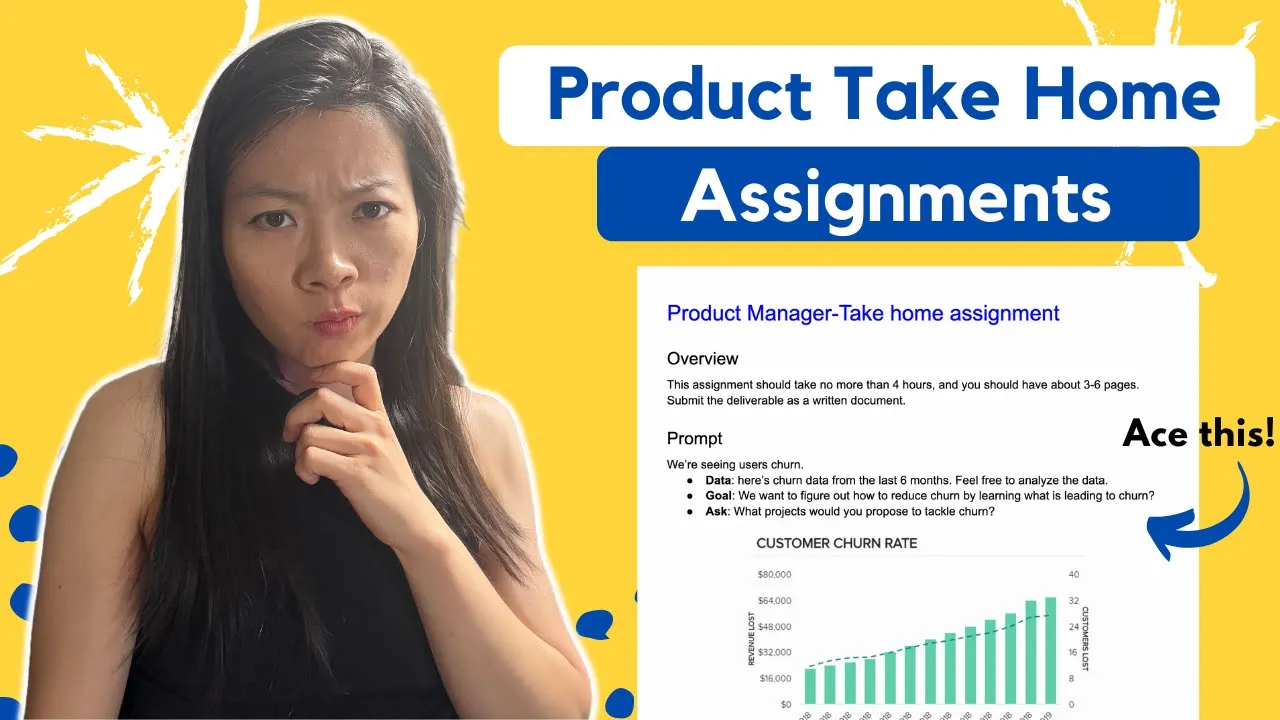
at least 50 of product rolls today are asking you to do a take-home assignment when you interview with their company oh God and even though they suck we're going to teach you in this video how to Ace take home assignments so you get the job hey guys I'm Diana and I'm a senior product leader at a big tech company take-home assignments have become increasingly popular you have smaller companies and startups giving out take-home assignments and it usually sounds something like oh here's a take-home assignment we don't want you to spend more than four hours four
hours yeah right that usually means I'm spending the whole week perfecting this take home assignment so I get this job so what are these take-home assignments sound like and what are they assessing it usually sounds like this here's some data this is our goal why don't you prioritize a couple of things to help us achieve our goal and some of these companies will ask you just for a write-up other companies will ask you to present it like I am to you so hence towards the end of the video I'm gonna give you the 10 sections
you'll want whether it's in a write-up or a presentation so in this video we're going to go through the eight steps that you want to go through in order to Ace your take-home assignment let's start with step number one which is to understand the goal and the first part of understanding the goal starts with understanding the company what their products are and what is their business model the second part of understanding the goal is understanding the explicit goal that they gave you so reduce churn or increase engagement or increase Revenue why is this goal important
how does it relate to the company's business model if it's something like increased Revenue that would be a bit more obvious but if it's something like increased engagement how do you tie that back to a company's larger goal like revenue for example if you're talking about a company like meta increasing engagement on the platform is going to help people stay longer on the platform which exposes them to more ads and with more ads the company makes more money so that's how you want to map back the goal that the company gives you what the company's
business model is now on to the second step do you want to start analyzing your data and I mentioned before this comes in three different forms so you might get raw data so what do you do with hundreds of fields of data and this one tends to be the most annoying but here how I've tackled it before is I basically load them into a Google spreadsheet and use that as well and what I did was I started segmenting the data by using pivot tables and then I use the pivot tables to create charts and graphs
so again a bit more effort no not a bit a lot more effort but that's what you would have to do in order to actually pull interesting Trends and insights out of the data for you to interpret companies might also give you data in the form of tables or graphs and in those cases your job is to interpret those table and read them to understand what insights and Trends are we seeing based on the data and lastly if they give you just user feedback which again is the easiest to understand you will take that user
data and group it into themes basically buckets to help you understand what are the most common areas of feedback that the company is getting so a pro tip here what's going to help you best interpret the data is twofold if you have specific questions that you want to answer by just looking at the raw data or graphs or you want to look at the tables charts and just observe the data to see what interesting insights fall out just by observing the data the first is important asking specific questions because that tells you what graphs you
might want to create and the latter part helps you then observe those graphs and charts to see what interesting Trends you're seeing for example from a data set I might ask well what's the breakout between revenue driven from small medium businesses versus Enterprise and the one data I actually extracted was 80 of revenues is coming from 20 of businesses for you guys out there that's the Pareto rule and that is an extremely huge insight and that the 20 of those businesses are mostly Enterprise customers so that would be telling me that as a company our
biggest bet to increase our Revenue might be to focus on more revenues from Enterprises or I could also tell you that there's a large potential for the small medium business part to hike up your revenues now going forward in this video we're going to use an example question so the example we're going to go through today is we are travel tour booking company something like TripAdvisor so let's say we're only seeing about five percent of people viewing tours and of that three percent are actually booking any of the tours and of that 2.5 percent of
those who have booked tours and have done the tours said that they would come back so you already see some problems here which we'll dive in if you're getting one of these take-home assignments and your semi-loss and you wish you had a thought partner book a session with me and I will help you think through it so step number three is to start prioritizing the problems and here if you look at the prompt or the question that I just gave you some things will be apparent so there seems to be a acquisition Discovery problem I
mean five percent of customers viewing tours for a tour booking company is pretty darn low I mean given that TripAdvisor has other products on it another problem you'll notice is that there's a low percentage of customers booking I mean three percent it depends relatively whether that's high or low but in general that doesn't seem very high and the last problem you'll observe from from what I just shared is there seems to be a customer satisfaction problem which you're most likely lead to a retention problem basically only 2.5 of customers are saying that they would book
another tour that's not very convincing that this is going to turn into a sustainable business so the next step under prioritizing problems now that you have an understanding of what the problems are is to actually prioritize so of the three problems that we just shared which would you prioritize as the most important if you had let's say three months to solve something and here you want to prioritize problems that have the largest impact on that initial goal that we talked about in Step number one was understand goal and let's say the goal here because I
I realize I forgot to State it is increasing the number of or the amount of revenue for the company for this travel booking site and as I reflect on the problem from the three I would probably prioritize The Last Problem the retention customer satisfaction problem why well if you think about it if I go solve the other two basically increasing Discovery and basically people viewing tours on the website and or I solve the problem getting more bookings but if after people book and they're not satisfied they're not going to come back and when they don't
come back they also do not recommend their friends so organic growth is also going to come to a halt and hence you're gonna have a flailing business and what we called a leaky bucket you'll basically get people into this bucket but there's holes in that bucket and hence those customers that you spent so much money acquiring are just gonna leave step number four now that you understand the most important problems you have to create a strategy to tackle it to help you achieve the goals and by the way some people ask like what the heck
is the strategy that's like one of the most overused terms a strategy is basically a plan of attack so here how are we going to attack the retention customer service problem these are just three ways that I could tackle it and you might think of three other ways for this video we're going to focus on the first action to make customers more satisfied I want to ensure that the supply we have on the platform is actually meeting the demand of what people have for Travel Tours so for example if people like to go whale watching
or windsurfing and that's not on the platform as available I would make sure to get that onboard that on the platform instead of getting other type of supplies that is not as popular the next part of my strategy is ensure a positive experience on the tours so we mentioned only 2.5 percent of customers mentioned they would book another tour which probably means they didn't have the best experience so here we're going to want to help the organizers of these tours design a great experience so people want to book over and over again why because acquiring
a customer in the first place is pretty costly so it's in your benefit like you as a company to retain these customers and keep them in the ecosystem oftentimes it's going to be more expensive for you to acquire an entirely new customer versus keeping the existing customer that you have and the last part of our three-prong strategy is to better help customers discover tours that they would find satisfying so maybe they were really unsatisfied with their experience because they chose an experience that wasn't a great fit by the way I think I realize why companies
are signing so many take-home assignments because it's an efficient way for them to test candidates think about it they can have the recruiter give someone a prompt which requires no time of an interviewer and whoever reads the prompt can skim through it in 20 minutes and get an assessment does this person know how to communicate can they think of product Solutions can they assess metrics by defining success metrics anyways step number five that is to measure success so say we have the strategy how do we know when this strategy is successful or not and for
Success metrics you first want to start off with the goal that we talked about so with success metrics you first want to start off with the big picture in this case I would say the short-term goal is to increase our retention rate but the long-term goal increasing our retention rate is going to help the number of bookings which is going to help the revenue which we talked about was that Top Line goal for this company now I'm going to want to break down the metrics even more granularly and ask how do we know our strategy
is succeeding so back to our three prong strategy we know that Supply is meeting demand when we're seeing higher click-through rates which shows interest and higher number of bookings we know that tours have become a better experience if we're seeing higher csat scores so customer satisfaction surveys and higher net promoter scores which basically asks would you recommend this tour to a friend and then we know we're providing better recommendations to customers if we're seeing higher click-through rates based on the results that we show them and we're seeing that the percentage of sessions that people are
spending searching is actually leading to a booking and step number six is to start thinking about pain points that you could solve and here's where you break down the problem and think about the pain points from different user stakeholders so here remember this travel booking site you have the organizers of the tour company and then you have the people doing the booking and the problem that we're seeing or tackling in the strategy could be twofold for example the problem of Designing more positive experiences for tours could be a supply side problem where suppliers really don't
know what their customers expect or what customers like so they're basically going through trial and error figuring it out and that's why it's leading to negative experiences and once you identify the pain points step number seven is where you go into those solutions that the companies are looking for to solve their problem so here I might recommend for each strategy and here we have a three prong strategy you want to think about two to three solutions and then you'll prioritize your Solutions based on Impact versus effort and then from all the solutions that you come
up with you want to narrow down Solutions that'll build a three to six month roadmap I mean maybe even 12 months depends what the company asks for and when you nail down those Solutions optionally some companies might ask you even for a user flow a written up user flow or wireframes like rough wireframes because you're not a designer and step number eight is the write-up so again whether they're asking you to present this or just write it up in a document for them to read you'll have to write it up because they'll probably want documentation
of your work so here what are the 10 sections for your take-home assignment so the first section section or your first slide is an executive summary don't forget this this is basically what we call tldr at our company too long don't read short summary of what are the key findings and what are the key proposed solutions that if someone only had a minute they would get a good grasp of what your presentation is about the second slide or the second section would be calling out the business and the goal and the content for this comes
from Step number one we talked about above which is understanding the goal how the company Works what is their business model the third section is the Data Insights basically What observations did you come up with when you analyze the data that they gave you and here you want to have it summarized in neat forms whether that's starting with headings or statements of your findings do not do not I emphasize lead with graphs do not just throw a graph in there leaving the audience to interpret the graph instead you want to have done the work for
them and done the interpretation written it down so it's easy for them to digest and have the graph as supporting where they can look at any other data points that they want the fourth section you'll want to have your list of prioritized problems the next section after that is your strategy or your plan of attack to tackle those problems after strategy are the success metrics we talked about starting with the short term long term and the strategy specific goals next is followed up by the MVP solutions that you come up with and here I will
emphasize MVP as a minimal viable product basically think of solutions that you would want to test and are not Holistic Solutions that will take six months to build for you to understand whether your hypothesis of the solution is validated or not Section 8 are your prior Solutions based on which Solutions have the highest return on investment section number nine is optional this is either mocks or rough wireframes or even written user flows and the last section section number 10 is your roadmap which comprises of timelines and a sequence of projects that this is something you
can share with leadership so we say take home exams aren't that bad they do suck because of how long they can take but they could be fun exercises if you like product sense problems but if you're struggling with developing product sense you want to take a look at these two videos that'll help you understand the framework necessary to generate ideas and user segments for product sense questions and I will see you guys in the next video