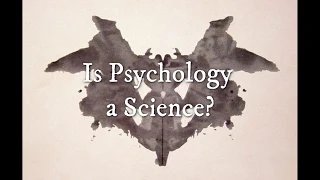
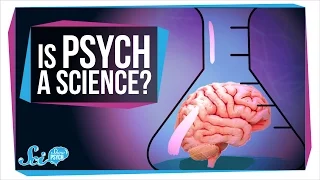
psychology is not a science okay it's a sign well yes it is a science well some of it is yes I don't really know I could say about that well you'll get a different answer depending on who you ask I mean psychology is a very wide discipline it goes from one end that's practically sociology to one end it's very very hard neuroscience new biology psychology is a science because it involves and requires a scientific methodology for its investigation so if you carry out experiments in a way that is objective as much as possible if you're
interested in replication if you record your observations and expose them to the world for scrutiny if you have a theory when you come to the hypothesis when you come to the research and you try to falsify that theory through that experiment then I would say it's a science and it doesn't matter what you study I mean I actually see psychology as a sub-discipline of biology because human beings and other animals are all driven by biology and psychology is really about how our brains and bodies function in this sort of social environment we're interacting with each
other many of us do you use the scientific method so we make hypotheses we collect data we look whether the data follows our hypotheses so in my view psychology is a science I think the best answer to this is to say that psychology is an incredibly vague word and it's a huge umbrella that includes you know a whole array of different things and unlike something like say chemistry or physics that umbrella includes things which are very qualitative so it would be things that would be difficult to measure probabilistically and statistically and scientifically as well as
things that are incredibly quantitative and that we can measure in those ways partly I think people associate psychology with psychoanalysis so for many people the word psychology would bring a purse of image of Freud so understandably you might argue that that is not a very scientific rage and some psychologists don't use the scientific method and also because there's a kind of a public misconception of psychology the kind of pop psychology is out there that's you know no better than kind of horoscopes really is that kind of psychology you know people trying to convince you that
they can tell what you're thinking or that they can hypnotize you to do this that in the other or whatever psychology is a science there is a there is a degree to which I agree with the idea that it's not a science this professor water Mitchell called it the toothbrush problem which is the idea that psychologists are a bit like people all sharing the same bathroom they all want their own toothbrush they don't want to share them and you see this in the journals that you read everyone seems to want their own theory or their
own bit of of psychology and no one wants to really step on each other's toes and upset each other because of the peer review process and so each person carves out their own little area and does a very special bit of psychology I'm sure they approaching that element that bit in a scientific way but really science if we look at physics with a chemistry for the biology science is about theories that bring things together that that draw out common principles it's not a January an approach where you have separate rules for all the different kinds
of possible things you could be looking at the reason people probably think it's not a science is because humans are all individuals and this makes it slightly difficult for us to follow some of the more experimental procedures of biology or physics or chemistry for example because we have to take into account such massive amounts of individual variability but psychology is a science because psychological investigation psychological research requires us to draw on scientific methodology using statistical methods of analysis and psychology have suffered a little bit this was falling between two Python won the one hand we
were interested in essentially we're interesting human mind at human behavior so if you're interested in human behavior then you're always gonna have an element of things which aren't hard science so you could you can measure behavior to a certain degree or observe behavior if you're measuring it then you know that is science that's what science really is it's measurement so I would call myself a neuroscientist rather than a psychologist in fact I was incredibly surprised when I learned that what I do fits under the category of psychology because I never studied psychology I think it
could be a touchy subject for some of the people who are on the more qualitative side because as I said I think what they do is science but maybe it's a little bit harder for them to explain why but if you if you really want to get some little gritty you have to get into the gets it into the laboratory and conduct experiments so the harder the grasp on hard science you get the further the further removed from everyday human behavior you get so there's always a constant but between the two so you know I'm
interested in time behavior but if I really want to nail it down and get measurements and I have to get people into a lab and by its nature it's always going to be slightly artificial so you gained something on the one hand but lose something slightly on the other there may be an element of scientific snobbery so those working in the harder sciences and don't don't necessarily understand the scientific aspects of psychology and therefore banch it in this particular way it bothers me slightly partly because I don't think it's really relevant psychology is psychology you
can call it a science or not I think it bothers me perhaps if it's used to suggest that somehow it's a soft subject and this has lots of implications both for young people thinking about psychology and maybe being told in their school oh that's a bit of a soft subject one if you can't do maths or biology or chemistry yes why don't you go and do psychology well you come and do psychology and see I'm sure if you talk to any scientist see they'll say their science is misrepresented some way in the media and to
some extent probably our fault in the way we engage in the media yes it does it does bother me that people think it's one thing and then they get here to study and find out something completely different sometimes I think students who come to study psychology are surprised by how much science there is or how much they need to get to grips with statistics even if they're really working in topics that might not be considered that scientific it's kind of perceived to be not really a science so it's not actually being rated at the right
level it's not rated at the same level in terms of the cash per student as biology for example even though our students need a lot of equipment and facilities in order to learn psychology properly and apply it in a way that is useful to society I think psychology is a bit like the sort of Midlands of science so if you come from the Midlands you're neither in north nor a sadhana but if you're a psychologist you're neither fully viewed as a scientist but some of the people in the humanities or social sciences wouldn't view use
fully belonging to their fold either you have a scientific family is this a dinner table conversation that ever comes up do you ever have find yourself having to defend the corner of psychology or have you converted all your family to and I think when when I first said I wanted to study psychology at University and I did a joint degree in psychology and neuroscience which was great because I got quite a broad grounding and I remember it did raise a few eyebrows but my dad was convinced when I gave him a copy of the astonishing
hypothesis by Francis Crick to read and I think he felt it was good enough for the Nobel Prize winner and you know perhaps it was it was okay after all