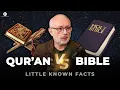
in this video I want to uh compare and contrast the Quran with the Bible particularly the New Testament and ask some basic questions do we have the original Quran do we have the original New Testament and how were they viewed was the Quran viewed as the words of God himself was the New Testament regarded as scripture was it regarded as Revelation and inspired by God now these questions m because historically the answers are quite shocking actually and particularly if you a Christian you may not be aware of some facts that are well known to Scholars
of the Bible I want to begin by sharing some words from a very uh wonderful scholar who's sadly no longer with us Dr shabir akar Who was an academic at Oxford University he was a Muslim and he wrote this amazing book which I really recommend the Quran and the secular mind a philosophy of Islam it's one of my favorite books and he says on page 123 some very interesting things uh about the Quran and the Bible and then I want to go to another Christian uh scholar from Ox University is Professor there and what he
says about his own scriptures uh reporting on mainstream well understood well agreed upon scholarship and then we'll go to what the BBC and a fascinating uh short video said uh several years ago about the Birmingham Cor just how early is it just how reliable is it was it in fact written by uh someone who knew the prophet Muhammad upon whom be peace and you may be shocked to hear uh what they have concluded at the University of Birmingham about this incredible crme they have in their custody anyway back to shabi AKA and he says the
following fascinating words use up three paragraphs in his book he says the following unlike the scriptures of other extent historical religions the Quran is contemporaneous with the faith it established the Hebrew Bible and the Christian New Testament for instance came to acquire belatedly the status of scripture within their communities groups of churchmen in the case of the Greek New Testament New Testament is written in Greek not the language of Jesus of course which is Aramaic but in the language of the Greco Roman Empire groups of churchmen canonized a set of writings well over three centuries
after the events those books and letters allegedly record 300 years so the 27 books of the New Testament what's the earliest what is the earliest list of the 27 books that we have today in history was the earliest time that anyone ever said aha there are 27 books the same list we have today actually it was in the fourth Century if you Google a guy called Bishop athanasius uh he was a a bishop in Alexandria in Egypt very senior outspoken Bishop uh of the of the church and in 367 ad he wrote um a letter
to his congregations detailing exactly the same Cannon of scripture that we have today starting with the gospel of Matthew all the way through the gospels Paul's letters James John you name all the way to the Book of Revelation he's identical to our list but he was the first man in history the first mat actually had the same list before that there was disagreement about which books go in and which books go out of the New Testament there wasn't a consensus and even after his time there still wasn't consensus for a couple more centuries so in
fact shabi aka's claim is actually historically uh accurate it was well over three centuries after the alleged events they narrate in the first century were these writings canonized as a set of scripture that's the first remarkable point that many people don't know and then he says the result is often seen even by Jews and Christians as a poorly edited anthology of religious literature I'm not sure I agree with him on there I'm not sure I don't know many Jews or Christians who would see it that way but that's his view then he says the quran's
status is different it is self-described as Revelation constantly by the way if you look through the Quran it talks about itself as a revelation from God to mankind it's very aware of its status of what it is as God's speech God is speaking through the Quran and shab says and it singlehandedly created the community that treated it authoritatively not the converse this is very interesting it is self-described as Revelation and it's single-handedly created the community the Muslim Community that treated it authoritatively rather than the converse now Christians will often say well hang on the New
Testament also says that it is revelation of God doesn't it and the favorite verse they quote is in the New Testament in a letter uh allegedly written by Paul and I say allegedly because many scholars think it's a forgery but won't go there uh it's called the second letter of Peter to uh sorry second letter of Peter the 3 chapter vers well 14 onwards I'll read the context of the verse the verse is number 16 but I'll back up a bit and go back to 14 because it really matters the context of this statement that's
made all scripture is inspired by God it says but what is this scripture it says is inspired that's the question and Christians always uh leave out the context they don't look at the verses before and the verses after and so it gives I would think I would argue a misleading understanding what Paul is actually saying in his letter so from verse 14 onwards he says the following I'm reading from the nrsv which is this the god standard translation uh in Academia Paul writes but as for you now Paul is writing to Timothy so Paul is
writing say probably in the 60s ad this Matters by the way he's writing in the 6 no no one disagrees that Paul was around in the 60s whether he may not have written this letter it's probably a later forgery but let's assume it's authentic so he is writing to Timothy who's a younger younger disciple younger companion follower of Paul so this is what Paul says to Timothy but as for you Timothy continue in what you have learned and firmly believed knowing from whom you have learned it and how from childhood is Timothy's childhood you have
known the sacred writings that are able to instruct you uh for salvation through faith in Christ Jesus so Paul is referring to the scriptures that Paul that Timothy knew as a baby now this is way before the New Testament was written and nothing in the New Testament was written at the beginning of the first century no one thinks that and then the next verse all scripture is inspired by God and is useful for teaching for Repro correction and training in righteousness so that everyone who belongs to God may be proficient equipped for every good work
all scripture is inspired by God says Paul what scriptures are we talking about well we know we're talking about the sacred writings they obviously the Jewish Bible that is able to instruct you for salvation now when Paul was writing the gospels hadn't been written Matthew Mark lukee and John are dated much later so Mark is dated in the 70s uh Matthew and Luke are usually dated in the 80s or 90s even and John towards the very end of the first century or possibly even later no one thinks that uh the gospels are written uh By
the time Paul was around so when Paul says all scripture is inspired by God he cannot be referring to texts or gospels that had not been written he didn't know about them he'd never heard of them no neither had anyone else had heard of them and of course Paul's letters themselves some of them hadn't been written either let alone the other letters so I I would say and this is actually common sense when you read it in context that when Paul writes in verse 16 all scripture is inspired by God he must be referring to
what Jews had as scripture which is the Jewish Bible mainly preeminently the Torah the pentiuk within it these the books of of Moses the first five books of Moses it must be referring to that it can't be referring to the New Testament so when Christians say aha um the Bible does claim to be inspired by God if you read this passage and this is their favorite verse to Timothy 3:16 when you read that verse in context it's not referring to the whole Bible because the whole Bible hadn't been written then it's impossible for it to
be referring to the New Testament it must be referring to what Christians call the Old Testament so um in fact I'll just share some other words before we go back to shabet ACTA from this marvelous book this is a history of the Bible the book and its Faith it's written by John Barton now John Barton who I've had the privilege of interviewing on blogging theology um is a professor of the Bible at Oxford University no less and he's a clergyman so he's a church of England uh priest so he's a believing Christian and he's an
expert on the Bible and this book this book particular book is hugely uh uh esteemed and critically praised for its incredible knowledge and erudition it's very lucid very readable and if you want a good education about the history of the Bible its texts its canonization and so on this is one of the best books on the market I do recommend it so what does this expert say about the New Testament and I think this is really important this comes as a shock uh will come as a shock to Christians I would saying 99% of have
no idea about this see what you think about what he says just think about it and see if it makes sense so um in chapter 10 excuse me page 239 professor John the Reverend professor John Martin writes the following the New Testament did not begin life as a collection of sacred writings at all but as occasional literature highly important but not sacran each of Paul's letters is addressed to a specific situation in one of the local churches and though he no doubt intended his letters to be kept and reread they were not holy in the
way that the Hebrew scriptures unequivocally were the gospels treated so solemnly in later Christian Life and L and liturgy are the distillation of traditions about Jesus and as such were also naturally highly regarded and copied for subsequent Generations but they were not seen by the first Christians as verbally exact there was no tradition as there was in Judaism of precise copying of the text with the consequence that new testament manuscripts vary greatly and none is authoritative then he continues there is clear evidence for the first few Generations the gospels did not operate as sacred scripture
they did not operate as sacred scripture but was seen as collections of material about Jesus which could be drawn on in retelling his story just as Matthew retold Mark with additions and omissions because the scholar the stand ofie is that Matthew copied Mark changed him embellished him corrected him because he disagreed with Mark on important matters to do with the Jewish law for example and other matters so clearly Matthew didn't regard Mark as scripture otherwise why would he change him he wouldn't want to do that would he obviously just as Matthew would uh retold Mark
with additions and omissions so an early Christian preacher could in some measure extemporize from the gospel he or she knew best or perhaps already from a mental Harmony of more than one gospel so this the point here is there is clear evidence that for the first few Generations the gospels did not operate as scripture they were not quoted as scripture now he goes on to explain in a lot more detail how this is the case he looks at the works of Justin Marr for example in the 2 century and he looks at the early fathers
in the second century and when they quoted the words of Jesus they were not quoting them as part of a Canon of scripture but the words themselves were authoritative like the red letter Bibles we have today in some additions it's like ah the words in red they're inspired they're from God they're they're from the prophet Jesus but the other words around it the narrative and S are not inspired by God because that's just Luke saying things or Matthew that's not canon that's not scripture that's how many of the early fathers seem to have used what
we call the New Testament not that it existed in form completely at that point either so it's a fascinating story so when our Muslim writer Dr shab uh actor says um that the Quran status is different it is self-described as Revelation this is true because it literally is I mean virtually every every chapter of every Surah of the Quran has statements to that effect but you don't find that in the New Testament uh for reasons I've explained anyway uh shepher actor continues no discipline Among The Sciences of the Quran corresponds to the critical historical concerns
of critical biblical scholarship a field covering textual criticism as well as form Source redaction literary and historical criticism these are all sort of specialist branches of the study of the Bible in in Academia I'm not going to go into them now but they're all very very interesting particularly in my view redution criticism how how later gospel writers change the words of Jesus in clearly identifiable ways to raise his status from Prophet to son of man to a Divine or semi Divine being you can actually see the mutations a bit like a darwinian to use a
metaphor darwinian Evolution you can see how uh the ontology of Jesus changes really from the purely human figure to someone who is in some sense Divine uh as the gospel writers exalt him more and more till we get to John's gospel where he is divine in some sense I say in some sense because that caveat really makes the difference because lots of people in the ancient world were called Divine both in judism and in the Greco Roman world for example Pho Alexandria the very eminent biblical SCH Jewish biblical scholar commentator uh hellenized Jew based in
Alexandria Philo p i l o uh he wrote lots of commentaries on the Bible in Greek of course because he was a heniz Jew um and he actually refers to Moses as hoos Theos God God now he doesn't mean that Moses is is Yahweh he doesn't mean what we mean by God as the Creator Eternal uh being who created the universe it doesn't mean that it's just an like an honorific um it's is the way they use language at that time now it's unacceptable of course for us as Muslims or even the Christians to use
such language but nevertheless my point is that to call someone Divine in the ancient world doesn't necessarily mean they are God with a big G in the sense they are Yahweh it doesn't necessarily mean that at all and that's where the different worldview the different religious universe that the ancient people inhabited if we're not aware of that we're going to make some Mis we're going to misin reparate what they're saying sometimes so even when a Christian might say Jesus is divine or God he may not quite mean what we think he means he may not
he may make a distinction still between Jesus and the Father which is who is Yahweh the god of Israel the creator of the universe in the beginning God created the heavens and the Earth it says in Genesis 1:1 it may not mean that they think Jesus is that person that being but it has a kind of subordinate Divine status now this is all getting way off the subject um but is these kind of issues these historical issues that we must be aware of if we're to interpret the New Testament correctly so does Paul call Jesus
God for example well no not in the sense that we mean God but he does still call him a Divine being in some sense and you got to understand the Greer Roman world I think to appreciate what's really going on rather than just reading Paul through our own 21st century theological lenses it's easy to misunderstand Paul that's why historical criticism as it's called is so important when it comes to the New Testament anyway back to shab he says no discipline among the science of the crown corresponds to the historical critical approach of the uh Bible
how so how can this be so shabia shab says the Muslim reluctance to develop the discipline of critical chronic scholarship is mistakenly thought to be connected to religious obscurantism in other words oh we just don't want to face up to the truths about our scriptures we just want to be hold on to our fundamentalism or whatever how we want to put it sometimes that is assumed but in fact he says there are no materials and no need for such a discipline the Quran unlike the Bible is not the heterogeneous work of many hands in other
words it's not written by lots and lots of different people like the the Bible 27 books in the New Testament but there are many many more authors and writers many of who we don't know who they are who involved in producing what we call the Bible the Quran is not like that it's not the heterogeneous work of many hands in several genres in a trio of languages the Bible of course is in Greek Aramaic uh and Hebrew mainly Hebrew in the Old Testament mainly Greek in the New Testament in very geographical locals stretching over Millennia
surviving only in uncertain and fragmentary forms the K isn't like that the oldest and this is another shock for people who don't know what is the and I often ask Christians this question it's not meant to be it's not a trick question it's a question of fact what is our oldest New Testament manuscript often Christians say oh the first century we got first century manuscript and say where is this manuscript tell me I'd like to know and they can't name it they can't say oh well it's this manuscript in this University and it's been classified
and we know it what it's no no in fact the earliest New Testament manuscript we have the complete New Testament manuscript not fragments bits and pieces is from the fourth Century the fourth Century remember Jesus lived in the first century and uh this of course is the famous codex caticus because it was found in a monastery of Mount Sinai sinus in in uh in Egypt uh in the 19th century and it's dated to about 350 aish and it's in the British library in London and I've seen it lots and lots of times it's in Greek
really difficult to read because it's all in Block capital letters Greek letters and there are no gaps between words and sentences like just a stream of words and goodness knows why they did it that time but so it's not easy to read but anyway nevertheless that is the oldest um authenticated certain New Testament manuscript and is hundreds and hundreds of years after Jesus's time anyway the Quran is different because we have manuscripts now increasingly so going back to the time of the Prophet himself actual manuscripts and shortly I'm going to invite you to look at
a brief video produced by the BBC the British Broadcasting Corporation uh a couple of years ago about the remarkable discovery of the Kuran in the University of Birmingham here in England they they actually had this manuscript for years they didn't know how old it was and then some enterprising researcher thought um we got a carbon date this this looks early how early is it and they did not in their wildest dreams they say this is the world we do think on our West dreams would this manuscript be so early because it goes back to the
time of the prophet himself and there's a professor there you you're here at the University who I've actually interviewed who's actually a Christian and he says some fascinating things about who the likely author of this particular manuscript is he been carbon dated to the time of the prophet and the companions of the Prophet peace be upon him so look we're going to watch that video shortly um but just coming back just to finish off what shabir says so the Quran unlike the Bible is not the heterogenous work of many hands in several genres in a
trio of languages in Vari geographical locales stretching over Millennia surviving only in uncertain and fragmentary forms it is a unified Cannon the cannon is one revealed in just over two decades addressed to a man fully known to his contemporaries and to subsequent history a man living in only two geographical locations in the same country It Was Written in one language the language of the recipient and of the first audience think of today how many of us can read Aramaic I can't how many of us can read Greek I can read Testament Greek but I can't
speak it how many of us can read Biblical Hebrew very few people can and yet the language of the Quran is the language of literally hundreds of millions of Arabs today what is an Arab it actually means someone whose native language is Arabic so the language of the Quran is still living uh and is and so the Quran is still understood unlike the Bible I've never come across anyone I know of people like two Scholars I know of that's it one of whom is no longer with us um uh could re you can read Aramaic
because parts of Daniel for example Book of Daniel are in Aramaic and a few other places as well so no one can actually understand the book in its language apart from a handful of people out of how many Christians three billion Christians it's it's remarkable contrast that with the Quran It Was Written in one language the Quran the language of the recipient and of the first audience a living language that is still widely spoken the period of his AAL Revelation and final authoritative compilation is only about two decades remember what I said about the codec
caticus in the Bishop Museum the earliest complete copy we have it's in the 4th Century 4 100 years after the birth of Jesus the Quran goes back to within a couple of decades uh of of its initial Revelation the the physical crme we have or could be even earlier apart from some variant readings he says of the Quan that do not materially affect the sense the text is invariant defined and fixed textual amendation editing the text to remove alleged Corruptions or errors copying was never permitted the text has retained Perfect Purity a unique version has
enjoyed universal currency during the entire history of Islam I cannot see says Dr shabi AKA barring motives of malice and envy that should have no place in scholarship any grounds for developing a critical textual scholarship of the Quran so that's just two paragraphs actually from page 123 of this marvelous book the Quran and the secular mind uh I certainly do recommend it and and these contrasts between you know the earliness of the Quran and the much later manuscript evidence from the New Testament are not really accepted and known by Christians when often I bring this
up they resist what what I've just said and I'm thinking on what grounds do you resist what I've just said is it on factual ground fine please let's talk about facts is hysterical historical grounds fine let's talk about history when I say that the earliest list of the 27 books of the New Testament we have comes from the fourth Century from Bishop uh athanasius from Alexandria in 367 ad they didn't know they don't know that and even then and some Scholars make this mistake they think oh well that was it it was settled then in
3678 at that point the church agreed surely on what the cannon is the list of books but that's not true either still in the east in places like Syria and elsewhere books like the uh The Book of Revelation the last book of the Bible second Peter were very much disputed and doubted because if you look at the Book of Revelation it's pretty weird I mean it looks at the guy is on something I mean it's it's really it's apocalyptic in a very strange kind of weird way if you look at it if you read the
book you'll know what I mean and to Peter no one ever heard of the second letter of Peter until a couple of centuries after Peter died and today it seen to Peter almost universally as a forgery as a fake and this matters because it states in it that it is a letter by an eyewitness by Peter himself so someone is faking testimony to the life of Jesus as an eyewitness we have seen him this on Mount Mount uh uh I think it's the mount Transfiguration I should say in uh 2 Peter chapter 2 but in
fact this is not by an eyewitness it's a fake and there are lots of very strong historical and literary reasons why Scholars have concluded this they don't want to conclude this Scholars are usually Christians in this field but they have and as the uh the well the well famous uh dictionary of the Christian Church published by Oxford University press has has stated you can read it for yourself it's virtually impossible quote for two Peter to be by the Apostle Peter virtually impossible for the reasons they outline in the article which I won't go into now
so which means that we have faked testimony about the life of Jesus in the New Testament which is acknowledged by the highest authorities in the church itself this is unknown to 99% of Christians but it is known to Scholars and this disconnect between Scholars Christian scholars in universities like Oxford Cambridge Harvard Yale whatever and the so-called you know the lay people patronizing term uh couldn't be greater they simply no uh Knowledge from one to the other people don't know what their own Scholars have been saying for hundreds of years but many Muslims interestingly do know
what's been going on and uh have shared the the findings of Christian scholarship with a wider audience so that's the reality the early the letters of Paul and the gospels were not seen as scripture but the first Christians and we can know that if you look at the early Christians where they they cite passages from the books that did become Holy Scripture they don't refer to them as scripture they don't refer to them as Revelation very interesting and if you want to read the stories the full details of this look in this book a history
of the Bible the book and its Faith by John Barton uh Bart ER himself in a book uh called Lost christianities um has discussed this in great detail uh this is a a subject for another session perhaps but uh another podcast another YouTube video so I hope you found that interesting I'm now going to leave you with the BBC um here we go BBC News oldest cran found in Birmingham uh this came out nine years ago it's had 1.7 million views this video which is unusual for um uh something like this uh is the world's
oldest fragment of the Quran found by the University of Birmingham on their in their Library they didn't even realize they had this really early text it's radiocarbon dated to around the time of the Prophet himself um absolutely remarkable and it's the same Quran that we have today that's the that's the point it's the same Quran I I've been there I've seen it I've been with Muslims who've read it yep they actually recognize all the Ayah yep that's that's what we know that's our Quran and it comes from the time of the Prophet himself and the
time of the companion so that's it game over we we can all go home and stop arguing about we have to though keep on asserting this truth because some people don't want to hear it um because the Quran has been preserved in its Purity intact for all these 1,400 Years alhamdulillah anyway enjoy the video until next time you're looking at one of the oldest fragments of the Quran ever discovered it's written on parchment most likely made from sheep or goat skin and it's been d by experts as being more than 1300 years old and that
makes it among the earliest known fragments of the Quran anywhere in the world and it's here in the University of Birmingham this remarkable document had been resting on the shelves of the University library for decades without anybody realizing just how old it was until a researcher decided to take a closer look the pages were radiocarbon dated to no later than the year 645 which means the university has found found one of the very earliest known examples finding out that we had one of the oldest fragments of the Quran in the in the whole world was
fantastically exciting individually and for the University as well as well I mean we were expecting it to be early but we we did not I think in our wildest dreams expect that it would roughly correlate to the lifespan of the Prophet Muhammad which makes it an incredibly early quranic fragment the manuscript had been stored here in a collection of Middle Eastern documents brought to Birmingham in the 19 20s academics here say that this discovery goes back to the earliest years of Islam the person who actually wrote it may well have known the prophet Muhammad he
would have seen him probably he would maybe have heard him preach um he may have known him personally and that really is quite a thought to conjure with Birmingham has one of the country's biggest Muslim communities and they have welcomed having such a treasure in City when I saw these pages I was very much moved and there were tears of joy and emotions in my eyes and I am quite sure that even the people from all over UK would come here to Birmingham to just have a glimpse of these Pages people would love this this
is an exceptionally rare and valuable Discovery and the university says it will be put on public display it is no intention of letting these pages from world history leave Birmingham Sean cin BBC News