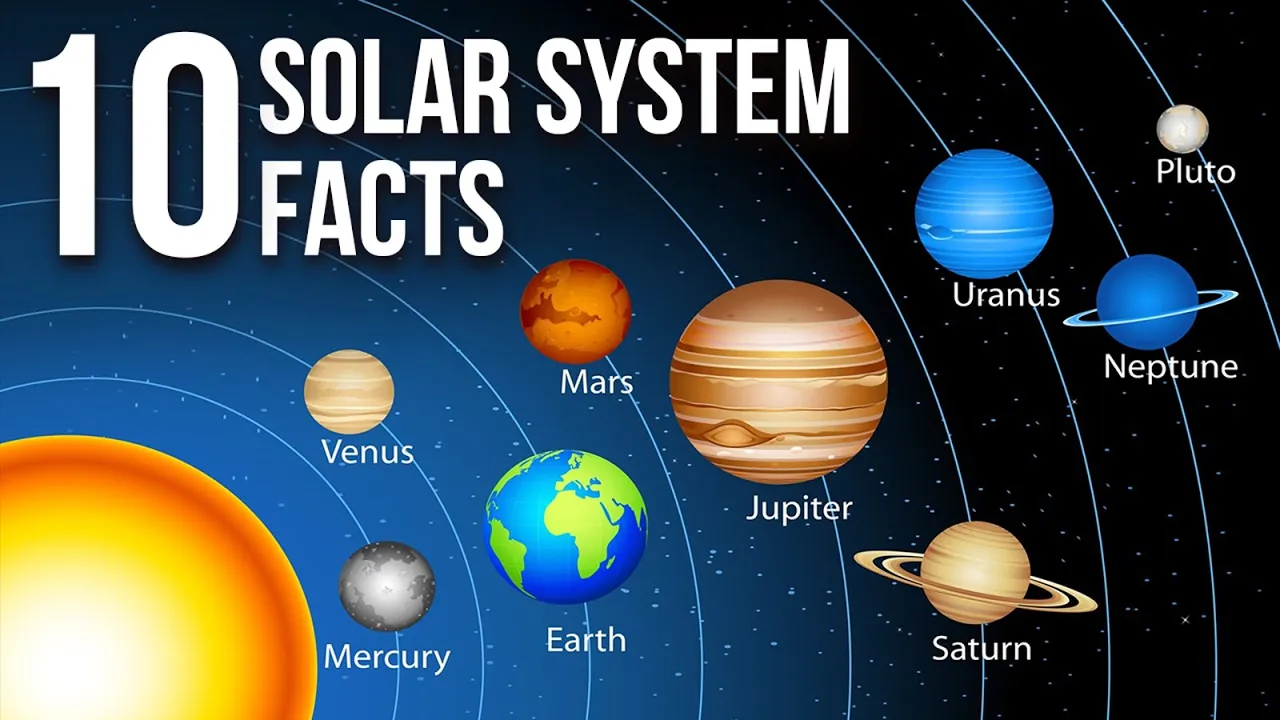
10 Mindblowing Facts You Never Knew About the Solar System Do you really think you know everything about the Solar System? A silly and rhetorical question. .
. no one, not even the greatest planetary scientists, could swear to possess all the data, measurements, relationships, and stories that have to do with the physical reality of our cosmic backyard. .
. No matter how much one has studied or thought, there will always be something that suddenly sounds new or completely bizarre,Like these ten facts. Enjoy watching!
There are asteroids with rings! In the vast cosmic landscape, there's an object that continues to amaze astronomers with its peculiarities: Chariklo. This 250 km (155 miles) diameter object, discovered in 1997, defies easy classification, representing a hybrid identity somewhere between an asteroid and a comet.
Located between the orbits of Saturn and Uranus, Chariklo stands out not only for its position but also for its ambiguous nature. But what really grabs attention is the presence of rings, a rare and fascinating feature that it shares with giants like Saturn, albeit on a much smaller scale. The system consists of two narrow, dense bands, 6-7 km (4 miles) and 2-4 km (2 miles) wide, separated by a gap of 9 kilometers (6 miles).
The rings orbit at distances of about 400 kilometers (250 miles) from Chariklo's center, a thousandth of the distance between Earth and the Moon. Recently, the James Webb Telescope discovered that Chariklo's rings are made of water ice, not dust and debris. This is truly surprising and still under evaluation.
But wait. . .
Chariklo was the first, but three more small ringed bodies have since joined the family! In 1993, Chiron, the progenitor of the Centaurs and half the size of Chariklo, also showed it has a ring system. In 2017, the large and bizarre Kuiper Belt Object Haumea (same diameter as Pluto and Eris, but shaped like a rugby ball) entered the exclusive club with a ring of 2287 km (1421 miles) radius.
And in 2023, another surprise: Quaoar, a KBO about a thousand kilometers (621 miles) in diameter, revealed a ring system! Two distinct rings have been confirmed, at 2500 and 4050 km (1553 and 2516 miles) from the surface. Incredible, right?
Until 1977, when Uranus's rings were discovered, Saturn was the only known ringed object in the solar system! Today, we know that all gas giants have rings, and even small asteroid-like worlds do too! Triton orbits the wrong way!
At first glance, Triton, a large moon with a diameter of 2700 km (1678 miles), seems to have all the characteristics of a natural member of Neptune's satellite system. It always shows the same face to Neptune, just like the Moon does to Earth and the Galilean moons do to Jupiter, and its orbit is almost perfectly circular - two features that usually indicate a satellite formed alongside its parent planet. It would seem impossible to see Triton as an intruder.
Yet, there's something strange about its orbit that, once identified, makes it clear that Triton could NOT have originated there among Neptune's other satellites! An anomaly that, considering the object's significant size, can only provoke disbelief. .
. What are we talking about? Well.
. . the fact that Triton's orbit is retrograde!
In essence, Triton is like a big truck going the wrong way on a highway! This is really strange because all the larger objects, having formed from a single rotating disk of dust, orbit the Sun counterclockwise. To be clear, there are other moons in the Solar System that orbit their planets in a retrograde direction, but they are tiny moons, essentially small asteroids captured by the planets in various ways.
And all are located on the outskirts of the satellite system that has captured them. Triton, however, is very close to Neptune: only 350,000 km (217,480 miles), less than the distance between the Moon and Earth. Retrograde orbiting moons cannot form in the same region of the solar nebula where the planets orbit, so Triton must have been captured from elsewhere.
But where? And how? Stickney Crater on Phobos is the most shielded spot from cosmic radiation!
The small Martian moon Phobos (22 km or 14 miles in diameter) is tidally locked with Mars, meaning it always shows the same face to the planet, just like our Moon does to Earth. It's also very close to the Red Planet, orbiting at about 6000 km (3728 miles) away. A recent NASA study on the feasibility and benefits of building a space base inside Stickney Crater, a natural basin 9 km (5.
5 miles) in diameter and 1. 5 km (1 mile) deep, found that being shielded below by Phobos's mass and above by Mars, the settlement would have almost unprecedented protection from galactic cosmic rays and solar energetic particles. It was calculated that any object placed inside Stickney Crater would receive only 10% of the radiation normally coming from outside, equivalent to one-fifth of the radiation that hits the International Space Station.
The same source also states that even the general surface of Phobos facing Mars (outside Stickney) would receive at most only 25%. Aside from hypothetical lunar caves, Stickney would be the most radiation-protected place in the inner solar system, with the huge advantage for a space base of being an open-air location. The Sun never sets on Mercury: just keep walking!
After Pluto's demotion, Mercury is once again the smallest planet in the solar system. With a diameter of 4879 km (3031 miles), less than half that of Earth, it's even smaller than the moons Ganymede and Titan. Mercury orbits at an average distance of 58 million kilometers (36 million miles) from the Sun, but its orbit is the most eccentric of any planet, getting as close as 46 million kilometers (29 million miles) at perihelion and as far as 70 million kilometers (43.
5 million miles) at aphelion. But the planet's celestial dynamics oddities don't end there. Remember how our Moon rotates on its axis with the same period it takes to orbit Earth?
This is called a 1:1 tidal synchronization. Well, Mercury's very slow rotation, which takes 58. 65 days, is synchronized with its orbital period around the Sun, which is 88 days, in a 2:3 ratio.
In practice, Mercury completes two orbits for every three rotations, meaning that for a hypothetical Mercurian, the Sun would set (or rise) every 176 days. And here we find the planet's most striking feature, the one that has made it famous in many science fiction stories: the incredibly slow movement of the terminator line! On Earth, the line that separates day from night moves across the surface at a very high speed: at the equator, it reaches up to 1670 km/h (1037 mph).
. . and it's obviously impossible to follow its movement on foot: only the fastest planes and artificial satellites can keep up with the speed at which dawn and dusk cross seas and continents.
The Moon's terminator, by comparison, moves at no more than 16 km/h (10 mph), which means 100 times slower! On Mercury, however, the terminator moves at a maximum speed of only 3. 6 km/h (2.
2 mph)! Think about it. .
. Even an elderly person could walk at that speed, thus keeping the Sun always near the horizon! What's the advantage?
Well, walking within a zone where the temperature might reach bearable levels. This idea - believe it or not - has been considered for planning potential human missions to Mercury, with the design of motorized and mobile bases built along the terminator. .
. And science fiction has embraced the idea too. .
. In Kim Stanley Robinson's novel "2312," the main city on Mercury is called Terminator, and it's entirely built on a railway track that circles the planet, moving slowly to stay in the habitable zone. The energy to move the city and for the human inhabitants is generated by the thermal gradient across the various sections of the track.
Of course, on Mercury, solar energy is abundant! Double pairs in the solar system Curious facts about the solar system are sometimes so elusive that they remain hidden even after centuries of study and observation. There's one, in particular, seemingly so trivial and transparent that it escaped everyone's notice until a few years ago when it was pointed out by Dennis Rawlins, a historian of astronomy known for his quirky and unconventional character.
. . Rawlins was the first to notice that there are two pairs of planets in the solar system that share a series of common characteristics: the Venus-Earth pair and the Uranus-Neptune pair.
It's surprising that, for both pairs, each of the following statements is true: • Each pair consists of two contiguous planets. • Each pair is made up of two planets almost identical in size and mass. • Their position is central in the group of inner rocky planets and in the group of outer gas giants.
Consequently, the pairs are symmetrically positioned relative to Jupiter. • The inner members of each pair (Venus and Uranus) are the only ones among the 8 planets to rotate in a retrograde direction. Rawlins believes that this oddity might hide a profound cosmogonic significance, linked to some unknown mechanism of planetary formation.
"Hey, guys, just a moment before we continue. . .
BE sure to join the Insane Curiosity Channel. . .
Click on the bell, you will help us to make products of ever-higher quality! " There's space for all the planets between Earth and the Moon It seems like a really strange idea. .
. and even after doing and redoing the calculations, it's still hard to believe. .
. You know the planets of the solar system, right? In our imagination, they are enormous objects, and especially the gas giants, we tend to think of them as the epitome of everything in the solar system that is oversized compared to our everyday context.
. . Now, on the other hand, think about the distance between Earth and the Moon.
. . Don't we perceive it almost like a walk in the garden?
Nothing, compared to other distances. . .
So you would never believe someone who told you that if we placed all the planets side by side, all seven would comfortably fit in the space that separates us from the Moon. . .
Right? But. .
. Try adding up their equatorial diameters: Mercury 4879 km, Venus 12104 km, Mars 6792 km, Jupiter 142,984 km, Saturn 120,536 km, Uranus 51,118 km, Neptune 49,528 km. .
. What's the total? It should be 387,941 km.
. . right?
Now. . .
we know that the average distance between the Moon and Earth is 384,400 km, the minimum is 356,600 km, and the maximum is 406,700 km. So, this demonstrates that all seven planets can comfortably fit in this little corner of the universe that is cislunar space. Placed side by side, like old bottles on a shelf.
. . While we thought of them as gigantic white whales in the great ocean of the solar system.
. . This puts the relative volumes of space and matter into an interesting perspective.
Mercury, the infernal planet, is full of ice! Mercury is the closest planet to the Sun in our Solar System: on its sunlit side, temperatures reach 400 degrees Celsius (752 degrees Fahrenheit), yet water ice has been detected in some of its craters. This ice is found at the bottom of craters where the Sun never shines, thanks to Mercury's axis being tilted by only a couple of degrees.
But how much ice is there? Where did it come from? NASA's Messenger probe data from 2017 answered the first question: the average thickness of the ice is about 50 meters (164 feet), with a maximum of 85 meters (279 feet) in some areas.
Before this, it was believed that there could be no more than two meters (6. 5 feet) of ice. .
. As for the second question - where did the water ice on Mercury come from - there's still no clear answer: it's not at all clear how comets and asteroids could have delivered all that water to the planet. Some hypotheses suggest it arrived with long-period comets from the Oort Cloud, an immense spherical region of space surrounding the Solar System, composed of billions of comets, at a distance almost halfway between the Sun and the nearest star.
Others think the comets might have come from the Kuiper Belt, the giant doughnut-shaped ring of billions of icy objects that surrounds the Solar System beyond Neptune's orbit. In short, we'll need more detailed observations to know for sure. .
. but the important thing is that the poles of the small planet could provide abundant water and energy for potential human explorations in the near (or distant) future. In theory, you could travel from one side of the Earth to the other in 42 minutes Suppose we dug a tunnel through the center of the Earth, jumped in, and let gravity pull us through.
How long would it take to reach the other side of the planet? The simple answer is, in theory, yes. First, let's ignore friction, Earth's rotation, and other complications, and focus on the case of a hole or tunnel that enters the Earth at one point, passes through its center, and comes out on the opposite side of the planet.
If we treat the Earth's mass distribution as uniform, one would fall through the tunnel and then rise to the surface on the other side in a manner very similar to a pendulum swinging higher and higher. Assuming the journey started with zero initial velocity (simply falling into the hole), your speed would increase, reaching a maximum at the Earth's center, then decrease until you reached the surface, at which point the speed would be zero again. The gravitational force exerted on the traveler would be proportional to their distance from the Earth's center: it's at its maximum on the surface and zero at the center.
The total time required for this journey would be about 42 minutes, and the traveler's speed at the Earth's center would be 7. 9 km per second (4. 9 miles per second).
At this point, someone might ask. . .
once you reach the edge of the hole on the opposite side, what would happen to the jumper? If there were no friction, there would be no loss of energy, so our traveler - unless held by someone - would fall back towards the Earth's center and spend their life oscillating between the two ends of the tunnel. This journey - obviously - could not take place in the real world for several reasons, including the implausibility of building a tunnel 12,756 kilometers (7,926 miles) long, moving all the material in the proposed tunnel path, and passing the tunnel through the Earth's molten outer core and its inner core, where the temperature is about 6,000 degrees Celsius (10,832 degrees Fahrenheit)!
What would happen to Earth if its orbital speed suddenly dropped to zero? A question we often ask, and many take for granted, is why the planet Earth, or other planets, don't fall into the Sun. The answer lies in Isaac Newton's theory of universal gravitation.
Remember the story of the apple falling from the tree? The apple is attracted to the Earth, and once it detaches from the branch, it falls with accelerated motion towards the surface. .
. but the Moon is also attracted to the Earth, yet. .
. it doesn't fall! Why not?
For a simple reason: unlike the apple, the Moon compensates for the centripetal gravitational attraction by traveling in an orbit at a speed that allows it to develop a centrifugal force in the opposite direction. This concept can be extended to the Sun and the planets orbiting it. The magnitude of the attraction is the same, but the effect it generates on the body is proportional to the mass of the two bodies.
If the Sun were to magically disappear, all the planets would fly off tangentially and leave their orbits, retaining the speed they had at the moment of separation. Earth, for instance, would end up like the Moon in Space: 1999. .
. drifting through the solar system. But what if it were the orbital speed, or the centrifugal force, that suddenly dropped to zero?
Well, in this case - assuming such a thing were possible - it would be even less fun. Our planet would start to fall towards the Sun. .
. slowly at first, and then at an increasingly rapid pace! The question then becomes.
. . how long would it take for Earth to fall into the Sun?
Is there a formula that can tell us? There is a formula, albeit an approximate one, and it's very simple: Fall time = Orbital period / 5. 66 And it tells us that Earth would plunge into the Sun in about 0.
01767 years, or 64. 5 days, hitting the photosphere at a speed of 616 km per second (383 miles per second)! The same formula obviously applies to all other planets in the solar system, so it will be easy to calculate, for example, that Jupiter's fall would last 766 days (more than two years!
) and Neptune's even 29 years! The Moon has the same apparent diameter as the Sun One thing that has always impressed us about our solar system is that the apparent diameters of the Sun and the Moon appear almost identical to us. This strange concordance of angular sizes, as we know, gives rise to solar eclipses, one of the rarest and most exciting astronomical phenomena offered by our sky.
Faced with these two "miracles," it's no wonder that for many centuries this was considered by religious thought as one of the proofs of God's will to give the world two identical sources of light, one for the day and one for the night. . .
Of course, today the vast majority of astronomers believe it is just an interesting coincidence that the Moon can almost perfectly overlap the Sun, as there is no physical reason for it to be so. Simply put, the Moon is about 400 times smaller than the Sun, but the Sun is also about 400 times farther from Earth than the Moon. This simple geometry tells us that the apparent disk of the Moon is almost exactly the size of the apparent disk of the Sun.
But, pay attention to that "almost exactly". . .
the distances between Earth, the Moon, and the Sun are subject to small variations due to the eccentricity of their orbits. Thus, observed from the Earth's surface, the angular diameter of the Sun varies between 31. 6 and 32.
7 arcminutes, while that of the Moon varies between 29. 6 and 33. 5 arcminutes.
As you can see, the match is not perfect, and for this reason, total solar eclipses occur only at certain times and have different durations. But if it's all a coincidence, would it be possible to calculate the odds that our Earth is the only one in the solar system with a moon capable of just covering the solar disk? Well, assuming the Sun has those dimensions, someone has estimated that the odds of Earth's only natural satellite being large enough to just cover it are about one in two hundred!
Not many, but not few either! However, some say that the size of the Moon is not entirely coincidental, but somehow justified by the very existence of our species. .
. They argue that a planet without a Moon, or with a moon too small, would not benefit from tides capable of starting the chain of life according to the "tidal pool" theory. On the other hand, if it had been much larger than it is, the Moon would have disrupted the Earth's surface with tides kilometers high, which would have had the opposite effect.
. . So, according to a scheme that refers to the "anthropic principle" and "intelligent design," since we exist, the Moon could not have been much different from what it is!
However, it should also be considered that on longer time scales, the Earth-Moon system is not static. Each year, the Moon's orbit grows by about 3. 8 centimeters (1.
5 inches), and our day lengthens by about 0. 000015 seconds. At this rate, in about 50 million years, the Moon will never completely eclipse the Sun again, producing only increasingly narrow annular eclipses.
This orbital evolution also implies that total solar eclipses in the distant past would have been much more frequent and of longer duration.
![Everything NASA Discovered with JWST's Year 2. Closest to Farthest [4K]](https://img.youtube.com/vi/wh4G1Wh79Ck/maxresdefault.jpg)