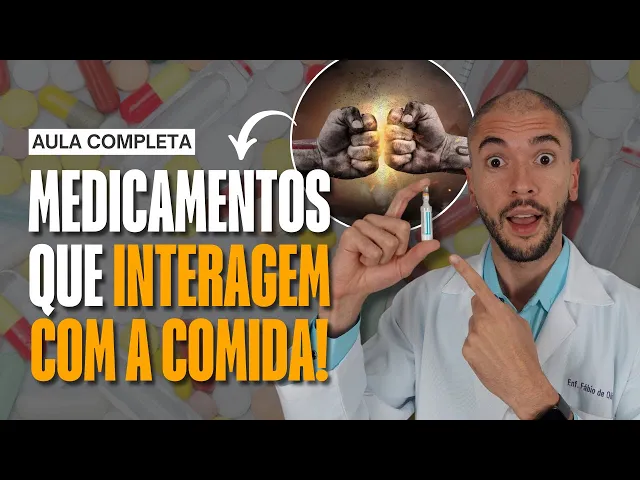
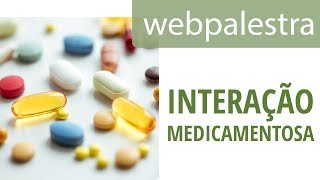
More and more people are talking about drug interactions. Medicines that interact with each other end up reactivating, increasing and decreasing their effects. But what about nutrition?
Does what you eat also affect the medications you take or vice versa? That's what we're going to talk about in this class. So, get your coffee or tea and welcome, welcome to another video from Enfermagem Total.
Speak, Nursing, how are you? I'm nurse Fábio, I'm a Nursing professor. I've been in Nursing for a while now and today I want to talk to you about a subject that I don't see many people talking about, actually, which is about drug-nutrient interactions.
In other words, the food. The food the patient is receiving, the diet the patient is receiving. Does it interfere with the medications the patient is receiving?
Or vice versa, could a certain medication contribute, could it result in a lack or increase of some nutrient in the body? So it's important for us to talk about this so you can think about these interactions that may be happening on a daily basis. But before we start this class, I'm going to ask you to please click the like button below, subscribe to the channel, activate the notification bell so you don't miss any more videos.
And of course what helps me the most right now is sharing this video with other people. We are almost reaching our first goal, which is 50 thousand subscribers on this channel. And next, our big goal will be 100 thousand subscribers, but let's first reach 50.
Help me reach 50 thousand subscribers by sharing this video with other people, whether it's a WhatsApp group, a family group, whatever a group of people from work, people from college, people from technical courses, sent it to them and I'm sure this content here will be really cool and you'll be able to get a lot of use out of it. But let's talk here about nutrient medicines, this interaction that happens between the two. What will you learn before starting this class here, what will you learn from this class.
What is this interaction, medicine, food? Examples of interactions. So, I'm bringing you a list of interactions.
Medicines that interact with certain nutrients or nutrients that interact with medicines. And finally, we're going to talk a little about alcohol. How alcohol also interacts with medications.
And then we will reach that conclusion, and then you can or cannot drink before taking a vaccine, after taking a vaccine or something, or some certain medication, an antibiotic and alcohol, which is talked about so much. We're going to talk a little about this here in this class too. Let's start here by first talking about what a drug-nutrient, or drug-food, interaction is.
A drug-nutrient interaction is the effect of a drug on food or a nutrient that is within a food. These medications, when the patient is there under a drug treatment or when you yourself end up taking a medication, the medication, you decrease the appetite, you can decrease the appetite or change the way the nutrient is absorbed, metabolized or excreted. It is important for us to stop and analyze that both the food you are receiving, which you are eating for breakfast, lunch, dinner, and the medicine, they are probably being metabolized by the same organ, okay?
? And this will be a bit of a competition, and then who has preference? And depending on whether, let's say, the medicine arrives first, it may alter the absorption, or the metabolism, or the excretion of your food, or vice versa.
Sometimes a food that you ate before taking the medicine may change how the medicine or what effect the medicine will end up having on your body. So, it is important for us to be thinking about this when you become ill in your professional practice when prescribing medication times. By the time we schedule our medication, there is even a video here on the channel about scheduling medication, it is important that you also take into consideration not only other medications so that they do not interact with each other, but also what, what diet, in what time the patient is also eating.
As a consequence of this interaction, it could be leading to nutritional deficiencies or the diet, as I said, could change the way the medicine works. So increase or decrease its power, its action. Of course, I'm not telling you here that, oh, Fabio, so you're telling me that, if I take some medication at the same time as I'm eating, it will make me deficient in some nutrients.
So it's important that I go there and take a nutritional supplement along with this medicine and this food, which solves my problem. I'm not saying that. Of course, it's unlikely that if you take, I don't know, a five-day, seven-day course of a certain medication, it's unlikely to affect its traditional value or form.
We are not talking about a short-term interaction, a five-day, seven-day treatment, but when we are talking about longer treatments or even chronic treatments, medications that the person takes for many, many years, many, many months, this could be leading to this deficiency. And it's not dietary supplements, for example, that will go there and solve your problem. We're not talking about that here, we're talking precisely about this marriage between medication and nutrients and as we already prevent it, we already understand that this could be happening.
Well, and then here I brought you a list of some medications, there are three slides of medications and the effects they will have on our body. We're going to comment on them here, I'm not going to bring so much more information, maybe a practical example that I 've already experienced in my practice, but there's no way to write it down in your notebook and understand that this could be happening, right? So let's start here with a classic, paracetamol, paracetamol can have an effect on your diet, on your metabolism, on the issue of nutrient absorption, it will be less absorbed with food, okay?
So, taking paracetamol with food will make it less absorbable. So, it's that old saying, that old maxim, right? If you take 500 mg, for example, of paracetamol, know that your body will be there, absorbing around 300, 350, depending, of course, on the organism, depending on which food, depending on whether we are talking about children, adults or elderly, there are several factors.
However, taking parastamol with food will cause it to be less absorbed. AAS, acetyl salicylic acid, will decrease the absorption of folic acid, vitamin C, vitamin K and iron. Penicillin will have less absorption of the medicine with food.
Therefore, it will be less absorbed if taken with food. And it will also change the taste. So, that's it.
The patient started to complain to you that he doesn't want to eat, that he has a lack of appetite, but that he is taking penicillin. Know that this is already a side effect, you can even warn him. It's because of the penicillin, but make an effort, Mr José, Mr João, right, make an effort, Ms.
Maria, because eating is also important, in this case. A cephalosporin, you know, the entire family of cephalosporins, it will reduce vitamin K. I'm not going to comment on them all here, otherwise it will end up being a slide talk, but I'll talk about the main ones that you use in your practice.
our beloved Capitopril. Capitopriuzão here from the dough. Dona Maria Seu José, at UBS, has been taking it for a long time and starts to complain that her taste is changing.
It's because of him, this is an effect. And it could also be causing anorexia. The patient no longer wants to eat and begins to refuse food.
This could also be an effect of Capitopril and it has to be thought about by you, nurse, the nurse doctor at the clinic, at the UBS. Our beloved methylodopa is also well known at UBS, it causes a long-term reduction in vitamin B12, folic acid and iron. Now, thinking a little more about pediatrics, for example, or respiratory patients in general, salbutamol, our beloved connection there with salbutamol, it stimulates the appetite, here we are talking about the long term.
Of course, Fabiou, when we are thinking about the child there, that acute bronchiolitis that is having to be treated with sabutamol, there will be a 7-day treatment, 14 days maximum and it will be over, okay? So, it is unlikely that, perhaps in the last days of this treatment, the child will start, the adult will start to show this symptom, this increase in appetite. However, we know that there are people with chronic asthma and everything else who take the salbutamol pump together with the atrovente pump, often taking turns.
Yes, in the long term it may be causing this symptom. It is important that you know that it exists and take the necessary precautions if necessary. Furosemide, that diuretic of ours, often taken together with medication for high blood pressure.
it causes you to have less absorption with medications. And our alcohol, right, Fabio? You said you were going to comment a little about alcohol here.
Let's assume that alcohol can slow down the your body's metabolism, okay? Alcohol will make your body's metabolism slower and slower. So, if you already have a problem, Ah, Fabio, my metabolism is slow and so on.
Know that when you consume alcohol, you tend to become slower and slower. It does leave your body a little more lethargic, in a systemic way, thinking about metabolism. As a result, what will the medications do?
They will stay longer, remain active in the body for longer than they should. So, if the metabolism is slow, absorption is slow, peristalsis is slow, everything else is slower, obviously the medication when you take your paracetamol, ibuprofen, whatever, whatever the medication, it will take longer to be excreted from your body. In some cases, depending on the mixture, alcohol and medication, depending on which medication, this prolonged period inside the body can even cause death, it can be fatal for the person, okay?
So, that's where the big deal lies, and why should you be so careful? And we must also guide, you are a nurse , healthcare professional who often doesn't drink, but you must guide your patient, so he is being careful with it. And of course, not only will alcohol increase the effect of the medication, but some other effects may also occur .
I will bring three examples here for you. Alcohol together with dipyrone, if you took dipyrone and drank, will make the effect of the alcohol intensified, which can often lead to alcoma, alcoholism, and even death. Alcohol, if taken together with paracetamol or vice versa, if you took paracetamol after you drank, can cause you to have an even greater risk , so to speak, of drug-induced hepatitis.
It's important for us to remember, I already have a video here on the channel about paracetamol, that paracetamol is metabolized in the liver. And very high dosages or a long period of treatment with paracetamol can result in drug-induced hepatitis caused by eloparastamol. And alcohol speeds up this process.
And you took that AS, our dear AS, delicious there, sweetie, but you shouldn't consume it with great care, it could be leading to very serious bleeding, let's say, in passing, in your gastrointestinal tissue, so your intestine, your gastric mucosa, then your stomach index will start to bleed seriously, okay? It may start to bleed, it won't, but it can start and there is a high risk of this happening. So be very careful, right?
Guide your patient about this, right? Of course, there are a multitude of other interactions there, alcohol and medications. In fact, if you want a video about it, I bring an exclusive video talking about the interaction of alcohol and medications and what the effects of these medications are, whether they are increased, decreased, etc.
for alcohol, write to me here in the comments, and then I can organize this class for you. Well, but what I would like to talk to you about today was this. Be very careful there with in relation to which medications and the schedule, right?
If this could be changing the issue of your patient's nutrition, especially when we are thinking about long-term treatments , right? I hope you liked this video. If you liked it, click the like button below, subscribe to the channel, activate the bell so you don't miss any more videos.
The main thing, which helps me a lot, is sharing this video with other people. We are heading here, almost reaching 50 thousand subscribers on the channel. I'll see you in our next class here on the channel.
Until next time. Bye, bye.