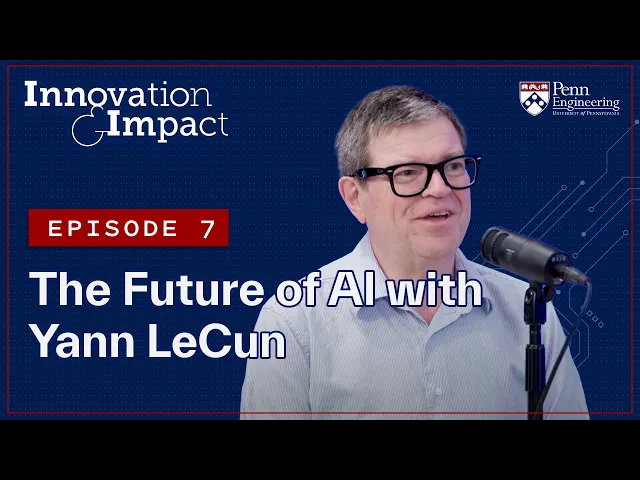
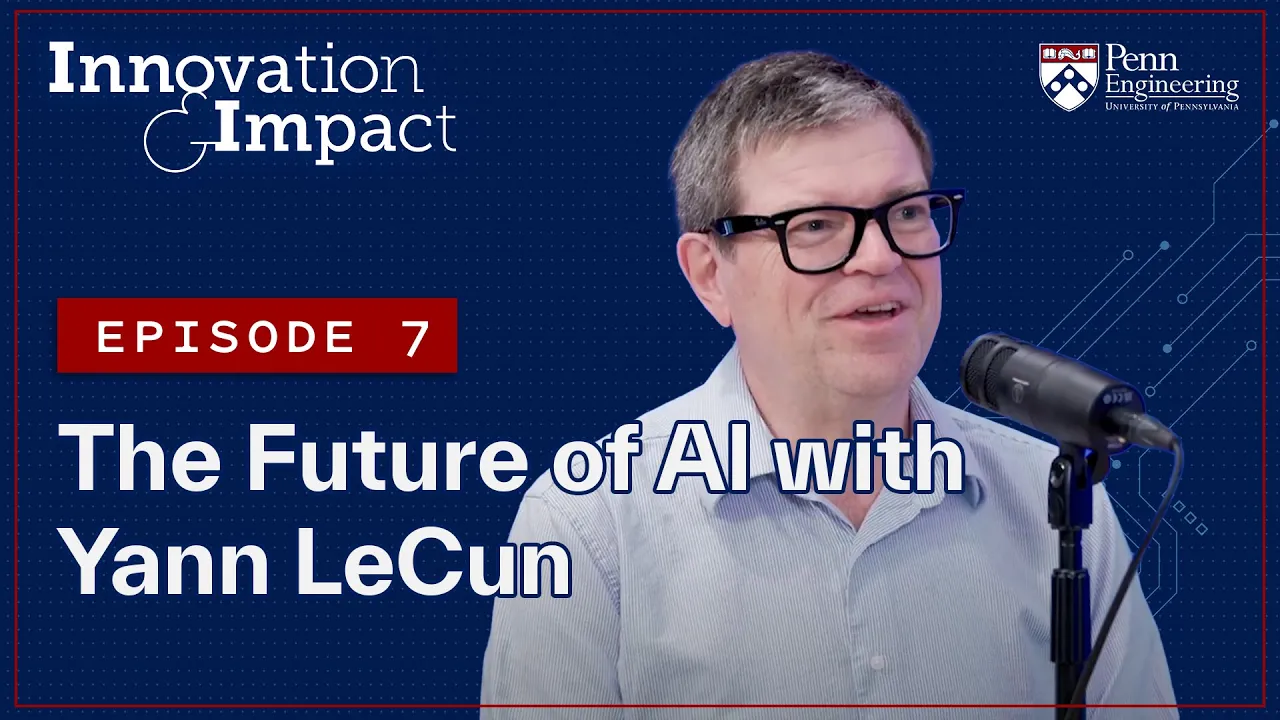
[Music] My name is Vijay Kumar. I'm the dean of pengineering and I'm your host for pengineering's innovation and impact podcast. Our podcast shares insights from some of the leading experts from around the world.
Experts who will bring you the latest breakthroughs and innovations in science, technology, and medicine. Today we're honored to sit down with one of the true pioneers of artificial intelligence, Yan Lun, Meta's chief scientist and a touring award winner. Yan's work has helped laid the foundation for deep learning as we know it today.
And he's at the forefront of thinking about the next generation of intelligence systems. From the realities of AGI to how AI might reshape creativity, work, and even how we govern society, YAN brings not only technical brilliance, but also a vision for where the future is. So, thank you again for joining us, Yan.
Pleasure. So, I'm going to get started with some uh easy questions, but perhaps you'll have some difficulty recalling the early days in the 1980s when you first started working with neural networks. Um, and as I as I remember, you were the first person to think about using it for understanding writing, handwriting.
And I'm just curious what was the backdrop? What made you focus on this problem? What was your motivation?
So, I was not interested in recognizing writing. Uhhuh. uh I was interested in building intelligent machines and something I I got fascinated by when I was in undergrad and when I I realized that people in the 50s and 60s had worked on uh what we now call machine learning although in a fairly simplified form um and I was fascinated by the idea that machines could learn because uh I didn't think uh humans or certainly not me who were smart enough to just design an intelligent machine from scratch that and and and in the uh in the realm of uh living things, intelligence emerges uh from from learning.
And so um so the idea that a machine could learn, I think, was really fascinating to me from the start when I was an undergrad, maybe around 1980 or so. And and then when I really wanted to push this idea, decided to go to grad school and uh find people uh in France um that might be interested in those questions and at a very hard time. No one was working on this in the early 80s um certainly in France but even in North America very few people were working on machine learning what we now call machine learning and certainly nobody was working on neuron nets um but that didn't stop me.
So um so I um kind of figured out you know if you want to build intelligent machines they have to learn. Now what is the simplest uh situation where you can train a system um or or or get a system to learn and that that would be pattern recognition basically or you know maybe computer vision if you are ambitious enough. That's the only domain where there was data.
it would correspond to perception in uh animals which is one of the things that evolved you know where nervous systems evolve to to do um and then the only thing in the 1980s that you could put your hands on in terms of data there were only two domains one was uh character recognition OCR or handwriting recognition if you're lucky and speech recognition speech recognition already had a lot of people kind of working on the on the topic in in sort of various ways and it seemed to be kind of a separate field so I thought um recognizing visual shapes I think was probably a good um a good domain and um and then the next question is how do you build a neural net that can uh recognize shapes it you know probably has to have multiple layers which which is what got me interested in uh what we now call deep learning wasn't called that way back then and then how do you structure those those things so that they can deal with images and that's that's where the idea of conventional neural nets came from. So tell us something about back then tell how how are computers were they you know probably way too slow and today you know we obviously take deep learning for granted partially because the the acceleration in processing speed the storage etc. Tell us what the 1980s looked like when you when you were working on this really hard problem.
So 1980s when I was doing my PhD I had access to uh what was called at the time a mini computer which was capable of about one one MIPS okay not one megaflop much less than this uh and the amount of memory was very restricted and this was like a a big computer that was you know for the entire engineering school I was I was working in and um and so the the amount of computational power we had access to was not nearly what we have now obviously And um and also the tools that we had to develop software was was not nearly as flexible as what we what we have now and so that it was a big effort to you know develop a piece of software that was capable of training neural net for example you know now we can use you know pytorch and we have python and things like this. Yeah none of that uh existed. U then after I graduated I moved to University of Toronto for a posttock.
Um while I was there the department bought um a new type of computer that Sun micros systems had um come up with called a sun 4 and when I was recruited by Bell Labs uh when I was still a postoc my my future manager at Bell Labs asked me um we'd like to just you know order a computer so it's ready when you when you come what kind of computer are you using right now I said well I use a sun 4 u when I got to Bell Labs it was a sun 4 but the sun 4 was just for me whereas University of Toronto, it was for the entire department. Okay. So, so I asked my manager what's uh what's going on.
He said, you know, at Bel, you don't become famous by saving money. Um so I said, I love this place. uh but you know what's interesting is that the time it took at the time to to train accomplish on net to you know recognize handwritten digits was on the order of one to two weeks about 10 days or something like this.
The time it takes to train the best experimental systems has remained constant over for decades now. It's still about a week to 10 days because that's basically determined by how long you're willing to wait to get a new a new result. So it's it's it's more governed by how patient human beings are basically and the timeline of like you know how long you're willing to wait.
I have to remember that you don't become famous by saving money, right? Uh I I wish we could use that philosophy today. Um so we talked a little bit about technology and how quickly it's changed.
Um but I'm also struck by the fact that some of your early papers the techniques that were described you know this idea of using multi-layer back propagation networks and so on to learn very complex um mappings u uh that has still stayed with us and it's it's been commoditized. It it took three or four decades but it's been commoditized and it's still the heart and soul of uh deep learning systems. Would you agree?
Oh I totally agree. Um what I find surprising is that it took so long for you know the majority of the research community to realize how powerful this concept was. But uh these uh multi-layered systems have become more complex in the sense of having more weights more layers.
Tell us about the earliest networks you used and tell us about the networks that people are using today. So the earliest networks um of course the the first experiments were absolutely tiny networks just a few dozen parameters and things like this just because we wanted to understand really what the dynamics of learning was. This was when I was doing my PhD.
uh but I did work during my PhD on uh a two or three layer neural net that was um attempting to do diagnosis of abdominal pain. And so a patient would be described by something like 100 different features. Um and then there would be something like 20 or 25 different uh syndromes or or or diagnosis.
And um the network was actually pretty big and we already faced the issue that um the number of parameters in those networks was was bigger than the number of training samples that we had. And if you if you were to talk at the time to any uh computer, you know, every pattern recognition or statistic person or statistician, they would tell you that's crazy. Like you know, it can't possibly work.
If you have more parameters and you have training samples, you're going to overfit. Um but that turned out to be wrong. It's in every textbook, but it turned out to be wrong.
Uh we we noticed pretty early that uh although it was a good idea to sort of try to make those networks relatively small, um uh making them bigger actually made the system work better in the end. And the this overfitting issue was not didn't seem to be a real problem empirically. Uh and so the the the first convolutional nets that I trained when I I arrived at Bell Labs had uh you know maybe 10,000 parameters free parameters um and a few tens of thousands or maybe a couple hundred thousand uh operations required to compute the output and at the time it allowed us to uh run them pretty quickly on um DSP chips.
So, we had this demo. There's a a video on YouTube of of kind of me putting a sheet of paper under a camera and hitting a key and there is a DSP board with a DSP capable of 10 or 20 megaflops actually doing the computation for the the neural net and it was you know pretty amazingly fast and robust for the for the time. So at what point so obviously compute was a limiting factor at some point uh but then that was no longer a factor but then data was a limiting factor I mean you talked about the difficulty in collecting data with handwritten text for example at what point did that not be that stopped being a limiting factor?
Um so it was always it was always a problem. Um when I was at uh when I arrived at Bell Labs, the the group I was in led by Larry Jackal um had had access to a data set from the US Postal Service um that they obtained through a contract with State University of New York in Buffalo. those.
So the it was basically images of zip code digits and and we we could experiment with this and then after that came uh the NIST data set which we modified and it became Amnest which you know every student now has to deal with in the machine learning course. Um so yeah there were very very few domains for for which we had enough uh data that would make a sort of very sort of heavily learning based method win. And for the longest time in the 2000 when I started to when I restarted a research project in in neural nets and deep learning um the the the dominant data sets in computer vision had very very um few training samples.
Um this is when computer vision started to get interested in in machine learning a little bit in the mid200s and the data sets typically had you know a few categories uh maybe a few dozen or a few hundred samples per category and so that did not favor learning based approach approaches it it favored approaches where you build most of it by hand and you know have a little bit of tuning in the end. Um uh the one of the main data sets was was called Caltech 101. It was collected in um um at Caltech obviously and it had 101 categories but uh only 30 training samples per category and so you could not train a convolutional net to a reasonable amount of performance level of performance with this um and it's not until you know data sets like imageet there were a few before that but they they were not they were kind of peripheral to the interest of computer vision community but really imageet is is where um where things changed because there was all of a sudden there was 1 million training samples and a thousand categories and it turns out having more categories is actually very favorable to things like convolutional nets to deep learning methods and so that that changed changed everything.
Yeah, this just one uh data set imageet that you mentioned really had a huge impact and uh you know philosophically you didn't have to be a computer vision expert anymore to do uh to do a pattern understanding image image understanding or pattern recognition which is it's a bit scary if you think back uh um we started in the 80s with your early work um I'm going to fast forward three decades to 2015 that was the landmark paper that that you wrote with um with Jeff Hinton and Yoshio Benj um that that has been as of this morning when I looked it up on Google Scholar had been cited 100,000 times more than 100,000 times. Um so what was the inspiration behind that paper? Of course it was the culmination of many years of work but I just wonder uh at what stage in your career were you at that time when you when you wrote the paper and did you know that it would be as influential as it is today?
Uh yes and no. Uh so uh Jeff Yosha and I started a bit of a conspiracy in the mid 2000. This is when Jeffington came back from the UK to Toronto and was approached by Sefar, which is a Canadian private foundation to start a a program on whatever topic he thought was interesting.
And he started a program called uh neural computation and adaptive perception and brought together you know in the context of workshops and things like this a number of people who are interested in sort of you know using learning in a bigger way for perception perhaps using connection with uh neuroscience and um and so basically we we said like we know those deep learning methods work nobody really they've been extremely unpopular for the last almost 10 years, right? The interest in this kind of started waning within the machine learning community in the mid '90s. And so how can we kind of revive this the interest in it because we know it works really well.
And so the idea was to kind of show that it works experimentally but also invent new techniques that might allow us to kind of go beyond the capabilities of the system. So we started working a lot on unsupervised learning, self-supervised learning, this kind of stuff. So things that would perhaps allow us to pre-train a very deep neural net uh because we thought we couldn't make the the neural net very deep uh that that you know back prop basically would get stuck or something.
So the idea was to kind of pre-train the layers so that they would be in a good starting point so then we could fine-tune using backrop. Turns out that wasn't actually entirely necessary. You can do back props with many layers as long as you use a combination of tricks like you know values and good initialization and you know all kinds of tricks like this and uh what's called residual connections.
So there's a paper you know famous paper u the that that sort of proposes this idea resnet um the lead author was coming her from at the time Microsoft research in Beijing. This is the most cited paper in all of science in the last 10 years. half a million citations or something like this.
That's remarkable, right? It came from China. This is an interesting thing that a lot of people now, you know, debating about geopolitics of AI should remember there's a lot of good things coming out of China.
Good science. Um Kaiming soon joined uh us at at at meta at fair and uh spent um um eight years at fair and since last year has been a professor at MIT. So um so that that's um um you know an interesting story but um but what happened is because of success of deep learning in the late um 2000s in speech recognition and success in uh image recognition with imageet in 201213 uh and then later in 2015 success in natural language understanding uh It was clear to to the three of us that deep learning was a big thing that could be applied to a lot of different domains and that the larger scientific community should learn about it.
Um and u an editor from nature approached me and said like would you write a review paper on uh on on the topic to introduce the topic to the larger scientific community and that's how this paper came about. So uh I want to go forward another three years. In 2018 you won the touring award which is of course uh the most prestigious award in computer science.
Um looking back well it seems obvious right? Um but in 2018 I think uh the idea that a machine learning expert or machine learning experts would win the touring award uh that was a bit extraordinary. I don't know if you agree with me and I just want I I wonder what went through your mind when you found out that you had been awarded the Turing award and uh and and and also your perception about the the state of u machine learning at that time.
It was a bit of a shock and and and disbelief at first because uh I was in France when uh the the head of the committee Al Spector who um who was the head of the the award um during award committee at ACM was trying to reach me and I was not answering my phone. I was in France you know the with the time difference or whatever. Um and eventually he I managed to be aware that he was trying to reach me and so he he reached me but I I didn't know why and he told me uh I call you to tell you that you want to turn or I said like this is a joke said no is that a joke and uh that was that was certainly a bit of a surprise actually if you had emailed him then if he had emailed you perhaps you would have thought it might be might be a spam or way to get get hold of it but it happened with a more recent prize, but that I I did see it right away.
But to me, the again it's it's obviously I'm not taking away from your work. It's remarkable work, but the idea that computer science would honor somebody in machine learning with this award. Yes.
I I thinking back I said, "Wow, this machine learning has come of age. " Um no, I I agree. Uh and and you know, I I bit have a bit of an imposter syndrome as far as as far as computer science is concerned.
I do not see myself as a legitimate computer scientist. My undergraduate degree is in electrical engineering. My PhD is in sort of Yeah, be careful.
This podcast will be viewed by hundreds of millions of viewers. So, don't say you have imposttor syndrome. I I realize that.
But uh but like I I never learned like all the things that uh at least North American computer scientists consider core computer science. you know, you know, algorithms, complexity theory, systems, you know, all that stuff. I never studied this, right?
So, I have a hard time like viewing myself as a card carrying computer scientist. And so, that was even more of a shock for that for that reason. and and there's a lot of uh departments within uh CS departments uh within the US where you know at the time certainly uh machine learning and certainly neural nets were seen as kind of a little bit outside of the core if you want of computer science.
So I also want to just have you look back on the history uh of machine learning and deep learning in particular. Uh four decades ago this idea of using neural networks was very very esoteric. Today it's mainstream.
I with some probability our next door neighbors would know what deep learning means. Um I wonder if you can reflect on that. H how did this suddenly happen?
I mean didn't happen suddenly of course it happened over four decades but still the fact that it's mainstream it's a household term that to me is still shocking. It is shocking to me particularly when I get stopped on the streets in New York or Paris for by people who want to take selfies with me. Um so it's it's not just a a household term.
It's uh I mean it's impacting everyone's life. AI is is everywhere, right? Yes.
Um but but the fact that um you know there is kind of progress in the science that are attached to this that people can identify I think is is good. Um makes people realize really how the sort of technology that they use every day comes about. It's not like they don't come from the sky, right?
There is real people who who invent those uh those things. And I think that's not recognized enough. Uh even for engineering students, right?
What you learn in first year of engineering studies or or computer science, someone came up with this idea and published a paper about it and maybe won a prize for it. Yeah. Yeah.
Um so again looking at the field today, the hottest thing today is large language models. That's what people when you say deep learning they think LLMs and they think of all these chat tools and so on. Um on the other hand you've gone on record saying that LLMs will be obsolete in 5 years.
I wonder if you can say and again this is mostly for our students who are looking for thesis topics and we're trying to figure out if this is a viable route for them to pursue in AI. Um what advice would you give them? So I'm being deliberately provocative when I say this right and perhaps a little bit excessive but basically uh in my view LLMs are a very useful development in AI obviously a lot of people are using them there is a lot of things to develop on top of uh of LLM to get them make them better to fine-tune them for particular vertical applications there's a whole industry around it which there's there's no issue with this where I have an issue is that I don't believe it's by itself a path towards more intelligence systems that have some level of common sense that have sort of human level intelligence but but even animal level intelligence right so I joke very often that um the most intelligent of our AI systems are actually not nearly as smart as a cat certainly when it when it comes to understanding the physical world so what I think is what we're missing in uh AI today are systems that understand the physical have persistent memory are capable of planning and reasoning but not planning and reasoning by just generating tokens planning and reasoning in abstract mental representations of a of a situation.
Um and I think that's a big challenge for the next decade in in AI and if we make progress over the next five years then that will make LLM essentially obsolete. They'll be replaced by systems that are capable of those uh those four things. um LM will still be useful.
Um but the the the second part of that answer is is the fact that LLM nowadays is in the hands of industry. Um and you know several companies have hundreds of engineers and scientists working on LLMs using you know tens of thousands of GPUs if not more uh you know with engineering support with you know enormous amounts of efforts and it's very difficult for uh an academic group or PhD student to contribute to this other than by kind of analyzing where they work but it's kind of boring a little bit. Um so I think what academia should be focusing on is the next generation of AI system that are capable of understanding the physical world for example and in my opinion that's that will require drastically different architectures from the ones that are you know currently fashionable in the context of LMS do you feel u that there's a there's a gap between where we are today in academia and industry of course the answer is Yes, obviously.
But, uh, the real question is that is the gap widening? Um, and is is it getting harder and harder for academia to play catchup? Well, I don't think academia should even consider playing catch-up.
Uh, there's no way to to really uh to really catch up in that in that in that domain by by working on LLMs. Now in the context of AI, I think a lot of innovative good ideas have come and will come from academia at least is if academic research funding still exists um in the next few years. So um so I think academia has a very important role to play.
Um what is missing really is uh computing resources. doesn't have to be at the same level of scale as we we have in industry but uh but there is you know a need for you know decent sized GPU clusters for um in the hands of academia and some countries around the world have uh kind of natural programs for this where they make those facilities available Europe just announced a big program along along those lines there's not been such a program in the US unfortunately and so some universities like NYU like I just learned uh Princeton have kind of built clusters for that for that purpose. But um I think that's required on on a bigger scale.
That's a that's a great point. I think AC academic investments may not be as focused. Um and AI certainly qualifies for these kinds of investments.
Um I want to come back to something you said about uh your cat. Um, and I I think when you when you have AI agents in the physical world, um, the fact that AI relies on large data sets put AI in the physical AI systems in the physical world at a disadvantage because we clearly don't have that kind of a data those kinds of data sets in the physical world. Uh, um, I don't know what what you think about uh, the catch-up problem there in terms of creating these large data sets and learning from them.
So, I actually disagree somewhat. Uh-huh. Uh so um this is something I've I've said publicly several times but I think it's a interesting uh exercise.
Um if you take the some of the largest LLMs that are trained today like like Lama um LMA is LMA 4 has been trained on on the order of 30 trillion tokens right so 3 10^ the 13 each token is about three bytes so that's about 10^ the 14 bytes u this represents a big proportion of the publicly available text on the internet it would take any of us on the order of 400,000 years to read u for any any single um probably more actually. Um now compare this with a 4-year-old. A four-year-old child has been awake a total of 16,000 hours.
In the course of those 16,000 hours, how much data has come through the brain through the visual cortex? And the answer is about 10^ the 14 bytes in only four years as opposed to 400,000 years. The reason is that you know vision is a very high bandwidth uh modality similar to touch.
Actually, touch is also a very high bandwidth. Audio a little less. And you know, we have two optic nerves, each of which has 1 million nerve fibers, each of which carries about one bite per second.
And do the arithmetics and you get to about 10^ the 14 bytes in 16,000 hours. Now, 16,000 hours is not a lot of video. It's it represents roughly 30 minutes of YouTube uploads.
We have way more um video data than we can manage with uh you know learning systems. The main the main challenge there is not the amount of data. It's uh and we can generate also synthetic data but you know in simulated environments with robots and with action and things like that, right?
Um what we're missing is good techniques to train u a system to understand the physical world by observing video or maybe interacting with in a simulated world or maybe the real world. We don't have good techniques that work for this. The techniques that work for text do not actually work in the context of video.
And the reason is the main qualitative difference between language and the real world is that um language is discrete, right? It's a sequence of discrete symbols. When we train an LLM, we we train it to predict the next token in the text.
But really what we train it on is that we give it a sequence of of words or tokens and then we train it to just reproduce its input on its output. We call this an autoenccoder. Um but because of the architecture of the system, it cannot cheat.
It cannot use the one input to predict the corresponding output. It has to predict it from the previous ones. Um and so that constructs a system basically that predicts is trying to predict the next word or the next token.
It works in a context of of text and discrete sequence of symbols because you can never predict what word follows a sequence of words but you can predict a probability distribution of all the possible words in the dictionary. Now if you want to translate this to the context of video take a video stop it and then train a big neural net to predict what's going to happen next. We don't know how to represent probability distributions over you know snippets of uh highdimensional continuous signals like like video.
We just don't know how to do it. It's a mathematical u intractable mathematically intractable problem actually. Um and so we have to invent new techniques that are not generative models to be able to deal with video.
I made proposals along those lines. I call this JEPA that means joint emitting predictive architectures and basic idea is to learn abstract representations. So that video so you can make predictions in that abstract representation space.
That's what I've been working on for the last uh number of years and we're making progress in that direction. Yeah. So what you're hinting at is that even the fundamental representations in terms of tokens is not powerful enough and we have to rethink how the systems are represented not much less the architecture the algorithms piece right and it's you know it hits on something that robotists have been famous very familiar with for many years called the Moravec paradox yes right where you know Moravec many years ago said why is it that we can get machines to play chess test which is sort of one of the most complex kind of intellectual tasks that humans could could do.
But then we can't get a robot to just you know grab grab an object. Now we can to some extent but but but still we have you know a lot of uh issue. It turns out the the physical world is just much more complicated than language and and the world of uh continuous and highdimensional makes it a lot challenging.
So let me ask you to speculate about the future and where this technology is headed. Uh so if I were to mention AGI to you uh what would you be your reaction? I don't like this phrase AGI artificial general intelligence is predicated on the idea that um what it really means is human level AI right AI systems that have the same intellectual capacity as as humans if not better.
um is predicated on the hypothesis that human intelligence is general and that's just false. Human intelligence is very specialized. We have a hard time accepting the fact that is specialized because all of the problems that we can apprehend are problems that we can apprehend.
You know, there is a whole world of problems that we have no idea that we could possibly solve. And so we think we have general intelligence. We just don't.
So um I prefer to use the the phrase AMI which means advanced machine intelligence or AMI. Um if you pronounce it in French that means friend in French I think it's more appropriate. I love it.
Uh but one point I want to make there is no question in my mind that at some point in the future we're going to have machines that are as good or better than humans in all the domains um where where humans are good. It's not going to happen next year. It's not going to happen in two years.
We might make some significant progress over the next 5 years. It's probably almost certainly harder than we think. So before we reach human level intelligence, we're probably going to have to go through like rat level and cat level or something like that.
Maybe over the next decade and then it's going to take some time after that to really reach uh human intelligence. Um and that requires that will require scientific breakthroughs. It's not just a matter of kind of you know techn technological advances and engineering and scaling up current technology and having faster computers and more more data sets.
It's it's actually kind of coming up with new fundamental concepts about about learning. So maybe I can press you on this a little bit. Uh uh machines are already superhuman along uh narrow axes like you mentioned chess playing.
We can build machines that can run faster than the fastest human being. We can run, we can build drones powered by AI that can fly faster than uh human human piloted drones. Uh but isn't the idea of AGI that you somehow wrap all these axes together and you perform in a superhuman way with everything combined?
Uh that's what people are hinting at. Yes, indeed. U it's is true.
But the um for any particular domain or narrow area, there's always going to be one adoc solution that's going to make machine perform, you know, maybe at superhuman level in that domain. That's basically the history of computer science, not just AI, just all of science. U and we're familiar with this, right?
We have, you know, gadgets, you know, $30 gadgets you can buy at the toy store that can beat you a chess, right? So, it's been around for a while. Yeah.
Um so um so the question is like is there a sort of unifying under underlying principle that would allow a machine to be good or to learn to be good really quickly at all of those tasks? Like why is it that you know we have AI systems that can pass the bar exam. We still don't have domestic robots, right?
We have uh efforts going back 15 years of trying to get going back 40 years actually, you know, trying to get cars to drive themselves. We have millions of hours of training data of self-driving cars for for for car, you know, cars being driven by humans that we could use to train a machine learning system. We still don't have completely autonomous level five self-driving cars except uh you know companies like Whimo but they but they use all kinds of you know exotic sensors like LAR and it's a managed fleet and there's a huge amount of engineering and they can the cars can only work in areas that are completely mapped and there is you know human operators can be called if the car gets stuck.
So, we don't have like, you know, compare this to the fact that any 17-year-old can learn to drive, you know, in about 20 hours of practice. Okay. Obviously, we're missing something really really big.
And that's what I'm after. That's you know I would be I'd be really happy if by the time I I retire which may be coming soon um we have some decent way towards uh you know system that that really learn how the world works like babies um by watching the world interacting with it a little bit and um they really understand uh a lot about the world mostly by observation requiring a small amount of training data really. Let me uh uh ask you a last question on uh perhaps uh uh the macroeconomics of everything.
So do you worry about um AI and future advances impacting jobs? And there are a lot of claims that it'll have a trillion dollar impact, $3 trillion. I mean depending on which uh consulting uh company you you you reports you look at uh you have all these projections.
You ever thought of that? and um and do you think any of these are realistic? Okay, so I'm not an economist first of all, but also a lot of those predictions are made by people who are not economist.
If you talk to economists whose career has been built around or whose expertise is the effect of technological revolutions on the economy and the labor market. people like Philip Aon in France, like Eric Binson who was a student with Philip um at MIT who is now a professor at Stanford uh and a bunch of other people they have a very different language. So first of all they're telling you AI like every other uh technological revolution before before it will not create mass unemployment.
So the idea that somehow, you know, robots are going to do all our work and we we can stay home and most people are going to be destitute because they don't have a job, that's just not going to happen. Eric says we're not going to run out of jobs because we're not going to run out of problems. Um, which, you know, I think is interesting um reflection.
So, uh, that's the first thing. The second thing is you know could there be like a trillion dollar uh business like you know sure if we have you know human level intelligence in robots they can do most of the the jobs the economy will look very different uh and will expand you know the the productivity of individual humans will augment u they're not going to replace humans humans are going to be their boss right so um the future in which we have super intelligent machines whether they are physical robots or whether they are kind of virtual assistants that live in our smart glasses or something like that. They'll be with us at all time.
It's as if all of us will be working around with a staff of virtual people who are smarter than us. And uh you and I are professors. We're very familiar with working with people who are smarter than us or students.
Um it's the best thing that can happen to you. Um we shouldn't feel threatened by this uh by this idea. Uh or intelligence is going to be amplified by it, right?
and our productivity and possibly our creativity also is going to be amplified by it. Um so this is I mean certainly maybe in the best of all possible scenarios this may create kind of a new renaissance for humanity right similar in the effect of the effect of the printing press perhaps in the 15th century Europe but um but um but I you have to be very circumspect about the actual effect. So for example, Eric and um and and Philon have tried to compute how much increase in productivity will result from AI over the next few years uh in like you know GDP growth or something like this and it's on the order of 7%.
Additional you know growth in productivity it compounds over time so it's it's actually big but it's not like enormous. Well, something tells me that you're not going to retire soon and something tells me you're going to be busy with fundamental problems uh to advance the state of AI. Uh so, Yan, thank you very much for sharing your opinions, your expertise and uh and thank you for the contributions to the field.
You've really put AI on on the on the map to success. So, thank you again for joining us. Thank you, Vijay.
It's clear that the future of AI is as complex as it is promising. and hearing it from someone at the very forefront of that future has been truly inspiring. Please subscribe to Pengineering's Innovation and Impact podcast series on your favorite podcast platform.
We'll see you next time.