In 1957, astronomers found something in the sky that shouldn't be possible. An object that looked like a star. But it was too bright to be a star and too far away to be that bright.
So luminous it was visible across most of the observable universe. They cataloged it simply. Ton 618.
Tonintla object number 618. One entry in a photographic sky survey. A dot on a plate.
Strange but unexplained. It took decades to understand what they'd found. It's a quazar.
One of the brightest objects [music] in the universe. powered by a black hole at the center of a distant galaxy. Not just any black hole.
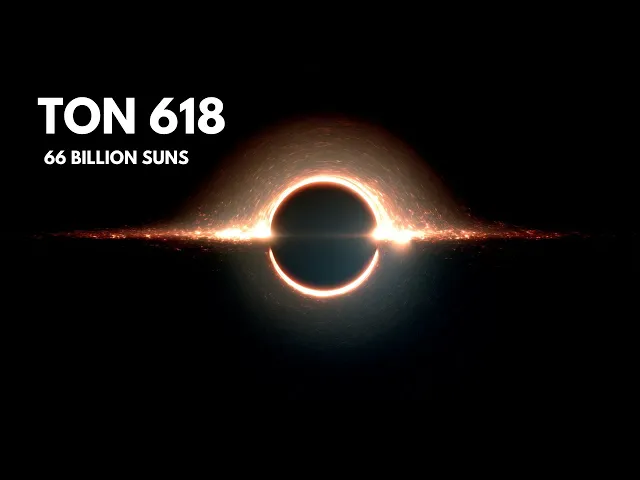
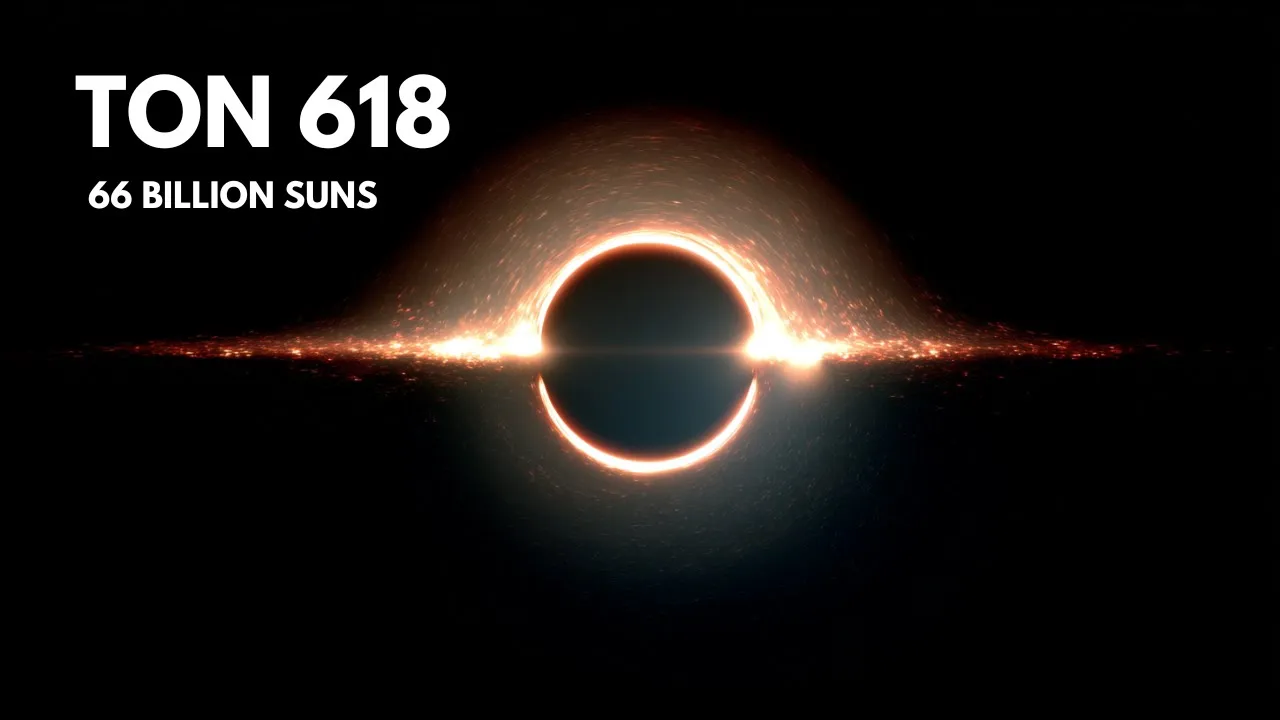
A black hole with a mass of 66 billion times the sun. An event horizon so large you could fit our entire solar system inside it. 40 times over.
One of the largest black holes ever discovered. Tonight we are visiting a monster. An object [music] so massive, so distant, so impossibly bright that it challenges [music] everything we thought we knew about how black holes grow.
The light we see left ton 618 when the universe was only 3 billion years old. We're watching ancient history and what's happening there now, right now in this moment, we won't know for 10 billion [music] years. Let's begin.
A quazar. The name is short for quasi stellar radio source. something that looks like a star but isn't a star at all.
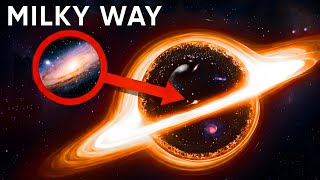
What it actually is, a super massive black hole actively feeding. Picture this. At the center of a galaxy, a black hole [music] pulls in everything around it.
Gas, dust, stars that drift too close. The material doesn't fall straight in. It spirals forming a massive disc [music] around the black hole, an accretion disc.
As matter spirals inward, it accelerates faster and faster, approaching the speed of light. The particles collide, friction heats them, and temperatures [music] reach millions of degrees. At those temperatures, the disc glows, radiates energy across the spectrum.
X-rays, ultraviolet, visible light. So much light that it outshines the entire galaxy surrounding it. Hundreds of billions of stars.
And the quazar becomes visible across the universe. This is what a feeding black hole looks like. Not dark, not quiet, blazing.
Ton 618 is one of these objects and it sits unimaginably far away. In today's expanding universe terms, ton 618 is about 18. 2 2 billion light years from Earth.
But the light we're seeing left turn 618 about 10. 8 billion years ago when the universe was approximately 3 billion years old. The universe is now 13.
8 billion years old. We're looking back across more than 10 billion years of cosmic history. At the center of that distant quazar is a black hole 66 billion times the mass of the sun.
To put that in perspective, Sagittarius A star, the black hole at the center of our Milky Way galaxy, has a mass of about 4 million solar masses. It's the gravitational anchor of our entire galaxy. Massive beyond comprehension.
Ton 618's black hole is 16,500 times more massive than that. It's one of the largest black holes ever found. Only Phoenix A, a more recently discovered black hole estimated at around 100 billion solar masses, might be larger, but the measurements are less certain.
Ton 618 is confirmed, measured, real. And to understand what 66 billion solar masses actually means, we need to talk about scale. Every black hole has a boundary called an event horizon.
The point of no return. Cross that line and gravity is so strong that nothing, not even light, can escape. For a black hole with the sun's mass, the event horizon is about 3 km across.
A tiny sphere. For ton 618, the event horizon has a diameter of approximately 2,600 astronomical units. An astronomical unit, AU, is the distance from Earth to the Sun, about 150 million km.
It's how we measure our solar system. Earth to Sun, 1 AU. Sun to Mars 1.
5 AU. Sun to Jupiter 5. 2 AU.
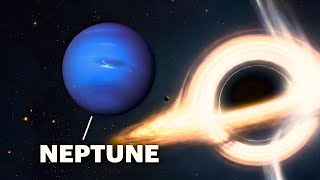
Sun to Neptune, the most distant planet, 30 AU. Ton 618's event horizon is 2,600 AU across. That's 40 times the distance from the sun to Neptune.
If you placed Ton 618 where the sun is, its event horizon would stretch past Neptune's orbit and keep going 40 times farther. You could fit our entire solar system inside the event horizon and then fit it again and again, 40 times total. Think about that for a moment.
Everything we've ever known. Earth, Mars, Jupiter, Saturn, all the planets, the asteroid belt, the Kyper belt, every comet, every piece of rock orbiting our sun fits inside Ton 618's event horizon 40 times over. Light traveling at 300,000 km/s takes 11 days to cross from one side of the event horizon to the other.
For comparison, light takes 8 minutes to travel from the sun to Earth. About 16 minutes to cross Earth's entire orbit around the sun, but 11 days to cross T 618's event horizon. 11 days of traveling at the speed of light, and you still haven't crossed from one side to the other.
Now consider the mass itself. 66 billion times the sun. The sun weighs about 333,000 Earths.
It's so massive that its gravity holds eight planets [music] in orbit across billions of kilm. Ton 618 is 66 billion times more massive than that. That's 22 quadrillion Earths.
[clears throat] 22,000 million million Earths. If you somehow lined up planet-sized objects, each one as massive as Earth, side by side, you'd need 22 quadrillion of them to equal Ton 618's mass. That line would stretch across the observable universe millions of times.
Let's compare it to other black holes we know. Sagittarius A star at the center of the Milky Way. 4 million solar masses.
Enormous. Its gravitational influence [music] extends across tens of thousands of light years holding our entire galaxy together. M87 star.
The black hole photographed by the event horizon telescope in 2019. The famous image of the orange ring around darkness. 6.
5 [music] billion solar masses. One of the most massive black holes we'd measured before ton 618. Ton 618.
66 billion solar masses. 10 times more massive than M87 star. 16,000 times more massive than Sagittarius A star.
And here's the question that haunts astronomers. How did it get this big? Black holes grow by consuming matter.
Everything that crosses the event horizon, gas, stars, entire solar systems, adds to the black hole's mass. But there's a limit to how fast they can grow. When a black hole feeds, the infalling matter radiates energy.
That radiation creates outward pressure, pushing surrounding material away. It's called the Edington limit. The black hole's own feeding slows its growth.
Yet somehow, ton 618 reached 66 billion solar masses within the first few billion years of the universe. How? We don't fully know.
It might have started with a massive seed, an enormous gas cloud collapsing directly [music] into a black hole, or it might have somehow fed faster than the Edington limit should allow. Either way, ton 618 grew to 66 billion solar masses, impossibly fast. And while it was growing, it was shining.
Active quazars are among the brightest objects in the universe. The feeding process, matter spiraling in, heating to millions of degrees, radiating energy, produces light that can be seen across billions of light years. Ton 618 at its peak was approximately 140 trillion times brighter than the sun.
140 trillion. The sun is bright enough to light our entire solar system to provide all the energy for life on Earth to be visible from Pluto billions of kilome away. Ton 618 was 140 trillion times brighter than that.
Imagine standing on a planet orbiting a star in that distant galaxy looking toward the center. The light from the quazar from ton 618 would be so intense it would outshine everything. Every star in the sky combined wouldn't come close to the brightness of that central point.
The quazar was brighter than the entire galaxy. Hundreds of billions of stars and the quazar at the center was brighter than all of them. And even though that light has been traveling for more than 10 billion years, we can still detect it with our telescopes.
But here's the thing we need to understand. The light we're seeing left ton 618 about 10. 8 billion years ago.
It's been traveling through space ever since. Through the expanding universe, past forming galaxies, past stars being born and dying. For more than 10 billion years, that light has been traveling toward us.
What we're seeing is not 10618 as it is now. We're seeing it as it was when the universe was 3 billion years old. So what is ton 618 like today, right now in this present moment?
We don't know. We can't know. Light from ton 618's present day won't reach us for another 10.
8 billion years. By then, the universe will be incomprehensibly older. The sun will be long dead.
Earth will be gone. And only then will we see what ton 618 looked like today. It might have gone quiet billions of years ago.
Black holes eventually consume most of the gas and matter nearby. The accretion disc thins. The fuel runs out.
The quazar fades. What's left is just the black hole. Silent, dark, no longer feeding.
Our Sagittarius A star was probably a quazar once billions of years ago. Now it's mostly dormant. It flares occasionally when a gas cloud drifts too close.
But the era of constant feeding ended long ago. Turn 618 might be like that now. A 66 billion solar mass giant sitting silently in the dark.
Or it might still be shining, still feeding, still blazing across the cosmos. We won't know for billions of years. We're separated not just by distance, but by time.
A more than 10 billionyear gulf. We can never cross. All we can see is the past.
Ancient light from a younger, more violent universe. Ton 618 tells us something profound about the early universe. When we observe it, when we see that ancient light, we're seeing the universe at approximately 3 billion years old.
And already the black hole had reached 66 billion solar masses. This is faster than our theories predict. Black holes grow by consuming matter.
But the Edington limit, the radiation pressure from [music] feeding, slows that growth. Even under ideal conditions, there's a maximum rate at which a black hole can accumulate mass. Yet, Ton 618 reached 66 billion solar masses [music] in roughly 3 billion years.
That suggests one of two things. Either the black hole started with an enormous seed, perhaps from the direct collapse of massive primordial gas clouds in the early universe, skipping the star formation process entirely. Or it somehow fed faster than the Edington limit should allow, violating the theoretical growth rate we thought was absolute.
We don't know which or if it's both or if there's something else we're missing entirely. Ton 618 pushes our understanding to its limits. It shows us that in the early universe when things were denser, more chaotic, more violent, black holes could grow to sizes we still struggle to explain.
Quazars were most common when the universe was between 3 and 4 billion years old. This was the peak of black hole feeding. The universe was filled with gas, fuel for black holes.
Galaxies were colliding, merging, funneling matter into their centers. Ton 618 represents that era, the peak of cosmic violence. Now 10 billion years later, most quazars have gone quiet.
The gas has been consumed or blown away by radiation pressure. Galaxies have settled into more stable configurations. Black holes sit dormant, occasionally flaring, but mostly silent.
The feast is over. Ton 618 shows us what the feast looked like when super massive black holes grew to incomprehensible sizes. When they outshun entire galaxies.
When the universe was young and turbulent and blazing with light from feeding monsters. The light we see from turn 618 left its source 10. 8 8 billion years ago.
It traveled through the expanding space, past galaxies forming, evolving, colliding, past stars igniting and dying through the vast emptiness for unimaginable time. And it reached us, a faint signal from near the edge of everything we can see. What we observe is not ton 618 as it is, but as it was.
Ancient history frozen in light. A snapshot of the early universe when black holes were still growing, still feeding, still blazing. Turn 618 as it exists now in this present moment.
18 billion light years away is unknowable. We're separated by more than distance. We're separated by time itself, by billions of years between what was and what is.
The monster might be quiet now. The feeding might have stopped long ago. The accretion disc might have thinned to nothing.
The light might have faded and all that remains is a [music] 66 billion solar mass black hole sitting silently in the darkness. Or it might still shine, still feed, still grow. We can't know.
And even if we wait, even if humanity survives for millions or billions of years and we turn our telescopes back to that point in the sky, we'll still only be seeing the past. Always delayed, always looking backward through time. Never the present, only echoes.
Somewhere 18. 2 [music] billion light years away, turn 618 exists right now in this moment. Whether bright or dark, feeding or quiet, growing or dormant.
But we can't see it. We can only see what it was billions [music] of years ago. A monument to the early universe.
to the era when black holes grew beyond comprehension. To the extremes that physics allows, one of the largest black holes we've ever found. And all we have is its ancient light traveling across the cosmos, carrying a story from when the universe was young.
A story we'll never fully know the ending to. Because by the time we could see Ton 618 as it is today, it will already be something else. And we'll still be watching the past.
Always the past. The light continues its journey from the edge of everything, carrying its message across billions of years. And we watch and wonder what's happening there now knowing you'll never see it.