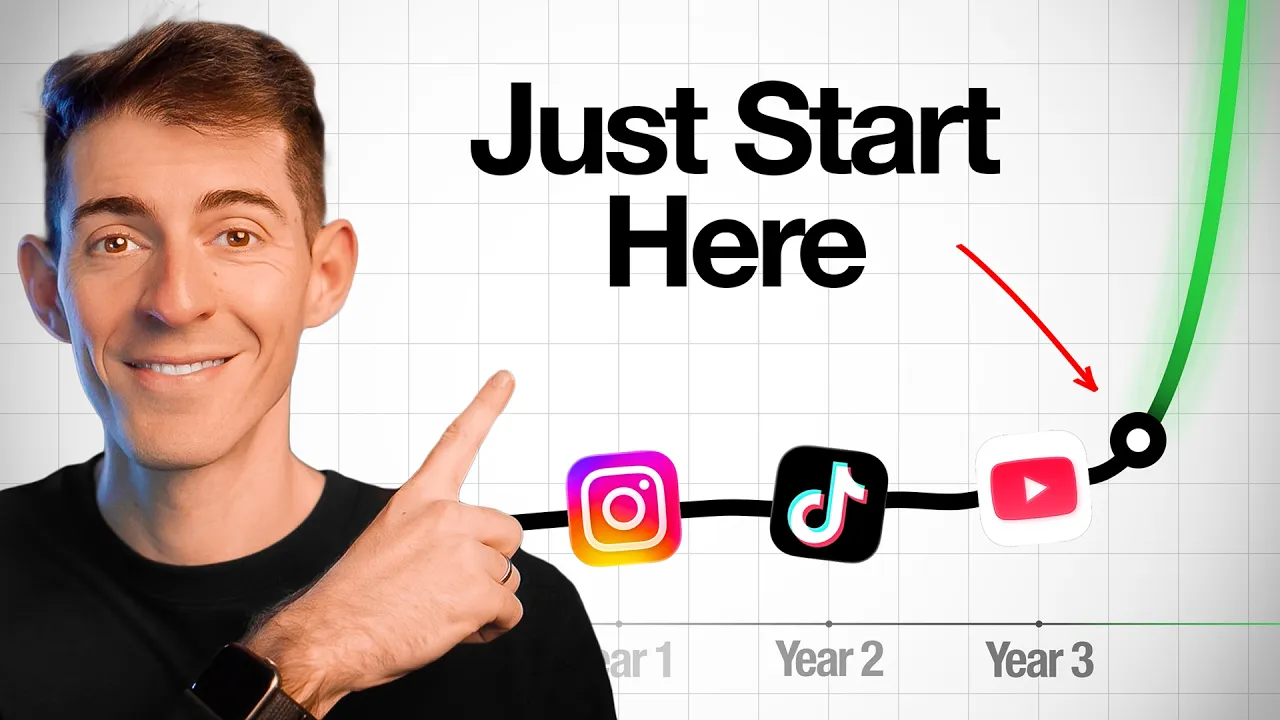
In this video, I'm going to break down how to speedrun social media. I'm talking zero to a million followers in just 6 months. Now, I've studied every single creator that's come even close to this type of growth. And it turns out, not only is this possible, but they all run the exact same playbook to do it. So, I'm going to break down the whole thing. This is the full formula for how to speedrun social media. If you want to Go from zero to a million followers as fast as possible, these are the six things you
have to do in your positioning and your content strategy to make it happen. Now, I know this works because content is all I do all day long. I have a million followers. I've done billions of views. And I've literally helped hundreds of entrepreneurs and creators rev up their personal brands using these tactics. So, if you're trying to grow faster, you're Going to want to pay attention. All right. Now, first of all, if you want to grow this big this fast, these three things are going to have to happen. One, you're going to have to go
from zero to owning your own lane in a niche pretty quickly. Two, you're going to have to get a ton of views in that niche. And three, you're going to have to convert a lot of those views into followers at a much higher rate than normal. But mechanically, these are the only three Things that have to happen in order for you to go from 0 to a million followers. So, the six tactics I'm about to walk through will give you an unfair advantage at accomplishing those three things. Building a cult-like personal brand, revving up the
views significantly, and increasing the view to follower conversion path. All right, let's start with number one. I call this bingeability. The people that grow the fastest are able to build connective Tissue between their videos. Meaning, when a viewer watches one, they feel like they need to binge and watch 10 more in the same session. Now, this is really important because if somebody watches four to five of your videos back to back, they are 10 times more likely to follow. And the reason for this can be explained by my content minutes framework. To get someone to
take an action, you need them to consume a certain number of minutes of your Content. To get a follow, in most niches, this only requires four to five content minutes consumed. So, basically, you're in a race to get that viewer to watch five of your videos so you can earn the follow before they get bored and lose interest. Now, the best way to drive one of those binge sessions is to create a series where the viewer actively wants to go from one video to the next. In other words, you force that connective tissue. And this
works Because the human brain was designed to complete puzzles. If you tell someone there's five steps and you give them the first three, they're going to want to know what number four and five are. So when you have a series like this is day seven of 10, people want to go back and watch all the previous episodes and that creates the bingeability to get them to that follower conversion moment. Now there are two types of series that you can make. A hard series is one with a Finite number of episodes that is literally stated by
the creator. And this is what Khloe should did really well. Her series was 30 lessons before 30. She literally went from 0 to a million followers in like 4 months. And almost all of the growth was on the back of this 30-day series. Now, these numbered series are super useful because they give a set number of episodes for the viewer to look at. And if you get dropped into a good episode, typically You're going to want to scroll back and watch all the previous ones. Now, a soft series is something like what my friend Maxim
did. He goes by by Maximize on Instagram. He doesn't actually number the videos like Kloe or even name them under a series, but every one of his first 100 videos felt like it was an episode from the same thematic grouping. He would aim his phone at his laptop, press the space bar, show you an interview with some famous person, and Then zoom into it and take you on the ride. You could get lost in his profile for 20 to 30 videos in a row if you really like this way that he presented information. My friend
Orin is the same way. He's kind of in the middle between Khloe and Maxim with his series Product versus Brand. It's not numbered like Khloe's, but every single one of Orin's episodes starts the same way. Are you buying for the product or are you buying for the brand? And then he breaks down a Category. Again, if you see one of Orin's product versus brand videos and you like it, you're going to want to go to his profile and see if there are other ones like it because it feels like this episodic series. And that turns
one view into eight views, which gets you over that content threshold and drives the follow. The truth is, most of the big creators, if they haven't done a hard series, almost all of them are structuring their videos into episodic Themes or pillars. So, your goal, if you're trying to grow super fast, is to come up with a unique series concept for your niche. And it can be numbered or not. Numbering obviously helps give the viewer a set number to look at, but it can also be a treadmill that you might want to get off of.
So, if you do it numbered, do it 7, 10, 25, 30, some set number, either weeks or months, that you can have all the videos relate to one another and come out daily. The goal is That they need to match theme, vibe, and topic bucket. Now, when you're trying to develop what a series could be for your niche, you want to try to frame them around a painoint, a desire loop, or some storytelling arc that you're interested in. For example, Khloe's series was 30 lessons by 30, which basically frames the 30 most important things she
learned before turning 30. This is a massive total addressable market, but also a very clear pain Point. Anyone in their 20s trying to improve their life might resonate with these lessons. That's one of the reasons why this series worked so well. The content was obviously great, but there were so many people that could see any of the episodes, relate to it, and then want to jump in and see the rest. Here's another example. This is the 100day Film School from TMS Productions. Now to me it is wild to commit for 100 days in a row
but this series absolutely crushed For them and it works because it clearly communicates that anybody trying to learn filmm and close that painoint is going to get a daily course for 100 days dripped for free. And here's one more series just so you have tons of examples. This guy Yanni we've talked about before on the channel built a series storytelling daybyday as he rehabbed a vintage bowling alley. Now this is more on the entertainment side but this one crushes from a storytelling Perspective. It gets people to buy in and support and then that ground swell
of attention helped him and his business. Now, before I end this point, one last thing to warn you about on series. It can be extremely easy to get into an overthinking spiral about trying to frantically figure out what series you're going to do before you post and that be the reason why you don't get started. So, you want to avoid that at all costs. Here is an exercise you can Run to help you figure out what series would make sense for your niche. Think about the biggest pain points or interest areas in your space. And
then ask yourself, is there a bucket of things that could be split up into individual episodes? Or a question that could be answered over and over in similar but different ways? For example, if you're a food creator that tries sandwiches, could you do 20 sandwiches in 20 days where you go around to Different restaurants and every episode looks the same? Or if you're an accounting creator, could you do 10 days to lower your taxes? And in this case, each day of the series is kind of building on itself until you've saved a certain amount of
money. Or if you're a Vibe Code creator, could you do a series where you take popular software and rebuild one every episode and show how much cheaper and easier it was for you to build than the expensive version? Once you start thinking in these terms, it'll be a lot easier to come up with compelling series. Honestly, you'll be overwhelmed with ideas and really have to parse through to make sure you pick the right one. Also, one last warning. Typically, when people commit to posting every day for a certain period, they almost always get burnt out.
So, if you don't think you're going to be able to commit and fulfill that obligation, don't do a hard series where the Episodes correspond to every single day. Just do a soft series. Because if you're speedrunning and you're trying to grow this fast, this quickly, you cannot post filler videos that just fill the feed. Every single rep needs to be an intentional improvement on the previous. So, if you don't think you're going to be able to stick to the daily posting, that's fine. Just do a soft series and post that way. If you want help
figuring out what series to make, the easiest way Is to just study the top creators on Instagram and Tik Tok and figure out what worked for them. You're obviously not going to copy their series exactly, but just seeing the structure, even orange product versus verse brand, A versus B, it can be really helpful to see that and then think about how something similar but different could apply for your niche. To do this and see what works for the best creators, go to sandcastle.ai AI and build a watch list Of your favorite creators and then pull
them up in the videos tab sorting by most views. This will give you all their videos in one place in one feed and you can start to see the trends pretty quickly. So for me, you can see I built a watch list with 23 of the top marketing creators in the world. And so if I want to see what videos are working best, I look at this cohort view. Then I can go to the channel filter and individually pick one channel out of Those 23 and look just at those videos. When you do it like
this, one channel at a time, immediately it starts to pop out what series performed the best because when you sort by most views, all the best performers bubble to the top. This is what I use to get inspiration for figuring out what's trending or what's working from the top creators. Super helpful. All right, let's move to step two. If you want to grow faster than everyone else, you need to have unique Visual positioning. I call this a signature visual style. Your visual format and the visuals you use have to be unique and different from what
people normally see. This doesn't mean they have to be cinematic, but they have to jump off the page and force the scroll to stop because they're so different from what people typically see in the category. Now, I know hearing that can trigger anxiety and frustration in people if you're not good with editing Or motion graphics or visual design. But don't worry because I'm not either and I was able to figure out my signature visual format. So, I'm going to show you how to go about that even if you're not good with visuals. But the reality
is social media is a visual slot machine. So if you want to grow faster than everyone else, you need to be unique when it comes to your visual packaging. You have to have an answer for this. Now, personally, I think of myself as Someone with above average taste, but below average ability to actually fulfill creatively to make that taste. So, I can't actually make the visuals with my own hands, but I could see good verse bad and distinguish it. If that sounds like you and you're sitting there and you're not sure how you're going to
close the visual gap, let me explain exactly how I think about it and what will work for you. Your signature visual style is made up of four components. Your look, your set, your shot framing, and then the editing, which is like a catch-all bucket for motion graphics, typography, colors, and really everything else you can do. Let's go through each one of these quickly, talk about what it looks like, and then I'm going to show you a couple examples of really good signature visual formats, signature visual styles, and break down how they did them across those
four buckets. Again, cracking this will make You grow so much faster. If you figure this out before you start posting, you're going to be golden. Okay, the first part in the visuals is the look. And this is made up of literally how you look as well as how you dress, like what you wear. Now, if you're just really hot, you might not need to do anything else. And sadly, that's just the way it is. Look at Alex Earl. She's super hot. She has a good personality. Her set is basically just a random room. She has
Almost no visual differentiation in the shot. Literally just straight on eye level. And she does no editing. And yet, she grew millions of followers in a few months. And her brand deals, every time she makes a post, she makes six figures. That's real fandom, real money from brands. Now, obviously, if you're sitting there, unless you're going to do plastic surgery, you can't change how you look, but you can change how you dress and what you wear to kind of fit The look that you want. And that will definitely help elevate your character branding based on
the type of niche you're playing in. But that's only one of the four factors. So, let's move on. The second piece in the visual positioning is your set. And this is the background of wherever you're shooting. This can literally be a studio like what I have that you set, it's fixed, or in the world, you go in environments and shoot. It could also be if you're using Green screen and you kind of create cinematic or visually interesting sets that aren't really there. Anything like that applies in the set. Now, set design is super underrated and
one of the easiest ways to visually pop on the feed without having to do a ton of work on every rep. My friend Mark has used set design better than almost any new podcast I've ever seen. And the reason why his clips pop so hard on social media is because visually when you see His sets, it just looks different than anything you've seen. Okay. Third is your shot framing. And this is the angle, frame, and distance that you are away from the camera. Now, most people, like Alex Earl, for example, just shoot frame on, eye
level, standard, and keep the camera locked off there. That's what I do. I don't change this shot at all. It's one camera. But there's no rules against changing this. You can go out and shoot a ton of different angles and Shots to add visual differentiation, and this will help build a signature style different from what everyone sees. This guy, Musa, was famous for this fisheye lens shot with the camera in the corner of his bedroom. He made like 2 million bucks before he was 19. Take that for what it will, but he kind of pioneered
that look and all he had to do is change the angle and perspective that he was shooting in. If you want a free resource that shows you a lot of different shot Angles just to give you a reference, there's a site called eye candy.com. It's spelled a little weird, so just look in the description. You could also use Higsfield, higfield.ai AI with the Nano Banana Pro, the brand new AI image model from Google. And you could put one screenshot of you in there and then ask it to give you 10 other angles and tell you
where to put the camera and what focal length to use to get those angles. And it will do it automatically. It's Pretty crazy. So, you can basically simulate your own shot library automatically with AI. Now, fourth in the signature visual format is the catch-all bucket for editing. And this really is what most people think of when I say signature visual style. They think of the B-roll, the colors, the motion graphics, the animation, the typography, like all the stuff you can do to the shot. Now, there is an endless amount of stuff you can do here.
And again, I Really don't know how to edit. I had to teach myself the very basics, but I'm not good at it. I don't know how to use After Effects, so I just hired an editor as soon as I could to handle building the cinematic world for me. Now, I know not everybody can afford editors in the beginning. I totally get that. But if you want to hire the same editors that I use, both for long form that everything you see, they built that world without me giving them any direction and short Form that's gotten
me billions of views on tech. If you want to hire those same editors, I have a link in the description below. I'll connect you directly. But if you can't afford editors or you don't want to work with them for whatever reason, here's what I would do. I would go to Sandcastles and I would go to the projects tab and create a folder called visual styles. The projects in Sandcastle are just different ways you can organize videos. Then I would save one video from each of my favorite creators that I like the visual look of into
that folder. And so literally all you have to do is just go to the videos tab, go to the channel filter, pull up their channel, you see all their videos, sort them by most views or outlier score to get like the best ones at the top. Click into one, click save to projects, and then save it into your visual database. After doing this, you'll have a visual styles Library of all the visual styles you've collected. You can add to this over time so it's all in one place and not all over the place in like
an Apple note. And so the reason this is helpful is because when you're trying to build a visual style, you can click in, watch the video, and then analyze what they've done across the four aspects that I just talked about. I'm going to go through two examples right now to show you how I would do this. But this is the exercise You can run through. You kind of scroll for 2 hours, assemble them all in one place, and then you can kind of analyze, okay, how did they approach the look? How did they approach the
set? How did they approach angles? How did they approach editing? Which of those things can I take and use as inspiration for my visual format? Also, if you want to be really different, and I think Orin's probably the best at this, you can look at other mediums, not social media, but Even not even digital, you could look at vintage western magazines would have amazing imagery and layouts that you do not see typically on social media. So, if you just take a photo of those, load them into Nanabanana Pro, it'll build you a whole brand library
and a bunch of other images based on that one picture. It's pretty wild. Now, let's look at two different signature visual styles, and I'm going to explain across the four categories what exactly they're doing And why they stack together so well to cut through the feet. Now, all these people, the two that I'm going to walk through and then all the other ones I'll list, they're all attractive. So, I'm not going to comment on like their body composition, but I will say the way they dress really does matter cuz they dress differently for different types
of viewers and it works super well. Okay, first we have Khloe. I mentioned her already. She crushed. She grew super Fast. Now, if you watch this video on the screen, I'm going to break down these four pieces. The first was the look. So, I want to comment on how she's dressing. She's both dressing almost like a costume to complement the character. So, like this video, she's a painter. She's kind of dressing like this trendy painter, but she's also switching into outfits that map to like a classy working professional girl in her late 20s, which is
kind of who she's Trying to attract. So, it it perfectly signals exactly what personal brand visually that she wants to communicate. Now, for her set, she uses a combination of inworld shots, but they're all shot in the same way. They're kind of cinematic. I wouldn't say crazy on the like movie level quality, but they're more cinematic than just like a standard iPhone shot. And they're all shot in the same way. Light and airy and like realistic. So, they all have the same Vibe. Now, on the shot framing, this third bucket, this is one of the
places where she really shines. She takes a ton of shots at different angles. You see the ones zoomed in of her hands on the computer. She's got front on. She's got changing angles as she turns. This makes a huge difference in keeping the dynamism of the video high as she's telling the story. And then fourth, on the editing side, what she does is actually pretty minimal because she Spends so much time on buckets two and three, actually getting the shots in the world at different angles. All she has to do is quick cut between those
and it handles a lot of the motion and visual change that you would want. She does do two things in the edit that I think are really signature to her. One, she uses fonts in a really great way. She spaces them out and lays them out based on the composition of the frame. And then she uses a couple different fonts to kind of Like tastefully signal to her brand. So that's one thing. The other thing, occasionally throughout the video, usually once at the beginning in the hook and then once throughout, she uses like a magical
seeming animation. So with the paintbrush one, she like draws with the paintbrush and kind of animates the stroke. That's just like a tiny little signature detail, but she only has to do a couple of them and it creates this like magical high quality Feeling for her. So these four aspects, the way she's kind of dressing in costume as a classy professional, the way she's taking in world shots that are all light and airy and like on brand, the way she's varying the shots, and then her editing, the typography, and those little magic moments, those four
things stacked together to create what is now kind of considered the Khloe Sha style. And once she had that dialed, it took a while for her to experiment with It, but once she had that dialed, she never had to think about visual strategy again. All right, let's take another example in a completely different niche. This is JB Copeland. You may have seen him on Instagram. This guy's huge, 1.8 million followers, and his visual style is actually way easier to execute than Khloe's. Each of his videos probably only take him like 15, 20 minutes total to
make, but it's obviously working, so we should break it down. Now, on the Looks front, again, not going to comment on his looks. He's an attractive cat. But on the clothes side, he always dresses in something really cool looking. Like, he's on trend. The colors pop. His outfit is fitted. Like, it it looks good. and he's trying to attract this like both kind of young aspirational male audience that's sensitive and trying to figure them out but also appeal to women. So he has like a huge tam with the way he looks. Now His set design
bucket number two is really where he shines. This is his differentiation. He was kind of the first creator to have this like cinematic look with the gallery wall behind. And because the way he's lighting it with his like warm ambient lighting, it creates this like safe and cozy environment. But that could just be a room in his house or maybe it's a set studio but he built it one time. every incremental video, he doesn't have to Touch it. He can be in the same set because it transfers like the emotion and the safety of his
niche. It works super super well. So, that's really where he shines is is bucket number two with the set. Now, bucket number three on the shot framing, he doesn't really do anything. He has one shot. It's locked off at the eye level. You know, he's editing. This is more the editing bucket, but like jump cutting in and out, but he's not changing the shot at All. Super simple. No work there. And then on the editing front, he really does almost nothing, but there's two things I want to comment on. They're not really visual, but they
kind of fall into the editing bucket. For one, he edits super slow pace-wise. So, his music, which is the second piece, is mood matching his tenor in his voice. So, he's trying to be very calm and very like therapeutic and say, "Listen, it's not a problem the way you're doing these Things, right? He's at a very slow cadence. The music matches that cadence, but also he's editing with space to create that flow so it feels comfortable. This inherently is a difference compared to all the crazy retention editing on the feed. So, it's not visual, but
like he is doing those two things in the edit. The typography is pretty standard. He's not doing any flashbangs or anything else. So, if you really audit this guy's style, what he's Wearing helps. The way he looks helps. But the big thing is his set design is so dialed that it just pops right off the feed. The point is, these are two very different approaches at building your signature visual style. But both when Khloe and JB figured them out and it worked, they knew they didn't have to spend a ton of time reinventing the visual
strategy every single time. And that's why it's so critical to nail this. Those separated them from the Niche immediately. And you could tell based on the traction. Now, I have a lot more examples of signature visual styles across a bunch of different categories. Adrien Purr, if you ever seen him, he has a great one. Carl Shakur, one of the sickest like cinematic traveling creator styles. Roberto, my homie, RPN, the best in tech. He's got the best cinematic style in tech. Gakuen, I hope I'm pronouncing that right. Or Gakuen in the film making space, he's amazing.
Ava in The personal brand, social media growth space, amazing. And my friends Alex Garcia and Orin, also really great marketing and branding. All of them have different unique ways they stack those four pieces. And it doesn't just have to be cinematic, right? Ava style is not really cinematic, but it's very signature. Immediately, you know it's her and that sticks out on the feed. It's very memorable. So, these are a lot of examples you can go study, but Typically any creator you remember, they're going to have the signature visual format dialed. All right, just to recap
where we're at before we move on. I'm walking through the six core things you must do in your content positioning and strategy if you're trying to grow faster. In this case, from 0 to a million followers. So far, we've covered two huge ones. The first one was building that connective tissue, that bingeability with a core series. And Then number two, what we just went through was building your signature visual style. Both of these will help you cut through and stand out on the feed much quicker, which will make people want to binge your content and
follow faster. Now, before we keep going, if you like the way I'm breaking this down, this is kind of just like how I do it. I've got a free community for entrepreneurs that are trying to get better at content. It's called Wavy World. We have 65 free trainings just like this, 38,000 entrepreneurs that are all in there working together in small groups trying to help each other. So, if you want a peer group and you also want to just elevate on either social media or YouTube, you should definitely join. It's completely free. Got a link
in the description if you want to join. All right, step three in the six-step playbook is called building your unique edge. We talked about the visual piece, Which is very important, but perhaps even more important is the actual substance that you say in the video. If you want to grow super fast, you have to figure out how to carve your own lane in the niche. And the best way to do that is by actually having interesting things to say or by saying them in an interesting new way. Okay, so what does all that actually mean?
If you want to be interesting or valuable, you really have two options. You either say Something people haven't heard before, that's new information, or you say something they have heard before, but you say it in a new way. That's new delivery. You have to have at least one of the two, new information or new delivery, or you just will never cut through. For example, that guy JB Copeland, he grew super fast, but he was pretty much sharing basic mindset therapy style tips. Anyone could have looked that up. Those could have been Oneliners off poems or
fortune cookies or whatever. Anyone could have found that. But his difference was his delivery style and his vibe. He slowed everything way down almost uncomfortably so for someone on the feed that's used to all the retention editing and that is what signaled some difference to people who are interested in that category. That is how he cut through same messages broadly different delivery. Now these six pieces that I'm talking about in This video they all stack on each other. So if all he did was like therapy oneliners slowly that's not enough. But when you combine that
with his unique signature visual format and the way that he kind of like bucketed that as a series, all of a sudden those things start stacking together to create this unique cult-like personal brand. So the reality for this third part, building a unique edge is this. If you don't actually have something unique to say or You can't come up with a unique way to say it, you're not going to cut through. And this really is the main reason why people don't grow. Now, I've got two separate personal brands that I'm one of the top in
the categories for Tekken AI and content marketing. Both times I share new stuff and I found a way to share it in a new way. This is how I was able to grow faster than almost everyone else. So, tactically, when you're making each video, you need to ask yourself, am I saying something unique? Or if I'm not saying something unique, am I at least saying it in a unique way or not? Now, the unique way you do it on the delivery could be the way you cut the B-roll, the examples you use, the metaphors you
say, the way you pair the visuals with the words, the delivery speed. There's lots of new ways to do it, but you have to have a perspective on how you're going to deliver differently that's cutting through in the niche you're in. Essentially, you have to have an X factor, and if you don't have that, you'll never have the unique edge. All right, so far we've covered building a series, signature visual format, and developing your unique edge. Now, step four is going to get a lot more tactical. And this is all about the hook. The people
that grow the fastest have their hooks dialed to level 12. There's just no way around it. Now, I've made a million videos on hooks in the Past. If you want to go as deep as possible, I've got a full 2-hour course linked below if you want. I've got a ton of other videos for free on YouTube. You can go down the rabbit hole if you want. There are three things all the best people do in the hooks. You have to have this if you want to go from zero to a million. The first is the
visual hook. And this kind of extends into the signature visual format. If you have that solved like JB Copelan, that acts As your visual hook. But if you don't have that solved, you have to have the visual hook solved. It has to act like a stun gun that stops the scroll visually. There's no way around it. You have to have that. The second and third points are speed to value and speed to relatability. Speed to value just means that the point at which the value is mentioned is before the average person scrolls. In short form
land, you've got about 2.5 seconds to signal value. That Doesn't mean all the value has to be transferred in 2.5 seconds, but you've got to insinuate or create curiosity that something interesting is coming in the first 2 seconds or you've lost them. And this basically means you need to be hitting your first value signal by the second sentence or the viewer's going to churn. Now, this matters because if a viewer doesn't stick on the first video, they're not going to finish it. If they don't finish it, they're not going to Binge. If they don't binge,
they're not going to follow. So, that first video and the first hook of the first video is actually very critical at kickstarting this whole flywheel. Now, your goal in the hook, people don't talk about this, so if you hear this again, it came from me. The goal in the hook is to get two hits of dopamine before they bounce. The first hit is going to come from the visual hook. When you first see the visual, you're getting a hit of Dopamine. If it's compelling, the second hit of dopamine is going to come from your teasing
of the value. If you can get two hits of dopamine to fire in someone's brain before they churn, they'll stick. Now, the other point about speed is speed to relatability. One of the easiest hacks to get someone to stick on a video is to build common ground by showing them something they already recognize by default. And this could be a celebrity, it could be a Logo, it could be a brand, it could be mentioning a name that they recognize, something to build common ground immediately because when the brain notices something it's seen before, it feels
safe and comfortable. It's less confused and therefore less anxious. It almost like drops the guard of the brain and lets the person watch for longer. Now, the easiest way to do this speed relatability is called cult hopping. And I've talked about this before in a Couple other videos. Cole hopping is intentionally using a celebrity or brand. Like I mentioned, not forcing it in where the script becomes more confusing, but if you have a visual describing the thing you're talking about, use the celebrities face instead of a rando's face and it will add that relatability. A
lot of Maxim's early videos, the reason they crush, other than like the great editing and storytelling, was that he did interviews With famous people. He was using those interviews. And so when you saw the famous person's face, ASAP Rocky, David Gogggins, Steve Jobs, Jeff Bezos, Elon, these famous interviews, you recognized the face and immediately you're like, I know who that is. And that that second stun held you long enough to start watching. The overall point of the hook section is this. The people that really grow the fastest, they have compressed all the fluff and all
the waste out of The hook. They visually popped and stunned the viewer and then they've given two hits of dopamine, ideally with some relatability in the first three seconds. That helps get somebody to watch the first video which kickstarts the binge flywheel. All right, let's move to step five. So far, we've covered series, signature visual format, unique edge, and hooks. Now, we're talking about storytelling. And when I say storytelling, I mean the way that you Sequence the points of your story in the flow of the script or in the flow of the video so the
viewer can maximally understand. Now, there's a lot of nuance here. What I like to do is try to come up with different types or buckets that things fall into. So, I've identified that there's 12 or 13 core storytelling types that you see for short form video. And those types are breakdown, case study, problem solution, simple tip, quick tutorial, full tutorial, listical, Ranking or rating, scenario, personal update storytelling, day in the life storytelling, or just general narrative driven storytelling. Those are kind of like the 12 buckets or archetypes of different stories that you typically see for
short form video. Now, each of those has kind of a rough script structure that you can follow to execute. But the key thing here is not to say there's one that fits best for every niche. That's not the answer. The key thing here is to Make sure you pick a storytelling structure that best accentuates the things you're great at. So, if you're great at coming up with really creative, like outside the box takes, then you want to pick a storytelling structure that gives you room to do that. Maybe that's a scenario where you're like pontificating
on what you would do if you were X or it's a breakdown where you can kind of expand on your take at the end. If you're super charismatic, but You're not maybe great with visuals, then you want to use something that's a lot more low-fi that requires less visuals. And that might be something like a personal update or day in the life, but like lowfi delivery. If your information is more common, but you're really really sick with editing and visuals, then you want to pick a storytelling style that can accentuate the visual. So something like
this narrative-driven visual storytelling Might be the best arc. So the thing is I've harped on in the past that you want to make sure you pick the right storytelling format that sequences your points for maximum clarity. And that is true, but also the best people that grow zero to a million followers, they accentuate their strengths and they hide their weaknesses. Now, I will say in this current era, end of 25, early 26, the one storytelling framework that seems to be working the best, that it's The most popular for right now is this narrative driven, visual,
personal storytelling archetype. And you can see some of these examples here. Khloe Shu does it. Carl Shakur has done it in the past. This guy Kent went super viral for doing it. It's not breakdowns. It's not tutorials. It's this narrative style where people are telling personal stories, but then visualizing them cinematically. If you want to grow as fast as possible right now and you had To pick one and you had like completely even ability and even gifts across all the buckets, this is the style that I would try to hop on and ride. However, it's
very important to note you should only execute a storytelling structure or a visual format attempt if you have the ability to make that video at a high quality. If you can't edit or make great visuals and you don't have an editor and you don't have a way to close the gap, don't try to make formats that require Amazing visuals. That's just a losing proposition. Also, the meta for what works best in storytelling changes all the time every three to six months. So, it was case studies before and before that it was tips and before that
it was listicles. Now, it's this personal storytelling. So, if you're trying to chase the hot trend, this might not even be the key meta in 6 months. So, really, you want to pick the storytelling structure and visual format that best Accentuates your ability that you actually like making. That's the key. And again, an easy way to take the storytelling formats that your favorite creators are doing and use them as templates is in Sandcastles. We have a feature called the vault. Anytime you scroll through a video, you can click and save the style to the vault.
The style will extract the full transcript and basically create a preset template of that story. Both the writing style And the way the story is structured all into one that lives in your vault so that when you write scripts using sand castles, you can oneclick apply that as a layer on your scripts. Super helpful. Obviously, you have to do the work to go through and find the best examples that work for you and your niche. But once you find them, you have a one-click style preset. All right, we've arrived at step six, and this is
posting frequency, timing, and mindset. So, I'll Be super direct here. If you're trying to go from 0 to 1 million followers in 6 months, that is 180 days. You're going to want as many of those days to be videos that get posted as possible. I would post at least one video a day, every single day, at the exact same time for 7 days a week to give yourself the best chance. Posting at the same time has nothing to do with the algorithm. It's more just to help keep you accountable so you have a schedule that
You don't miss. Now, here's how I would structure it. The first four to five videos I would post would be great attempts, but really just designed to warm up the algorithm. I'd make sure it's on target with my niche, so the algorithm starts to understand what types of videos my channel posts. Then, after those first four to five warm-ups, I would start with a batch of 10 on my hero series. Whatever my best series was, I would make 10 videos, one per Day, so you could iterate. Don't make them in a batch before you actually
look and improve your skills. Make them one. look at it. Two, look at it. Three, look at it. And use that as a way to iterate. So, I'd start with 10. I'd post all 10. Then, I would try to figure out which of those 10 drove the most followers for my channel. And the way to do this on Instagram, you can probably do it on Tik Tok as well. Go to profile, go to professional dashboard, go to content, Go to switch date filter. You can leave it at 30 days when you have less than 30
posts, but after that, you can switch it. And then go to sort by highest follows. This will show you how many followers each video drove. Here, we're going from zero to a million followers. So, if that's what you want, sort by this metric and see which video did the best. If you have one that outperformed everything, study that intently and try to take what you did on that one that You did differently from the others and apply that moving forward. If your videos are not working off the bat, chances are you are messing up one
or more of the other five things I mentioned here. Either you don't have a series, which means your idea filtering is not good. You don't have a signature visual format, so your visuals are not popping off the feed. you don't have a unique edge. So, what you're saying is not interesting or you're not saying it In an interesting way. Your hooks are not dialed. So, they're not actually hooking or your storytelling format is not good. It's not clear to understand what you're saying and it's not compelling. One of those five, if not all of those
five, is the reason why your videos are not working. I would do this three times for 10 days each. So, it's 30 days. After my first month, I have three batches to look at. If after 30 days, none of them have broken out, The reason why is probably one of two things. the stuff you're saying is not that interesting or the hooks are not hooking. You can solve the visual format a little bit later. As long as you have an attempt at that, that would be good. If you're just doing selfie shots, obviously that's a
problem. But typically, it's going to be on the meat of what you're saying, the substance or the hook. Those are the reasons why it's not working. Now, in order to get this To work, 0 to million followers in 6 months, you need three things to happen. One is what I call ignition via a super share. I'm going to explain what that means. Two is high bingeability. And three is a very high comment rate of ontarget comments. Let me explain each one of those so you know what to look for in the data. If you execute
on all five of these things and you're actually dialed in and good, all you need to kick off the flywheel from zero is one viral Breakout. I call this the igniter. Typically, it's going to take five to 10 videos, regardless of how good you are, to get that igniter to hit. World class people, it'll still take four or five videos. Once that igniter does hit, you're going to rip past 5,000 followers, which will get you past the minimum viable credibility line. Anyone who's interested will follow. They won't think you're too small. And then you're going
to scale compounding from there. To help speed up that ignition process, all you really need is one big account to share your video on their stories. Obviously, they can't have a BS account. It has to be legit people. Or to reshare on their feed. I call this a super share. A share from a nobody is worth one. A super share from a huge account is worth a thousand. When you get a super share, you get 20 to 50,000 new eyes that see that video. You also get the cosign from that person. That might Be all
you need to go off to the races. And this works because followers tend to follow more followers. group thing starts to kick in and people see the cosign of oh if they followed I should follow and then it's a runaway train. So what this means that you need to get from zero to 5k followers as soon as possible below that line below 5K it signals that you're a beginner account and if somebody stumbled on it that the value has not been validated. Once you Get past that line you're good. Often times the way to get
that igniter to happen is through bingeability. And we talked about this already. The goal is to have one video lead to 10 in the same session. The only way to have that happen is to have 10 good ones on the feed. Now, there's no way to measure bingeability other than just looking at if you see the same names come up in the notifications on likes or in the comments, but once you start seeing This, you'll recognize something good is about to happen. The other metric that's a great signal is highinterest, high intent comments. If you
start to see a lot of comments come in and they're not trash, they're actually interested viewers that are on target, that's a good sign as well. So, in summary, this really is the playbook. If you're trying to go from zero to a million followers on social media on Instagram, on LinkedIn, on Tik Tok, this is the exact Thing I would do using short form video. First, I'm coming up with a core thematic series that works well to target a painoint in my niche. And I'm doing this because it gives me guard rails on how to
pick ideas that I can link together to create that bingeability. Second, I'm building a signature visual format as early as I can so that the visuals jump off the page. The easiest way to do this with the lowest lift is to take on the set. If you're not hot and you don't have a certain look that's working on its own, build a set. If you got to go out in the world and shoot a bunch of crazy shots or do a bunch of crazy edits, it's hard for beginners to do that. Anyone can build a
set that looks interesting or use a green screen. So, that's the easiest way to close the gap on that. Three, I'm going to design my unique edge positioning. And all that means is I'm going to think what does the niche Have and what does the niche missing. Do I know stuff in the niche that other people don't know? If so, I'm hammering that. If I don't know anything different because the niche is crowded and saturated, I'm just going to ask myself, how could I present this information differently? Could I use different examples? Could I use
different delivery? Could I use different metaphors? Could I borrow something from another category that they're doing well That my niche hasn't seen? Some unique angle to own the positioning, own a lane. You have to figure that out. All three of those things I'm doing before I make my first video. Now, the fourth thing is the hook. Every single video I make, starting, I'm going to make sure the hook visuals are extremely dialed. I'm going to watch the video in silence and see the hook. If it doesn't hook me relative to the feed, I'm going to
redo it. That has to be dialed. Two, the Speed to value has to be extremely high. So, I'm going to cut all fluff in the script. Three, if I can, I'm going to use celebrities or relevant brands that people know to increase the speed to relatability. Can't always do that one in a clean way. But speed to value and hook visuals you for sure can optimize. Five, I'm going to pick a storytelling structure that matches with my visual format that accentuates my abilities. And all that means is if I'm good with The visuals, I'm going
to pick a storytelling format where the visuals will work. If I'm not good with the visuals, I'm going to pick a storytelling format where I can kind of be myself via the spoken word or text. I'm going to figure out what I'm good at, figure out where my unique lane is and try to pick a storytelling format that best matches that. And then lastly, I'm going to post daily and I'm going to analyze in 10 video chunks. I'm going to Be militant about the data. The way you go from zero to a million is by
looking at what was the one out of 10 that performed better than everything else, extracting the best pieces and using it for your next 10. If you can do that, the graph goes like this. If you don't do that, the graph goes like this. And I realize I did that opposite. You get the point. The reality is 99.9% of people will not achieve this zero to a million. They just won't. And that's because A, They're not going to put in the work before to figure out the series, the visual positioning, and kind of like the
unique edge. and B the harder part, they just won't have the discipline to post this many times in a row and look at the data to iterate. That's just the reality. But if you do have the discipline to do those two things, this would be the playbook to do it. Now, for all the haters in my comments being like, "Yo, bro, if this is the playbook, Why haven't you used the playbook to go from zero to a million?" For all those people in the comments, cuz I know they'll be there. On my own channels, I
did not grow this fast. And that's because all the things I just gave you basically a university level course for free. I had to learn month by [music] month to acrue all that knowledge. So I wasn't able cuz in the 6 months I was trying to figure out why was my stuff not working. If I started now I could Definitely go from 0 to a million in the right niche. I don't really want to but maybe I should just to prove that I can do it. We'll stay tuned on that. All right guys that is
all I've got for this video. As promised that was the playbook to go from zero to a million. If you don't have a huge niche, you probably won't get to a million. But those those mechanics will grow you way faster. Even if you go from 15K to 200K in a small niche where with a lucrative offer in The back end, that will be insane. So, those are universal principles that can apply for faster growth for anyone. As always, I'm trying to make videos that are different in this space that really break things down in a
simple way. If you like the way I talk about this and you're a business owner, I recommend joining Wavy World. It's completely free. 38,000 other people, 65 other trainings like this across YouTube and short form, algorithms, ideas, editing, Like everything you need. It's all broken down in this way. I got a link in the description if you want to join that. And if you don't, it's all good. All right, we will see you guys on the next video. Peace.