[Music] So, welcome back to the option crash course strategy series. My name is Jim Schultz. We are going to continue with our undefined risk category today.
We are going to specifically cover the short straddle. Now, as you're going to see, this is going to be a little different from what we've covered thus far inside of the undefined risk category, so pay close attention. I'm going to do this the same way that we've done it to this point: winners, losers, and then dance floor.
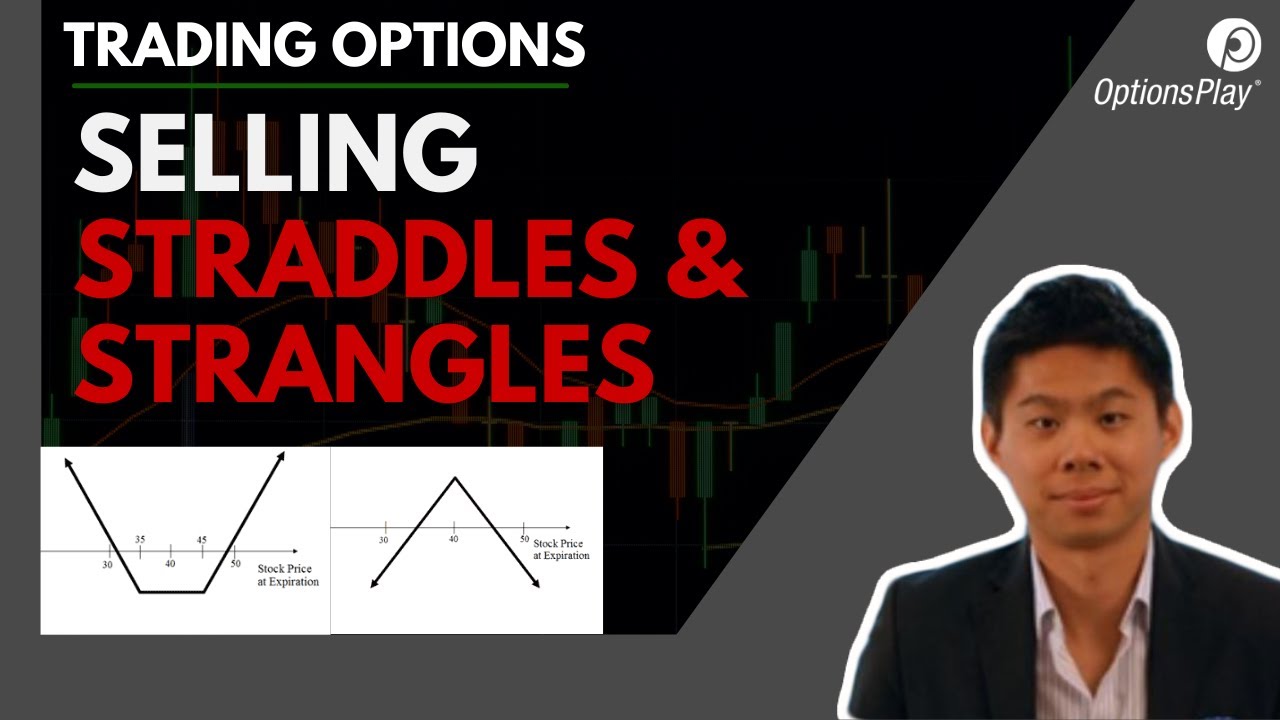
So, let's begin with how a short straddle sets up. Okay, so a short straddle actually sets up very similarly to a short strangle. You have two options: you have a short put and you have a short call.
The key difference here, though, is that with a short strangle we saw that there was some distance between the short put and the short call, but with a short straddle, they're actually going to share the same short strike. That short strike is usually going to be situated right around where the stock price is to create that neutral directional bias. So, for example, if the stock price was 100, you would do a short put at 100 and a short call at 100.
If the stock price was 45, you would do a short put at 45 and a short call at 45. Now, to be fair, naturally, if I heard that if I was on your end of the information today, my question would be, "Jim, why in the world would I do that? Why in the world would anybody not have any distance between their short strikes?
" Well, the answer, or at least part of the answer, is this: remember that the at-the-money strikes always carry the greatest amount of extrinsic value. So, by choosing to sell your strikes there, you are maximizing the short premium that you collect. Okay, so that's how the straddle sets up.
Now, on to the fun part: those winners. How do you handle those straddles that are profitable? Well, this is actually going to be different from what we've seen in the previous six videos.
We're going to target a smaller percentage of max profit; we're only going to target 25 percent of max profit. And the reason why is this: yes, it's true that the at-the-money strikes command the greatest extrinsic value, but they also cling on to that extrinsic value the longest. So, we combat this by more aggressively managing our winners at a smaller percentage of max profit—25 percent relative to 50 percent, like we've seen with the other strategies.
So, for example, if you sell a straddle for five dollars, we will be looking to take off about a dollar twenty-five, or 25 percent of that. If you sell a straddle for three dollars, we would be looking to manage that winner at about 75 cents. All right, so now on to the not-so-fun stuff: how do we handle those losers?
Well, similar to a strangle, this is going to be kind of a step-by-step process. As long as the stock is between your breakeven points, you sit and you do nothing. Since we have that shared strike, one of our strikes is always going to be in the money, so we can't use the distance between the short strikes as our reference point.
Instead, we use the breakeven points. As long as the stock is between those two markers, the strategy is working, and your best bet is most likely to do nothing. So, for example, if you sell the 50 straddle for five dollars, let's say your upside breakeven is 55 and your downside breakeven is 45.
Those become your two markers for knowing when it's time to adjust your strategy. Okay, but now let's say one of your breakevens does get hit, whether it be on the top side or the bottom side. What do you do?
Well, first, quick little disclaimer: this is, of course, not the only way that you can handle a short straddle and its adjustments, but I do think it's a pretty good foundation. Similar to what we saw with a strangle, this is going to be a step-by-step process. The key difference here, though, is we don't have as many adjustments available to us that we had with the strangle because we're already starting in the straddle position.
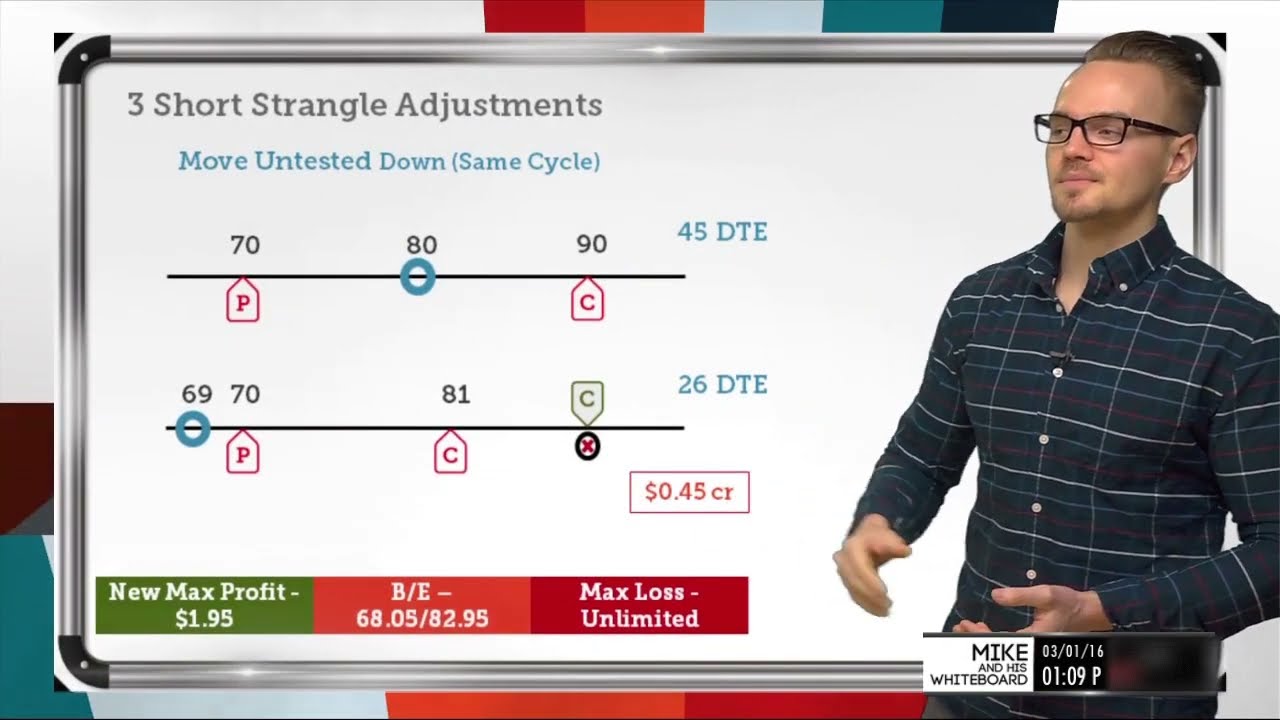
Since we're already in a straddle position, we basically only have two adjustments available to us: we either roll out or we go inverted. So, how do you know which of the two to choose? Well, take a look at how much time is left in your cycle.
Again, if you are close to around 45 days to go, the move might be to go ahead and go inverted. Follow the same protocols that we've laid out in the previous two videos with short puts and short strangles. Start with that at-the-money strike because it has the greatest amount of extrinsic value and then make adjustments from there.
The one thing that you want to be aware of, of course, is the credits you've collected relative to that width of inversion. Now, if you happen to be closer to 21 days to go, then roll out on time first, go to that next cycle, add duration, and pick up that extrinsic. And of course, don't forget, if at any point in time you want to more aggressively reduce your risk and more aggressively improve your basis, then you can do both—you can go inverted and roll out in time at the same time.
Okay, now as far as when to call it quits, when to wave that white flag—well, as we've seen in the last couple of videos, if you want to manage your losers, somewhere around 2x to 3x. . .
Of total credits received is a great starting point. So, for example, if you've collected seven dollars in total on your straddle and all of its adjustments, then buying it back for 21 would be a 2x loser. Buying it back for 28 would be a 3x loser.
If, however, you collected, let's say, nine dollars on your straddle and all of its adjustments, then buying it back for 27 would be a 2x loser, and buying it back for 36 would be a 3x loser. All right, so those are the winners, and those are the losers. But what about everything in between?
What about that dance floor? This one's pretty simple because it's the exact same as what we've seen so far. Look at IVR.
If IVR is still elevated, then consider keeping it on. If IVR has collapsed, then consider taking it off. All right, so that's it.
The short straddle is now in the books. Be sure to save this video for future reference, and then when you are ready, I will see you in the next and final video, the ratio spread. We'll see you there!