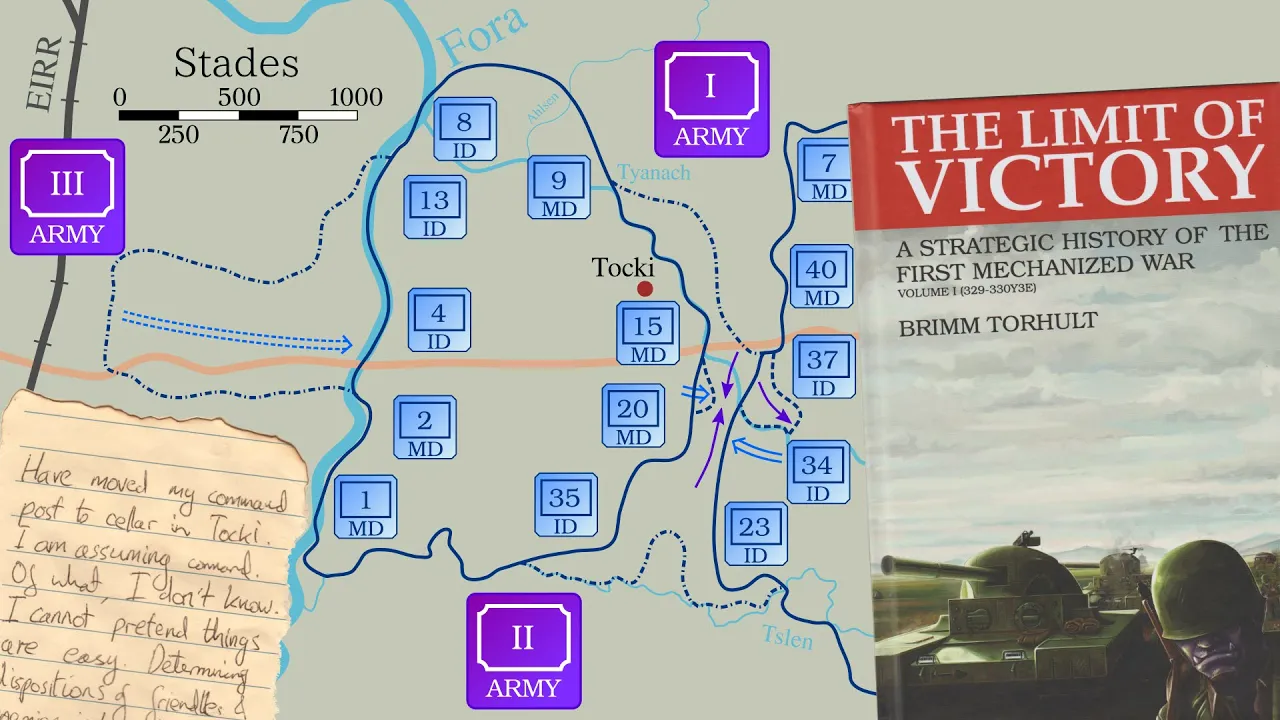
Hello, my name is Val and Improbable Matter is my YouTube channel. I have recently written and self-published a fictional fantasy book called The Limit of Victory. No, that's not my name on the front cover.
More on that in a moment. Now, before your eyes glaze over and you switch off this video, let me remind you that I have never asked for donations or patrons directly. I have rejected any sponsorship proposals and I've only put adverts on three of my YouTube videos and then only at the end.
So, if you've ever wanted to support my channel financially, please buy a copy of my book and use it to prop up a wobbly table or something like that or, you know, maybe just get the ebook version. The Limit of Victory is set on a planet with sources of magic with sapient species such as humans, elves, orcs, goblins, and so on. and non-sapient animals such as dragons and pegasotes.
The level of secular that is to say non-magic development is akin to the inter war period or the 1930s. So there are automobiles, early aircraft, steamdriven trains, oil-driven ships, tanks and so on. On the continent of Limtheria, a war breaks out between two multithnic ideologically opposed states.
For what it's worth, I've put as much effort into writing my book as I do my YouTube videos. So, I think it's technically quite well written. Nonetheless, for about 95% of you or more, this may well be the worst book you might ever read.
And you might want to buy it just because of that. You can put it to the end of your bookshelf knowing that no worse book will ever supplant it. And that is because of its central premise.
Its full title, The Limit of Victory: A Strategic History of the First Mechanized War, hints at the fact that it is a fictional history book, not a historical fiction where the Battle of the Milvian Bridge turned out differently or whatever, but a academic historical work within its own fictional universe. You will see inline sources such as the Benisk University Press or the Journal of Drgon Studies which are implied to exist within this universe. The author named on the front cover is himself an inhabitant of this world writing after the fact and it's up to the reader to decide whether he belongs to one of the two waring nations or is from an independent country.
So for example, whereas an ordinary fantasy novel might read something like, "Master Bibbons woke up hungry one morning, what's for breakfast? " he asked, a history book about, say, Napoleon would be written very differently. For one thing, how would you know that such a trivial conversation about breakfast had taken place?
But for another, history books are typically about strategy, logistics, geopolitics, and so on. So they would be very different. The limit of victory has very little characterization, almost no dialogue, no hero's journey or that sort of thing.
And of course that is why most people read fiction. I hope nonetheless that some of you see it differently. Maybe you're interested in world building or history, particularly military history.
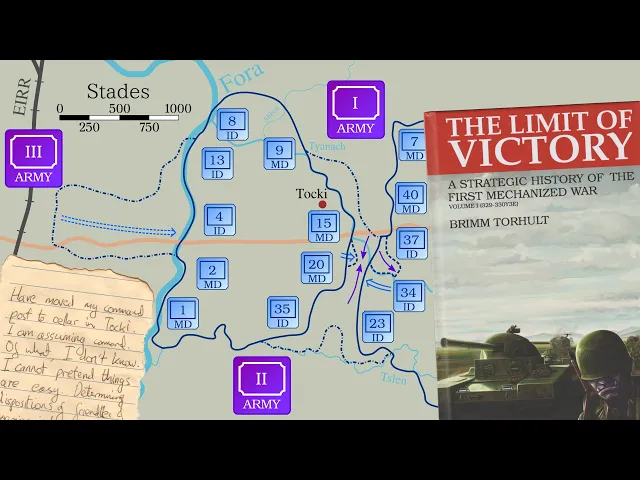
Perhaps you've been watching Indie Naidell and his time ghost series of documentaries or Paul Woodaj's World War II TV channel where even I've appeared a couple of times. If you have, then a typical paragraph from the limit of victory would sound very familiar. Just as 8 corpses shook itself free and picked up momentum, seventh army's main effort became bogged down on the road to Repoken.
Central the had been cobbling together an operation against the flank of 20 core which went ahead despite the slowdown. A small motorized counterattack in some sense little more than a raid cut through the weak screening detachments posted before the road from Shakarta. This might be reminiscent of the Hearts of Iron series of video games.
And indeed I've began making a mod for Hoy 4 to recreate the first mechanized war. Uh, there is some paradoxical name placement and I might do a dev blog or something like that on my second gaming channel. The closest book I'm aware of is Tom Clancy's Red Storm Rising, but this almost does the opposite of what I've written.
Clansancy began with a staff level simulation of what World War III in Europe would look like with divisions, accurate maps, logistics, and that sort of thing. And he turned it into a more usual style of novel by writing in a bunch of characters. As far as I'm aware, what I've done in the limit of victory hasn't actually been done before.
But uh if you are aware of such a thing, particularly if you're an author of such a book, please do let me know because I will buy it and read it almost immediately. If you're not interested in military history, you might nonetheless enjoy piecing together some of the world building from a source which assumes that the reader has background knowledge of the subject. So, for example, if you read a real history book about D-Day when the UK landed in France alongside the US and Canada, could you tell that the US and Canada actually used to be colonies of Britain and France?
Maybe. Distances are one example. A real history book would assume that a reader knows how far a mile or a kilometer is.
If you read the limit of victory, you'll soon see that the common units of distance they use are stads. Now, it's up to you to determine how far a state is through some detective work because the premise is that the earth doesn't exist in this world. So, there is no relative frame of reference for our world.
There is a lot of stuff that I've plotted out, but I can only give hints at given the nature of the book. Ultimately, I wrote this book because it's an example of something that I've wanted to read but could never find. I've gotten a bit frustrated with books where the plucky underdog, moisture farmer, goes on to destroy the villain's last horcrux in Mount Doom.
I hope that you are intrigued enough by the premise to consider buying this book. Thank you for watching this long advert. Just to preempt what I think the most common comment will be, just remind yourselves of the name of this channel.