My dear comrade, good morning! No doubt many of you have been shocked when Thanos kills 50% of humanity at the snap of his finger. And today we're going to talk about a disease that could very well personify Thanos: the plague!
Finally . . .
we agree, it's not over instant, it's even super long . . .
a bit like Thanos had merged with the sloth of Zootopia . . .
Anyway! If I tell you plague, it must most certainly talk to you about death, sickness, outbreaks and symptoms very not pleasant that we will come back to. Other says a lot of things that doesn't frankly make you want.
And in history there are dozens and dozens of these qualified epidemics plague: since Antiquity and even still until recent years in certain regions of the world. However the bacteria causing this disease particularly virulent and deadly was not isolated until the end of the 19th century a period of great progress in medicine, by a Franco-Russian doctor from name of Alexandre Yersin, himself a pupil by Louis Pasteur and sent to China during of a plague epidemic. So he left his name to the bacteria which was later baptized Yersinia Pestis.
Since we don't know this bacteria that since the XIXth century, we are not not sure that all qualified epidemics plague in earlier times have been caused by it, the term plague could also be used for example for designate deadly epidemics that also didn't understand at the time, like cholera epidemics for example. But if there is indeed an epidemic of plague which we know is due to this bacteria that has actually been both the deadliest and the most extensive geographically, we must of course speak of this black plague that touched Europe in the 14th century, and in particular the epidemic which takes place between 1347 and 1352. Before we take a closer look at this mid-14th century epidemic, let's go back a little bit more in detail on this plague disease and its spread.
You certainly know that the plague is a disease that comes to us from rodents and small mammals that are the first to be affected by the disease. So these are obviously in the first place the rats that are affected by the disease but we can also find it in squirrels or marmots for example. We could therefore say that the plague was transmitted from rat to man by the bites of it.
In reality, that's not how the disease spreads. The transmission of plague from one rodent to another, or towards man, is actually done through lice or fleas. Fleas feeding on blood and they can be contaminated by pricking an infected rodent.
Subsequently, by changing the host, by example to another rat or a man they also transmit the disease by stinging him in turn. This mode of transmission through the bite of a flea is the most common. He then gives place to what is known as bubonic plague.
One to four days after transmission the disease manifests suddenly: the patient feels very weak, he is quickly reached high fever, convulsions, headache, diarrhea, but also vomitings. A bubo which is swelling characteristic of lymph nodes, often present in representations of the disease, appears also, there can sometimes be several. This bubonic form of the plague is very fatal, 40 to 70% of patients didn't survive without modern treatment.
As for those who survive it, then they need a long recovery. Bubonic plague is rarely spread from being human to another, as we have seen it's the fleas that have the most important role. But it can happen if the disease reaches the patient's lungs.
In this case it can also transmit illness when coughing or spitting for example. We then speak of pulmonary plague if another person is infected. But this form of the disease is even more violent.
The first symptoms that we have already described (fever, headache) may occur just hours after infection. Worse, this plague quickly leads the patient into a coma and a quick death in just a few days in 100% of cases without a modern treatment. There is finally a last form of transmission plague, through direct contact with bacteria plague with blood, for example by through small wounds.
We are talking then of septicemic plague and the evolution the disease is also very brutal and also quickly leads to death of the patient. So obviously you have to know that these three plague forms exist, they are each linked to a particular mode of transmission, but the most common one is obviously bubonic plague. It is therefore the one that interests us the most in the case of these great episodes of plague like that of the middle of the XIVth century.
So let's get down to business with this the black plague butchery of 1347! That year, the disease which crosses Europe kills between a third and a half of its population at the time. It's this pandemic which is called "black plague" because of its scale and its violence.
You can find its origins in Central Asia in the 1330s, certainly in the present Kazakhstan. In the 1340s it was spreads towards the South, but also towards North and West, following the course of the Volga. In 1347 it reached the Crimea and in particular the city of Caffa which is a Italian merchant counter.
And from there, nothing can stop it to devastate the European continent. The disease spreads very quickly thanks to merchant ships: it reaches Constantinople then North Africa and all of Europe from 1347 to 1352, even if certain regions remain relatively spared like the West from Belgium or southern Poland. Recent research even leads to think that this black plague pandemic could have gone even further.
She could have crossed from North Africa the Sahara thanks to the merchant caravans and reach sub-Saharan populations, which would correspond to recent discoveries archaeological with in particular the abandonment many populated sites in sub-Saharan Africa at that time. But the plague does not disappear from Europe suddenly in 1352. Many epidemics more regional continue to affect different European countries until the end of the 14th century and even during following.
For example France is particularly affected by four epidemics of plague in 17th century, 300 years after the pandemic of 1347. Going back to 1347, you have to understand that for Europeans of the time, reasons for the pandemic are unclear and we must find an explanation for the appearance of this disease. And for that we are not looking not rely on medicine but to religion.
For Christians, but also for Muslims, the plague is above all an expression of God's wrath. Following this reasoning we must appease the discontent of God, especially through prayer but also processions and calls to the Saints. On top of that, since the plague is considered as a divine punishment, the plague victims are sidelined and isolated, similarly way that lepers.
And yes, since they are punished by God, they are also kept out of the community believers. Besides, lepers are also accused to be at the origin of the plague and for that is why they are being persecuted. Just like the Jews at the same time, qualified as "plague sowers" and doing the object of pogroms, i.
e. massacres and looting. The first pogrom linked to the black plague would have occurred in 1348 in Toulon, but there are many in following years and take place in particular at Strasbourg, Barcelona and even Brussels.
In Strasbourg alone, no less than 900 Jews, half of those in this city is burned, accused by the population of spreading the plague… And for once, such events occurred reproduced in many places and this despite the fact that the religious authorities like Pope Clement VI, publicly reject these accusations against the Jews. In short, we wary of the stranger, of the other and more generally of simple travelers, doctors and even priests who can be accused of spreading the plague all throughout this period. So you're going to tell me: but wait Ben, they tried nothing more… ”pragmatic” to save people?
Well, and rightly we will come back too! Obviously the medieval doctors put their usual treatments on plague patients: they practice bloodletting, make the patients sweat, sometimes they even cut into the bubo, and all without No result. In fact, doctors don't not understand the disease and ignore how to cure it.
So in addition to offering ineffective treatments, they show some imagination and go so far as to give feeding advice to their patients like consuming broths, digestive powders or preparations pharmaceuticals, which are obviously all no effect and alternate with enemas equally unhelpful in curbing development of the disease of course. In the 14th century there is therefore a society medieval who sees the plague above all as divine punishment and the doctors of the time can't prove them wrong since they are unable to cure it and to bring solutions in the treatment of the disease. To finish with these doctors of the time black plague, you most certainly know this characteristic bird-billed costume of the plague doctor, who is also the channel logo.
So i prefer take you by surprise: at the time of this pandemic, in the middle of the 14th century, the doctors who take care of the plague victims are not yet wearing this costume supposed to protect from contamination. In fact this costume was mainly worn in the 17th century century so much later in the many plague epidemics that have crossed modern Europe. So obviously much more than treating plague victims, what doctors don't obviously know not to do at this then we put them aside, like I have already mentioned it.
Both of course as they targeted by what appears to be a divine punishment, but also quite simply for fear of contagion. And in the end, it may not be stupid to put them in quarantine . .
. At first the plague patients are everything simply under house arrest, they no longer allowed to leave their homes. But it's not very effective, even because the sick rarely live alone and therefore this does not prevent the spread of the disease.
Plague hospitals are therefore created. They can either be created from scratch, either using old structures, whether already existing hospitals or leprosaria, places where we already isolated lepers. For example in current Toulouse La Grave hospital, which has existed since 12th century, welcomed many patients plague in the Middle Ages and was even enlarged for this purpose in modern times.
As epidemics are formed real places to focus and isolate the sick from the rest of the population to avoid contagion. In the towns these measures are most often initiated municipal authorities who want to keep plague victims as far away as possible from the rest of the population. But sometimes there are even more brutal methods of removal patients.
At the very end of the 14th century and at the beginning from the 15th century, we have for example the cases of the cities of Troyes and Nancy who decide simply to evict the sick and their families out of town. So this are two examples a little later than the plague of 1347, but it is a method which must have been used before and which shows that everything was done for protect yourself from the plague, even if it means leaving people on their own. Similarly, a few decades later this first epidemic of 1347, cities, and in particular the Mediterranean ports, will set up quarantine zones which are called lazarets.
These areas allow crews to undergo ships and their cargoes from regions infected a quarantine time which avoids the spread of the disease in cities port. This system appears in the city of Ragusa and is rapidly expanding to other port cities like Marseille for example. But despite all these measures which slow down the spread of the plague it does no less severely strikes Europe and especially in this first epidemic of 1347 where the human losses are very important.
So the black plague, what assessment? Positive or negative? For or against?
By becoming again a little more serious, it's still interesting to be interested in its repercussions in several domains. At first it is obviously necessary reconsider the high mortality linked to this illness and the consequences it had on European demography. Before 1347, and even from the 12th century, historians believe that the population European reaches a kind of "maximum "Or ceiling that it keeps until the black plague epidemic: cities have grown a lot and the campaigns are relatively full, to the point that agricultural productions with techniques of the time are barely enough to maintain these populations.
For this period of the XIVth century there has a real lack of general numbers but historians believe that this one epidemic from 1347 to 1352 killed between 30 and 50% of the European population. It's absolutely huge! So these estimates correspond especially the figures available for some cities, even if we still observe disparities.
In France many cities like Albi or Aix-en-Provence have simply lost half of their population between the start 1340s and late 1350s. In Germany, Hamburg loses two-thirds of its population and Bremen three quarters over the same period. This mortality is so huge and that means that on the population we start at the end of the epidemic sometimes with only one in two people or out of four in the most extreme cases.
As I told you, it is far to be finished in 1352 since others more localized plague epidemics are going take over until the end of the 14th century, with similar death rates. It gives you an idea of how much the European population has been reduced by this disease. It then takes the entire 15th century to that European populations are recovering slowly from these many epidemics of the 14th century and it was only really 16th century that Europe knows a another period of significant prosperity.
You can imagine, this very decrease large population had an influence all over the medieval economy. In parallel of the declining population there is obviously a general drop in all productions. For example in the countryside, the death of a significant part of the peasant population of course resulted in a drop in production agricultural, in the same way as death very many artisans in the cities rarefies their productions.
Yet Western Europe knew already a deep economic crisis, at less since the beginning of the 14th century with a general drop in production and not only agricultural production. Plague of course adds to these difficulties already earlier by deregulating even more the economic exchanges but it does not come herself to end a a period which would be prosperous. It occurs in an already difficult context.
For some historians the black plague has even could be a part of the solution of the agricultural crisis in the countryside which were very populated and where the land were missing before the epidemic, causing the poverty of a significant part of the population and recurrent famines. On the contrary, once the epidemic has passed many lands are free and can be exploited by survivors who scatter instead of staying too large number on the same family land. But at the same time the black plague poses also economic problems, in addition to the drop in production.
Since the dead pay no tax, the disappearance of a significant part of the population also means that a large number of taxpayers disappears. And this while the black plague generates additional costs for authorities who must, as we have already spoken, take care of the plague victims, create places to welcome them . .
but also hire a whole workforce able to treat them, especially doctors plague, or on the contrary, to transport the very many bodies and bury them. All of this has a very significant cost. So there is a contradiction between a these increasing costs, and on the other the number of taxpayers going down and this leads to problems.
Indeed in the Middle Ages the tax is not individual, we don't receive like today a precise tax sheet per household. Without going into detail, the tax works in fact by distribution: the amount is decided in advance by the authorities, and then it is distributed among the different homes. And as the final amount of tax is decided in advance and then distributed on has examples at that time of communities village women asking for a decrease because we always ask them the same amount while half the population otherwise more has disappeared.
Which means that in this case the tax pressure increases enormously and is no longer tenable for survivors who are unable to pay such sums. But beyond the only repercussions on the medieval population and economy the black plague has far more deeper consequences according to some historians. For them the black plague can be seen as a trigger in the passage of Middle Ages to the Renaissance and the modern era.
They believe that the black plague puts an end to the deadlock in the West medieval in the 14th century, with as we saw an economic crisis that was already there but also institutions and a stable social organization that evolve much in the following centuries. The decrease in population therefore allows diversification of the economy. From the generalized production of cereals to meet the needs of an important population succeeds the multiplication of pastures for livestock but also forests and sawmills.
In the end it all comes down to a level of overall higher life and especially a more balanced diet than before. And it affects even the most poor, which is incidentally at the time commented by columnists who criticize what they see as a "taste of luxury" on the part of the poor. At that rate, the poor might even steal our caviar.
For these historians the black plague also an important role in the development techniques at the end of the Middle Ages. Declining population pushes to seek new methods to decrease the need of labor which has become more expensive to use because more rare. In the countryside the breeding is a solution because livestock surveillance requires far fewer workers than plowing and field work in equal surface.
In the cities it is to obtain more efficient machines allowing increase productivity in different craft fields. The rise of printing in Europe in the second half of the 15th century is a good example, the machine then replaces the long and tedious work of copyists who were copying the books by hand, each book was therefore very expensive. With printing things are much faster there much less labor is required to produce as much and the cost of books goes down consequently.
Beyond the economic consequences, this epidemic of 1347 and those that affect episodically Europe for centuries following, also have cultural consequences. Some are also immediate: the death of a large part of the population prevents the usual funeral rites from occurring normally. In addition, in society medieval christian being buried in the rules of worship is essential, since it is the guarantee of being able to be resurrected the day of the last judgment.
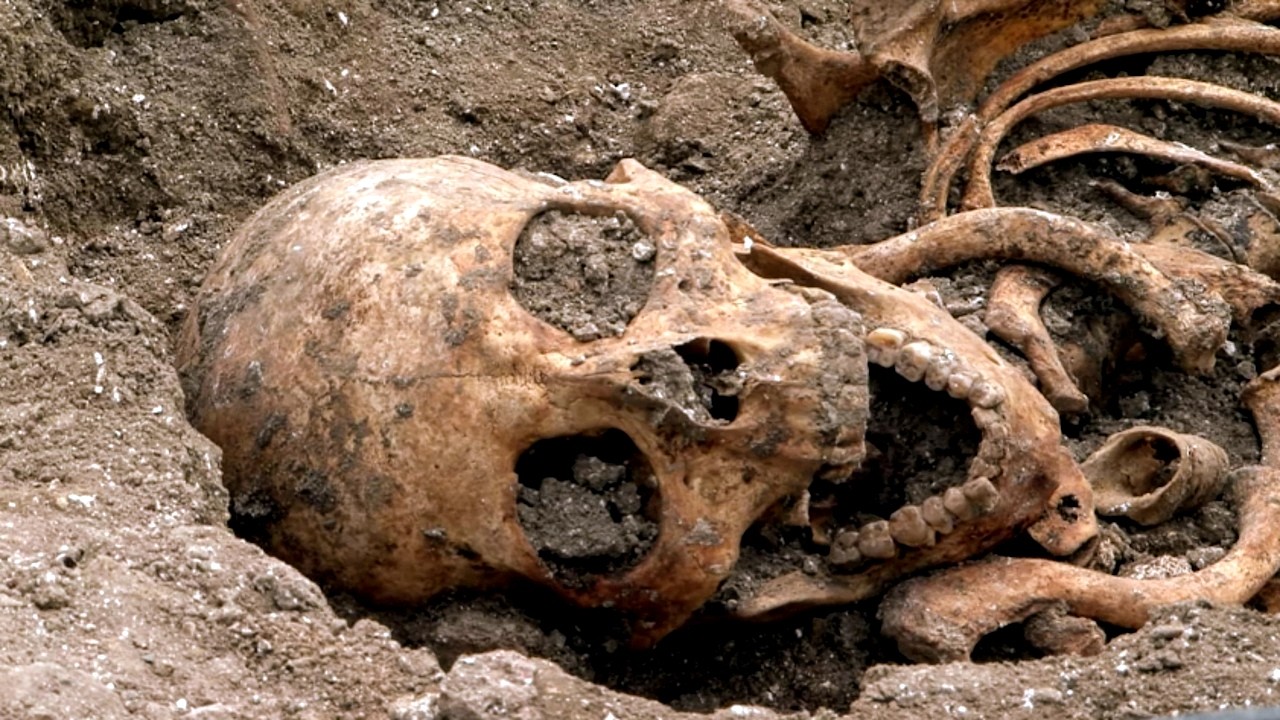
Yet in a society affected by plague many obstacles prevent this "normal" development of funeral: first because some religious themselves flee or are killed by illness, making it difficult for them to give extreme anointing to all the many dying. But in addition the number high from the dead shakes up all the rites and burials are most often expeditious, when the bodies are not just buried in mass graves. This alone question of mortuary rites is very important in a believing and religious society and the fact of no longer respecting them destabilizes one of the pillars of this medieval society West that is the church.
In the longer term, illness and death inspire a fear that takes root in all minds. At that time cultural production shows an evolution in the way individuals perceive death. The death is seen as a horror, a devouring creature the living and able to hit at any time.
This therefore develops a certain believers' obsession with their salvation: the cult of saints is developing, especially that of those who are considered protective against the plague like Saint Christopher or Saint Rose de Viterbo, but it's also from from there that the richest do all their possible to acquire relics, be buried within churches or still get the most masses in their honor after their death. This fear for his salvation and these new ways to appeal to religious masses or indulgences are debated, and these debates are also one of the causes which lead Christians to the schism of Protestantism in the 16th century, but that is another subject. To sum up all that we just said, take your notebook, the black plague of 1347 is therefore indeed an upheaval for the society of the late Middle Ages.
This highly virulent disease spreads across Europe thanks to the flow of goods and first to maritime transport, despite the various attempts by the authorities to the time to prevent its spread. Not only does it create real trauma by cutting Europe by between a third and half of its population then. But in addition it upsets economic structures and the cultural behavior of Europeans.
So we can say that it has a very important and even contributes in part, according to some historians like David Herlihy, at passage from medieval times to the time modern by ending several centuries not to share it, no need to spit your guts or explode your buboes for that, just a little click is enough! Thanks to Tony Livet with whom I prepared this program, he has the channel “History in 5 minutes ”and it's worth going take a look, I’ll linkit in description! When we meet very soon on the chain for new adventures in the depths of history, Tchao!