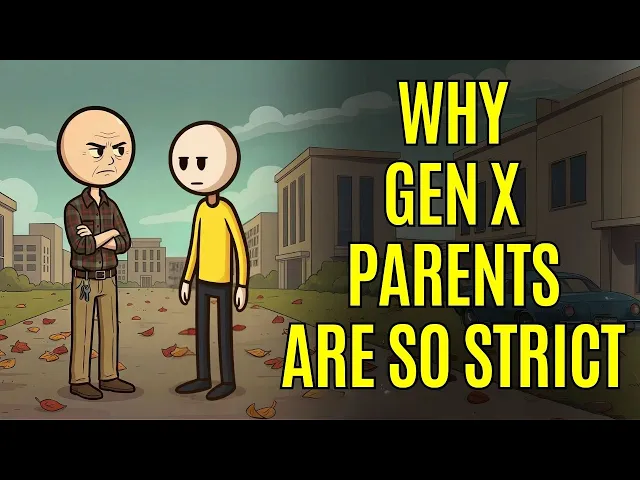
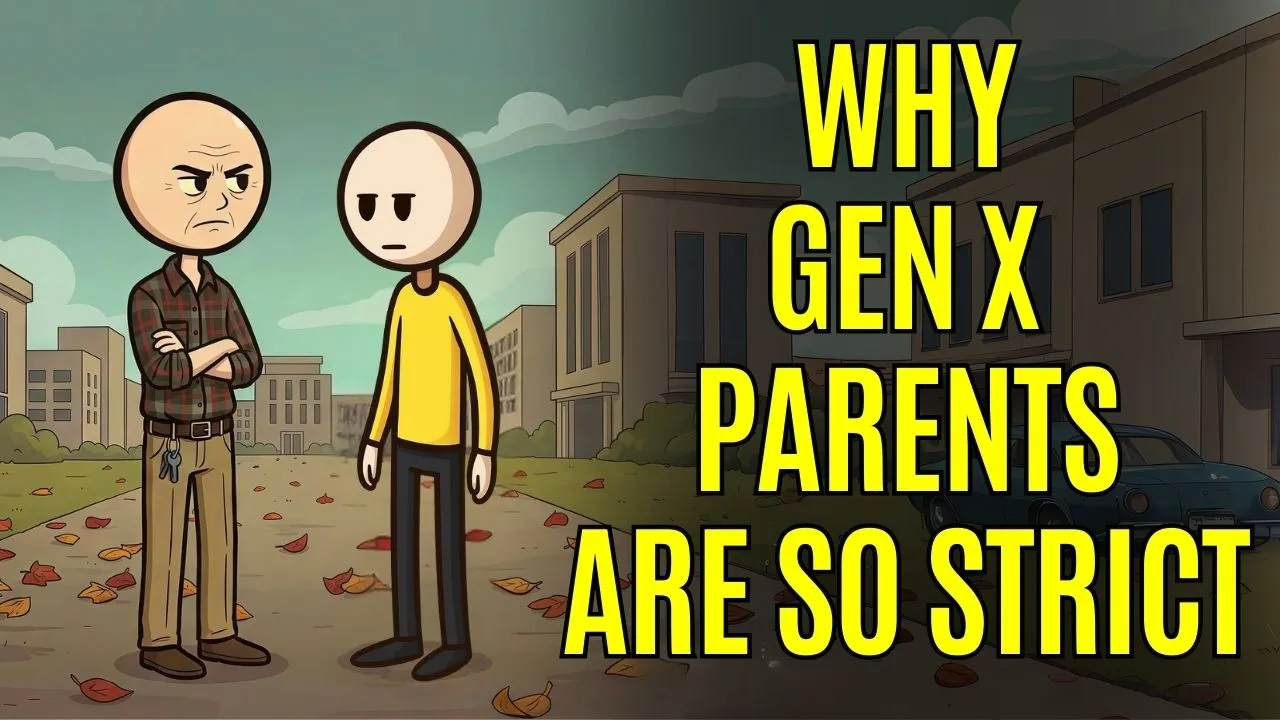
They were raised wild, drinking water straight from a garden hose, riding bikes for miles without helmets, disappearing into neighborhoods until the street lights flickered on. No GPS, no cell phones, no constant check-ins, just freedom, raw, unsupervised, sometimes reckless freedom. And now they are the parents refreshing life 360, setting screen time limits, texting, "Where are you?
" if a reply takes more than 5 minutes. How did the generation that practically raised themselves become one of the most protective, structured, and vigilant groups of parents in modern America? That contradiction is not hypocrisy.
It's psychology. Generation X, born between 1965 and 1980, grew up in a world that demanded independence early. Many came home to empty houses.
Many learned not to complain. Many figured things out alone. On the surface, it looked like resilience.
But beneath that resilience was something quieter. Uncertainty. A subtle awareness that safety wasn't guaranteed.
That adults were busy. That the world could shift without warning. So when they became parents, something instinctive activated.
Not control for control's sake, but protection. The child who once carried a house key on a shoelace now carries a smartphone app that tracks their own child's location. The freedom they experienced felt thrilling.
But sometimes it also felt like being unseen. And that is the paradox. raised wild, parenting wired.
Not because they forgot who they were, but because they remember. To understand the Gen X parent, [music] you have to return to an empty house in 1983. A backpack dropped by the door.
A key pulled from a shoelace around a child's neck. The sound of a television turning on, not for entertainment, but for noise, for proof that someone or something was there. The latch key kid era wasn't rare.
It was normal. Divorce rates had climbed. Dualincome households became necessary.
Parents were working longer hours. For millions of Gen X children, supervision was minimal and structure was self-created. They learned to make their own snacks, finish homework alone, clean up their own scraped knees, call a neighbor only if something felt truly urgent.
From the outside it looks like resilience, and in many ways it was, but psychologically something more complex was forming. Independence was not taught as a philosophy. [music] It was absorbed as a survival strategy.
When no adult is consistently available, you adapt. You stop asking for help. You quiet your needs.
You become competent quickly. This accelerated maturity built capability. But it also carried an invisible cost, subtle emotional neglect.
Not always dramatic, [music] not always intentional, just a quiet repeated experience of handling fear, boredom, and confusion alone. Over time, a belief settles in. If something goes wrong, I'll deal with it myself.
No one is coming. That imprint does not disappear when a latch key kid becomes a parent. It lives in the nervous system.
It shows up in hyperpreparedness, in backup plans, in overcheduling, [music] in the instinct to monitor, to anticipate, to prevent. Because for many Gen X parents, childhood freedom wasn't purely nostalgic. It was unpredictable, sometimes lonely, sometimes frightening.
And when you have known what it feels like to navigate the world without a safety net, you don't casually hand that experience to your own child. Independence shaped them. But it was independence forged by necessity, not by choice.
The latch key experience didn't just [music] shape habits, it shaped attachment. Attachment theory tells us that the way we bond with caregivers in childhood quietly programs how we connect and protect in [music] adulthood. For many Gen X's, caregiving was loving but inconsistent.
Support existed, but emotional availability was often limited by stress, work, or divorce. That combination frequently produces a complex attachment pattern. Part avoidant, part anxious.
The avoidant side learned early, "Handle it yourself. " Feelings were managed privately. Vulnerability felt inefficient.
Even now, many Gen X parents struggle to sit comfortably inside prolonged emotional conversations. When a teenager shuts down, their instinct might be to offer solutions instead of space. Fix it, move forward, don't dwell.
But alongside that independence lives anxiety. Because when you grow up without consistent reassurance, unpredictability lingers in your nervous system. As a parent, [music] that anxiety can transform into vigilance.
Tracking apps, detailed schedules, constant check-ins framed as practicality, [music] but fueled by fear. This creates a pushpull dynamic. A Gen X parent might say, "I trust you.
" while simultaneously needing proof [music] of safety. They encourage resilience yet feel unsettled when their child pulls away. They value autonomy but struggle when independence feels like distance.
It's not contradiction, it's layered attachment. In moments of stress, the avoidant instinct says, "Don't overreact. " The anxious instinct says, "Something could go wrong.
" The result is a parenting style that oscillates between emotional restraint and protective intensity. And beneath both responses is the same core motivation. Prevent harm.
Prevent loneliness. Prevent the feeling of being on your own too soon. They are not simply raising children.
They are negotiating with their own attachment history. Trying to offer security without suffocation, [music] strength without emotional silence. It is a delicate balance and one they often navigate quietly.
There is a powerful psychological mechanism quietly shaping many Gen X households. Reaction formation. Reaction formation occurs when we unconsciously transform [music] a painful or anxietyprovoking experience into its opposite.
If something felt unsafe, we create safety. If something felt chaotic, [music] we construct structure. If something felt lonely, we hover.
For many Gen X parents, the memory of unstructured [music] childhood freedom carries a dual charge, nostalgia on the surface, vulnerability underneath. They remember the bike rides [music] and summer evenings. But they also remember the uncertainty, the moments of [music] figuring things out alone, the subtle fear they never named.
So when they became parents, a quiet decision formed, [music] often without words. My child will never feel that alone. This is where overcompensation begins.
The child who once roamed freely now builds guardrails. Calendars fill up. Activities stack.
Location tracking becomes reassurance. Structure becomes love in action. But overcompensation doesn't always look like hovering.
For some, it takes the opposite shape. They double down on independence almost defiantly. I turned out fine, they say.
They push their children to solve problems alone, to toughen up, to develop grit early. Two different expressions by a same route. Both are attempts to resolve unfinished emotional tension from their own upbringing.
In truth, many Gen X parents are not simply responding to their child's needs. They are responding to the child they once were. The one who wished for more protection or the one who takes pride in surviving without it.
And that is the paradox of overcorrection. In trying not to repeat the past, we sometimes recreate it in reverse. If the latch key era shaped Gen X internally, Coline and 9/11 reshaped them collectively.
In 1999, the Coline school shooting [music] shattered the illusion that schools were automatically safe. For many Gen X adults, some already parents, others just [music] about to become one, it was the first time childhood itself felt publicly vulnerable. The fear was no longer abstract.
It had a location, a hallway, a classroom. Then came September 11th, 2001. Gen X watched the towers fall not as children, but as adults responsible for families, mortgages, and futures.
The sense of unpredictability [music] intensified. The world no longer felt temporarily chaotic. It felt permanently unstable.
Psychologically, repeated exposure to large-scale trauma doesn't always create visible panic. More often, it creates baseline vigilance, a low-grade hum in the nervous system that says, "Stay alert. " For Gen X parents, safety stopped being assumed.
It became managed. This is when parenting subtly shifted from [music] guidance to monitoring. Emergency drills became normal.
News cycles ran 24/7. Fear was no longer local. It was global [music] and constant.
Hypervigilance in this context is not about control. It is about preventing the unthinkable. If danger feels random, then preparation [music] becomes a coping strategy.
Tracking apps, detailed check-ins, knowing the plan, knowing the backup plan. To an outsider, it may look excessive. To the Gen X nervous system, it feels responsible because they are not just reacting to their child's world.
They are parenting in the shadow of events that [music] permanently altered their sense of security. And once that sense shifts, it rarely [music] returns to innocence. Generation X remembers boredom.
Long car rides with nothing but a radio. Afternoons stretched thin with no instant entertainment. Research meant flipping through encyclopedias.
Plans required calling a landline and hoping someone [music] picked up. There was friction in everything. And inside that friction, imagination grew.
Now they are raising children in an algorithmic world. A world of infinite scroll, instant answers, personalized feeds engineered to hold attention. Their children are not just using technology.
They're growing up inside systems designed to anticipate desire before it is even conscious. This contrast creates psychological [music] tension. Gen X parents often carry what could be called nostalgic mourning, a quiet grief for the analog childhood their kids will never experience.
They remember the mental quiet of being unreachable. The privacy of mistakes that didn't live online forever. The way bullying stopped when you closed your front door.
Today, conflict follows [music] you home. Social comparison never sleeps. Validation is quantified in likes [music] and views.
For Gen X, the internet feels both miraculous and dangerous. They adapted to it as adults. Their children are being shaped by [music] it as identities form.
This is why screen time debates are rarely [music] just about screens. They're about control in a world that feels uncontrollable. They're about protecting attention, protecting [music] innocence, protecting psychological space.
The analog childhood taught them self-reliance through limitation. The algorithmic childhood offers connection without limits. And somewhere between those two realities, Gen X parents are trying to decide how much freedom is still safe and how much access is too much too soon.
Generation X came of age in a [music] cultural climate steeped in disillusionment. They grew up in the shadow of the Cold War. They watched economic [music] recessions disrupt stability.
They saw corporations lay off loyal employees without hesitation. Political scandals eroded trust. The message was subtle but persistent.
Security is fragile. Pop culture reflected it. The tone of the 1990s was not idealistic.
It was ironic, skeptical, [music] grounded. Optimism felt naive. Independence felt safer.
This environment shaped what we can call pragmatic skepticism. Gen X parents do not assume the world will reward good intentions. They assume it will test resilience.
So when their child says I want to follow my passion, the first question is rarely why not? It is how will you support yourself? To Gen Z, this can sound discouraging.
To Gen X, it is protection. Their realism is not rooted in cynicism for its own sake. It is a strategy formed in response to instability.
Financial independence equals safety. Practical skills equal leverage. Backup plans equal survival.
They teach their children to advocate [music] for themselves because they learned early that institutions are imperfect. They emphasize self-sufficiency because they witnessed how quickly systems can fail. Underneath the blunt advice is anxiety.
Not about dreams, but about vulnerability. [music] They are not trying to crush ambition. They are trying to armor it.
Because in their worldview, hope without preparation is risk. And preparation is love expressed in practical form. To understand their skepticism, you have to see it not as doubt, but as defense shaped by experience.
Many Gen X parents were raised in homes where authority was rarely questioned. The prevailing philosophy was simple. Respect meant obedience.
Emotions were managed quickly or silenced. Stop crying because I said so. Therapy was stigmatized.
Anxiety was something you push through. Now, as parents, Gen X stands in a cultural shift. They see the value of emotional intelligence.
They understand that children need validation. They don't want to repeat the emotional distance they experienced, but they were never fully shown how to do it differently. So, they walk a tight rope.
On one side is the authoritarian blueprint wired into their nervous system, structure, discipline, control. On the other side is the rise of gentle parenting, [music] popularized heavily by millennials, emphasizing co-regulation, emotional coaching, and patience. When a toddler melts down over a broken toy, a Gen X parent may instinctively feel two impulses at once.
The first says, "Life is tough. We fix it or move on. " The second says, "Don't shut this down.
Stay with the feeling. " Often what emerges is pragmatic empathy. They validate briefly.
I know you're upset, but they also pivot quickly to problem solving. Let's figure out what we can do. It's not [music] a lack of care.
It's a balancing act between compassion and resilience. But this balancing act is exhausting. Because when they lose their temper, when stress overrides intention, shame follows.
They promise themselves they wouldn't repeat the past. And yet, in moments of overwhelm, old patterns surface. So, Gen X parents are doing something historically unique.
They are reparing themselves while parenting their children. Trying to build emotional openness without raising fragility. Trying to enforce boundaries without emotional silence.
It is not a perfect system. It is a generation in [music] transition doing the emotional work their parents never modeled while still carrying the blueprint of how they [music] were raised. There is a quieter layer to Gen X parenting that rarely gets discussed.
They are raising children and increasingly supporting aging parents at the same time. This is the reality of the sandwich generation. Many Gen X adults are managing college tuition, teenage mental health and rising living costs while also navigating medical appointments, financial assistance or caregiving responsibilities for baby boomer parents.
It is a dual [music] pressure system looking forward and backwards simultaneously. Psychologically, this creates chronic strain. Not dramatic [music] breakdowns, not constant crisis, but sustained responsibility without pause.
They're often at peak career years, carrying professional expectations alongside [music] family demands. Add inflation, housing instability, and a rapidly [music] shifting economy, and the margin for error feels thin. This sustained load can manifest as irritability, fatigue, or emotional withdrawal.
Not because they don't care, but because cognitive bandwidth is stretched. And yet, many Gen X parents don't frame it as sacrifice. They see it as duty.
They don't demand recognition. They don't post about [music] burnout as often as younger generations might. They simply keep moving.
But beneath that steady motion is exhaustion, the kind that accumulates quietly over years. Understanding Gen X parenting requires understanding this weight. They are not just protecting the next generation.
[music] They're holding two generations at once and trying not to drop either. For all the tension, all the vigilance, all the internal conflict, Gen X [music] parents are doing something remarkable. They are adapting.
They were raised in an analog world and learned a digital one. They grew up with emotional restraint and are now attempting emotional awareness. They experienced instability and chose to build structure.
That is not hypocrisy. That is evolution. They teach resilience not because they dismiss feelings but because they know the world can be unpredictable.
They encourage independence because they [music] survived on it. And even when they struggle to articulate emotion perfectly, they're far more willing than the generations before them [music] to acknowledge it. They're breaking cycles imperfectly but intentionally.
The child who once came home to an empty house is now making sure someone answers the phone. The teenager [music] who once navigated uncertainty alone is now determined to provide guidance even if it sometimes feels like overp protection. That is love shaped by memory.
If you were raised by a Gen X parent, you may not always see softness on the surface, but beneath the structure is a deep commitment to your safety and your future. And if you are a Gen X parent, you are doing harder emotional work than you were ever taught to do. If this resonated with you, subscribe for more deep dives into human psychology and share your experience in the comments.
Your story might help someone else [music] feel understood. Thank you for watching.