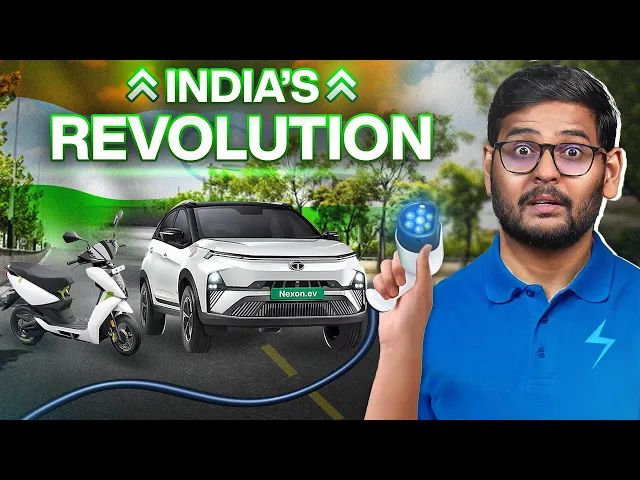
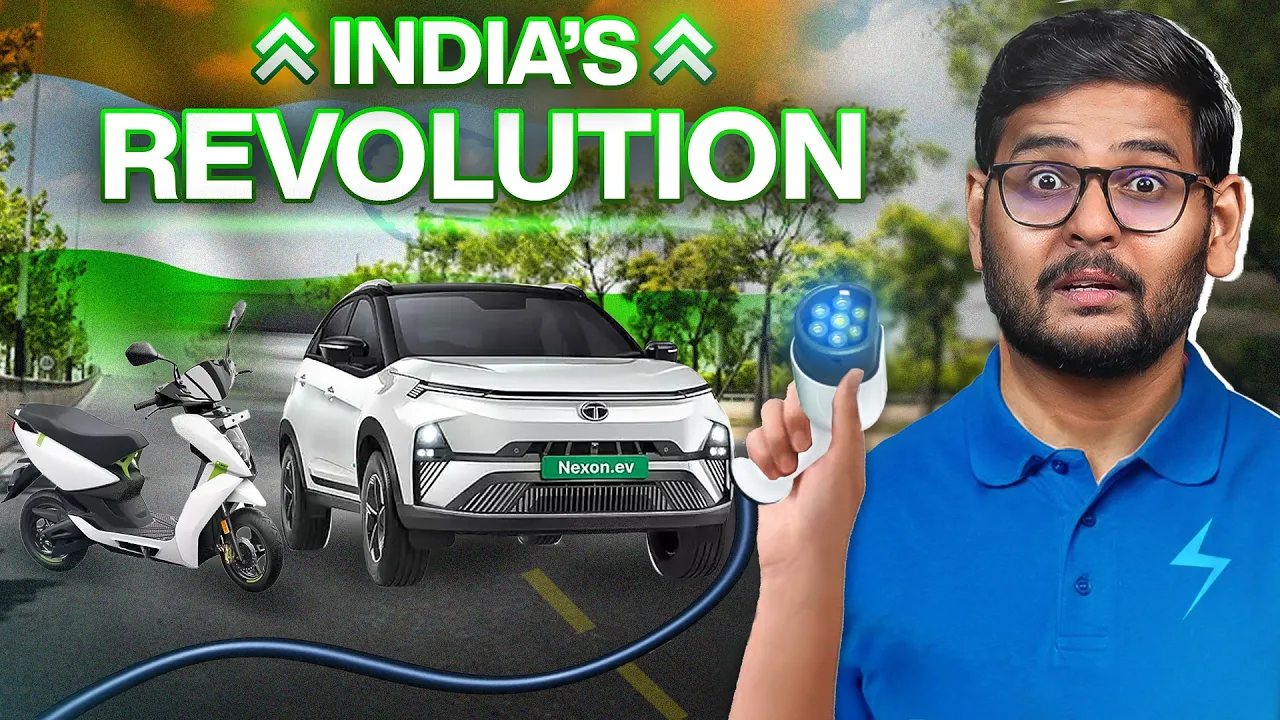
Is there an electric revolution in India? Well, if you look at it in Ford Wheelers, you may never see it there. But many times I have talked in the past that there is a revolution in electric two-wheeler in India.
But today in this video, let's go into a little detail about it. Can things really develop? Can they get some advancement?
And in the coming time, all the cars, bikes, scooters that are going to be on the road, can you see electric vehicles in all of them? Look, let's talk about cars first. At a global level, there was an electric revolution in cars and a company like Tesla led it.
The simple reason was that you will get such a car here, in which you will get a lot of features and you will get to see a futuristic vehicle. This was something that a company like Tesla had promised here and they delivered that thing there that you will get all those things in the car because of which they are a successful global car maker. Although a company like Tesla does not come in India and the trend of electric cars in India was started by a company like Tata who started it with Tata Nexon EV and after that, they have already created a whole lineup here.
But there is still a small problem with cars. Many people think that if we buy an electric car, we will be able to save money. Although this is not true in the case of electric cars.
First of all, you don't get to see any subsidy in the normal electric cars market here. These direct subsidies that the government provides are mostly for electric two-wheelers, two-wheelers, three-wheelers and commercial vehicles. But there is no subsidy for the four-wheelers you buy directly.
That is, if you are buying any car, you will have to pay 4 to 5 lakh rupees more for it. After that, you will be able to buy an electric version of it here. This is a normal thing that you get to see across the line-up.
That is, a petrol version will be cheaper and an EV version will be expensive. But still, people think that if they buy an electric car, it will cost less. Well, it is true to some extent, but it is true only when you are charging it at home.
If you keep the car at home, travel around and charge it at home, then maybe you can save the money for your car. But when we talk about public charging infrastructure, it is not that cost-efficient. And in the end, it often seems that it is better to buy a petrol car or a CNG car.
I will save more money there. Well, this is a fundamental thing because in India, the public charging network seems a little expensive. In addition, the public charging stations are very limited and not maintained.
And maybe the government has understood this now. That's why the PNE drive that they brought here, they were providing a subsidy for two-wheelers and three-wheelers. But for the first time, subsidies are being provided for electric charging stations.
Hopefully, electric charging stations will be a little more popular in India. Because if you leave with a car, then at least you don't have to worry about where to charge it. But when I talk about two-wheelers, the story is completely opposite.
The first thing in two-wheelers is that any person who drives an electric two-wheeler, he will drive all day and come back to his house at night. And then he can charge at night. And this is the biggest advantage with it.
It's just like a mobile phone. You left with a full charge in the morning, you did your work all day, went around, did everything. The battery is about to run out at night, you come home and put it on charging.
The same concept happened with electric two-wheelers. Due to which the penetration of electric two-wheelers in India has increased. There are a lot of companies, a lot of rebranded scooters, and a lot of start-ups that are jumping in this matter.
Because India has become the first country where the electric two-wheeler revolution is taking place. And we haven't seen this type of revolution in a country like China. Anyway, if we talk about it, electric vehicles used to be expensive a while ago.
There, the subsidy had to be given more, then it would be cheaper. Let me give you a simple example. When Ather company launched its first scooter, its pricing was 1.
5 lakh rupees. But the cost of making it was so high that it cost 5 lakhs. Now slowly its cost has come down.
Two years ago, the cost of the battery was 70,000-80,000 rupees. Now it has come down to 30,000-40,000 rupees. That too when we are not even making it in India.
Now when we start making it in India, and battery packs and battery cells will be made, then the price will be even lower. Talking about this, I saw in the electric two-wheeler that Ola Electric was the company that started selling scooters from January 2022. But after that, I saw an impact in the industry that all the two-wheeler companies jumped into the electric race.
First of all, Hero Motocorp, which did not have an electric scooter, you got to see a brand like Hero Vida, in which you got to see a removable battery. Bajaj Chetak's availability was very low. It became very popular here.
And if we talk about the build quality in today's time, then Bajaj Chetak's build quality and ride quality were the best. If we talk about it like this, then TVS's IQ used to come, but they had to change the whole product after the entry of Ola. TVS's IQ is good, but if we look at it according to 2024, then it has become a little outdated.
If we talk about it like this, then a company like Ather also had to take out multiple products. They also had to expand. And if we talk in an indirect way, then everyone's sales increased here.
But what was the loss here? The electric technology is a little new here. It takes a little time for people to understand and use it.
Because the way an electric scooter or electric vehicle is driven is a little different here. With this, this technology is a little different and advanced. That's why there is a problem with electric scooters and electric cars.
You can't get repair mechanics at any service center on the road in Kunare. If you want to repair them, you will have to rely on the company. And according to the sales in the last 2-3 years, most of the companies do not have good service.
Many people still have problems here. Anyway, this problem will be solved in the next 2-3 years. Slowly, when people will see it, observe it, learn it, and understand its technicalities.
Because it is a little different from the ICE vehicle. After that, things will be much clearer here. Anyway, all these things were going on with two wheelers here.
And in India, I am seeing that the production of electric two-wheelers is also increasing every year. Plus, the sales of petrol two-wheelers have started to fall here. And slowly, many big companies that have not yet launched their electric vehicles, will launch them in the near future.
For example, listen about Honda's electric activat, which can come here in 2025. There are also some startups like this. So we have cracked the scooter segment.
The good thing is that the top tier brands have come to their list. And the rebranded electric scooters that were being assembled and sold from China, are slowly disappearing from the market. But let's talk about your motorcycle.
Let's talk about two wheelers, it's not just a scooter. In India, the majority of two-wheelers are sold in Splendor. And Hero's Splendor is sold because its tires are good.
You are going to a village, there is no problem in driving easily. It will do off-roading, it will give a good average, it looks more useful than activa. That's why it's in the market as a reliable brand.
And because of this, there was no such concept of electric bike in the market. If you look at it, India's most popular electric bike is Revolt. This is the company that was started by Micromax's co-founder Rahul Sharma.
Today, this company is owned by Ratan India. This company has now established it a little bit. And Revolt has become a little popular now.
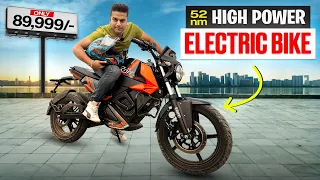
Plus, they have now launched new products, which cost 75,000-80,000. That is, products equal to Splendor have just entered their market. Which looks very good to see that mass market electric bikes are coming slowly.
Along with this, recently Ola Electric has also launched Ola's Roadster and Roadster X. Which goes in the segment from 75,000 to 100,000 rupees. And the segment of the majority of bikes is covered.
However, how exactly the bikes will be, what will be different in them, that will be a matter to see. Because it is still a market that no company has solved here. Because if you look at the bikes, there is a little bit of an enthusiast segment.
And at the global level, it is also made for those who are a little bit of a premium enthusiast or those who are fond of bikes. Even a surprising thing, there is a company called Zero at the global level, which makes premium electric bikes. But its electric bikes are not so popular, so successful.
But it is a benchmark that can be seen there. If we talk about India, if you look at electric bikes, then Ola and theirs have come. But an Indian company, a startup called Ultra Wallet.
This company makes superbikes in India, that too in electric. They have an F77. This is a premium super electric bike, which is also made in India and sold outside India.
Recently, Ultra Wallet showed the F99 superbike. The specialty of this electric bike is that it can achieve a speed of 0 to 100 km per hour in 2. 9 seconds.
Indian companies are achieving this thing here, which looks very good. Along with this, a company like Ather is also working on electric bikes. And the company I told you about, Hero Moto Corp is also working in India.
She will also launch her electric bike, which is already being tested. What I mean to say is that the budget electric bikes are done. You modified the scooter a little bit, removed the boot space.
You put a chain drive instead of a belt drive, increased the tires. I understood the budget segment. But a good premium segment where you get quality product, that is also going to come here.
There are such bikes available here. And in 2025 and 2026, we will see a revolution of this segment here too. Talking about this, there is one more interesting thing in electric.
The majority of electric vehicles sold in India, you will also be surprised that they are electric three-wheelers. The three-wheeler segment is also in India. Where most of the people who are your auto rickshaw drivers, they are on electric three-wheelers.
Because they have a low cost of driving. And if you are driving it all day, you can save a lot of money from petrol and CNG. And a lot of suitable things for the fleet.
Because of which the market was also removed by Mahindra. And that's why the government knows that this segment is running. This is working on public transport.
That's why give a subsidy here so that most of the auto rickshaw drivers shift here. Cargo and buses are also being made electric Because buses are used in cities to run all day and charge at night This is a simple concept Some people ask what will happen to hydrogen Hydrogen is not as successful as cars But hydrogen can be used in trucks and buses If you want to charge an electric bus, it will take 12-14 hours But if you want to refuel a hydrogen bus, it will take only a few minutes So hydrogen is very good in buses and trucks The tailpipe emission will be zero, but it will produce H2O So we can see hydrogen there too In India, there is still a problem of charging But we have to see how the money allocated for charging infrastructure is utilized How the charging problem is solved And how the companies that are making electric cars convince the consumer I saw a surprising thing in MG They said that you can buy a car, but we will give you the battery on lease And you have to pay Rs. 3.
5 per km But this will not be solved in India Because people say that you give us the whole car, I will not give you the money per km Many big companies are also planning to jump into electric Hyundai has a premium car But CRETA is also planning to launch an EV in 2025 Maruti Suzuki is going to launch an EV Surprisingly, they focus more on hybrids Mahindra is also working on multiple electric cars Mahindra is also planning to launch an EV in Thar Tata is already leading in the market But most of the car makers are made in China or South Korea So how do we do that in the long term? Because China has created a monopoly in the four-wheeler industry Most of the four-wheelers are made in China China has the largest electric four-wheeler company BYD is the largest company in China I saw a sealed car in India In India, they sell Tesla-level cars for around Rs. 40 lakhs Although the company is not very popular yet Many Indian companies and startups have a chance to grow But the electric four-wheeler revolution is still far away I think it will be clear in 5-6 years Until then, petrol and hybrids will be in the middle Electric four-wheelers have time But two-wheelers are growing well You will get coverage on everything People ask me why I leave the petrol car and go for the electric Because you get new features in the electric car Electric cars are not like the ones you buy and drive for the rest of your life There are updates and advancements The car you bought on day 1, after 2-3 years, may be better Range can be increased Software enhancements can be added Let's see what the future holds There are a lot of companies I have seen in India that there are many companies that have hired thousands of engineers What is your preference?
Electric, ICE, Petrol Diesel or Hydrogen?