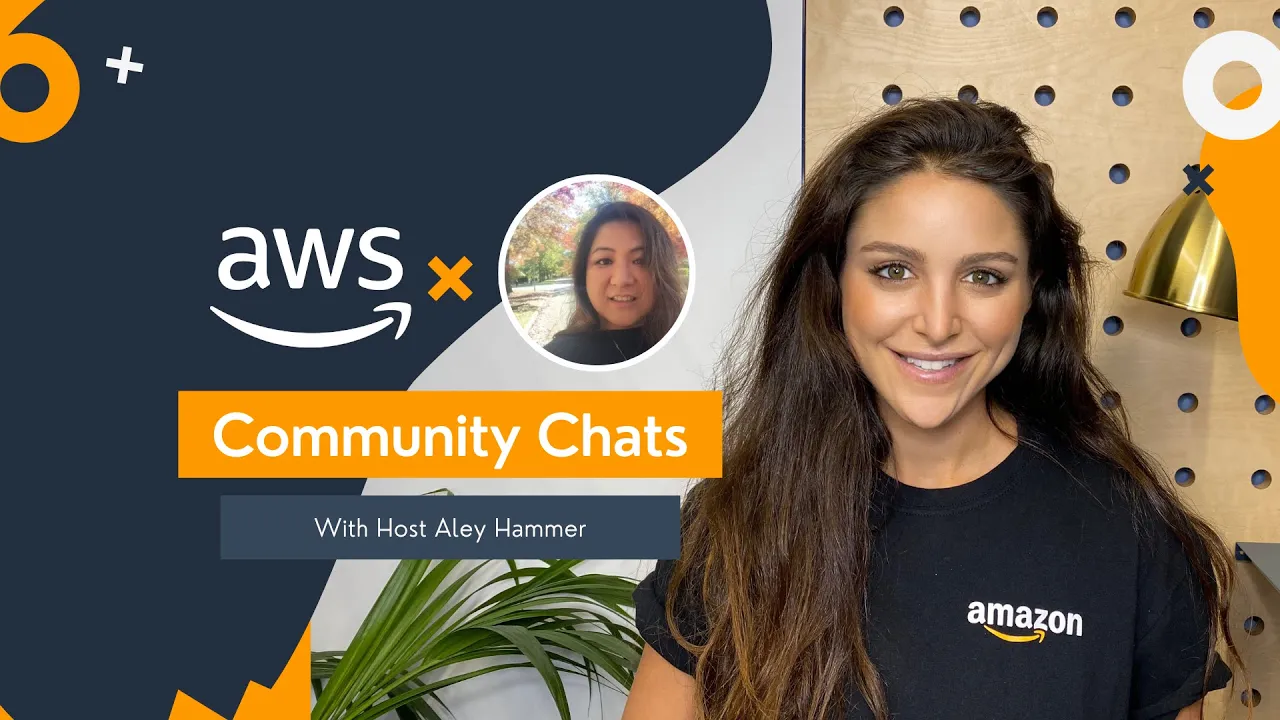
- Hello and welcome to "Community Chat. " I'm Aley Hammer, and today we're joined with Theresa Dang, a campus recruiter from AWS. Theresa, welcome back to the show.
To begin, what can a candidate expect in an AWS interview? - Yeah, depending on the role that you are applying for, so this could range from, live coding tests, or technical questions, but mainly will be based on our leadership principles. So, definitely encourage our applicants to really think about your transferable soft skills.
And the STARR methodology is definitely key. So STARR standing for situation, tasks, action, result, and reflection. The interviews will typically last around 45 minutes to one hour, so don't be surprised as the interviewer will be typing up notes during the interview, especially if it's a virtual one.
- Thanks, Theresa. And as a recruiter here at Amazon I'm sure you've seen it all. So what kind of tips can you give our audience in succeeding in an AWS interview?
- Yeah, definitely read through our Amazon leadership principles. I don't think I can harp on enough about that, as a lot of the questions will be based around that. But it's not all about the principles but everything that incorporates in an interview.
So body language is really important. So it really shows your motivation in the role. So this could be from your posture, your hand gestures, eye contact, intonation, but also your pace when you're answering a question.
This can convey on either being nervous, confident, not motivated for the role or show, if you are actively listening. I would encourage applicants to be professional but also be yourself. At Amazon we'd definitely encourage everyone to bring their true, authentic self to work.
So please be authentic and be yourself. It's quite easy for hiring managers to see when you aren't being yourself or spot that out. When going for an Amazon interview, remember any key metrics of what you've done and your achievements.
We are a very data-driven company and everything we do is based from data. So definitely make yourself stand out from a good interview to an amazing interview. Also to note, a lot of interviews are virtual now, so it's easy to type things up or read on screen, however, an interviewer can also see that, when you're reading word for word.
So try to avoid, and making sure that you practice, your questions or practice your answers. Try to prepare by Googling maybe common interview questions to start off with and go from there. - Those are some awesome tips and honestly like data-driven, absolutely.
Back up everything you say with an example and LPs. Those are two tips that I can say that helped me for sure. Thanks so much, Theresa.
And how can a candidate go about looking for an internal graduate position? Do they just Google it or do they go on campus? Like where do they even find out about these opportunities?
- Yeah, so if you are one of those lucky people who know exactly what they wanna do in the future, that is absolutely amazing. But often applicants don't know what you know or how much time is involved even before you start applying for that potential job. So if you're one of those people, have no idea, which I was, I really encourage you to really sit down and do a, maybe a strengths and weaknesses exercise.
What do you really enjoy? What do you least enjoy? What are you happy to learn or build your skills on.
The strengths and weaknesses will really help you when you start reading job descriptions. Start to pin down the type of role that you want to apply for. The last thing that you want to do is apply for the sake of applying and you have no interest from the get-go for that role.
Next thing before you make those applications is really perhaps, be involved in like, with a university. Speak to the local team that will be able to help you with your CV writing or student societies. There are plenty of universities and student societies that will hold networking events.
So it's your chance to really speak to the people who work in these companies at these networking events, and understand the type of work that they do. If they can't answer, they'll also recommend you to someone who'll be able to answer your questions. So, that research piece is definitely key and to remember to be open to, I guess, any doors or opportunities presented to you.
So you never know if you say no to things. - Absolutely. And Theresa, does Amazon take on mature aged candidates who have decided to change their career, go back to uni and are interested in a role, or do you really look for that prior experience?
Like yeah, that's a question I often get asked, so let's speak to that one. - Yeah, this is a definite yes. And I personally say kudos to you, to you really make that decision to go back to uni and learn like a completely different degree or diploma and then re-enter the workforce.
You bring so much experience from transferable skills but also curiosity, to have an aptitude to learn something new. So we definitely encourage mature age in our applicants to apply through for our roles here. - Thanks, Theresa.
I mean, I'm not sure what you class as mature age, but 100%, I myself have had a career switch. Quite early on actually, after uni I graduated from a commerce law degree and very quickly, decided that law wasn't for me. I was a lawyer for only about a year and then made the switch to tech.
So absolutely have a go and as you say, kudos you going back to uni, that's incredible. Theresa, to round up this interview, do you think that a cover letter is actually required when making an application? I can't remember back when I handed in my CV, 4-1/2 years ago, if I had a cover letter.
But it is a question that I actually want to know the answer to. Is it important or can you still get a job without a cover letter these days? - Yeah, it definitely does not hurt to have one.
But you can also do a short blurb, highlighting the key points in your resume as well. So depending on your role. If you are going for a more senior role, definitely a cover letter shows that motivation and interest.
If you are going for more of the entry level or more of a junior role, sometimes the number of applications that we do see through as recruiters, we don't even look at the cover letter to be completely honest. And so when you wanna highlight your key highlights, it's definitely better to add that on your resume. Any employee would definitely see value of you taking that time when you're submitting your application.
So in saying that, make sure though, don't copy and paste, and make sure that when you're doing that, put the right company, as often I see candidates addressing to a different company altogether, so without that attention to detail. So a cover letter of one page is enough, just to kind of highlight your motivation and key strengths. - Theresa, when you see something like that like for instance the wrong company name, is that just an automatic like no, or do you still consider that candidate if they've got an stellar CV.
Like, I'm actually really interested in that one. - Yeah, definitely. So depending on the role itself, I would definitely call the candidate and really question them up on that.
But often we do make mistakes as well but as I said, attention to detail is key when you are applying through for multiple roles. Definitely doesn't put you in the right foot, to begin with. - Oh, goodness, all right.
Well, Theresa, thank you so for the tips. We'll get you back next week for some more tips. So you so much.
If anyone has questions, please pop them in the comments section below and we'll get back to you. Thank you so much. - Amazing, thank you.