How is someone meant to balance working full-time with constantly learning and upskilling while getting enough sleep while exercising and taking care of your health and then spending time with your loved ones and then having free time for hobbies? Is that even possible? Yes, it is.
But only if you think in systems. I've spent over a decade coaching thousands of professionals to learn efficiently and succeed in their careers while having enough time and freedom to live life. And in my experience, thinking in systems is the secret to regaining control and freedom so that you're not stuck on that hamster wheel of constantly feeling busy while at the same time not making progress on the things that you really care about.
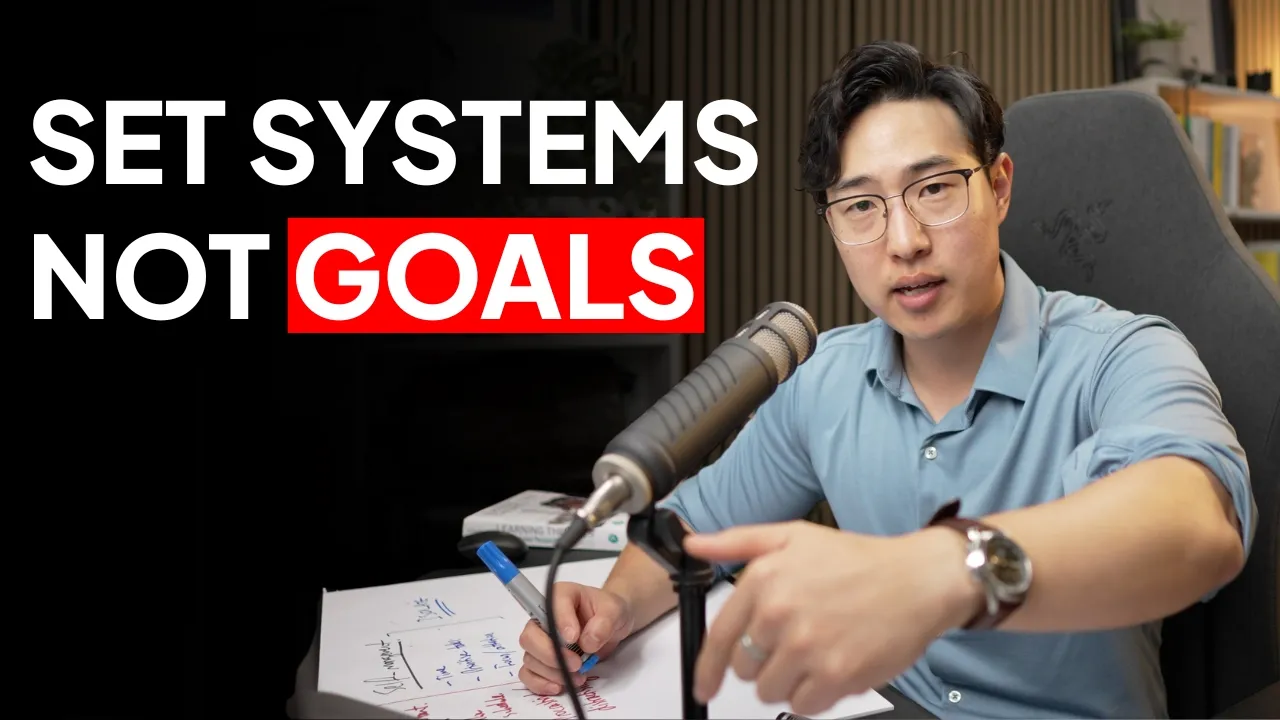
So, in this video, I'll explain what thinking in systems actually means, and I'll share with you some simple ways to build systems for your own goals utilizing the same principles I use when I'm coaching clients. So, what does thinking in systems actually mean? The point of thinking in systems is that you reduce your reliance on thinking in terms of willpower and motivation.
The aim is to reduce your dependency on these two things. And instead what we do is that we build processes that automatically help us to achieve the types of results that we're looking for. And once you find the processes that actually work, you then chain these processes together and now you've got a system.
Most people don't think in systems. Most people are operating in terms of intentions and tasks. So thinking I need to exercise today or I need to get more sleep or I need to finish that course.
But when you're busy, it is difficult to turn these intentions into reality. Now if you're more proactive, you go from these intentions And then you turn these intentions into plans. So for example, it's not just I need to read more.
It's I'm going to spend an hour every evening to dedicate to reading. And it's not just I need to exercise more. It's okay when I get home from work, I'm going to use that time to exercise every day.
Okay, I've made a plan. But what happens if you're too tired? What happens if something comes up?
What happens on day three of your plan and then you realize you haven't even started yet? At this point, you just feel frustrated and disappointed in yourself because yet again, your plans haven't come to fruition. So, let's look at this same problem through the lens of thinking in systems.
And there are three principles that I want you to keep in mind whenever you're thinking in systems, which will help you to build a system for your own goals. The first principle when we're thinking in systems is to think about things holistically. You look at your intention and then you think about all the factors that would influence the success of that goal and that intention.
So you are proactively expecting that plan to fail. You're expecting to be tired and lazy and for things to come up and you're asking yourself what can I do about that? And so when I'm coaching someone to build their own systems, one of the first things I'll do is I will ask them about all the things they've tried in the past and then why that didn't work for them.
And I'm paying close attention to what they did, but also how they responded to that obstacle or that challenge. It's important that you do this step because you need this list of all the possible barriers because there's a high chance that the system you end up creating is going to have to account for all of these factors. And this is actually directly tied to the second principle, which is that you should build your system for repeatability.
You do not want to develop a system of doing something that relies on like all the stars aligning. You want it to work on the worst day. And so if you think about your intention and then the plans that you have made, you can evaluate these plans in terms of how repeatable they are on a bad day and ask yourself, does it rely on willpower or motivation for me to execute on this plan?
And for the overwhelming majority of the clients that I work with, most of the plans that are created usually require you to inject motivation and willpower to make it happen. And that is a violation of the second principle which is to build for repeatability. You want to make sure that there is as little friction as possible.
And so what happens when we work with these two principles and then think in systems is that you actually end up sort of cycling back and forth between these two principles. You figure out something that is high effort that means that you know you're going to rely on this willpower. And then you think about ways to avoid that.
What are ways that I can make it easier? And then you go back and ask yourself, okay, well, what are the challenges? What are the obstacles?
What are the other factors that might make that plan not work? So, for example, there's this accountant that I was working with last year who was studying for their chartered accountancy exams, which is a pretty dense exam, and they're working full-time as well. And their plan to begin with was that they were going to do a bit of studying for their CA exams every day after work as soon as they got home.
Now, this plan failed like all the time because there's too much traffic and sometimes he gets too tired on his drive home and then he gets home and there's family and he has to, you know, prepare dinner and then after dinner he's like too tired and too sleepy. He just wants to relax. And so, one solution to that, which is the common one, is to say, okay, well, you just need to like dig deep and then try harder.
You know, forget it if you're tired. You know, who cares if you're tired? Just do it anyway.
And yes, that can work for a period of time, but personally, I don't believe that that is sustainable. And it's also kind of like a not a pleasant way to live every day. So instead, when we think in systems holistically and for repeatability, we look at that problem and we say, "Okay, sure.
What can we do about that? Perhaps we can uh stay at work for longer after work. " And then you you beat the traffic, you do the work and the study that you need to do in your office and then you come home after that.
So that's us trying to reduce the amount of effort, tackle some of these barriers that come up in terms of feeling too tired, not enough energy. And so we go back here and think, okay, well, what are the reasons why that might not work? So in this case, it's if I come home that late, then my entire family has to push back their dinner time.
Could that work? Could you have a conversation with your family and maybe they're all fine with it? Maybe they can just push back dinner by an hour and it's no big deal and then we've won.
So that was one option. And we explored another option. Okay, could we just study another time of the day?
Could you study before work in the morning? The issue is, well, then I'm not going to get enough sleep. Okay, so could you sleep earlier to get enough sleep?
Well, I can't because in the evening, whatever. Okay, could you change your nighttime routine to make that happen? So, you see, we're constantly bouncing back and forth between looking for that loweffort solution and then going back to think about all the reasons why it might not work until we arrive at this combination that allows us to lock in that success.
And what's really important with this process is that you have to think about it as a series of problems to solve. Just because your first solution isn't perfect doesn't mean that there is no solution. There is some combination of solutions that will work.
Your role when you're thinking in systems is to look for that combination until you figure it out. And this is a process that I personally repeated hundreds of times, which eventually is what allowed me to work full-time as a doctor while running a business full-time uh and then doing my masters full-time while going to the gym and having a social life and spending time with my family and getting 8 to nine hours of sleep every night. And often one of the biggest things I do now when I'm coaching someone is that I simply am more committed to looking for that solution for longer than they normally might.
And a lot of the time the solution we come to from this thinking process involves a certain level of discomfort. But this is actually fine. In fact, this is a good thing.
The fact that a solution feels uncomfortable means it's different than what we're used to doing. and getting a different result to what we're used to getting is actually the whole point of thinking in systems. And what I found is that the discomfort of making the change and acting on the solution is often not as bad as the discomfort of not making the change.
Or it may be uncomfortable to change your nighttime routine so that you can sleep one or two hours earlier. Yes, that's uncomfortable. Sure.
But it's not uncomfortable versus comfortable. It's uncomfortable versus even more uncomfortable because if you don't make those changes, you have to live with the stress and the pressure and the anxiety and the disappointment of never being able to make meaningful progress on these things that matter to you. Now, as you do this process and you go back and forth between these two principles, you will find that your intentions and your plans become much clearer and much more specific.
Your plans are not just general statements about the fact that you're going to do something at a certain time. It covers contingencies. If I'm tired, I'm going to do this.
If I'm not tired, I'm going to do this. You will learn so much about yourself and how you respond to different challenges that you will also learn how you can make it easier for yourself to just do the things that you need to do. The way you follow your plans and create habits and achieve your goals becomes much more fluid and dynamic, adapting to the unexpected challenges of life rather than having this rigid approach which constantly butts up against it and the only thing holding it up is your unwavering willpower which will waver.
Now, this is something that I've been doing for years, and I've been helping people to build their own systems for years as well, and I've picked up a lot of little tips and tricks that make it easier to build systems for certain goals and overcome certain obstacles. Now, some of these things I share on YouTube, but another place that I share them is in my free weekly newsletter. These are emails, newsletters that I write up with my fingers myself.
You not chat GPT generated uh where I think about what are the things that I wish I had known when I was first building my systems and learning to learn effectively and manage my time more effectively. What are the biggest needle movers that allowed me to learn effectively and advance my career while maintaining that balance in life? And I summarize those in these emails and I send them to you for free every single week.
So, if you're interested in getting some of those insights, then I'll leave a link for you to sign up in the description below. Now, on to the final principle. At this point, if you're just doing the first two, you will succeed.
Each iteration of your plan and your system will just get better and better until you just don't have any obstacles left. But this final principle is what will allow that system to stay with you and evolve for life. And it makes it much easier to just maintain this system.
And so I call this peeling the band-aid. So peel the band-aids. Your first system that you build from this process is going to be full of band-aids.
So for example, let's say that a problem you have uh with carrying out your plan is that you always feel too tired and you struggle to focus. So the first solution might be to take a nap during the day and to use a timer when you're working to try to increase your focus. These are band-aid solutions because they help you right now in the short term without addressing the underlying issue.
The reason you're tired is because you're not getting enough sleep. The reason that you can't focus is because your attention span is terrible. And the reason we want to remove band-aid solutions even though they can serve us in the short term is because it just overbloatates our system.
And if possible, we want to remove the limitations and conditions for us to succeed. You know what? If you don't have time for a nap, what if you don't have a timer available for you?
Well, in that case, your just plan just fails for that day. So, while these band-aid solutions do give us a benefit right now, they should be a temporary solution while we work on solving the underlying problems. And often uh working on these underlying issues involves a change in habits which means because it involves unlearning and retraining your habits, it's going to take time.
And so the very act of changing your habits so that you can one day remove these band-aid solutions should actually be part of your system. And so this changing habits actually ends up becoming another intention and then we plug that into our system. So for example, yes, we might have figured out that taking a nap and using a timer is helpful for us right now.
We can use that. But then at the same time, we think about how we can improve our sleep habits and how we can train our attention span. That becomes our new goal.
And then we go through to these first two steps again to work that into our system. And by doing this, it means that the system we create ends up being effective for us not only in the short term but also in the long term. So these are the three principles for thinking in systems.
And it may seem like a lot of work and a lot of thinking and you know all very complicated to create this system. But the crucial thing you have to understand is that it is the exact same amount of effort. It's the same amount or less discomfort.
All we're saying is that there is a different way that you can direct that time and effort which is much more likely to help you achieve your goal and finally feel like you have a bit more time and freedom in your life. Now, if you're a busy professional with lots to learn and the time spent learning is sucking away that time and freedom from your life, then you might want to check out this video where I teach you how to create a learning system so that you can develop deep, meaningful knowledge for huge workloads in half the time.