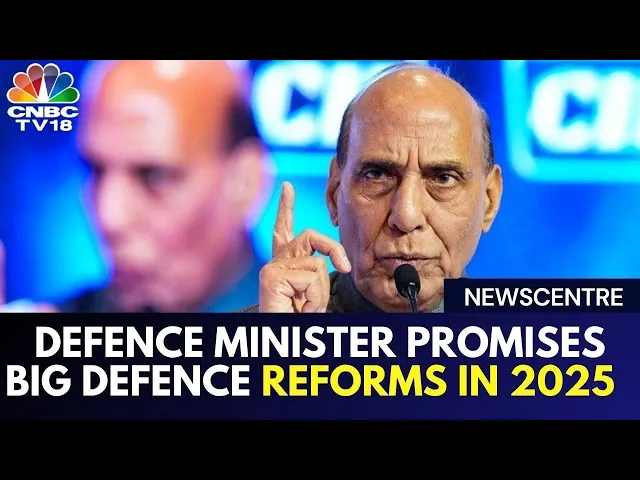
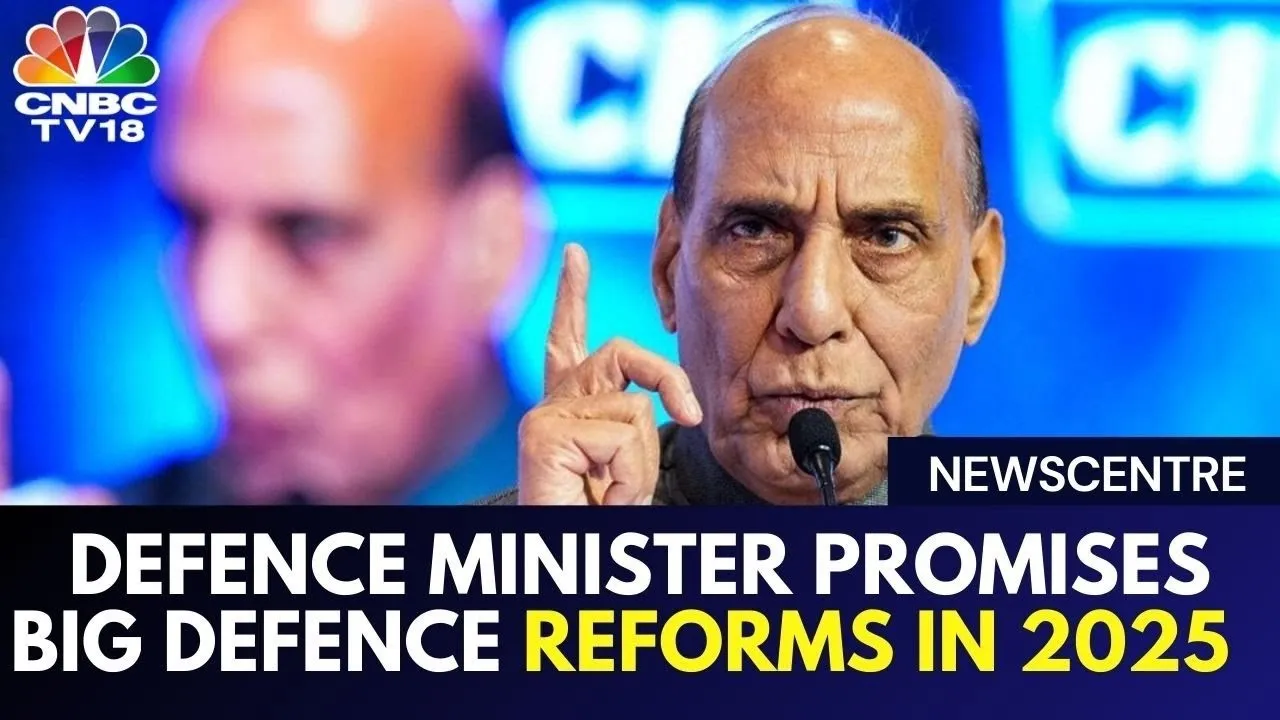
[Music] hello and welcome to News Center wishing all of you a very happy New Year I'm parikshit lutra defense minister rajat Singh has declared 2025 as the year of reforms for the sector the decision was taken at a high level meeting chaired by Singh the minister has said that the focus in the new year will be on new domains such as cyber and space as well as emerging Technologies like artificial intelligence the broader aim of the reforms would be to make defense acquisition procedures simpler the reforms will also aim to ensure deeper collaboration among key
stakeholders and optimize utilization of resources the ministry has also said that the reforms will facilitate establishment of integrated theater commands under this model the government seeks to integrate the capabilities of the three branches of the Armed Forces at present the Army Navy and the Air Force have separate commands the welfare of veterans is also on the list of priorities to take this forward I'm now joined by vice admiral madjet Singh former flag officer commanding and- chief of the western Naval command rajendra Singh baa president at the Society of Indian defense manufacturers he's also the chairman
of the defense business of the Kalani group we also have with us Arun ramchandani the head and Executive Vice President of L&T defense gentlemen thank you very much for joining us and wishing all of you a very happy new year uh Mr baa if I can begin with you if we speak about this high level meeting that took place in the defense Ministry one of the issues that was prioritized was acquisition procedures how to make them more simpler have how to make them time sensitive what has been the industry ask here um firstly preet Happy
New Year to you and to all your viewers and listeners uh regarding this acquisition procedures the issues are actually twofold one is that acquisition procedures must be time bound and secondly they must be in a certain time frame now time bound will allow the industry to prepare for the orders which need to come in because then the Investments can actually take place in the Indian industry secondly making it time bound is also important from the point of view of Technology obsolesence if your acquisition cycle is longer than the technology development cycle the products which you
are going to get are not going to be of the state of art technology in the current scenario where technology is changing so rapidly and when we are talking about new domains I think it is Paramount that the acquisition Cycles become shortened and hence they will enable the industry to offer products which are state of heart as far as Technologies concern anything else that is an important I will R to you sir I'll come back to you again shortly let me also get in Mr Arun ramchandani Mr ramchandani there was a lot of discussion on
bringing reforms to fa facilitate greater preparedness in New Age Warfare such as cyber warfare uh artificial intelligence machine learning robotics uh and also having adequate training and preparedness to win Wars with these new technologies and new domains how is the industry preparedness here and what is the kind of support you need from the government uh so once again happy New Year to you and all your viewers uh coming to your question uh let's just say that the industry is looking at all of these Technologies with a lot of focus both in the Civil domain and
in the defense domain uh the deployment of these Technologies probably is far ahead in the Civil domain and it's good that the government is giving a Thrust to deoy these Technologies in the defense domain uh we are quite geared up to uh you know look at deployment of these in fact uh stuff like AI is already finding its way into many of the Control software that we write for defense systems uh there is a whole ecosystem of startups and New Age Technology Ventures that that uh is being encouraged by the government and we have various
schemes like the idex the ad the tdf which provides funding for you know trying out these Technologies and deploying them in real life environments in defense environments so I think uh with the thrust on building this ecosystem with the industry embracing these Technologies uh it is the right time to put an impetus to uh create a Thrust for deploying these Technologies in the military domain and I would say that uh we are geared up uh these Technologies are changing fast we will have to keep Pace with the world uh as these Technologies are deployed uh
in a greater way we would have to seek uh High degree of innovativeness from among our people to make sure that we are able to deploy them effectively and I think India uh today is well geared up to take advantage of these technology ships and prepare itself for the wars of the future right uh let me go across to uh rajendra Singh baa once again Mr baa when it comes to our defense budget the allocation for Capital acquisition has been going up on a year year-to-year basis what is the kind of capex push for modernization
for acquisition that you're actually hoping for in this budget and when we want to achieve the aim of BEC becoming an economy which has achieved 3 lakh CR in defense production 50,000 crores in defense export by f529 what is the kind of uh growth in capex that we need on a year-on-year basis so let's take a look at the growth in the defense manufacturing the country it has been growing uh quite well in fact if you take a look last year we were 1 lakh 8,000 crores this year we are at 1 lak 128,000 crores
which shows an increase of nearly 16 to 18% but if we were to reach three lakh crores which is the target which has been put by the Ria Mont obviously the allocations on the capital side or Capital acquisition budget would need to go up by something like 20 to 25% in my talks with the people and in the ministry they have always indicated that there will not be any shortage of funds for capital budget in case the requirement of the servic is there but we really need to see this happen the second part is on
the export side today we are standing at about 21,000 crores we if you need to really double we need to last year we grew almost 32% from where we were but we need a growth of regular growth of about 25% cagr or little more if we are to achieve 50,000 grow now exports are not dependent upon capital budget and in fact this can fill the deficit in case the domestic budget is not enough to actually fill that void so one recommendation which the industry has been making is that try to facilitate the exports because exports
will have a more than one advantage to the Indian industry first is that the Indian industry will be able to supply their goods outside the country but it will also be able to take care of the hacka demand which is always a very important characteristic of Defense Manufacturing in the country which means you get one particular order and then for few years you do not get an order and hence the demand continues to go down but if you have a export market then you can fill that voids when the demand is going down by supplying
products to other countries so if you ask what is the industry asking today industry is asking actually help in exports and whatever reforms we have put into place or what we intend to put into place operationalization of some of those reforms and most important in all of this would be that two announcements which were made last year one was reservation of 25% of R&D budget for the Private Industry and secondly was that one lakh cres which were e marked for deep technology development in the country if both these things are really put into place I
think both these targets are well within the reach of Indian industry absolutely let me also go across to vice admiral a former vice admiral madjet Singh uh vice admiral Singh I would like to ask you about integrated theater commands there has been conversation about this since 2021 when the exclusive Department of military Affairs was set up work on establishing integrated theater commands has been happening since then experts have been demanding that this should happen uh what do you think have been the hurdle so far and considering this was the number one priority in terms of
reforms listed out by rajat sing's office for 2025 do you think this will happen yeah it should happen the problem is that um there is not a very clear understanding on what exactly you want to you know create and this is within the service as also in the government uh this issue of um joint jointman ship has been actually focused upon from 1985 then we had the post Carill uh task force and I happen to be member of that we went through that in great detail now 25 years later we have still trying to Define
what exactly we want to create and in all these in all the countries um where uh such integration has taken place uh one of the net benefits has been reduction in Manpower and this has been flagged earlier too and whether we want integrated Thea commands or Regional commands is also to the best of my knowledge there seems to not be adequate Clarity and to remember in the countries big countries with the big big Armed Forces uh they have been led by the uh the the government and not necessarily left to the services headquarters and uh
well very prime example is what happened in USA the gold waterer nickels unfortunately we don't have people who have a you know reasonably clear understanding when the dma was created I think in my opinion personal opinion it was a bit lopsided because we we made the CDs secretary to the in the ministry of Defense the CDs was supposed to be or is supposed to be a principal adviser to the government he does not have an operational role now we started creating thinking around with what exactly is going to be uh you know created and he's
become a bureaucrat and uh so that is not the way I mean I've been involved the the discussion in the past and that is not the way we did away with commanderin-chief India in 1952 for good reasons and in no Democratic country do we have a system like that they report for example I'll give you a very quick example of chairman joh chief of staff of US forces they he has no Ro he advis the Pres sir I just want to bring in I just want to bring in another point you know integrated theater commands
as you've been seeing has been spoken about since 1989 now when you speak about defense challenges in 2025 and Beyond one of the reasons why we spending what we are spending on defense is because we need this for our defense needs we have a threat from China we have a threat uh from Pakistan as well there is Insurgency issues in uh the Northeast also giving the threats that India faces at this juncture what kind of uh military preparedness or production capabilities we need to have at the earliest what are the kind of uh issues in
our acquisition process we need to remove for further efficiency you know the acquisition process itself the first uh DPP was laid down in 1992 in fact I happen to be a signatory to that since then we have changed it so many times does it make things move fast no our whole system approach for I'll give you a very simple example uh let us take Aviation Aviation there are seven different entities in Bangalore the HL being the biggest player then they you know Ada ad semil etc etc they all have different bosses they operate through a
system of writing letters and notes to each other it should be a one simple entity and which should do that and similarly between the dro rationalization is far long over due there's a committee which has gone into this last year but I think to the best of my knowledge they only Tinker around with the small items they the whole system approach what we are developing we are not able to produce because the transfer of technology is not taking place by the way you know people are talking about high high energy weapons and etc etc now
this project was given by Naval headquarters to drdo in 1990 you know we who who is looking who's forecasting future Technologies you know we have to have a system approach and that is not happening that is still lacking and finally on this issue production yeah let me just say uh the the um unless it is a partnership between the dpsus and private sector and essentially led by the private sector we will not approach the figures that we are talking about and let us look at not the quantity let us look at the qualitative uh aspect
of what what are we exporting why can't we give this targets of Defense cooperation or exports to our missions abroad other countries do that we are not doing it what are the targets given to any mission of our in a big country you know I think I think missions are being involved but probably they can be involved on a much greater level at a much greater level uh but we have to give a Target you've got a country and let big Partners in Russia us Etc there has to be a Target given to the mission
and it's not to be left to the okay uh Admiral madin sing We have to take a break I'll request rajender Singh Raj singhh and Arun ramchandani to also be with us we'll be right back don't go [Music] anywhere welcome back you're watching newss Center we still have with us vice admiral madanit Singh rajendra Singh baa of the Society of Indian defense manufacturers and Arun ramchandani of L&T defense uh Mr ramchandani now when we speak about collaboration between dpsus uh the dro and the Indian private sector how successful has been the partnership so far yes
rajat Singh has said that this will be one of the areas of reform where we want things to be speeded up but uh what's what's really desired here and what's been your experience so far well uh the the government has spelled out its intent and uh clearly it's an area of Reform uh you know traditionally the private sector really had somewhat of a back seat with lot of nominations of orders going to the public sector uh and the government has been progressively changing this uh the need for us to work together to exploit the infrastructure
that exists uh across the sectors is something that is important and it is something that is taking shape there is lot of dialogue there is a good amount of programs where public private partnership is uh taking place in fact uh you know we for example at lnt are working on some gun systems with the uh ordinance Factory uh infrastructure and so on uh the collaboration with Dro has been fairly strong and Dro has used Private Industry as a partner they have the development come production partner model where they induct industry as partners uh in the
development phase to speed up the production phase and this is something which needs to scale up uh probably the whole uh you know the construct and mindset that uh the private sector uh you know the process probably is more more stringent when contracts are awarded to private sector industry and that kind of mindset shift where private sector is seen on an equal footing with the defense public sectors in terms of Partnerships in terms of contracts in terms of speed of placing of contracts all of this will be great enablers and it will Unleash the Power
of the private sector to grow the industry right uh when it comes to the R&D fund as Mr bharta pointed out on deep Technologies on R&D on future Technologies we want the research fund to be operationalized how far behind are we uh from countries like China Russia United states which have a much higher defense budget compared to India so yeah Mr ramchandani that's to you okay so uh my take would be that uh you know there is really need because defense is something which has to be government supported it's a niche technology area it requires
uh highrisk investments in R&D it has you know long payback periods and unless the government supports it uh we will lag behind in Cutting Edge technology uh there has been a constant demand that R&D funds need to flow into industry so that industrial R&D can Propel growth uh the industry has an ability to build new product products uh you know to innovate on existing Technologies and build new products and money needs to flow in to support that uh kind of venture you know uh right long-term uh highly futuristic work can be done in government Labs
but lot of the conversion level moving things from technology rless levels of say three or four to higher levels can be easily done by the industry and enough funding needs to go in in place for that all right let let me also yeah yeah let me also get in um Mr baa on that Mr baa we've got these numbers on our screens United States the defense spending was $939 billion in 2024 according to the LOI Institute China was $373 billion Russia was $225 billion India was 132 billion and then you have Saudi Arabia but when
it comes to specifically R&D Capital Acquisitions uh where does India need to step up according to you so parit you had asked this question and let me take it up a little bit on what you asked before so basically the technology development in the military vience is divided into various revolutions on Military Affairs which have taken place there was RMA 1 which came up which was probably missed totally by us R2 when command Centric Warfare came into the country we were trying to play catch up RMA 3 is on us which means all this so-called
emerging and Advanced Technologies come into place we are behind many countries in this case and it is a well-known fact but going ahead in that particular queue can only happen through breakthrough Technologies you know if you are going to go with the traditional methods of research and development and Innovation you will still continue to but catching up is going to be difficult and that's where the role of the so-called the uh you know startups come into the country we you know over the period of last four years they're almost close to 9,000 startups which have
registered themselves for defense various challenges out of which 900 actually have now been successful in one way or the other in developing certain technology now these startups have a way of making you jump that CU you know you can come with a breakthrough technology which can give you a jump start into the technology bandwagon which is what India needs today so I would say that we need to focus more on developing this breakthrough Technologies through startup ecosystem and that's where that role of that one lakh CR which we are talking about deep technology funding becomes
extremely important and let me give you a small question here uh if you see that technology Development Fund was initially given out in 20078 after kker committee but to operationalize that fund we took many years and finally when it was operationalized it was abun to the dro funding because it was placed under di now when you are talking about research and development funding I think it needs a separate framework and that is where I think the thrust should be so that we can maybe there can be a million startups in defense and India has the
ecosystem India has the brain part to take this on okay and finally sir what would be your outlook on the ful year defense production for fi25 and the exports you're asking me again so yes sir uh very difficult to answer I would say that it is looking into the future the spending because of the elections and certain reason what lacking pace which you know in your economic predictions it it has already been indicated that the government spending was not up to the mark and hence certain growth patterns but I'm sure we are surely aligned to
do better than the last year as of today and we are hoping that we'll do much better than last year okay so hopefully the defense production exports will be better than f524 that's all we have time for but Mr Arun ramchandani Mr baa and vice admiral madjet sing thank you very much for joining us on the program giving us your outlook on the reforms promised by defense minister rajat Singh [Music]