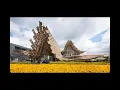
architectures of multi-agent systems here i'm showing you the work of daniel bologen this is an example of stigma g stigma she is defined in the dictionary as the mechanism of spontaneous indirect coordination between agents or actions where the trace left in the environment by an action stimulates the performance of the other subsequent action in many ways it's following the logic of the pheromone trail this is the kind of work that has really been spawned by the use of multi-unit systems daniel balajam writes his own algorithms he doesn't use processing um but what we're getting is
this astonishing effect and this in a way is why architects were so fascinated by the use of multi-editing systems it opened up a whole new dimension a whole new way of thinking about design curiously many of these architects who are working on swarm intelligence are now working on artificial intelligence as though the next step is to go and to work with with artificial intelligence itself daniel bollage at him is one of the leading experts in artificial intelligence that we've seen in some of the other lectures in fact one could say that there are certain limitations
to the use of swarm intelligence what level of intelligence does it actually possess if it has any intelligence and it does have some intelligence it's a relatively low level intelligence compared to say what we find in deep learning nonetheless it does produce some astonishing work there are of course of course ways in which one can use swarm intelligence in a kind of performative way swarm particle optimization is one of the techniques that has been used to uh to to optimize the facade of buildings for example but much of the work we put into into the
swarm intelligence book was not based on that it was really about opening up new ways of expression expressing themselves new forms of architecture itself let me show you then some of the kind of work that has been coming out by some of the cutting edge architects in this domain elisa andrescheck has been one of the leaders from the pioneers she was many years ago one of my students at columbia she's now a professor at rmit but she's taught all over the world and she taught roland snooks her work is exquisite in many ways one thing
you can say about elisa is that she always produces something that looks astonishing this is the project she calls invisibles it's a form of inverse kinematics on the left hand side you can see the kind of mechanism as it were that is clothed on the right hand side it is the inverse kinematics is kind of think of it almost like the way that an elbow joint work how one one one operation then in it has an influence on the entire assembly of operations of course this is not built as such but nonetheless this kind of
exploratory work was really has really been pushing the boundaries of what we might find what we might call like the most progressive forms of architecture expression alisa's work has also been using um other sort of other systems to go into produce these things this is an electromagnetic field that was used for her cerusi pavilion um and she's also been using multi-editing systems in particular this is a project that she did um with jose sanchez using these these agents to go and define a kind of canyon-like operation you can see the agents then kind of tracing
this kind of this this pathway that then itself becomes consolidated into a kind of panel facade or something what is it for we don't know exactly it's not necessarily a kind of pragmatic thing it's not necessarily trying to define a functional building but rather it's trying to open up the possibility of what architectural expression might be and in many ways this is really what was been happening with the exploration these new techniques that is in a sense pushing the boundaries opening up what possibilities beyond those that we might ourselves envisage in other words in many
ways like ai itself some intelligence becomes a kind of a muse a muse that opens up and suggests things that we would otherwise not have thought about this then has been the kind of work that has been largely coming out of this particular kind of system um exploratory work progressive work not necessarily pragmatic work not necessarily feeding into a kind of the professional discourse of architecture but certainly pushing the boundaries of what might be possible in terms of architecture itself this is some work that she produced and when she was teaching at ucl bartlett she
had a um a studio called wonderlab of course elisa her name means alice alice in wonderland and and always what you can find with the work produced by elisa is that you and her students is that it looks exquisite and this essentially is what they've been looking for trying to find ways of producing um exquisite looking work this is a 3d printed um study uh and so on roland snooks was himself a student of elisa's um this is one of his projects uh for a mace um for rmit in australia the leading school of architecture
it's a mace that was generated the pattern was generated using three uh multi-agent systems and then 3d printed in titanium in many ways one of the challenges of of working with multi-agent systems is they they are basically agents that leave traces they leave traces therefore you can define lines and so on but they don't necessarily lend themselves to being architectural forms if you think of an architectural form as being something that is bounded by certain planes but nonetheless they can open up they can open up possibilities of how might we might reimagine architecture this is
a project for a museum in korea um that points to the was the possibility of how how how ravishingly exquisite some of this work can be um another another project that he um that was done in collaboration uh with tom wiscons who teaches at psych a kind of what he calls messy computation where you use computation then you intervene um with your manually as it were um you so it's a combination of the what the computer might throw out of the possibilities that we wouldn't have imagined and then human manipulation making it into a building
and then further work coming out of roland stuxx's studio he's now a professor at rmit um in melbourne himself and looking also the possibility of robotic fabrication using these techniques to produce this kind of work and this is the work of his students some some time back using processing this is work from the students from upenn university of pennsylvania and then more recent work from his students in rmit jill retzem was also a a student of uh of elisa's at the aadrl and he is now a professor of the bart this is one of his
projects that he did when he was at the drl and finally let me just mention briefly that the the work of uh satoru sugihara who is also working on multi-agent system he was teaching at syap for much for many years and collaborating with um tom main um of morphosis in fact this building by morphosis this facade here is generated using a multi-agent system so although on the whole this hasn't been used in in terms of the the profession of architecture in the terms of the pragmatic pragmatics of building nonetheless it has that potential and satoru
is still working as a consultant for a number of architects producing a project such as this swarm intelligence then has its place in the history of architecture as something that really opened up a new way of thinking new forms of expression it might be being eclipsed by artificial intelligence now but nonetheless in many ways it set the scene for artificial intelligence