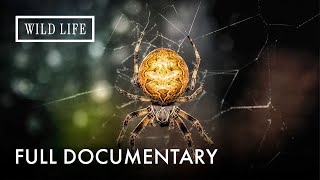
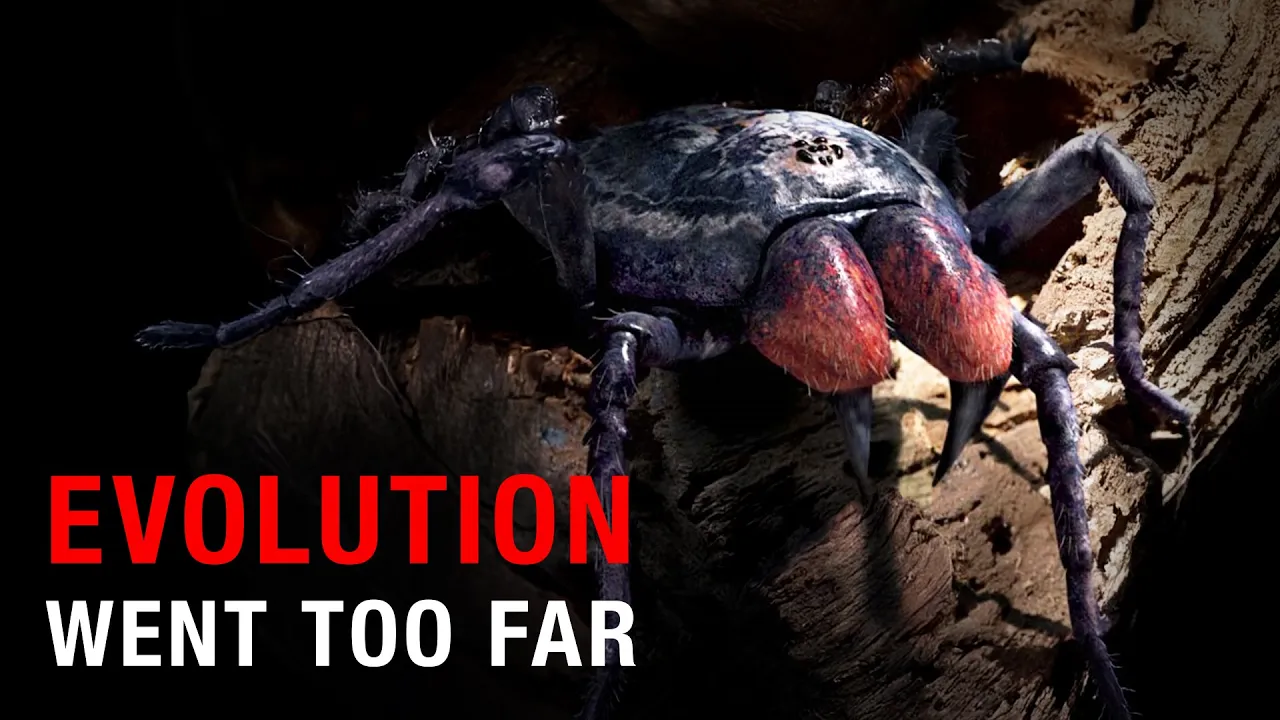
A spider always looked simple to me. Eight legs, tiny body, builds a web, nothing special. But once I actually started digging into how a spider works, everything changed.
I didn't expect to find a creature this overengineered, this efficient, and this bizarre. Like, there are species of spiders that can literally fly, drifting through the air on strands of silk like tiny parachutes. and some even crosses entire countries and oceans this way.
The deeper I went, the more shocked I became at how much I never knew. Spiders are 400 million years old. That's older than dinosaurs, older than trees, older than flowers, forests, or anything we'd recognize as a modern landscape.
And here's something that might surprise you. Technically, a spider isn't an insect. Saying a spider is an insect is like saying a human is a shark.
Spiders belong to an ancient lineage called chelliserates. Creatures that split from the insect line over 500 million years ago, back when life was still figuring out how to survive on land. And spiders actually share their roots with some creatures you already know today.
Scorpions, horseshoe crabs, and even ticks. Yep, those are their distant cousins. But what makes spiders truly fascinating isn't just their age.
It's that their evolution produce traits that don't appear anywhere else in the animal kingdom. So, how did spiders become this strange? What evolutionary pressures turned aquatic ancestors into eight-legged architects?
And why did they invent silk, arguably one of nature's most sophisticated materials, long before they ever used it to build webs? To understand spiders, we need to go back to a world barely recognizable as Earth. Around 400 to 450 million years ago, during the Siluran and Deonian periods, life was making its first serious attempts to colonize land.
The continents were barren rock and primitive plants. There were no birds, no mammals, no dinosaurs, just arthropods. And among those early pioneers were the ancestors of spiders.
These protospiders didn't have soap glands yet. They didn't have venom. What they had were eight legs, simple fangs called chiser, and a body plant that had evolved in the ocean, but was now being tested on dry ground.
Spiders split from insects roughly 500 million years ago. While insects developed six legs and eventually wings, the chiserate lineage went a different direction. Eight legs, two body segments, and a fundamentally different approach to sensing the world.
no antenna, no compound eyes in most species. Instead, they relied on simple eyes and incredibly sensitive hairs covering their bodies. And here's something most people don't realize.
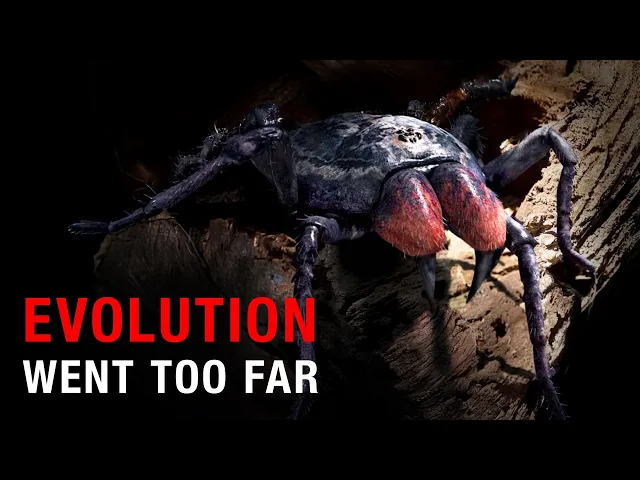
Spiders evolved before flowers existed. Before bees, before butterflies, before the ecosystems we associate with nature today, they were among the first complex predators on land, hunting in a world of ferns, mosses, and enormous arthropod prey. Some of the earliest spider fossils like Idon archn from around 305 million years ago had features we don't see in modern spiders like segmented plates on the abdomen and possibly a short tail.
These were experimental designs, evolutionary prototypes testing what worked. But what truly set spiders on their path to dominance wasn't their legs or their body structure. It was two revolutionary inventions.
Venom and silk. Venom is one of evolution's most elegant solutions to a fundamental problem. How do you safely kill something that might kill you first?
But here's what surprised me when I started researching spider venom. It didn't originally evolve for killing. It evolved for digestion.
Early spiders had digestive enzymes in their gut like most animals. But at some point, those enzymes began to be produced in glands near the fangs. When injected into prey, these enzymes started breaking down tissue externally, predigesting the meal before it was consumed.
Over time, some of these enzymes mutated into neurotoxins. Instead of just dissolving tissue, they started disrupting nerve signals, paralyzing prey almost instantly. This gave spiders an enormous advantage.
They could subdue dangerous prey without prolonged struggle. And venom didn't just evolve once. It evolved independently in multiple spider lineages.
Each time producing different chemical cocktails tailored to specific prey. Tarantulas develop venom optimized for insects and small vertebrates. Widow spiders evolved neurotoxins that target the nervous systems of larger animals.
Funnel web spiders in Australia produce some of the most potent venom on Earth, containing compounds that can kill a human in hours. But most spider venom isn't designed to kill. It's designed to liquefy.
Spiders are external digesttors. They bite, inject venom loaded with digestive enzymes, then wait for the preys insides to turn into a nutritious soup they can suck out. Some species even evolve venom that works like anesthetic.
Certain tarantulas inject compounds that numb prey tissue, preventing the victim from struggling while digestion begins. Others use venom that hijacks muscle control, forcing prey into paralysis while remaining alive, fresh food stored for later consumption. This is predation at a chemical level.
And it set the stage for the next innovation, silk. If venom was spider's weapon, silk became their superpower. Spider silk is one of the most remarkable materials in nature.
Poundforpound, it's stronger than steel. It's more elastic than rubber, stretching up to 40% of its length without breaking. And spiders have been producing it for over 380 million years.
But silk didn't start as a webb building material. It originally evolved for protecting eggs. Early spiders produced silk from specialized abdominal glands called spinterettes, wrapping their eggs in protective cocoons.
Over time, they discovered other uses. Drg lines as safety tethers, burrow linings, and eventually aerial snares. Here's where it gets extraordinary.
Modern spiders don't produce just one type of silk. They produce up to seven different kinds, each with distinct properties. Drgline silk, the strongest, forms web frameworks.
Capture silk comes coated in sticky droplets. Wrapping silk immobilizes victims. Each type comes from a different gland, and spiders switch between them depending on the task.
The golden orb weaver produces silk that literally glows gold in sunlight. Darwin's bark spider makes silk tougher than Kevlar, building webs that span rivers, some stretching over 25 m. Some spiders abandon webs entirely for creative silk uses.
Bolus spiders spin single threads with sticky balls, swinging them like lassos to catch mods. Water spiders construct diving bells, underwater air chambers made of silk. Others use silk for ballooning, releasing strands into wind to travel hundreds of kilome.
But the most incredible thing about silk isn't its material properties. It's that spiders use it as an extension of their nervous system. A spider's web isn't just a trap, and this blew my mind.
It's a fullon sensory organ. When prey lands on a web, vibrations travel through silk strands like signals through a network. [Music] Spiders read these vibrations with extraordinary precision.
Identifying prey species from vibration frequency, estimating size from movement amplitude, distinguishing between struggling prey, mating signals, and wind. Silk transmits vibrations incredibly efficiently. Each strand acts like a tuned guitar string, resonating at specific frequencies.
Spiders monitor the entire structure simultaneously from the center or through signal threads. Research shows orbwaving spiders detect and locate prey in complete darkness using only vibrational cues. Different web designs optimize for different information.
Orb webs detect flying insects. Funnel webs amplify ground vibrations. Cobwebs confuse prey while providing multiple signal pathways.
Here's something that surprised me. Many orb weavers rebuild their webs daily. They tear down the old structure, consume the silk to recycle proteins, reclaiming roughly 90% of what they invested, then build fresh webs optimized for current conditions.
The web is temporary architecture, a disposable sensory interface rebuilt to maximize hunting efficiency. It's extended cognition made physical, allowing spiders to perceive their environment in ways their nervous system alone couldn't achieve. But the weird part is that the spider doesn't rely on the web to be impressive.
Its own body has features that are just as extreme. Spiders possess sensory and mechanical systems that seem almost engineered. Most spiders have eight eyes, each serving different functions.
But jumping spiders develop something extraordinary, telescopic retinas. Their front-facing eyes have layered retinas that move internally, scanning environments without head movement. They perceive depth through chromatic distance measurement.
Different light wavelengths focusing at different distances. They see ultraviolet wavelengths invisible to us. This visual acuity allows jumping spiders to hunt without webs, pouncing from distances up to 50 times their body length.
But that explosive leap reveals another bizarre feature. Hydraulic legs. Spiders don't have extensor muscles.
Instead, they pump hemolymph, their blood, into legs, creating internal pressure that forces joints to straighten. It's construction equipment principles, but miniaturized and biological. This hydraulic system provides incredible jumping power but creates vulnerability.
Punctured exoskeletons lose pressure preventing proper leg extension. This is why dying spiders curl up. Beyond vision, thousands of specialized hairs called tririccobria cover spider bodies.
These hairs detect air movements as small as onetenth the width of a human hair. Some species use them to detect insect wing beats before prey touches webs. Others sense air flow from approaching predators.
One study found certain spider hairs respond to soundwave frequencies, effectively allowing spiders to hear without ears through mechanical deflection of sensory structures. Everything about spider physiology seems optimized for predation through millions of years of evolutionary refinement. But the actual hunting behaviors are where things get genuinely strange.
[Music] Trapdo spiders hide underground and launch ambushes. Netcasting spiders throw silk nets at prey in pitch darkness. Crab spiders change color to match flowers.
Ant mimicking spiders disguise themselves to infiltrate colonies. But perhaps the most surprising discovery isn't strategy diversity. It's evidence that some spiders plan their attacks.
Spiders have tiny brains. Most nervous systems fit inside their sephiloththorax with room to spare. Jumping spiders, particularly genus Porsche, demonstrate planning like behaviors.
When hunting other spiders, dangerous prey that fight back. Porsche spiders perform reconnaissance. They observe target webs from distances, sometimes for extended periods, analyzing structure and position.
Then they execute detours, approaching from angles minimizing detection. [Music] This suggests spatial memory and root planning, cognitive abilities typically associated with vertebrates. So what's happening inside brains the size of poppy seeds that enables this?
One hypothesis, spider cognition is heavily embodied. Intelligence isn't centralized in brains processing abstract representations, but distributed across sensory systems, directly coupling perception to action. Webs become part of cognitive architecture.
Hydraulic legs provide decisioning feedback. Sensitive hairs create realtime tactile environmental maps. Spider intelligence might not work like ours.
It might be cognition we don't have frameworks for understanding. Evolution doesn't stop. It's happening now in every spider population on Earth.
Urbanization creates new selective environments. Some species adapt to artificial light, attracting insect prey. Certain orb weavers now build websites, exploiting concentrated prey.
Others shifted activity patterns, avoiding light pollution. There's evidence some species evolved to live almost exclusively indoors. Sinanthropic spiders thriving in human structures, hunting household pests.
These populations isolated from outdoor relatives potentially undergo realtime speciation. Climate change drives shifts. As temperatures rise, spider ranges expand.
Some tropical species move into previously temperate zones, creating new predator prey dynamics and competition. Spiders survived multiple mass extinctions. They outlived dinosaurs.
They've persisted through ice ages, super volcano eruptions, and asteroid impacts. Barring catastrophe, they'll likely outlive us. Right now, I'm trying to push the production quality higher with better visuals, better research, and better storytelling.
But it does take a lot of time and resources. So, if you enjoy these videos and want to see even bigger, better films in the future, your support means everything. Thank you truly.
And until the next, you can watch this video right here. I think you'll love it.