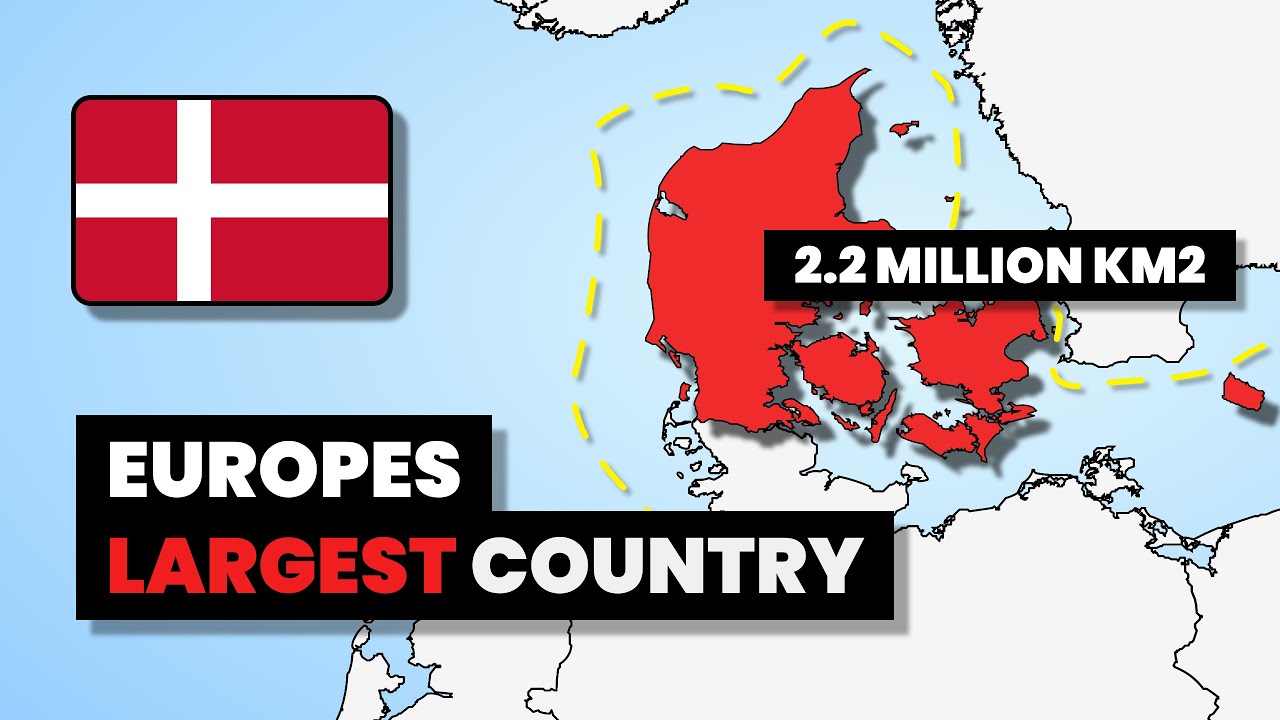
have you ever wondered which country in Europe has the highest taxation well Wonder no more because I'm not going to leave you without a doubt any longer that country is none other than Denmark and take note because Denmark is not only the most heavily taxed country in Europe it is also the second highest tax country in the world to give you an idea some taxes such as income tax have rates that exceed 55. 9 or to put it into perspective Danish workers pay up to three times more tax on their salaries than workers in countries such as Estonia or Lithuania as if that were not enough other taxes such as capital gains tax which for those who don't know is the tax paid when receiving dividends or selling shares of a company for example can reach up to 42 which is practically double what is paid in countries that are hardly likely to be mistaken as being Ultra capitalist such as Spain although let's stop for just a moment because now that I've mentioned Spain this is where the most interesting thing of all appears foreign to popular convention or at least according to what most economists tend to say a country with taxes as high as Denmark would inevitably be doomed to failure it would be a country incapable of economic prosperity and certainly doomed to ruin right well maybe not I want you to take a look at this graph [Music] what you see on the screen is the Jeep GD per capita adjusted for Price differences between Denmark and Spain as you can see Danish production has not stopped growing at almost any time in the last 30 years what's more of unlike the vast majority of countries in the world Denmark has managed to grow its economy even during the worst phases of the coronavirus crisis and keep in mind it's not just about economic growth if we admit microstates such as Monaco and Liechtenstein Denmark is currently the fifth richest economy in Europe after Ireland Switzerland Luxembourg and Norway is Denmark a total exception as far as tax theory is concerned it's a country with a lot of taxes but at the same time it's very wealthy and what does all this have to do with Spain well let's go back to that graph from before the blue Lane that has just appeared on the graph is the line that represents the GDP per capita that Spaniards have unlike Denmark Spain is a country that had great difficulty recovering from the 2008 financial crisis its rickety growth has also been doped by a lot of public debt and to top it all off it has been the slowest country in the oecd to recover from the coronavirus crisis in addition it's not just that Spain has taken a long time to recover it's the even two years after the pandemic it is only just managed to reach its pre-crisis GDP levels that is to say recovered if you can say that which kind of can't at this point many of you might be wondering what about taxes in Spain does Spain also have very high taxes is this an example of a country that does comply with the rule that high taxes equals low wealth well not exactly it is true that Spain is not an outstanding country in the matter much less a quasi-tax even but if we take a look at that indicator that so many economists use as a guide the tax burden the truth is that Spain is the opposite of Denmark it is one of the countries that collects the least taxes in proportion to GDP of the entire European Union to give you an idea for every 100 euros of GDP that Spaniard produces on average only 37 Euros is collected in taxes by way of comparison in countries such as Germany and Sweden this figure reaches 42 and 43 Euros respectively and returning to the case of Denmark it even exceeds 47 Euros in other words Danish citizens pay 27 more taxes than Spaniards and yet they're much richer so with all this in mind I think the question we need to ask is pretty clear why do taxes in Denmark not seem to affect the country's economic performance wider countries with relatively low tax pressures such as Spain failed to prosper as the Danish case a refutable proof that taxes need not harm economic activity well today on video economic we're going to answer all of these questions so let's get cracking [Music] if there is one thing that most economists politicians and in general anyone interested in the social sciences agrees on it's that for an economy to grow the most important thing is for citizens to be able to find Productive work the thing that is in order to get more people to work is also necessary for someone to organize them and make them more productive in other words you need companies to invest in machinery and new ideas and development projects and above all to Bear the risk that these business projects could go wrong no what does all that have to do with taxes in short according to traditional theory the more you facilitate the creation of companies and the easier it is to hire staff the better the economy will be if you tax too much you risk companies earning less workers having less incentive to work and ultimately the economy ends up stagnating however something that is not often mentioned is that in reality not all taxes are the same nor do they affect the economy in the same way here's an example imagine two countries the blue country and the Red country in the blue country there is a single 50 tax levied on wages however in the red country a 50 tax is also charged but only and exclusively when a worker spends his or her money note that wherever a worker lives if he or she receives a salary of 100 euros say and spends that entire salary the worker will pay the same taxes in each country so you could say that there is no difference between these two tax systems right however if instead of spending the money the worker decides to use their salary to invest in the company what will happen is that in the blue country the worker will only have 50 euros available while in the red country up to 100 of the workers income would be available that is a hundred euros in other words the tax that affects consumption and not wages allows the citizens of the Red country to devote twice as much money to creating new businesses foreign tax would be better for growing the economy for two main reasons firstly because at the end of the month the worker will receive more money in his or her bank account and if a person receives more money but is also free to decide what to do with it then that person will certainly have more incentive to work and secondly because by having more resources to invest in companies in new projects there will be more companies these companies will hire more workers they will innovate more and over time they will make the economy Prosper more so as you can see not all taxes are the same nor do they affect the economy in the same way be that as it may we are now going to look at more concrete data we're going to look and compare the real taxes in Denmark with the taxes in Spain will they be the same or will the differences such as those we have seen in our hypothetical example let's find out question of costs imagine you want to open an IT company where 10 programmers will work you have calculated that each worker you hire will generate around 5 000 Euros so you decide to spend 4 500 euros to hire them knowing less now comes the key question what differences would there be between hiring workers in Denmark and hiring them in Spain well in Spain the company would have to pay taxes for common contingencies unemployment contributions accident and illness contributions and insurance for the wage guarantee fund and another for the professional training of the unemployed these are the so-called social contributions but that's not the end of it after all this the worker will also have to pay for more common contingencies unemployment insurance professional training and finally income tax in the end after the company has paid out 4 500 euros per employee the employee would only receive 2 540 euros and 51 cents in his or her bank account but what happens when we make the same calculation for Denmark well in this case the company will have to pay 153 Euros of social contributions later the worker will have to pay the national personal income tax the municipal income tax and finally some other minor taxes well taking everything into account the Danish worker would receive 2870 euros and 97 cents in hand at the end of the month that is with the same hiring cost for the company the Danish worker would receive 3965 euros and 49 cents more in his or her account each year than the Spanish worker as you can see the Danish system seems to match much more closely to a red country model where there is less taxation on wages while the Spanish one looks more like a blue country model but wait a minute because we're not actually done yet let's imagine that the Spanish programmers are very stubborn and insist on charging the same as Danish programmers in that case the Spanish company would have to increase its recruitment cost and pay much more for them the question is exactly how much money would a Spanish company have to pay for its employee to be paid the same as a Danish worker [Music] foreign well again we make the same calculations as before and observe that to pay the same net salary in Spain the company would have to pay 5 256 Euros each month 756 Euros more than the Danish company and view of all this let's just recap for one quick moment we have said that we would hire 10 workers and we have seen how the tax burden pair worker in Spain seems somewhat higher than in Denmark in total if we add and multiply it turns out that setting up the same company in Spain costs 90 720 Euros more each year than it would in Denmark and yes before you say it I know that the cost of living in both countries is different but even if we adjust the percentage of taxes to the average salary in each country the result is that in Spain you pay 11 more taxes than you do in Denmark surprised well hold on to your chair because there's still more another of the most outstanding characteristics of Denmark is that hiring practices are some of the most relaxed in the world you could say that in a way both employer and employee have a lot of leeway to decide all of the details of the contract is eventually signed things like the minimum wage the minimum duration of a contact the type of contract that must be indefinite and severance pay are practically non-existent this actually means that in terms of bureaucratic costs hiring is still much cheaper to give you an idea in Spain alone companies tend to spend around a billion euros each year on laying off workers they no longer need which if you think about it is something like another hidden tax or at least another additional cost to hiring that would be equivalent to about 540 Euros per year permanent worker in Spain tax by the way that companies usually pay right in their worst moments which is when they are forced to lay people off which leads to many other problems that we will talk about at length in an upcoming video here on visual economic so don't forget to subscribe to the channel and hit the little bell button down there to keep abreast of all of our news the important issue is that while hiring in Denmark is Affordable and flexible in Spain there are non-stop costs and bureaucracy which as we have explained in the example of the Red and Blue country that we saw at the beginning leads to fewer companies fewer companies hiring and workers generating less savings and less capacity to invest once again not all taxes are created equal and for example making it easier to hire workers is perhaps what explains news stories like this one Denmark alert 32 000 workers required one thousand jobs offered per day the unemployment rate in Denmark is at historic lows 3. 3 percent of unemployed representing 140 000 people in a country of 3.
6 million people of working age know then if it's so cheap to hire workers in Denmark how do you explain that at the end of the day its level of taxes on GDP is the highest in Europe where does the Danish government get the money if not from higher taxes on labor well let's find out the Danish ecosystem as we have said Denmark is very much like a red country a country with reasonable taxes on hiring but with very high taxes on consumption in particular with a flat 25 vat rate the Danish consumption tax is amongst the highest in Europe going back to our comparison the effective vat rate in Spain is 15. 6 much much lower if Spain had the same vat rate as Denmark this alone would increase its annual revenue by nearly four percentage points of GDP at this point it is worth mentioning that if there is a very high vat then both rich and poor have to pay the same percentage bat is a tax that does little to redistribute wealth that is when you go to the store to buy you pay the same percentage of tax regardless of your purchasing power this has led many politicians to interpret raising vat as an attack on the redistribution of wealth now the main argument against this way of thinking is that in reality it's not always necessary to make taxes Progressive not even with the intention of Distributing wealth for example an alternative model would be to charge the same percentage of taxes to everyone but when that money is collected spend it exclusively or mostly on those with lower incomes does this seem difficult to implement and do you think that a model with high consumption taxes would inevitably lead to enormous inequality maybe well if you do pay attention to this news story Paradise of the middle class Denmark the country where inequality hardly exists most Danes belong to the middle class and only a very small portion to the economic Elite Denmark is such a high and equal income country to only 1. 3 average salaries are needed to reach the highest marginal tax rate this also explains how although Danish workers do not pay a higher percentage of taxes through their salaries as they end up having higher and equal wages in the end this results in higher tax revenues think about it in Spain whoever earns an average salary is already among the 25 of employees with the highest salaries in that Country and this means that in the vast majority of workers they contribute very little to the public coffers in Spain it is difficult and expensive to hire staff which lead to fewer companies lower salaries and as a result little Revenue collection as if there were not enough we can still find more factors that explain why Denmark is so rich despite its high yet efficient taxes for example its education system is ranked in the top 18.