The art of rhetoric is an ocean, vast and boundless, and today, the plan is to plunge deeper still. If you’ve already drunk from the waters I drew up for you in my last presentation on this crowning art of the Trivium, then prepare yourself, because we’re about to dive headlong into some of the discipline’s more hidden recesses, trenches, and caves. We’ve tasted the pools of pathos, lapped up the lakes of logos, and charted the estuaries of ethos.
We’ve put the shorelines of rhetoric behind us by looking at its most basic figures, and the time is right for us to sail off into the horizon and submerge ourselves into the abyss of human persuasion. Now, why bother to learn the figures of rhetoric? Well, it’s because language shapes our world; it persuades, compels, consoles, and most importantly, it both obscures and illuminates the truth.
To master rhetoric is to master the currents of communication itself. These figures of speech we’re about to explore, these are not mere ornaments or academic curiosities—they’re the tools of influence, the very building blocks of persuasive discourse that have swayed minds, stirred hearts, and moved history. Knowing them gives you a map to navigate the endless expanse of language, to speak not just with words, but with intention, precision, and power.
Whether you’re in the boardroom, the classroom, or the courtroom, these figures allow you to be not just heard but understood, felt, and remembered. They’re the difference between merely saying something and making an impact. In learning the figures of rhetoric, you’re learning to harness the power of language, to turn words into something alive and unforgettable.
But remember, the power of rhetoric is morally neutral, wielded by both the virtuous and vile alike. Rhetoric, like fire, can warm and enlighten, or it can burn and destroy. In the right hands, it illuminates truth, bringing clarity and order to a perplexing infinitude of facts.
But in the wrong hands, it can obscure, manipulate, and mislead. It is as much a tool of tyrants and demagogues as it is of saints and sages. It is wielded in service of justice and deception alike, shaping empires, swaying crowds, and guiding minds.
In skilled hands, it is a lantern, casting light on truth and giving coherence to the chaos of information. Nevertheless, it is also a smoke that clouds out our judgment, a shroud that masks reality, leading the unwary down twisted paths. To understand rhetoric, then, is to recognize its dual nature—a force that can build bridges to wisdom or walls of illusion, depending on the integrity of those who use it.
Now in 1663, the English poet and satirist Samuel Butler wrote disparagingly of rhetorical handbooks, claiming that “all the rhetorician’s rules teach nothing but to name his tools,” and while this may be true, it takes for granted that everyone even knows all the tools that are already at their disposal, and I simply don’t think that’s the case. Not everyone has the benefit of receiving the same classical education he did. We may indeed already use some of these figures we’re about to discuss unconsciously, but it’s my hope that by learning more about them, we can increase our awareness of them, make use of our tools more conscientiously, and thereby, make use of them more effectively.
So, with that said… let’s continue in our discussion where we left off, unpacking the catalogue of rhetorical figures. But this time with an eye towards the esoteric and the lesser known. We begin with epanalepsis: the secret of the circle.
It’s a deceptively simple figure, starting and ending a clause with the same word. This device is for those times when you need to hammer home a thought, to encircle it like a Solomonic seal, and let it echo in the listener’s mind. JFK’s words spring to mind: “War will be the end of mankind, or mankind will put an end to war.
” See how that locks us in? It traps the mind, enclosing the thought so that it can’t escape. “The king is dead; long live the king!
” It binds us in a loop wherein we’re trapped by the finality of each beginning and the predictability of each end. Tacitus gives us another great example: “Leaders fight for victory, comrades for their leader. ” This is so powerful a figure of rhetoric, that even one of the names of God is grounded in it: “Ehyeh asher ehyeh” – I am what I am, or more literally “I will be what I will be.
” This isn’t exactly an epanalepsis in English translation, but it is in the original Hebrew, and if it’s good enough for God to use in persuading Moses to return to Egypt, it’s probably good enough for you to include in your rhetorical toolkit. Now, if epanalepsis wraps a thought in the comfort of its own borders, epizeuxis is its relentless cousin—the hammering repetition that strikes like thunder. “Rage, rage against the dying of the light!
” The effect is raw, primal. With epizeuxis, we don’t speak; we shout, we cry, we declare. It’s a kind of anaphora, or repetition, but without pause, without hesitation, without even a hint of apology.
So when you hear someone say “No, no, no, PLEASE GOD NO,” you know they mean business. It’s powerful, it’s passionate, and it’s pure emotion. “Never give in — never, never, never, never, in nothing great or small, large or petty, never give in except to convictions of honour and good sense.
Never yield to force; never yield to the apparently overwhelming might of the enemy" said Churchill. Another familiar example is Joseph Conrad’s “The horror, the horror! ” if you can forgive the intervening article.
And if you can’t, well, well, well… that leads us to diacope (die-ak-uh-pee), which means ‘cut in two’ in Greek, and arises when the repetition of a word or phrase is broken up by an intervening word: “The name is Bond. James Bond. ” Or Shakespeare’s “I am dying, Egypt, dying.
” Or “A horse! A horse! My Kingdom for a Horse!
” Vocative diacope is quite a common figure of rhetoric in popular culture: “Help, somebody, help! ” “Run, Forest, Run! ” “Burn, baby, burn!
” “Romeo, Romeo, wherefore art thou Romeo! ” Next up we have litotes or in Ancient Greek λιτότης — the art of the subtle, the understated, the restrained. We live in an age of hyperbole and exaggeration, and litotes steps in like a quiet, unsuspected guest.
It doesn’t shout or scream; it merely suggests. It whispers, ‘not bad,’ when it means ‘good,’ or ‘not uncommon,’ when it means something is as frequent as sunrise. Litotes lets you approach the truth without inflating it, adding a twist of irony or a touch of humility.
In an era of loud voices, sometimes the whisper speaks loudest. In Book 24 of the Iliad, Zeus describes Achilles as “neither unthinking, nor unseeing,” to say he’s wise and prudent. In Latin, the sayings ‘non semel’ (not once) or ‘non numquam’ (not never) are quite common ways to say ‘frequently’ and ‘sometimes’, and these are textbook examples of litotical expressions.
But what if we want to invite our listeners into a conversation? That’s when we turn to hypophora. Ask a rhetorical question, and before they can answer—answer it yourself.
Why does this matter? Because it gives the illusion of every day speech, making what you’re saying more personable. Hypophora allows us to anticipate objections, to bring a listener into our world, to make them part of the journey.
It’s a strategy as old as Socratic dialogue, a way to guide without appearing to lead, to suggest without overtly commanding. It simulates the problem-solving processes in our minds, without allowing your audience to think for themselves. Churchill, again, is the textbook example for this when he asks: “You ask, what is our policy?
I will say: It is to wage war, by sea, land, and air, with all our might and with all the strength that God can give us. ” An example of hypophora arises in Corpus Hermeticum V (which incidentally closely echoes God’s rhetorical questioning in Job 38) when Hermes asks his disciple: “Who keeps this order? … Who set the limits to the sea?
Who settled the earth in place? There is someone, Tat, who is maker and master of all this. ” Both Corpus Hermeticum V and the Book of Job string together long chains of rhetorical questions to prompt contemplation and wonder in regards to the mysteries of creation and the limits of human understanding, and both ultimately point to a divine figure as the answer, but only Hermes makes use of hypophora here, while Job is left in the dust to answer the whirlwind: “Behold, I am vile; what shall I answer thee?
” acknowledging his inability to respond and choosing silence as a mark of respect and submission. Next, we have polysyndeton—the rhythmic beat of repeated conjunctions: and, and, and. It slows the pace, draws out the sequence, pulls the listener deeper.
The King James version of the Bible makes extensive use of this, for example, in Genesis 7:22-24: “And every living substance was destroyed which was upon the face of the ground, both man, and cattle, and the creeping things, and the fowl of heaven; and they were destroyed from the earth: and Noah only remained alive, and they that were with him in the ark. ” Each ‘and’ builds, brick by brick, creating a wall of thought, giving each element weight. It’s cumulative, growing heavier, word by word, like a builder laying stones one by one.
It’s the difference between ‘I came, I saw, I conquered’ (an example of ‘asyndeton’) and ‘I came, and I saw, and I conquered’—the latter feels weightier, more deliberate, with each step magnified. Another example from Shakespeare’s Othello might be "If there be cords, or knives, or poison, or fire, or suffocating streams, I'll not endure it. " In Corpus Hermeticum XI, Hermes asks of Mind: “But the wisdom of god – what is it?
” And Mind answers: “The good and the beautiful and happiness and all excellence and eternity,” thus creating that cumulative, weighty effect. Now, speaking of gravity, this brings us to anastrophe. Normally, we’d say to a mighty warrior, ‘You have become powerful,’ but with anastrophe, we twist it: ‘Powerful you have become.
’ Why? Because inverting word order adds gravitas, it slows the listener down, forces them to reconsider. It’s not for nothing that Yoda speaks like this.
It’s strange and stilted, yes—but sometimes that strangeness is the very thing that makes a phrase thought-provoking and memorable: “by the pricking of my thumbs, something wicked this way comes” says one of Shakespeare’s weird witches in act 4, scene 1 of Macbeth. “Under the mountain, dark and tall, the king has come unto his hall” sing Tolkien’s dwarves, pushing the adjectives to the end of the line, not only to fit the rhyming scheme, but to add emphasis on those foreboding qualities. Now, we come to aporia – the figure of doubt, of feigned uncertainty.
Aporia is the Greek word for “to be at a loss,” and it is the rhetorician’s moment of hesitation that invites the audience into a shared space of inquiry. It arises when a speaker pretends to be unable to speak competently about the topic at hand. It is an affected modesty that arises often at the outset of an oration.
Take Cicero’s Pro Sexto Roscio, for example: “Of what shall I first complain… or where shall I first begin? Of what or of whom shall I call for help? ” In doing this, speakers give themselves an opportunity to respond to the very doubt they’ve sown.
It is a favourite of teachers and PowerPoint presenters. Socrates was a master of aporia—he would ask question upon question, leading his audience to ponder along with him, rather than declaring truths from the start. What this does is models an openness to multiple possibilities, signaling that, perhaps, the solution lies not in one answer, but in the journey of questioning itself.
But beware—the power of aporia lies as much in its ability to sow confusion as to inspire understanding. Used sincerely, it fosters intellectual humility, inviting the audience into a shared quest for insight. Used cynically, it can manipulate, planting seeds of doubt where none should exist.
In Hamlet, Shakespeare uses aporia frequently to convey Hamlet’s inner conflict. In perhaps the world’s most famous soliloquy, Hamlet contemplates existence, fate, and action versus inaction, posing questions that reflect his indecision and philosophical uncertainty. Each line seems to deepen his doubt rather than resolve it, drawing the audience into his internal struggle.
“To be, or not to be? That is the question: Whether ’tis nobler in the mind to suffer The slings and arrows of outrageous fortune, Or to take arms against a sea of troubles And by opposing end them…” Moving on, let us consider paradiastole, the alchemy of words, of turning vices into virtues and virtues into vices. Paradiastole shifts the perspective, reframing a quality to cast it in a different light, as if words themselves can wield the power to make a fault appear commendable or a virtue seem flawed.
Imagine describing someone as ‘tenacious’ rather than ‘stubborn,’ or ‘cautious’ instead of ‘cowardly. ’ Consider John Milton’s Paradise Lost, where Satan redefines his fall from Heaven as a quest for freedom. In Book I, Satan famously declares that it is ‘Better to reign in Hell than serve in Heaven.
’ Here, paradiastole transforms what might seem like a rebellion against divine order into a courageous stand for autonomy. Milton’s Satan presents defiance not as mere rebellion but as heroism, casting a vice as a virtue to justify his actions. In George Orwell’s 1984, paradiastole takes an even darker turn with the concept of doublethink.
The Party constantly reframes language to control perceptions: ‘War is Peace,’ ‘Freedom is Slavery,’ ‘Ignorance is Strength. ’ By manipulating the meaning of these terms, Orwell shows how paradiastole can serve not only as a persuasive device but as a tool of control, twisting reality to suit those in power. Ultimately, Paradiastole isn’t about lying; it’s about bending truth, tilting it just enough to change the angle of our vision.
In your own speech, you might use paradiastole to paint a favorable picture of a controversial idea or person—characterizing a disruptive change as ‘innovative,’ or a risky move as ‘adventurous. ’ The strength of paradiastole lies in this art of subtle redirection, using words to open the door to new interpretations. In the end, whether it reveals or conceals depends on the hands that wield it.
" Then there’s antanaclasis or ‘reflection’—a trickster of a device that takes a word and gives it two meanings within the same breath. It’s a figure of wordplay that forces the listener to reconsider the same word in a new light, adding layers of depth and, often, a touch of wit. Ben Franklin once said: ‘We must all hang together, or assuredly we shall all hang separately.
’ In that single word, ‘hang,’ we find both solidarity and peril. Antanaclasis forces the audience to engage, to think twice, to hear the echoes of language and make sense of its double meanings. “Time flies like an arrow; fruit flies like a banana” or “If you aren’t fired with enthusiasm, you’ll be fired, with enthusiasm” are two great examples of this.
Next up we have epitrope (or in Latin permissio)—the sly consent to something as a means of undermining it. It’s a device based on ironic permission, or mock concession. The venerable Fred Durst comes to mind: “So go ahead and talk $H!
T, talk $H! T about me! ” or Clint Eastwood’s “Go ahead, make my day.
” In Plato’s Apology, where Socrates says “If I am guilty of corrupting the young, then I must surely be guilty of great wisdom that no one else possesses,” by pretending to grant the accusation, he undermines it, inviting the audience to see the absurdity in his accusers’ claims. Epitrope gives the illusion of permission while maintaining authority, a rhetorical judo move that turns the attack back on itself. It disarms through apparent surrender.
Caligula’s “Let them hate me, so long as they fear me” (Oderint dum metuant) comes to mind. Or King Creon’s answer to Antigone: “Go, bury your brother; but know that for your obedience to your heart, the penalty is your life. ” A great use of this figure comes from Ecclesiastes 11:9: “Rejoice, O young man, in thy youth; and let thy heart cheer thee in the days of thy youth, and walk in the ways of thine heart, and in the sight of thine eyes: but know thou, that for all these things God will bring thee into judgment.
” Let’s turn now to antanagoge (or compensatio in Latin)—the art of balancing a negative with a positive to soften the blow. ‘The road is steep, but the view is worth the climb’ or “When life gives you lemons, make lemonade. ” The result is a sort of verbal “silver lining” to a rhetorical black cloud, where the speaker acknowledges the downside of a thing while shifting focus to a redeeming feature.
Antanagoge tempers harsh realities with hope, placing obstacles alongside rewards, forging a path where one might otherwise be tempted to turn back. It’s particularly powerful for persuading an audience to overlook flaws or to find optimism even in challenging situations. In Shakespeare’s As You Like It, we have ‘Sweet are the uses of adversity,/Which, like the toad, ugly and venomous,/Wears yet a precious jewel in his head.
’ William Blake’s “If the fool would persist in his folly, he would become wise,” is another good example. Now let’s take the low road and hit below the belt with bdelygmia (or in Latin: abominatio), one of the sharpest tools in the rhetorician’s arsenal—a form of fierce, unfiltered invective that heaps on the scorn like an imposing tower of hate. Bdelygmia isn’t mere insult; it’s an appeal to pathos that piles up disgust upon disgust.
Even the word itself sounds like vomiting. This is what you get when someone calls smoking a “nasty, dirty, filthy, disgusting habit. ” It’s a litany of abuse.
It’s like amplification (or auxesis) but brimming with vitriol, like when Princess Leia calls Han Solo a “Stuck up, half-witted, scruffy-looking nerf herder! ” Or in Shakespeare’s King Lear, when Kent calls Oswald “A knave, a rascal, an eater of broken meats; a base, proud, shallow, beggarly, three-suited, hundred-pound, filthy worsted-stocking knave; a lily-livered, action-taking, whoreson, glass-gazing, superserviceable, finical rogue; [a] one-trunk-inheriting slave. ” With each insult chained in succession, the trash-heap that is your intended target grows greater and more monstrous, more stinking and abominable with every hate-filled hyphenated word.
It’s fantastic. Lastly, if you happen to be on the receiving end of such a roast, and you really want to surprise an accuser, then synchoresis – in Latin concessio or concession – is the tool for you. This is when you concede to an opponent’s points in order to bolster your own position.
This technique builds trust with the audience by appearing fair-minded or even generous to a hostile interlocutor. Synchoresis can subtly disarm an opponent or skeptical listener by validating a part of their viewpoint, giving the speaker credibility and a sense of balance. James 2:19 is a good example of this: “You believe that God is one; you do well.
[But] even the demons believe—and shudder! ” Again in Plato’s Apology, Socrates admits to being like a gadfly, buzzing and stinging around the horse that is the Athenian state, but this nuisance is necessary for stirring the city to life. I’m reminded of the British officer who says to Captain Jack Sparrow while searching his tattered belongings: “You are without doubt the worst pirate I’ve ever heard of,” to which he proudly responds “…But you have heard of me.
” Lastly, in the film Braveheart, William Wallace, delivers an iconic line about courage and the choice to fight rather than flee. When rallying the Scottish army before the Battle of Stirling, he addresses the temptation to run away: “Aye, fight and you may die. Run, and you'll live… at least a while.
And dying in your beds, many years from now, would you be willing to trade all the days, from this day to that, for one chance—just one chance—to come back here and tell our enemies that they may take our lives, but they'll never take our freedom! ” Wallace acknowledges the safety that running away might offer in the short term but pivots to argue that freedom is worth risking one’s life for. Wallace concedes the point of temporary survival through retreat, only to emphasize the greater value of fighting for liberty.
For good or ill, the art of rhetoric has been known by many names throughout the centuries: good style, deception, the oldest of the humanities, sophistry, eloquence, purple prose, practical logic, political spin, the art of persuasion, smoke and mirrors, effective communication, and the cloak of language. For the last two-thousand years and then some, it has stood as the very cornerstone of law, politics, and teaching, alongside of grammar and logic. A good classical liberal arts curriculum calls for its students to read Aristotle’s Rhetoric, Plato’s Gorgias and Phaedrus, Isocrates’ Against the Sophists, the Philippics of Demosthenes, Quintilian’s Institutio Oratoria, Cicero’s De Oratore, the Rhetorica ad Herennium, and Erasmus’ De Copia.
So if you’re interested in further gilding your tongue, or even just improving your writing, I would direct your attention to those works that have served to inform the greatest rhetoricians in Western history, rather than any kind of derivative modern textbooks. But remember: rhetoric is not only for the ancients or for those with lofty rostra, platforms, and soapboxes. It’s for anyone who wants to communicate clearly, argue persuasively, or connect more deeply with others.
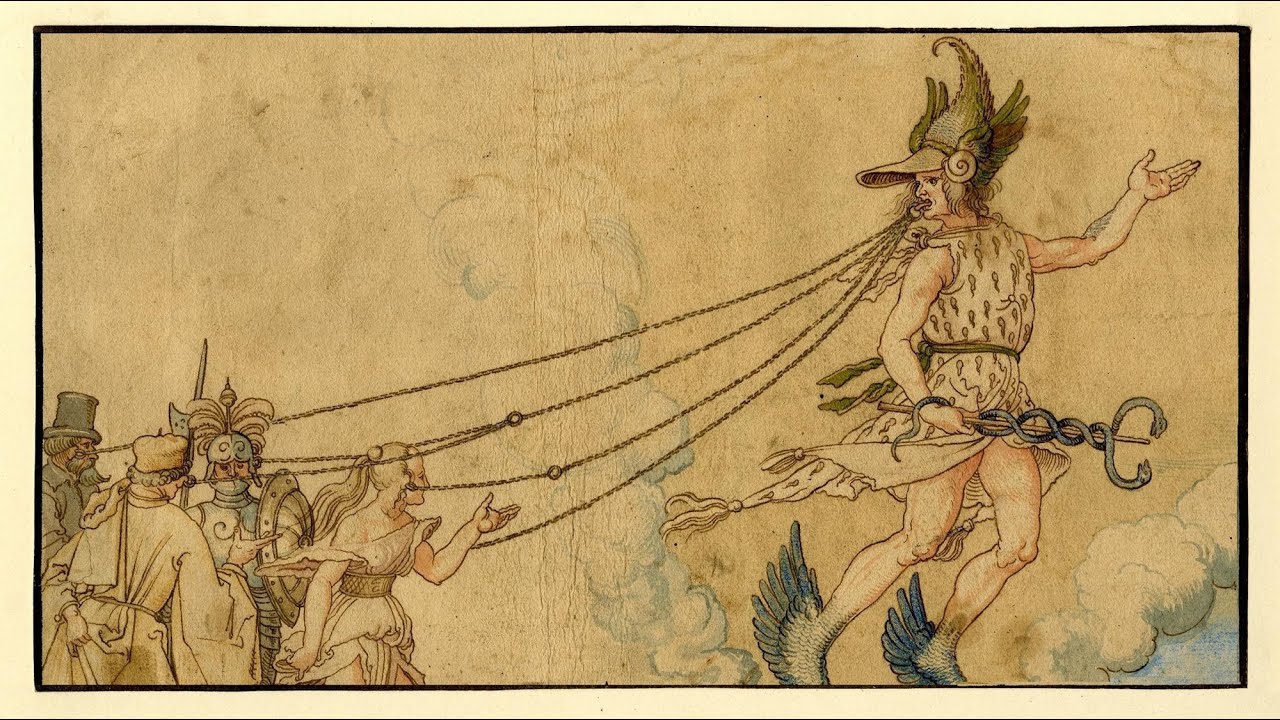
Today, as in antiquity, it remains a tool of influence, and a means of effecting change in the world. In this way, it is – according to a number of definitions [Epistles of the Brethen of Purity (52a) listed “Fine skill in rhetoric, eloquence, and wit” among their definitions of magic] – magical. It’s not for nothing the art is attributed to Hermes or Mercury.
For to speak well, to move others with mere words—this is a power that borders on the divine.

![Keeping Magic Secret [Esoteric Saturdays]](https://img.youtube.com/vi/lX5pibjc8w8/maxresdefault.jpg)
![Astrological Theology [Astrology and Religion among the Greeks and Romans]](https://img.youtube.com/vi/jerjMh1LH_E/maxresdefault.jpg)