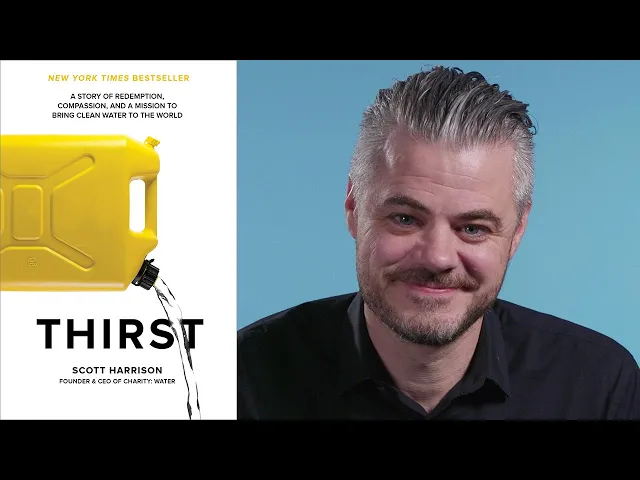
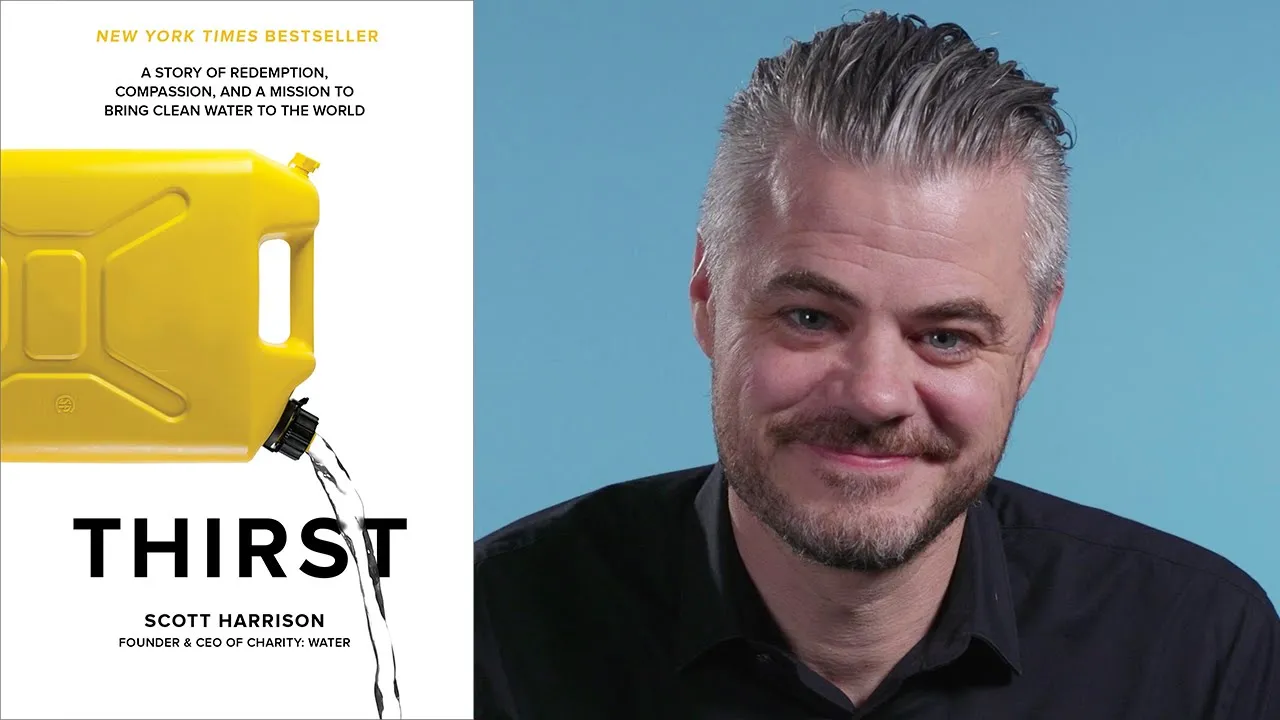
[MUSIC PLAYING] My book is about my journey, beginning in childhood, where our family survived a traumatic carbon monoxide gas leak that rendered my mom an invalid. That led me to New York City, where I became a nightclub promoter for 10 years, working at 40 of the top venues in Manhattan. And then at 28, I realized that I'd made a mess of my life.
I was the most selfish, hedonistic person that I knew. I sold almost everything to join a humanitarian mission as a photojournalist in Liberia, West Africa. It's there that I came across the global water crisis.
I saw people drinking dirty water and dying for the first time in my life and learned that 663 million people around the world didn't have access to something I'd taken for granted my whole life-- clean water. The book talks about the starting of charity: water an organization that was started when I was living on a closet floor $30,000 in debt but went on to raise over a third of a billion dollars and help almost 10 million people get clean water. One of the most difficult things in building charity: water was that people in America don't trust charities.
I had come across a statistic that 42% of Americans flat out say they don't trust charities. A more recent study by New York University found 70% of people in this country believe charities waste their money or badly waste their money. So that was the problem that we were trying to solve.
This was a shame that so many people were cynical and skeptical about giving. People felt betrayed by the system, by traditional philanthropy. So we tried to create a unique business model where 100% of every donation we would ever take in from the public, 100% would go directly to fund water projects and help people in need.
That created a challenge because we'd have to raise all of the overhead and the operations money separately. And I write about some of those challenges in the book. We've been able to keep that model intact for 12 years now, raising over $360 million.
But along the way, it was really difficult getting people who just often don't trust. And we would say to them, hey, take another look. We're doing things differently.
Not only are we using 100% of your money to help fund water projects, but we'll prove each of those projects. And one of the first things charity: water did was put every water point up on Google Earth and Google Maps, building the most hyper-transparent layer of rural water supply in the history of the world. My hope is that this book not only would get people inspired about ending this solvable problem, inspired about bringing clean and safe drinking water to every single person on this planet.
This is something we can do. But I also hope that this book would inspire future social entrepreneurs, people who might feel passionately about another issue. And if a nightclub promoter $30,000 in debt living on a closet floor in New York City can start an organization that helps almost 10 million people get clean water, I'm pretty sure you can do even more.
[MUSIC PLAYING] [MUSIC PLAYING] My book is about my journey, beginning in childhood, where our family survived a traumatic carbon monoxide gas leak that rendered my mom an invalid. That led me to New York City, where I became a nightclub promoter for 10 years, working at 40 of the top venues in Manhattan. And then at 28, I realized that I'd made a mess of my life.
I was the most selfish, hedonistic person that I knew. I sold almost everything to join a humanitarian mission as a photojournalist in Liberia, West Africa. It's there that I came across the global water crisis.
I saw people drinking dirty water and dying for the first time in my life and learned that 663 million people around the world didn't have access to something I'd taken for granted my whole life-- clean water. The book talks about the starting of charity: water an organization that was started when I was living on a closet floor $30,000 in debt but went on to raise over a third of a billion dollars and help almost 10 million people get clean water. One of the most difficult things in building charity: water was that people in America don't trust charities.
I had come across a statistic that 42% of Americans flat out say they don't trust charities. A more recent study by New York University found 70% of people in this country believe charities waste their money or badly waste their money. So that was the problem that we were trying to solve.
This was a shame that so many people were cynical and skeptical about giving. People felt betrayed by the system, by traditional philanthropy. So we tried to create a unique business model where 100% of every donation we would ever take in from the public, 100% would go directly to fund water projects and help people in need.
That created a challenge because we'd have to raise all of the overhead and the operations money separately. And I write about some of those challenges in the book. We've been able to keep that model intact for 12 years now, raising over $360 million.
But along the way, it was really difficult getting people who just often don't trust. And we would say to them, hey, take another look. We're doing things differently.
Not only are we using 100% of your money to help fund water projects, but we'll prove each of those projects. And one of the first things charity: water did was put every water point up on Google Earth and Google Maps, building the most hyper-transparent layer of rural water supply in the history of the world. My hope is that this book not only would get people inspired about ending this solvable problem, inspired about bringing clean and safe drinking water to every single person on this planet.
This is something we can do. But I also hope that this book would inspire future social entrepreneurs, people who might feel passionately about another issue. And if a nightclub promoter $30,000 in debt living on a closet floor in New York City can start an organization that helps almost 10 million people get clean water, I'm pretty sure you can do even more.