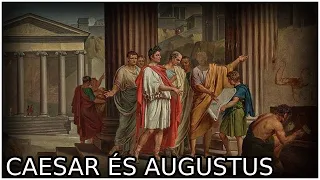
Welcome! This is the Hilarious History channel! In this episode we present you the incredibly adventurous life of Julius Caesar.
Julius Caesar was an ambitious young man, set to emerge. He decided at an early age that it was politics he really wished to engage in. He was born into a wealthy family and did not have to worry about a living, but was by no standards rich enough to practice his enthusiasm for politics in the senate - the playground strictly reserved for the elite of the time.
He found an alternative solution, which led through fighting and battles. He fought with such courage and gained such popularity among his fellow soldiers that he was awarded the Civic Crown (Corona Civica), a chaplet of common oak leaves woven to form a crown and the second highest military decoration to which a citizen could aspire at the young age of 22. He was thus entitled entry into the Roman Senate.
Rome at the time was governed by the Roman Assemblies and the Senate. The Roman Senate was the supreme legislative institution, with its members being rich Roman aristocrats. They decided by voting on key military, financial, interior and foreign affairs.
Their power was only limited by the tribune of the plebs, whose duty was to protect the interests of the plebeians as a class. With the power to veto, he could nullify any resolution, verdict and law. This was therefore the institution Caesar became a member of, where he presented his speeches so well, even Cicero, the famous politician of ancient Rome made a remark of it.
This was indeed a great honour, as Cicerot was considered devilishly talented even by his adversaries. Caesar was also popular among the people, as he never forgot to entertain them. He organised spectacular games of gladiators and circus performances.
Caesar held a number of well-paying offices through the years, but his real goal was to become a consul. In Rome, consuls held the highest power besides the Senate, they governed the state and were the chiefs of the army. Initially, there were two consuls, preventing either of the from acquiring exclusive power.
Caesar therefore wanted to be elected as consul by all means. For this, however, he needed allies. He instantly began to build contacts in order to seek influential friends.
Pompey was one he chose, as he possessed military power and the authority to be in control. Since he not only needed an army, but significant amounts of money as well, his choice of another friend was Crassus, who possessed enormous wealth. He was the richest man of the Roman Empire.
Making friends is of course not very easy, but in the present case, Caesar’s situation was aided by the fact that they were both infuriated by the Senate. Crassus had hoped that crushing rebellion of slaves under the leadership of Spartacus would earn him a higher rank, a better position and even greater wealth. The Senate, however, crossed these plans.
Pompey, on the other hand, would have liked to replace his exhausted soldiers with new ones. This he could only do if he provided his veterans with land. This did not work out either, the senate blocked his efforts as well.
Making use of the grudges they bore, Caesar made a union with them, hence the secret alliance of 3 men in 60 BC, which came to be known as the First Triumvirate. The alliance was further cemented by the marriage of Pompey to Caesar's daughter. This cooperation made Caesar’s wish come true: he was elected a consul.
As a consul, he immediately proposed a law for redistributing public lands to the poor, allowing Pompey to settle his veterans. Pompey became the governor of Hispania, Crassus was given command of the province of Syria, and Caesar became the governor of Gaul. In 58 BC, he started his Gallic and Germanic campaigns, and his victories increased the area of the Roman Empire.
Caesar did everything to be popular among his soldiers: As a general, he fought with death defying courage in the first lines and gave an equal share of the loot to all his soldiers - himself being no exception. In 55 BC his consulship expired. The three allies then meet in Lucca and decide that Crassus and Pompey will be consuls for 5 years and extend Caesar's governorship of Gaul for this time, to run for consulship again in 49 BC.
Although the Senate did accept their alliance, it began to deteriorate fast. Crassus launched it, when he was killed in an eastern campaign in 53 BC. Pompey was consul in Rome at the time and Caesar was away in the Gallic Wars.
Pompey liked not having to share power and in time he came to be in good terms with the Senate. They mutually thought Caesar should be put aside, as he is more clever and popular than they are. Pompey’s wife had died in the meantime, ripping the last cord binding the alliance of the First Triumvirate.
Pompey’s current interests decreed Caesar be isolated. This he achieved by accusing Casear of trying to establish his monopoly of power and therefore being Rome’s and the people’s enemy! With is power as a consul and the support of the Senate, he had disbanded Caesar’s armies and ordered him to return to Rome to be prosecuted for his crimes.
Caesar did leave for Rome, but he did not leave alone! In 49 BC, Caesar crossed the Rubicon River, the boundary between the Italy and Gaul and headed to Rome. Tradition holds it was here Caesar made his famous comment on crossing the Rubicon: “Alea iacta est” (usually translated as “The die is cast”).
At this time, crossing the boundary of Rome was a legally proscribed action forbidden to any army-leading general and was therefore considered a rebellion. This step led to an outbreak of a civil war between the supporters of Pompey and Caesar. Unbeknownst to Pompey Caesar possessed only a single legion, he was frightened to hear Caesar is headed for Rome with an army.
He saw it better to flee. Caesar soon defeated Pompey’s troops at Pharsalus from where Pompey fled once again. This time, however, he picked the wrong place for hiding!
He went to Egypt, where he was betrayed and murdered by an officer of King Ptolemy XIII, on his orders. Egypt was right in the middle of war for the throne at the time. The Alexandrine civil war between King Ptolemy XIII and his sister, wife, and co-regnant queen, the Pharaoh Cleopatra VII, who, using her womanish charm, convinced Caesar to help her.
She offered everything in return to our emerging protagonist - even herself. This trick had worked out so well that Caesar did not think of returning to Rome for a full year. Soon after his return, he was appointed dictator.
The term ‘dictator’ in ancient times had a meaning different from the contemporary. Dictators in Rome were only elected in emergencies for a maximum of six months. His power for this period was unlimited, but he was obliged to elect a deputy and all other officers kept their positions.
After six months of duty, his special authority expired. When Caesar returned to Rome, the Senate granted him triumphs for his victories and triumphal games were held. From here onwards, he could wear his triumphal attire at all public events, including the red mantle and the laurel wreath.
He had been given a golden chair in the Senate and even a statue was erected of him. Caesar then went to work. A new land redistribution reform followed and he began to renovate Rome, made up of ramshackled buildings.
He ordered reorganisation of the calendar, as they were significantly shifted from real time. He set the length of the year to 365. 25 days by adding an intercalary/leap day every fourth year.
He established public libraries and several baths. He also had his will prepared, in which he designated his nephew, Octavian as his successor, and upon his death, Brutus. The Senate was increasingly displeased with Caesar’s growing popularity.
And his coins bearing his face and the proclamation of “dictator in perpetuity” were the last drops in the cup. A secret plot against him began to unfold. They thought that as dictator in perpetuity, he will attempt to monopolise power and the Senate would lose its influence.
Therefore, they prepared to assassinate him on the Ides of March in 44 BC. They had intended to justify the deed as the killing of a tyrant, which is not considered murder. Then came 15th March, when Caesar was on the way to the Senate.
As he was going up the stairs, a man stepped up to him, handing over a note, warning him of the plot. Sealing his fate, Caesar simply said: ‘I’ll read it tomorrow. ’ Then, as he reached the Senate, Brutus and Cassius, along with a group of senators murdered him with a total of 23 stabs.
Seeing Brutus among his assassins, he said: “You too, my son, Brutus? ” And then he fell down dead, ironically, right at Pompey’s statue. Caesar’s body was cremated and the Temple of Caesar was built at the cremation site.
In the period of chaos following his death, his friend Mark Antony and his son Octavian would fight for power. If you enjoyed the video, give it a thumbs up, and if you would like to see more exciting stories, Click the Subscribe button, and turn on the notifications too ;) In the comments, write to us: - what was your favourite part of the video, and - what else would you like to see on this channel! See you next week!