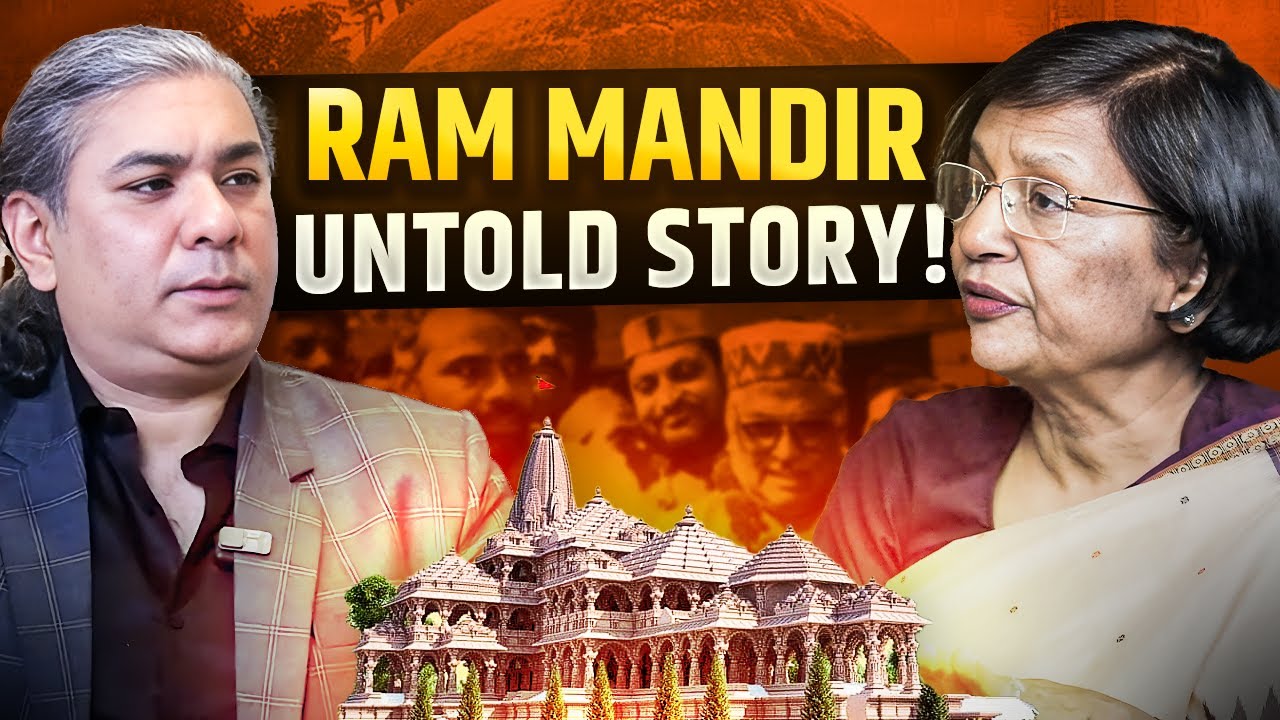
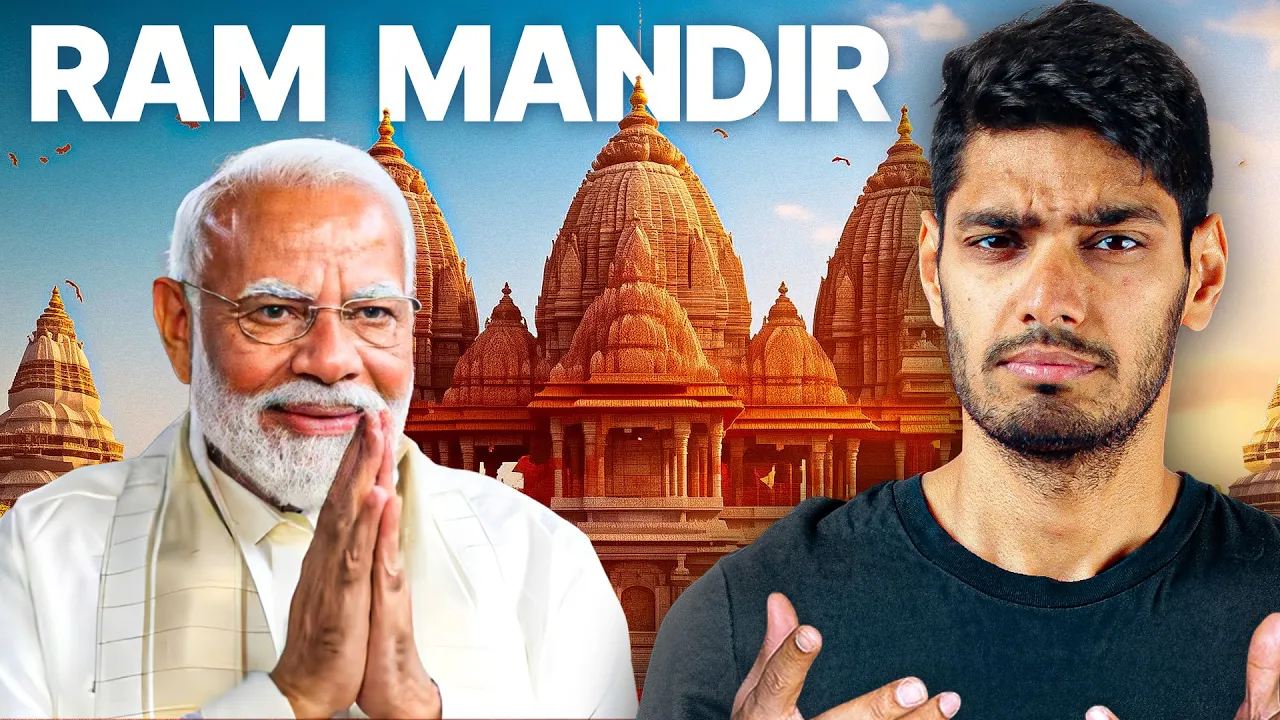
According to the 2002 report of the Archaeological Survey of India, a large structure was found under the site of Babri Masjid. The report said that many stones, bricks and architectural elements were found there, which are usually found in temples. B.
R. Mani, who was the main author of this report, said that the bases of the pillars were equidistant from each other and were in alignment. Because of this, there is a good possibility that there was a mandap of a temple there.
The report said that they found many such things, which are usually found in the temples of North India. And 20 years after the publication of this report, now the Ram Mandir is going to be inaugurated. Huge preparations are being made for this event.
More than 8000 people have been invited, many of whom are VIPs. The Ram Mandir project will be one of the most expensive projects. Rs.
1800 crores are being spent to build this temple. This temple will be built on a land of 70 acres. And the whole picture of Ayodhya is going to change because of this temple.
But why is this temple being inaugurated on 22nd January? And why did the Shankaracharyas of Hinduism say that they will not be involved in the ceremony? Another question is what is the history of this temple?
The construction of the Ram Mandir is going to take place in three stages. The first stage is when the ground floor will be completed. On this floor, there's a sanctum sanctorum where the idol of Ram Lalla will be placed.
Because the first stage is about to finish, that is why this inauguration is being done. Why 22nd January? Because according to the Hindu calendar, this day is the day of Kurma Dwadashi, when Lord Vishnu took the avatar of a tortoise during the Sagar Manthan.
Because Lord Ram is the avatar of Lord Vishnu, so the day of 22nd January is being used for the inauguration ceremony. This ceremony is also known as Pran Pratishtha. This ceremony takes place when a new temple is about to be built or a new idol is placed in a temple.
The second phase of the temple will be completed in December 2024, when the first and second floors will be completed and engravings on 360 pillars of the temple will be completed. The third phase will take place when all the structures like the auditorium, which is going to be built in 70 acres of land, will be completed. And this is the debate going on between the Shankaracharyas.
"In our scripture, all the sages have stated one thing, that the temple is the body of God, and the peak of the temple is his eyes, the pot is his head, and the flagpole is his hair. " "So, the head has not been made yet, only the base has been made. " "And if you inaugurate the temple in the base, then it will be a disgrace.
" They say that if the temple has not been completed, then why is this ceremony being done? There are four mathas or four monasteries in Hinduism. In Dwarka, Joshi Math, Puri and Sringeri.
Shankaracharya is said to be the head of these four mathas. It is said that Adi Shankar, who was a philosopher, made these four mathas. The responsibility of Hinduism and its tradition is given to these four mathas and their Shankaracharya.
But two out of four Shankaracharyas said that they will not be involved in the ceremony of this temple. Because they believe that the scriptures are not being followed for the ceremony of this temple. Shankaracharya of Puri matha said that if Prime Minister Modi is going to do the entire ceremony, then what is the need for him?
"Modi ji will do the worship, will bow to the idol, and I will just watch and clap. " Others believe that these four Shankaracharyas should not think so much about their position, but should think more about religion. "The ceremony doesn't aim to offend anyone.
" "Whether it's me, or an ordinary citizen or a religious leader no one is above the ceremony. " If this day is a very big day for Hindus, then why don't they leave their position and get involved in this ceremony? But this is not a new controversy for Ram Mandir.
The biggest controversy is whether Ram Mandir was there or not. There are many dates of Ram Rajya in Hindu religion. For example, it is assumed that Valmiki Ramayana was written 500 BC or almost 2500 years ago.
The local guides of Ayodhya say that this is why many physical structures that were present during Ram Rajya are not present today. They believe that today's temple was built by the king of Ujjain, Vikramaditya. Narsingh Pandey, who is a local guide, says that Hanuman Garhi, which is a temple in Ayodhya, Ram Janmabhoomi Temple and Sita Rasoi, which are all important structures for Hindu religion, were built by King Vikramaditya.
The story is that Vikramaditya brought a cow from Benaras which was a shape-shifting cow. That is, whatever you ask for, the cow fulfills. He told the cow to go around Ayodhya.
Vikramaditya built a temple where the cow dropped the cow dung. Now this is a story. But there is no historical evidence as to who built the Ram Mandir.
But in the records of many travellers, such a temple has been mentioned. Historian Meenakshi Jain talked about these records in her book. She said that in the 19th century, it was written in many Arabic, Urdu and Persian texts how a temple was removed to build Babri Masjid.
Many years ago, Maulana Hakeem Syed Abdul Hai wrote a book. Ali Mian, his son, wrote in the Urdu translation of this book that Emperor Babur, who was the founder of the Mughal Empire, destroyed a huge Ram Mandir to build a mosque. Then she also talked about Austrian traveller Joseph Tiefenthaler that there was a house of Lord Vishnu in the form of Ram.
Later, Aurangzeb or Babur removed it. Meenakshi Jain says that when the British took over Awadh, their records also said that there was a temple before Babri Masjid. She gave many other historical sources in her book which I have linked in the description.
But not every historian agrees with this. Historian Gyanendra Pandey also said that in every Hindu historical text, this temple has not been mentioned. Many historians said that in Babur Nama or Akbar Nama, there was no mention of such a temple in Ayodhya.
Many historians also said that Tulsidas, who was a great Ram devotee and was alive during the time of Akbar, also did not talk about such a temple. These are the arguments the Supreme Court considered for its judgment on this temple. I will tell you about this judgment in a while.
For example, the Supreme Court's judgment said that the first recorded conflict was about this temple in 1855. Many Hindu saints and Muslims fought over Babri Masjid. These Hindu saints said that there was a temple before Babri Masjid and this land belonged to them.
According to historian Sushil Srivastava, a man ruined this fight further. This was a temple official who was expelled by other priests. In anger, he went to Lucknow where he accepted Islam.
There, he met a Fakir to whom he said that many Hindus wanted to occupy the mosque. After this, riots broke out between Hindus and Muslims. On 30th November 1858, another incident took place when Mahant Nihang Singh Faqir was accused of keeping an idol of Lord Ram in the mosque, worshipping there, and writing Ram Ram on the walls.
During this incident, he was accompanied by 25 other Sikh men. Rajnath Singh spoke about this incident. "Technically speaking, this all began with the Sikhs.
" To solve this issue, the British government tried to create a compromise. They placed a wall in a disputed area. But what was the wall separating?
The disputed site didn't just have Babri Masjid but many other structures. The Supreme Court's judgement also spoke about this. One was Ram Chabutra, which was called Ram Janmbhoomi.
It was a little far from Babri Masjid. Then there was Sita's Rasoi. Near Sita's Rasoi, there were footprints of Lord Ram, Lakshman, Bharat, and Shatrughan.
There were many other structures in that area like Bhandar, Hanuman Dwar, and Singh Dwar. But these structures weren't that important. The Supreme Court's judgement gave more importance to Sita Rasoi, Ram Chabutra, and Babri Masjid.
So the British placed a wall between these disputed structures. They divided Babri Masjid's compound into an inner and outer courtyard. The inner courtyard was Babri Masjid.
The outer courtyard was Ram Chabutra and Sita's Rasoi. Muslims could enter from the north gate and Hindus from the east gate. The members of both communities couldn't enter each other's areas.
This compromise did provide a short-term solution but it didn't solve the problem. And we saw this in 1949. On 22nd December 1949, Ram Lalla's statue appeared in the mosque.
The next day, Abhiram Das went to several local schools and announced that Lord Ram had appeared. Many people gathered because they wanted to see Lord Ram. But Abhiram Das was accused that he had placed the statue in the mosque.
The Muslim community was afraid that this was a way to take over the mosque. An FIR was filed against him. This news reached Prime Minister Jawaharlal Nehru who was worried about this incident.
He said that this incident would have bad consequences in the future. Kripal Singh, the police superintendent of the city wrote a letter to KK Nayar, who was the district magistrate. In the letter, he wrote that a big rumor was spreading that many Hindus will try to enter the mosque.
KK Nayar, who was the district magistrate, was not worried about this. He wrote to the Home Secretary in a letter that many Muslims are exaggerating such things. The state government ordered the district magistrate to remove Ram Lalla's statue from the mosque.
The district magistrate refused to do this and said that he will resign but he will not do this. An emergency situation was declared and the area was sealed. After 40 years of this incident, 5 major legal cases were filed, which were eventually merged by the Supreme Court and the High Court.
For example, Nirmohi Akhara filed a legal case, saying that the Ram Mandir is their responsibility and they're the rightful owner of the land. Another legal case was filed by Lord Ram Lalla Virajman, meaning Lord Ram was being represented in that legal case. Another legal case was filed by the Sunni Central Waqf Board, saying that they should be responsible for the mosque and all idols should be removed from the mosque.
Now legal cases were going on very slowly, but the political world was about to witness an upheaval. In 1981, 200 Dalit families accepted Islam in a temple in Tamil Nadu. After which the World Hindu Organization, VHP, said that there is a big threat to their religion.
They called for several meetings, after which they announced that the Ram Mandir will be built. They demanded the Ram Mandir and said three things. 1.
The Babri Mosque is the birthplace of Lord Ram. 2. There used to be a historic temple there, which is very important for the Hindu community.
3. Babur had demolished the temple to build a mosque. The entire country was mobilizing to demand the Ram Mandir.
But an incident stopped this demand. After Indira Gandhi's assassination, Rajiv Gandhi became the Prime Minister with a record election victory. One year after becoming the Prime Minister, a big legal case of Shah Bano was filed.
Shah Bano was a Muslim woman who filed a legal case against her husband. Her husband had divorced her. Her argument was that she should get maintenance money from her husband.
Her husband said that according to Muslim personal law, maintenance money is given only for three months, i. e. during the period of Iddat.
The courts didn't listen to her husband, but to Shah Bano. "The court directs Shah Bano's husband to give maintenance money to his wife. " After which many conservative Muslims started protesting.
Rajiv Gandhi was pressured to do something about it. So he overturned the court ruling with a new law. Many Hindu organizations accused Rajiv Gandhi of doing appeasement politics.
To satisfy these Hindu organizations, Rajiv Gandhi came up with a new plan. He got a chance in 1986 when a man named Umesh Chandra filed a legal case on why the Ram Mandir had a grill lock. He should be allowed to worship inside the temple.
Umesh Chandra said that not just 2-3 Pandits, but everyone should get access to the Ram Mandir. Rajiv Gandhi's government accepted this and the locks were removed. In the same year, Rajiv Gandhi's government approved Doordarshan to broadcast the Ramayana.
This increased the devotion towards Lord Ram in the whole country. During the Ramayana, the whole country came to a halt. Many people took off their slippers to watch the Ramayana.
A few years later, Rajiv Gandhi's government supported the VHP for the Ram Mandir foundation laying ceremony. This is also known as Shilanyas. But because of the appeasement politics, Rajiv Gandhi did not benefit.
A new political party, BJP, benefited. In the 1989 elections, BJP increased its seats from 2 to 85. A new coalition government was formed with the support of BJP.
A major factor behind BJP's success was their local organization. This helps them even today. I had made a video on how RSS benefits BJP.
To make this video, I used Prashant Jha's book, How BJP Wins. You can listen to his audiobook on KUKU FM. In this audiobook, Prashant Jha talks about BJP's organizational structure, their different election strategies, and the role of the Sangh Parivar in BJP's ideology and booth-level politics.
You will find a lot of audiobooks on KUKU FM. Whether it's fiction, history, or self-help. These audiobooks are not only available in Hindi, but also in many regional languages.
As these are audiobooks, you can listen to them whenever you want. Whether on your commute, at home, or before going to sleep. There's a link in the description where you can download the KUKU FM app.
Use the coupon code MOHAK50 to get a 50% discount in the first month. Now let's get back to our story. Along with BJP's rise, a political leader also rose.
Lal Krishna Advani. He made the Ram Mandir issue a priority. He decided to go on a journey, where he would go to villages to increase the demand for the Ram Mandir.
He was discussing this with BJP leader Pramod Mahajan. After this, it was decided that instead of walking, This chariot ride was to be from Somnath to Ayodhya. During this chariot ride, many aggressive speeches were given.
In many speeches, Muslims were dehumanized. And the atmosphere of the country became very hot. In two months, more than 100 riots took place.
And more than 500 people were killed. Lal Krishna Advani's chariot ride could not be completed. Because Lalu Prasad Yadav had arrested him in Bihar.
After this arrest, BJP withdrew its support to the coalition government. And the government fell. The new Prime Minister was PV Narasimha Rao.
And BJP became the government in Uttar Pradesh. BJP said that this shows that the people of Uttar Pradesh want the Ram Mandir. In June 1992, many Hindu organizations asked for permission from the state government to conduct the Chaturmas ceremony in Ayodhya.
Because of this, lakhs of people started gathering in Ayodhya. Many people started building a platform on the land of the Uttar Pradesh government near Babri Masjid. Prime Minister Narasimha Rao was very tensed that due to this, the atmosphere will become even hotter.
So he asked for three months to change this into a compromise. So that he can solve this entire dispute. But nothing happened after three months.
Hindu organizations said that they will continue their Kar Seva. And assured the Prime Minister that nothing will happen. But on 6th December 1992, things went out of control.
Babri Masjid was demolished. After the demolition of Babri Masjid, Allahabad High Court heard many petitions. Witnesses were interrogated for 11 years.
In 2002, the Godhra train accident happened where many Kar Sevaks were killed. After that, there were riots in Gujarat. In the same year, the High Court gave responsibility to the Archaeological Survey of India to conduct a scientific investigation on the disputed site of Babri Masjid.
One year later, ASI submitted its report. What was in that report? Let me tell you.
ASI's report said that there was a huge structure under Babri Masjid. As I mentioned in the introduction, ASI said that they found many elements which are usually found in a Hindu temple. Many historians and archaeologists criticized this report.
For example, archaeologists D. Mandal and Shereen Ratnagar testified against this report. After 7 years, the Allahabad High Court divided the land into 3 parts.
Ram Lalla's statue was given to Ram Lalla and its representative. Ram Chabutra and Sita's Rasoi was given to Nirmohi Akhara and one-third of the land was left in the inner and outer courtyard to the Muslim community. Supreme Court rejected this verdict.
They said that no one asked to divide the land into 3 parts. Then why did the High Court do this? In 2019, Supreme Court gave the disputed land to the Hindu community.
They gave 5 acres of land to the Muslim community saying that a big mosque will be built there in Ayodhya. What was the Supreme Court's argument in this verdict? They understood ASI's report well.
ASI's report said that a Hindu structure was definitely present there. Supreme Court also said that there are many gaps in this report. Supreme Court said that 3 things were missing in ASI's report.
1. Why was the Hindu structure destroyed? 2.
Was this Hindu structure destroyed to build a mosque? 3. The date of this structure was around the 12th century.
Babri Mosque was built in the 16th century. So, what happened to this structure in the span of 400 years? No information was given about this.
So, the Supreme Court said that it is difficult to say whose land it is. So, they will use legal principles that are used in civil cases for property disputes. Supreme Court read the accounts of many travellers.
For example, AustrianTiefenthaler or Montgomery Martin who said that many Hindus used to pray on that land. Supreme Court said that according to evidence, many Muslims believe that many Hindu elements are found in the mosque. For example, Jai Vijay, Varaha, and Garud.
So, looking at all the evidence, Supreme Court said that the Hindu community gets more ownership rights. But Supreme Court also said that in 1949 and 1992, harsh action was taken against the Muslim community. In 1949, Ram Lalla's idol was installed in the mosque.
And in 1992, Babri Mosque was demolished. Because of these two things, Supreme Court said that they are giving land to the Muslim community to build a mosque in Ayodhya. Because of this verdict, the inauguration of Ram Mandir is taking place on that land.
This will definitely benefit the city of Ayodhya. Uttar Pradesh government has announced that they are going to launch around 200 infrastructure projects worth 30,000 crores. This will benefit many small businesses.
For example, Kamal Kaushal sells utensils in the city. And he said that in 35 years, he has not seen such a demand for utensils as he has seen this year. Along with this, Ayodhya will also become a big destination for religious tourism.
Many major hospitality chains like Taj and Radisson are going to open hotels there. But the impact of this temple is not only on the economy of Ayodhya but also in our politics. Ram Mandir was a major reason why BJP could increase its seats from 2 to 85.
It's important to note that the inauguration of the Ram Mandir will be a big topic of discussion during the 2024 election campaign. The core BJP voters are happy about the fact that the BJP government has delivered on two main things. Article 370 and Ram Mandir.
Now, when this inauguration is about to take place, many people are very happy about it. In many corners of the country, there is an atmosphere of festivity. Many people in my family are also celebrating.
Because ultimately, it's a matter of religion and faith. If someone is religious and very happy, then we should not try to offend them for it. But we should ensure that we don't try to humiliate others in this happiness.
Don't forget to check out KUKU FM. The link is in the description. You will get a 50% discount using MOHAK50 for the first month.