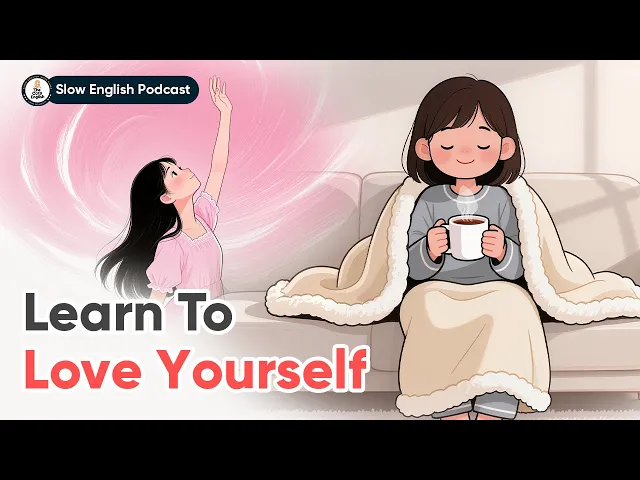
The Cozy English learn English slowly. >> Hi everyone and welcome back to the Cozy English. I'm Emma >> and I'm Daniel.
It's so nice to be here again with all of you. >> Yes, it really is. Before we begin, I just want to say a big thank you to you, our listener.
Every day you choose to spend a few quiet minutes with us, learning, reflecting, and growing. That means a lot. >> Yeah, truly.
It feels like we're all sitting together just having a cozy little chat about life. >> Exactly. And today our topic is something that sounds simple, but it's one of the hardest lessons for many of us.
Learning to love yourself more than anyone else. >> H, that sounds deep, but also a little confusing, right? I mean, what does it really mean to love yourself more than anyone else?
Isn't that kind of selfish? >> That's such a good question. And I think that's where many people get stuck.
When we hear love yourself, we often think it means being proud or putting yourself first all the time. But real self-love, it's not about ego. It's about care, respect, and kindness toward your own heart.
>> So, not about saying I'm the best, but more like saying I'm enough. >> Exactly. Loving yourself means accepting that you're human, imperfect, sometimes messy, sometimes lost, but still worthy of love and peace.
>> That actually feels comforting. But I have to admit, I find it hard to love myself. Sometimes I feel like I'm not doing enough or I'm not good enough.
>> Oh, Daniel, I think most of us feel that way. Society often teaches us to look for love and approval outside of ourselves from parents, teachers, partners, friends. But when that's all we depend on, our worth becomes fragile.
>> Yeah. Like if someone doesn't like us or if we fail at something, it suddenly feels like we're not worthy anymore. >> Right.
But the truth is, no one else can give you the kind of love that fills the empty space inside. That's your job. You know, I remember once I was trying to learn something new and I got so frustrated because I couldn't get it right.
I told myself, "You're so stupid. " Later, I realized I'd never say that to a friend. >> That's such a good example, Daniel.
We often forget that the voice inside our head becomes the home we live in. If that home is full of criticism, we'll never feel safe. >> Wow, that's true.
>> So today, maybe we can start by simply noticing how we talk to ourselves and ask, would I say this to someone I love? >> H, I like that. It's a gentle start.
Yes, gentle is the right word because loving yourself isn't a race. It's more like learning to walk home to yourself. >> I like that image.
Walking home to yourself. >> Then let's keep walking together. >> You know, Emma, after what we talked about earlier, I started thinking, why is it so hard to be kind to ourselves?
Like I can forgive other people so easily, but when it comes to me, I'm the harshest critic. >> That's a question I've asked myself many times, too. I think it starts early.
When we were children, we learned to earn love by being good, doing well, making people proud. Over time, we started believing that our worth depends on how much we achieve. >> Yeah.
Like love was a reward, not something natural. >> Exactly. And when we grow up, that voice stays in our head.
The one that says, "You should do better. " >> Fear. >> Mhm.
The fear of not being accepted, of being left behind, of not being loved. So we judge ourselves harshly because deep down we think that's how we'll stay good enough for the world. Wow, that hits hard.
I think that's me. Always trying to be good enough for everyone. >> I understand.
I used to do that, too. I remember when I first started teaching, I was obsessed with being perfect. I'd replay every mistake in my head after class.
A word I said wrong, a moment. Exactly. And when we forget that, we start believing there's something wrong with us.
So our inner critic gets louder telling us to do more, be more, fix more. But in reality, what we need is less judgment, more compassion. >> H So judging myself doesn't really help me grow.
It just keeps me stuck. >> Yes. Because when you're always criticizing yourself, you stop feeling safe enough to try again.
It's like trying to bloom while someone is yelling at you. >> That's such a good image. Flowers don't grow under pressure.
They grow under care. >> Exactly. The same goes for people.
Growth happens when we feel accepted, not when we're constantly punished. >> But how do we unlearn that? I mean, it's not easy to just stop judging yourself overnight.
>> True. You can't silence that voice in one day, but you can begin noticing it. When that inner critic speaks, pause and say, "Thank you for trying to protect me, but I'm safe now.
" >> Wait, thank it. >> Yes. Because that critical voice is actually trying to protect you.
It believes that if you do everything right, you won't get hurt. But it's working too hard. So you don't fight it, you soothe it.
>> That actually makes sense. Like comforting a scared child, not arguing with them. >> Exactly.
When you start responding to yourself with calm understanding, your mind begins to trust that it's okay to rest, to try to be imperfect. >> You know, I think I'll start practicing that next time I catch myself judging. I'll say, "Hey, Daniel, it's okay.
You're trying your best. " >> That's beautiful, Daniel. That's the beginning of healing.
Learning to be your own comfort. >> Yeah, maybe that's how we learn to love ourselves, by forgiving the parts we once judged. >> Yes, that's where real love begins.
Not in perfection, but in gentle acceptance. Huh? You know, Emma, I've been thinking about what you said earlier about forgiving yourself and speaking kindly to yourself.
>> Well, I'll tell you a story. A few years ago, I was going through a stressful time. Too much work, not enough rest.
I kept pushing myself, saying, "You have to do more. " Then one day, I just stopped and made a cup of tea. I sat by the window and said to myself, "You're tired.
It's okay to rest. " That tiny act, just listening to myself, made me cry. >> Wow, that sounds so gentle and so human.
>> It was the first time I treated myself the way I'd treat someone I loved. That's the quiet power of kindness. It doesn't shout, it heals.
>> You know, I usually tell myself to just get over it when I feel down. But maybe what I need is to say, "Hey, it's okay to feel this. " >> Yes, exactly.
Kindness starts with permission. Permission to feel, to rest, to be human. >> It's funny.
When I'm kind to others, I feel good. But when I try to be kind to myself, I feel guilty, like I'm being lazy. >> Many people feel that way.
But kindness isn't laziness. It's nourishment. Think of it like watering a plant.
If you never water it because you think it should survive on its own, it will wither. >> So, you're saying, "I've been letting my inner plant die of thirst. " >> Maybe just a little.
But the good news is plants and people can come back to life with a bit of care. >> That's a nice thought, but sometimes I don't even know what kindness looks like. Like, what do I actually do?
>> That's a great question. Kindness doesn't always mean big changes. It's in small choices.
Going to bed earlier, taking a deep breath before replying to a stressful message, writing something you're grateful for. It can even be saying no when you're too tired. >> So, it's not about being selfish.
It's about being honest with yourself. >> Exactly. When you start being honest about what you need, you stop abandoning yourself.
That's self-love in action. >> I like that. Stop abandoning yourself.
It feels powerful. It really is because every time you choose kindness, you send your heart a message. You matter.
You are worth care. And slowly that becomes your truth. >> I think I've been waiting for other people to send me that message.
>> We all do, Daniel. But the moment you realize you can give that message to yourself, that's when you become free. You know, I remember once I failed an English test.
I was so disappointed. But instead of encouraging myself, I just kept saying, "You're so bad at this. " Maybe if I had been kinder, I would have tried again sooner.
>> Probably because kindness gives courage. It tells you you can try again. That's why it's so powerful.
It doesn't just make you feel better, it helps you grow. >> That makes me want to treat myself differently. Not just when things go well, but especially when they don't.
>> That's the real test of self-love. How you treat yourself on your bad days. >> I think I'll start small.
Maybe tonight instead of scrolling through my phone and feeling behind, I'll just make tea like you did and tell myself, "You did enough today. " >> That sounds perfect because loving yourself isn't about doing more. It's about being gentle enough to rest in your own heart.
>> That's beautiful, Emma. >> It's simple, but life-changing. Kindness is quiet, but it's the strongest kind of love.
>> You know, Emma, I've been thinking. Sometimes I say yes to things even when I really don't want to, like helping a friend when I'm exhausted, or joining an event I don't enjoy, just because I don't want to disappoint anyone. >> Oh, Daniel, I think many of us do that.
We confuse kindness with pleasing everyone. But true kindness, especially to yourself, often means saying no when something doesn't feel right. >> That's the hard part, though.
When I say no, I feel guilty, like I'm being selfish or letting people down. >> Yes, that guilt is familiar to a lot of people. We're taught that good people always help, always say yes, always put others first.
But the truth is, when you never set boundaries, you slowly disappear from your own life. >> Disappear from your own life. That sounds so true, but also kind of sad.
>> It is sad because boundaries aren't walls, they're doors. They don't push people away. They teach others how to walk in gently.
>> That's a beautiful image. But how do I start setting boundaries without feeling like a bad person? >> Well, think of it this way.
When you say yes to everything, your yes loses its meaning. But when you say it only when you truly want to, it becomes honest, powerful, and full of love. >> H So saying no sometimes actually makes my yes more real.
>> Exactly. When you protect your time and energy, you're not rejecting people. You're simply respecting yourself.
>> I like that idea. But I think my problem is I'm afraid people will think I don't care about them if I say no. >> I understand.
But think about this. If someone only values you when you say yes, then they don't really value you. They value your usefulness.
And that's not real connection. >> O, that hits deep. >> I know it's a hard truth.
But setting boundaries is an act of self-respect. And people who truly love you, they'll understand. They'll even admire your honesty.
>> I remember one time my friend asked me to help him move. I had already worked a long day and just wanted to rest, but I said yes anyway. The next day, I was so tired I snapped at him.
It made things worse. Yes, that happens often when we say yes out of guilt. Resentment grows quietly underneath.
Then we start feeling tired, frustrated, even distant from people we care about. >> Yeah. I wish I had just said, "I'd love to help, but I need to rest tonight.
Maybe tomorrow. " That would have been honest and kind. >> Exactly.
Boundaries don't have to sound harsh. You can say no with love. You can say, "I appreciate you asking, but I can't right now.
" Or, "That sounds great, but always. " Because when you respect your limits, you invite others to do the same. And that creates relationships built on truth, not obligation.
>> So, loving yourself also means protecting your peace. Even if others don't understand right away. >> Yes, you cannot pour from an empty cup.
When you care for yourself first, you give others your best, not your leftovers. >> I love that. Not your leftovers.
I'll remember that. >> Please do. Boundaries aren't barriers.
They're bridges that lead to healthy love, both for yourself and for others. Hm. You know what?
Next time I feel guilty for saying no, I'll remind myself that it's not rejection, it's selfrespect. >> That's a beautiful promise to yourself, Daniel. So, Daniel, we've talked about kindness, forgiveness, and boundaries, but all of those things lead to one final truth.
Learning to become your own safe place. H I love that phrase, your own safe place. But what does that really mean, Emma?
>> It means being someone you can come home to. Someone who doesn't run away when life gets hard. It's the feeling of knowing that no matter what happens, you'll treat yourself with care, not punishment.
>> I see. So instead of looking for safety in someone else, a partner, a friend, a teacher, you start building that feeling inside yourself. >> Exactly.
Because if your peace depends on other people, it will always be fragile. But when it comes from within, no one can take it away. >> That sounds like the kind of strength I want.
Quiet, steady, gentle. Yes, gentle strength. You know, there was a time when I used to search for people who could make me feel enough.
But no matter how kind or loving they were, that feeling never lasted. One day, I realized it wasn't their job, it was mine. >> Wow, that's powerful.
So I started spending time alone, not in loneliness, but in connection with myself. I take a walk, journal my feelings, listen to music that comforted me. Slowly, I learned that peace isn't given, it's grown.
>> That reminds me of something. When I feel anxious, I usually try to distract myself, call someone, scroll on my phone. But recently, I tried something different.
I just sat quietly, placed my hand on my chest, and said, "It's okay. You're safe. " It felt strange at first, but also calming.
>> That's exactly it, Daniel. You were being your own safe place. You were giving yourself what you needed.
Comfort, presence, reassurance. It's interesting. I always thought loving yourself meant confidence or success, but now it feels more like being gentle with your heart.
>> You're absolutely right. Self love isn't loud. It's quiet.
Like a whisper that says, "I'm here for you even when you fail. Even when you're lost. Even when no one else understands.
That kind of love feels peaceful. Not proud, not dramatic, just steady. That's the love that lasts.
When you become your own safe place, you stop chasing love that hurts. You stop begging for validation. You start building a home inside you, one that no storm can destroy.
a home inside you. I love that image. >> It's true.
You carry your peace wherever you go. That's what it means to love yourself more than anyone else. Not because you think you're better, but because you've learned to care for your own soul.
>> You know, Emma, this conversation really changed how I see self-love. It's not about being perfect or always positive. It's about being kind enough to stay with yourself even when things fall apart.
>> Beautifully said, Daniel. That's the heart of it. As we close today's episode, I want to invite you, our listener, to take a quiet moment for yourself.
Maybe place your hand on your heart, take a deep breath, and whisper softly, "I'm here. I'm enough. I'm safe with myself.
" >> Yeah. Try to remember that even on hard days, you can be your own comfort. You don't have to wait for someone else to make you feel loved.
You already have that power inside you. >> Exactly. And every small act of care, resting, forgiving, saying no, or simply breathing is a way of saying I love you to yourself.
>> I think I'll end my night with that. A quiet I love you to myself. >> That's perfect, Daniel.
And to everyone listening, thank you for sharing this moment with us. We hope you remember you are never too much, never too little, and always deserving of your own love. >> Take care everyone.
>> Until next time, stay cozy, stay kind, and stay close to your heart.