English Leap Podcast >> from [music] Speak English with Claus. Hello. Hello English learners.
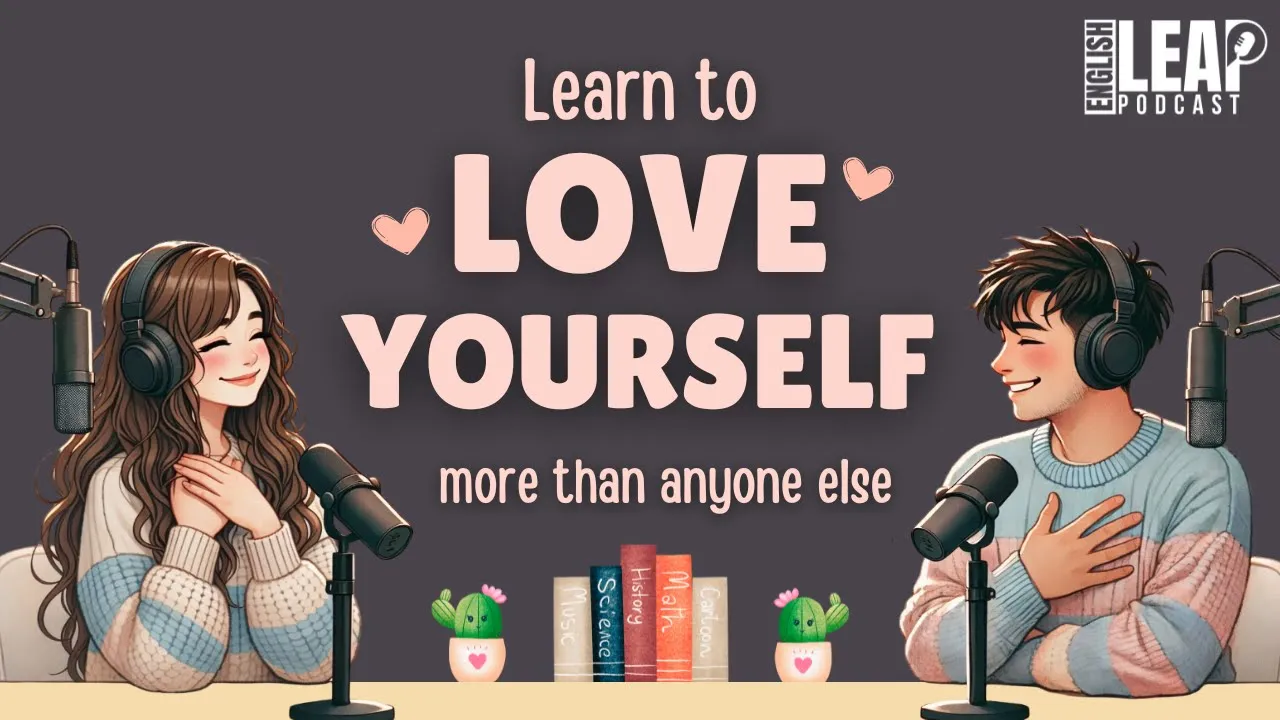
Welcome back to the English Leap Podcast, your cozy place to learn easy English through real conversations. I'm Anna >> and I'm Jake. We're really happy you're here.
>> Jake, quick check-in. How are you today? >> I'm good.
Today I saw something small that made me feel calm. Oh, what happened? >> I was waiting in a line and someone let another person go first.
No big show, just a quiet kindness. It reminded me small things matter. >> Quiet kindness.
H I love that. It's simple, but it stays with you. >> Yeah.
How about you? >> I'm okay. I caught myself rushing.
Then I stopped and I sat for one minute with my warm drink. just one minute and it felt like coming back to myself. >> Coming back to yourself.
Yeah, that's a good feeling. >> And maybe you listening right now, you also need that. A small return to yourself.
>> So today's topic is perfect for this moment. >> Yeah. Today we're talking about how to love yourself more than anyone else.
Not in a selfish way, in a healthy way. like respecting yourself, taking care of yourself, not abandoning yourself. >> Also, just so you know, this is a B1 level episode.
>> So, if you're intermediate, it's perfect. And if you're a strong beginner, you can still follow. >> Yes.
Just take what you understand, repeat the useful lines, and let the rest wash over you, like background music. That's still learning. >> Still learning.
Yes. And to help you today, we'll share a few simple self-love habits you can use in real life, >> like what to say to yourself on a bad day, how to set boundaries, and how to stop being so hard on yourself step by step. >> And we'll use real life situations like work, family, friendships, messages, and daily moments, so it feels practical, not theory.
And quick reminder, if you enjoy our episodes, please like and subscribe. It really helps the English Leap podcast grow. >> And leave a comment after you listen.
What is one small way you want to be kinder to yourself this week? >> H even one sentence is perfect. >> And because this is the English Leap podcast, >> at the end we'll do a short calm word tour.
That means we'll slow down, collect the key words and phrases from today and explain them with simple examples so they stay in your English. >> Okay, before we begin, take one slow breath in and out. >> No pressure.
You don't have to become perfect today. Just be here with us. >> All right, let's start with the first idea.
>> And please don't rush yourself while you listen. Just stay with us. Yeah, let the ideas land slowly.
>> No rush. And the first thing we want to share is simple, but it changes a lot. >> Okay, I'm listening.
>> Here's a simple truth. The way you treat yourself becomes your standard. >> Yeah.
It's like the invisible rules you live by. You don't announce them, but people feel them. >> Yes, totally.
It's almost like an inner price tag. Not money but value. >> Oh, I like that because when you value yourself clearly, other people usually follow your lead.
>> Right. But when you don't, you start teaching people something without meaning to. >> Like when you keep saying yes, even when you want to say no.
>> Yes. People learn, "Oh, Anna is always available. " >> And at first it sounds like a compliment, doesn't it?
Helpful, kind, reliable. >> Yeah. But then it turns into a habit.
>> And habits turn into roles. Suddenly you're the yes person even when you're exhausted, >> right? And one day you're tired, overwhelmed, and you think, "How did I get here?
" >> Yeah, I've been there, too. Can I share a small story? >> Please go ahead.
>> A few years ago, a friend used to message me late at night, not every day, but often. And I would reply even when I was half asleep. And I kept telling myself, "It's fine.
I'm just being nice. " But slowly it started to wear me out. >> Oh, yeah.
That kind of nice starts stealing your rest. Like your energy is leaking little by little. >> Exactly.
And then one night, I didn't reply for 1 hour. Just 1 hour. And the next day, my friend said, "Where were you?
" In a serious tone, like I had done something wrong. >> Oof. That moment.
Because you realize the expectation is already there. >> Yeah. I trained people to expect instant access to me.
I didn't plan it, but I taught it. >> So the lesson isn't stop being kind. The lesson is kindness needs a limit.
Kindness needs a line. >> Yes, that's the word boundaries. >> In English, boundaries means your personal limits.
What is okay and what is not okay. And boundaries aren't walls. They're more like doors.
>> Yeah, doors. You can still be warm, but you're also in control. >> You decide who comes in, how long they stay, and what behavior is allowed inside.
>> And you decide when to close the door so you can rest. >> And here's the interesting part. When you set a boundary, some people suddenly get uncomfortable.
>> Yeah. Especially the people who benefited when you had no boundaries. And it doesn't mean they're evil.
It just means they're not used to your new standard. >> 100%. New standard and a calmer you.
And when you raise your standard, something inside you has to change first. >> Yeah. Because boundaries aren't only about other people, they're also about what you believe you deserve.
>> Right. And that brings us to something deeper. >> Your worth is not up for discussion.
>> Mhm. Let's talk about self-worth. >> Self-worth means you believe you have value as a human being, even on your bad days.
>> Yeah. Not only on your good English days or your super productive days. [laughter] >> Exactly.
Not only on the days when you look perfect and do everything right. >> A lot of people connect their worth to money, looks, or approval. >> H that word validation.
>> Validation. Yeah. Validation means other people confirming you are good enough.
>> And validation feels nice, of course, but if you need it all the time, you become fragile. >> Because if someone doesn't like you, you crash. If someone criticizes you, you feel small.
>> I remember once I posted something online, a small thing, and one person wrote a rube comment, and my mood changed instantly, like they had a remote control for my feelings. >> Oh, wow. That's such a clear image.
One click and your whole day shifts. >> Yeah. And then I realized, wait, why does one stranger have this power?
>> Because you were borrowing your worth from outside. >> Right. So, here's a sentence you can keep.
My worth is not up for discussion. >> And here's another one. I am enough even while I'm improving.
>> Wow, that line feels like a deep breath. And when you start believing that you stop living for the audience. >> Stop living for the audience.
Yeah, that feels light. And then you can finally meet yourself. >> Yes.
And meeting yourself is where self-love really starts. Not with big words, but with honest noticing, >> right? Like you stop performing and you start paying attention.
>> And this is where it gets really personal. >> Yeah. Knowing yourself comes first.
Self-awareness first. >> Okay, Jake. Question.
How do you love yourself if you don't even know yourself? >> Exactly. You can't.
>> This is where selfawareness matters. It means you notice your feelings, your triggers, your needs. >> And I like the word trigger because it's like a button.
Something happens and boom, you react. >> A button. I like that.
Like someone says one sentence and suddenly you feel angry or sad or insecure. >> Yeah. So a simple exercise ask yourself what drains me?
What gives me energy? >> Drin means it takes your energy away slowly like a phone battery going down. >> Yeah.
For example, doom scrolling drains me. >> Same. Also, some people drain me.
>> Yep. Some conversations feel like a battery thief. >> A battery thief.
It's funny, but it's also true. >> H And self-awareness is noticing that without judging yourself. >> Exactly.
You don't say, "I'm weak. " You say, "Oh, this drains me. I need to protect my energy.
" >> So, try small, quiet moments, journaling, walking, even just sitting without your phone. >> It's like cleaning a window. When the window is clean, you can see clearly.
When it's dirty, everything looks cloudy. >> Yeah. When your head feels cloudy, your decisions get messy, too.
>> So, we're not trying to be perfect. We're trying to see ourselves clearly. >> And once you start seeing yourself clearly, you notice another habit.
A very common one. >> The sorry habit. >> Yeah.
And it's so common that people don't even notice they're doing it. >> I agree. It becomes automatic, like a reflex.
>> Like you're making yourself smaller before anyone even asks you to. Yeah. So, stop apologizing for existing >> because it sounds small, but it changes a lot >> and you see it everywhere.
People saying sorry for normal things. >> Sorry, I'm talking. Sorry, I'm asking.
Sorry, I'm tired. >> Of course, apologize when you make a real mistake, but don't apologize for being human. >> Because when you apologize too much, you send a message, I don't deserve space.
And you do deserve space. >> Yeah. And this reminds me of a co-orker I had once.
Really kind, but every message started with sorry, even when they were helping me. And I remember thinking, you don't need to shrink. >> You don't need to shrink.
Yeah, that's the feeling >> because sorry can become a way to ask permission to exist. >> And the right people won't ask you to disappear. >> And when you stop shrinking, something else shows up.
The inner critic. >> Yeah. It's like the moment you finally stand up a little straighter, that voice goes, "Wait, who do you think you are?
" >> Exactly. And that's why we need to talk about negative self-t talk. >> Yes.
Fixing negative self-t talk. >> H let's go inside the mind. >> Yeah.
Inside the head. >> The inner critic is that voice that says, "You're not good enough. You always fail.
" And the scary part is we start believing it >> like it's a fact, not just a thought. >> And once you believe it, you start acting smaller again. >> So here's a simple trick.
Talk to yourself like you talk to a friend. >> Because you would never say to your friend, "You're useless. " >> But we say it to ourselves so quickly, like it's normal.
>> It's like living with a bully, but the bully is in your own mind. >> O, a bully. Yeah.
And that's the hard part. You can't walk away from it because it's inside. >> So, we have to change the voice.
>> When you catch a negative thought, don't fight it aggressively. Just question it. >> Hm.
Like, is this a fact or is this fear? >> That one question saves people. >> Yeah.
Because fear is like fog. It makes everything look bigger and scarier. [laughter] >> Ooh, fog.
Yes. My mind becomes a drama director. one small mistake and it's like, "Okay, it's over.
" [laughter] >> And [clears throat] facts are like flashlights. They show what is real. >> So when you make a mistake, don't use it as proof you're bad.
Use it as information. >> Yeah. Like feedback, like, "Okay, noted.
Next time I do it differently. " >> That's it. Mistakes are stepping stones.
They are not your identity. >> And once your inner voice becomes kinder, boundaries become easier. >> Yes.
Because now you're not setting boundaries with anger. You're setting them with self-respect. >> Yeah.
And self-respect changes the feeling of no. It stops being a fight and becomes a choice. >> Right.
And this is where many good people struggle. Not because they don't know what to do, >> but because they feel guilty when they finally do it. >> Yes.
Boundaries without guilt. >> Many listeners are people pleasers. People pleasing means you try to keep everyone happy even if you suffer.
>> And you feel guilty when you say no. >> That guilt can feel so loud. >> Yeah, guilt has a big mouth.
You're bad. You're selfish. >> But saying no is not cruel.
Sometimes it's caring. >> Here are simple no sentences you can borrow. I can't today, but thank you for asking.
I'm not available this week. I need to rest tonight. Notice short, clear, kind.
No long explanation. >> True. Because overexplaining is a trap.
>> Totally a sticky trap. >> H it turns into a fivepage essay called Please Still Like Me. >> True.
>> And when you start saying no, something surprising happens. >> You get space. >> Yeah.
And in that space, you can finally feel joy again. >> Because joy needs room. When your life is too crowded, even good things can't breathe.
>> Yeah, that's so true. When you're always running, always pleasing, always explaining, you don't even notice the small good moments. >> Exactly.
And once you have space, you remember something important. >> M Yes. You remember that happiness is not a luxury.
>> Some people treat happiness like dessert. Maybe later, >> right? Like it's a reward.
But happiness is part of health. >> And you don't need a perfect life to feel small joy. >> Yeah.
Small joy counts. Like a slow coffee, a short walk, a clean room, a good song, >> a message from a friend, sunlight on your face, a laugh. >> Mhm.
Those little moments matter. And this is important. Don't let society define happiness for you >> because one person's dream can be another person's nightmare.
>> Absolutely. So ask yourself, what makes me feel alive? >> And sometimes the biggest reason we delay happiness is because we are chasing perfection.
>> Perfection. M >> like you tell yourself when I fix everything then I'll rest. Then I'll be happy.
>> Yeah, I know that voice. And the problem is that then never really comes, right? Because the finish line keeps moving, >> right?
That's why perfection is a myth. >> Yes. If you wait to be perfect, you'll wait forever >> because perfection is a moving target.
>> Yeah. It keeps shifting. And honestly, social media makes it worse.
>> That's the comparison trap. Comparing your real life to someone's highlight reel. >> And you don't see their bad days.
You don't see their stress. So don't measure your life with fake images. Measure your life with your values.
>> Yeah. Values are the real measure. And when you live by your values, you start protecting your energy.
>> Yeah. Because you realize your energy is not unlimited. >> So true.
You can't keep giving and giving and then act surprised when you feel empty. Even good people burn out. >> Yeah.
And I think many listeners feel that. They're not lazy. They're just tired.
>> Exactly. So, this is a gentle reminder. Protect your energy.
>> Not in a selfish way, more like in a I want to stay healthy way, >> right? Because your environment matters. People, content, routines, what you allow around you affects you.
>> Some relationships feel warm. Some feel unsafe. >> Yeah.
And your body notices first. You feel tense. You feel small.
you start choosing your words too carefully. >> And if someone constantly makes you feel small, that's a sign. >> Mhm.
It doesn't always mean they're a bad person. It just means the space isn't good for you. >> And sometimes you outgrow people.
It's sad, but it's real. >> Yeah. And you don't need a big fight.
You don't need drama. Sometimes you just step back >> little by little, >> right? A little distance, more quiet, more room to breathe.
>> Peace is also a choice. >> Yeah, I like that. And when you choose peace, you become stronger after hard moments.
>> You bounce back. >> And when you can bounce back, you start trusting yourself again. >> M Yeah.
Because you're not breaking yourself after every hard moment. You're learning how to recover. >> Exactly.
It's like life still hits you, but you don't fall apart the same way. >> Right. So, let's talk about that recovery.
That bounce back feeling. >> Yeah. Bounce back.
>> Bounce back means you recover after something hard like failure, rejection, or just a bad week. >> And I like this phrase because it doesn't mean nothing hurts. It just means you come back.
>> Yes. And people who love themselves bounce back faster because they don't punish themselves with shame. >> Yeah.
They don't do that long, I'm worthless, speech in their head. >> Instead, they say, "Okay, that was hard, but I'm still here. " >> And then they look for one small win.
Not a huge victory, just something small >> like, "I got out of bed. I answered one email. I went for a short walk.
" >> Yes, those are wins. celebrate small wins >> because small winds build confidence. Quiet confidence.
>> It's like building a wall with tiny bricks. One brick doesn't look like much, but over time it becomes strength. >> Yeah.
And those little bricks help on the bad days. Because you can tell yourself, I've done hard things before. >> And to bounce back like that, we need one final ingredient.
>> Forgiveness. >> Yeah. Forgive yourself.
H because honestly a lot of people are carrying old guilt like a heavy backpack >> and they've carried it for so long it starts to feel normal but it isn't. >> Yeah. It makes everything heavier.
Even small days feel hard. >> And forgiving yourself doesn't mean saying what I did was perfect. >> Right.
It means I'm human. I learned I will do better. And then you release the pain instead of living inside it.
>> Yeah. You stop replaying the same moment and beating yourself up again and again. >> You keep the lesson, but you put down the shame.
>> That's a beautiful line. You deserve a fresh start. >> Mhm.
And if you're listening and feeling emotional right now, just breathe. You're okay. >> Yeah.
and we'll end in a calm way >> because this is the English leap podcast. >> It's time for our short calm word tour. >> That means we slow down.
We collect the key words from today and we explain them with simple examples. >> You can replay this part anytime. No pressure.
Just let the words settle. >> Okay, let's start. >> First one we kept using was standard.
M yes your standard is your personal rule. It's what you accept and what you don't accept. >> For example, my standard is respect.
If someone is rude, I step back. >> Or my standard is rest. I don't answer work messages late at night.
>> We also said available, >> right? Available means you have time. You can respond.
You can do it. >> For example, I'm not available tonight. I need to recharge.
or are you available for a quick call? >> And we described people as reliable. >> Yes, reliable means people can trust you.
You do what you say you will do. >> For example, she's reliable. If she says she'll help, she really helps.
>> Or I want to be reliable, but I also need boundaries. >> We use the word overwhelmed, too. M overwhelmed means you feel like there is too much and your brain feels full.
>> For example, I felt overwhelmed this week so I took a quiet break. >> Or when I have too many tasks, I get overwhelmed. >> And of course, boundaries, big word today.
>> Yeah, boundaries are your personal limits. What is okay and what is not okay. For example, my boundary is no work chats after 900 p.
m. >> or my boundary is speak to me with respect. >> And when you set boundaries, some people get uncomfortable.
>> Yes, uncomfortable means you don't feel relaxed. You feel uneasy, a bit tense. >> For example, he looked uncomfortable when I said no.
>> Or I feel uncomfortable in loud places. We talked about self-worth. >> Yes.
Self-worth means you believe you have value as a person even on bad days. >> For example, my self-worth doesn't change because of one mistake. >> Or I'm working on my self-worth.
I want to respect myself more. >> We talked about validation. >> Right?
Validation is when other people confirm you're good enough, like approval. For example, I like validation, but I don't want to depend on it. >> Or if you always need validation, you start feeling unsure inside.
>> We also said fragile. >> Yes, fragile means easily hurt or broken. We can use it for feelings, too.
>> For example, when I needed approval all the time, my confidence felt fragile. >> Or after that comment, my mood felt fragile. >> We also said criticize.
Hm. Criticize means to say negative things about someone's work or actions. >> For example, my boss criticized my report, but I learned from it.
>> Or try not to criticize yourself all day. >> And then we said crash like emotionally crash. >> Yes, to crash emotionally means your mood falls suddenly like you feel okay and then you drop.
For example, when she ignored my message, I crashed and felt really sad. >> Or after that call, my confidence crashed. >> Then we talked about self-awareness.
>> M. Yes. Self-awareness means you notice your feelings, needs, and reactions.
>> For example, self-awareness helped me notice I was saying yes too fast. >> Or I'm building self-awareness by journaling. And we use the word trigger, >> right?
A trigger is something that causes a strong emotion quickly. >> For example, that comment was a trigger for me and I felt angry instantly. >> Or crowds can be a trigger for my anxiety.
>> Then we used drain. >> Yes, to drain means something takes your energy away slowly. >> For example, doom scrolling drains my energy >> or negative people drain me.
And we said doom scrolling. Such a modern word. >> Yeah.
Doomcrolling means scrolling online for a long time. Usually reading negative or stressful things. >> For example, I stopped doom scrolling at night and I slept better.
>> Or when I doomscroll, I feel heavy after. >> We used apologize, too. >> Yes.
Apologize means you say sorry when you did something wrong. >> For example, I apologized for being late. And we also said, "Don't apologize for being human.
" >> Then we talked about the inner critic. >> The inner critic is that voice inside you that says, "You're not good enough. " >> For example, my inner critic said I would fail, but I tried anyway.
>> Or when my inner critic gets loud, I take a breath and slow down. >> And connected to that was negative self-talk. Yes, negative self-t talk is the harsh way you speak to yourself in your mind.
>> For example, I'm replacing negative self-t talk with kinder words >> or negative self-t talk makes small problems feel huge. >> We also said the word selfish, >> right? Selfish means you only care about yourself and ignore others.
>> But setting boundaries isn't selfish. It's healthy. For example, it's not selfish to rest when you're tired.
>> And we talked about guilt. >> Guilt is that bad feeling you get when you think you did something wrong. >> For example, I felt guilt after saying no, but I reminded myself it was okay.
>> Or guilt can be loud, but it's not always correct. >> And the last one, regret. Yes, regret means you feel sad about something you did or didn't do.
>> For example, I regret not speaking up, but I'm learning now. >> Or I don't want to live with regret, so I'm choosing a fresh start. >> Okay, that was our calm word tour.
>> You can replay this part anytime. Listen again and try using one word in a sentence today. >> And remember, you're still learning.
That's not a problem. That's the whole point. >> Okay.
Before we go, let's just sit with one small idea. >> Yeah. Not 10 ideas, just one.
>> If you remember only one thing from today, let it be this. The way you treat yourself teaches people how to treat you. >> And you don't have to change everything overnight.
Just choose one small upgrade this week. >> Maybe one boundary. Maybe one kinder sentence to yourself.
Maybe one no without a long explanation. >> And if you want to make it real, leave us one comment. >> Yes, write one line.
This week I will and finish it in your own words. >> We read your comments and they really help other listeners, too. >> And if this episode helped you, please like and subscribe.
It tells YouTube, "Yes, more of this, please. " >> We're really proud of you for staying with us till the end. >> This is Anna >> and this is Jake.
And you've been listening to the English Leap podcast. Bye. Your progress doesn't end here.
To continue [music] advancing your English skills, click on the next video or explore the additional videos we've thoughtfully selected [music] for you.