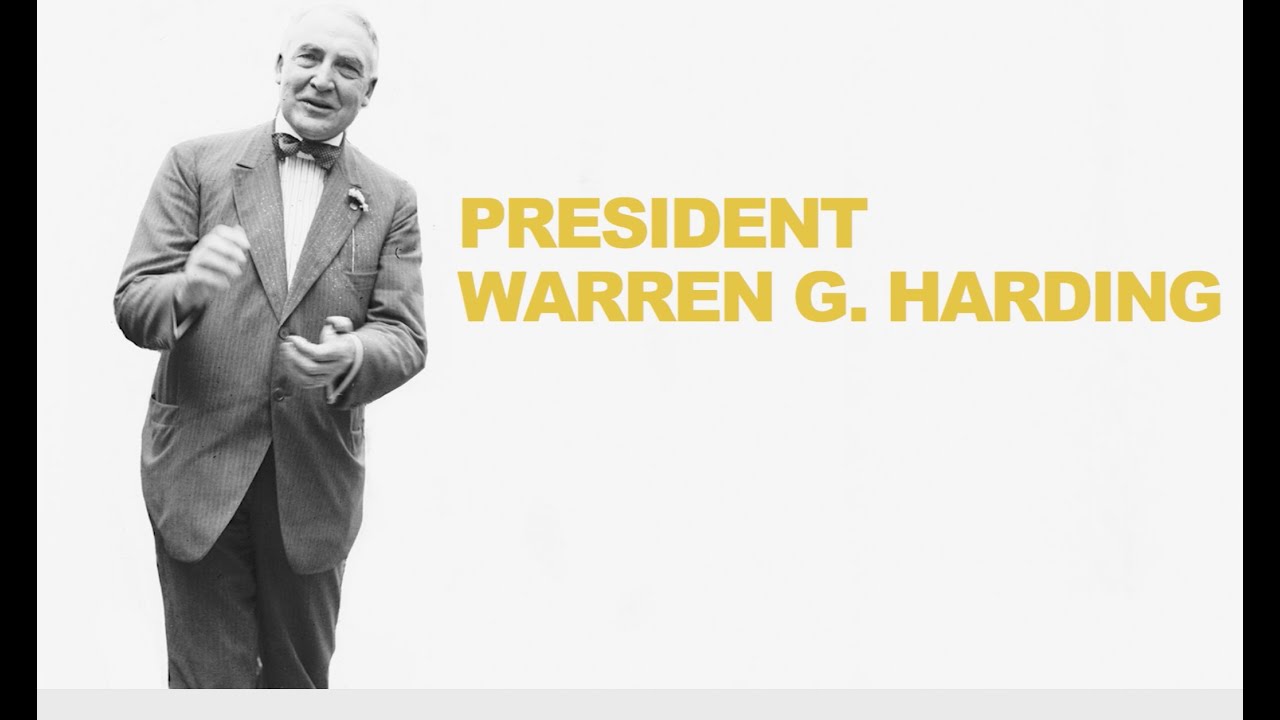
In 1956, an 83-year-old woman named Carrie Phillips moved into a nursing home. She left it to her lawyer to sort through all the stuff she still had stacked up in her home in Marion, Ohio, and he was digging through a closet when he found a box of letters—hundreds and hundreds of letters, nearly a thousand letters—and they were all from former President Warren Harding. These were raunchy, steamy love notes that spanned years of a previously unknown affair between Harding and Phillips.
While the lawyer hid them away until 1963 at his own house, he finally showed them to someone at the Ohio Historical Society. Word of the letters soon spread, and after many legal proceedings, the letters ended up in the control of Harding’s family. However, they were given to the Harding family on one major condition: that the family would eventually give those letters to the Library of Congress instead of destroying them.
So they did—but when the family gave the letters to the Library of Congress, they made their own insistence: that the letters stay sealed for 50 years. That's what happened. The letters sat at the Library of Congress for half a century, seal unbroken, contents unknown.
Two years ago, the 50-year wait was over, and when historians broke the seal. . .
Oh my gosh! I'm Lillian Cunningham with the Washington Post, and this is the 28th episode of "Presidential. " [Music] I shall resign [Music] [Applause] We're going to do something a little different with "Presidential" this week.
So, you know how I normally ask what it would be like to go on a blind date with the president? Well, this week, the entire episode is kind of an answer to that question. Nicole Hemmer, a scholar at the University of Virginia's Miller Center, is going to help me narrate this crazy, wild story of Warren Harding's life, relationships, and presidency.
It is a story about newspapers; it's a story about zodiac readings, love letters, suicides, scandal, jazz, Hollywood, prohibition, and even the Hope Diamond. Alright, but we're going to start by going back in time to Marion, Ohio, about 70 years before those letters were discovered. It's the late 1880s; we've got women wearing bustled dresses and men wearing those jackets that cut away at the bottom so you can see their watch chains.
Marion was a growing industrial city in sort of north-central Ohio, and at the head of the city's daily newspaper, the Marion Star, was a young man in his 20s named Warren Harding. A couple of years earlier, when Harding was only about 19 years old, he had bought the paper for $300 with two of his best friends. So, the young Warren Harding had something that would actually prove to be pretty important to his presidency: he was very charming, he was very handsome, and he was well-connected.
His position with the paper gained him prestige and connections across the city, especially since he wasn’t very interested in running critical or scandalous stories. Well, he was absolutely a people pleaser, and he was also someone who didn’t like confrontation. It was key to the success of his newspaper—not wanting to be too political—because you’re in an era in which journalism is undergoing a major change, moving away from party papers and moving to a more commercial or nonpartisan model.
Harding believed that because the Marion Star was the only daily paper in Marion, it was important that it be the paper of record, that it not be too closely associated with any one party, and so that really made it stand out. As publisher and editor, Harding wrote out an office creed for the newsroom that included points like: "Remember, there are two sides to every question; get both and be truthful, yet also boost, don’t knock. There’s good in everybody; bring out the good in everybody.
And never needlessly hurt the feelings of anybody. " This is the voice of my colleague, Michael Ruin. Michael covered the big unsealing of Harding’s letters two years ago, so I asked if he wanted to play the role of Harding for us, which he agreed to without fully remembering what he was getting in for.
Even though Harding kept his newspaper from wading too much into the political game, he himself got more and more involved in the local Republican Party, which was basically the party that most of Marion's business owners belonged to at the time. At 24, Harding took a brief hiatus from running the paper when he had what he called a nervous breakdown, and he spent a few weeks at a health retreat run by Dr Kellogg, the man who invented cornflakes. Soon enough, though, Harding was back about town, helping the Republican Party, running the newspaper, and catching the eye of many a local lady.
So, Harding was a very striking man; he had these angular, dramatic features, these dark eyebrows, a sort of prominent nose, and he was very tall. That was striking. This combined with a strong record of charisma and charm, and that sort of flirtatious attitude that he had, all made him a very captivating and compelling person.
[Music] One woman in particular who set her sights on Warren was Florence Mabel Kling, the daughter of one of the wealthiest businessmen in the area. Florence was five years older than Warren, and she had actually been married before, and she had a child. Florence’s father was not a fan of her interest in Warren, primarily because there were rumors at the time that Warren Harding had some black ancestry in him.
Still, Florence continued to be interested and pursued him relentlessly, much more aggressively than he courted her, until they married in 1891 when Warren Harding was 25 years old, and Florence. . .
Is 30, so she was a bit of a standout figure in Marion, Ohio, because in the late 19th century, to be divorced and to be a single mother was something that was pretty unusual. I think that it says something about Warren Harding that that wasn't something that drove him off. I think that he saw in Florence someone who was bright, who was motivated, who could challenge him, and who could be a real partner for him.
I think in those early years they had a good relationship, not just because it was a partnership, but because it still had those sort of early days of infatuation and passion. That's going to go away fairly quickly; he's going to turn those passions over to his extramarital relationships, inter Karrie Phillips, the woman whose stack of love letters would be found years later. Karrie Phillips was the wife of one of Warren Harding's best friends.
Their affair started in 1905, after Harding had served two terms in the Ohio State Senate and was back full-time working at the Marion Star. The earliest letters we have today, though, are from 1910—so five years into their relationship. This is the same year that Harding tries running for governor and loses.
Here's his letter to Karrie on Christmas Eve 1910: "My darling, there are no words at my command sufficient to say the full extent of my love for you: a mad, tender, devoted, ardent, eager passion; wild, jealous, reverent, wistful, hungry, happy love; unspeakably encompassing, immeasurably absorbing. " And he goes on, "It is the prayer and benediction of my heart; the surpassing passion of my body; the conviction and consecration of my mind; and the hope in heaven of my soul. " [Music] This was a deeply romantic relationship that went on for almost 15 years, so it was more than just infatuation; it was more than just sexual.
They had a very close, very intimate, very personal relationship. They sometimes talked about leaving their spouses and getting married, although this was something that obviously never happened. Over the next few years, in 1911 and again in 1912, Karrie Phillips takes long trips with her daughter to Berlin.
Harding wrote to her constantly while she was there, and he even devised a system of code words for their correspondence. Just as a couple of examples, the word "maternal" meant I'd like to make your favorite picture a rapturous reality tonight; the word "decree" meant I'd like to bring you the scepter tonight and make you my queen. And then there was the word "Jerry.
" It was a name that he gave a certain body part of his, and he said Karrie wrote a lot of letters with the word "Jerry" in them, and some are too explicit to read here. A lot are actually too explicit to read here, but here's one of the more PG-rated ones. Even this one kind of crosses over the line, but you know only if you're old enough to understand what a euphemism is; you're not old enough to know what that term means.
This letter is probably going to go over your head. Okay, in January of 1913, Warren Harding sends this note to Karrie from his office at the Marion Star: "I went home last night in the rain, in the night that turned to snow, and the surface is covered under six inches of snow. The trees are robed in white—a beautiful winter scene.
When I Conviction that I shall enlist to fight as I vote by April of 1917. Under President Woodrow Wilson, the United States has entered World War One, and meanwhile, around the same time that war is raging and his relationship is fraying with Carrie Phillips, Warren Harding is starting up some other trysts. There’s not a sense that he did very much to distinguish himself as a senator; he spent, I think, a lot more time working on personal relationships.
There is some evidence that he had an affair with his secretary in the Senate. There are also records that he was traveling to New York about once a week while he was a senator to visit a young woman named Nan Britton—a girl with sort of short, blonde, flapper-style hair. So, Nan Britton, who is also from Marion, Ohio, had had a crush on Harding.
Her father had introduced the two of them; he had presented this as sort of a schoolgirl crush. But it was a crush that continued for quite some time. She met Harding when she was in her mid-teens; she would’ve been 14 or 15.
When she graduates from high school, she moves to New York City and strikes up a new correspondence with Warren Harding. She reminds him of this schoolgirl crush, and over time it evolves into an actual physical relationship. This is something she would write about years later.
In 1917, they finally consummate their relationship, and in 1919, she gives birth to a daughter—that’s Warren G. Harding’s child. By 1920, Harding’s term in the Senate is drawing to a close.
The war is over, and a presidential election is on the horizon. The Hardings have become friends, by this point, with Evelyn and Ned McLean. Ned McLean was the owner at the time of the Washington Post.
Now, like many other society women at the time, Evelyn McLean, his wife, was interested in astrology, and she often would see this popular psychic in Washington, D. C. , named Madame Marcia.
Well, she encourages Florence Harding to start seeing Madame Marcia as well, and in early 1920, this is the presidential election year. Madame Marcia, the story goes, predicted to Florence in a psychic session that if Warren Harding could clinch the Republican nomination that year, he would indeed win the presidency, but he would die before his term was over. It wasn't really clear that he had a path to the presidency.
There were a couple of other people who were expected to win the Republican nomination, and Harding had no sort of national following—not within the party, not within the country. So there was no reason for him to suspect that he would end up being the presidential nominee of the party. It was only when the party failed to come to a consensus on nine different ballots at the convention that they finally looked around and said, “Well, who's left?
Who can we put up that people can agree on? ” Harding, because he didn't have much of a political record, and because he wasn't the representative of a major faction within the party, sort of became the best of the also-rans, and he became the nominee that way. Carrie Phillips, in 1919-1920, as she saw Harding rising, had cooled in her affections toward him.
She actually tried to blackmail him, saying, “You know, I'm going to expose you to the American people; this is going to ruin your political career; this is going to end your marriage. ” So he writes to her, “Your proposal to destroy me and yourself in doing so will only add to the ill we have already done. It doesn't seem like you to think of such a fatal course.
I can't believe your purpose is to destroy me for paying the tribute so freely uttered and so often shown. Given that he doesn't have as large of a sum of money as she's requesting for a payoff, Warren Harding says to her that he can either resign, or if you think I can be more helpful by having a public position and influence, probably a situation to do some things worthwhile for myself and you and yours, I will pay you $5,000 per year in March each year, so long as I am in that public service. ” She decides to take the five thousand dollars a year, and once Harding is the official Republican presidential nominee, the Republican National Committee starts also worrying about this scandal and how it might go public.
They knew about this affair, and they knew how damaging it could be, particularly because it was so long-term, because of the German connections, and because this was the wife of one of Harding's very good friends. So they decide to give Carrie Phillips twenty thousand dollars in cash, and they send her and her husband on an all-expenses-paid, very long, slow trip to Japan over the course of the entire election year so they can't surface any details of the affair during his campaign for president. If the story of the 20th century was the rise of the candidate-centered campaign, people like Teddy Roosevelt and Woodrow Wilson, who were these big personalities who had personal followings, Harding wasn't anything like that.
When he became the nominee, he put together a campaign that looked much more like something from the 19th century. He did what's called a front porch campaign, which is to say he didn't go out and travel around the nation and try to rally up votes; he stayed in Ohio and had voters come to him. That sort of non-engaged campaigning seems very much like a 19th-century model.
What made it more modern was that he was taking advantage of modern technologies to really get himself and his message out. So he relied on radio; he relied. .
. On photography, which was being used more and more in journalism, he also relied on celebrity surrogates. This was a novel innovation in the Harding campaign that made it much more modern.
He brought together all of these celebrities from the new world of Hollywood—silent film stars like Al Jolson—and had them travel around the country. That sort of celebrity endorsement really was the first time that that had ever happened. Hollywood is such a new thing; celebrity culture is such a new thing that this was the first presidential campaign where that celebrity culture could be activated.
The other thing is that there was an important person hired by the Republican National Committee for the presidential campaign in 1920: a man named Albert Lasker. He was a PR man, the first full-time advertising man to become the head of a national campaign like this. He understood the power of celebrity to persuade people because he was in advertising rather than, say, journalism.
Having someone like that in charge of the Harding campaign made a huge difference. So, the election rolls around, and Harding wins. By 1921, when Harding is sworn in, the United States is a country in transition.
In part, this is because of the war. After the war, there had been a recession, labor strikes, and race riots across the Midwest. There was a real sense that the country had been unsettled not only by the war but by a host of domestic issues that had been violent and dramatic.
Warren Harding came in promising normalcy in that environment, a sort of easing of the change in the country, but that was really about addressing those immediate dramatic moments. The country was changing on a far more fundamental level in a way that Harding really supported rather than challenged. So, by 1921, America was becoming a more modern America.
What that means is that you have the rise of jazz as this new American art form; it’s not measured, it’s not orderly, it’s not all written down. It’s loose, free-flowing, modern, and challenging. It is an African American art form, and so it also challenges the dominance of white art forms and Western art forms in the United States.
You have the rise of prohibition with the banning of alcohol in the United States, which gave rise to both a black market and a culture that isn’t as respectful of law, isn’t as respectful of police, and is somewhat criminal. But it’s also just about people making up their own minds instead of following the law, and so that's a big change in the U. S.
Then, you have a real change in sexual and cultural mores. If you read the letters that he wrote to Carrie Phillips, they aren’t just sexually explicit; they’re pretty sexually modern. They’re not romantic Victorian-era poetry and flowery language; they’re actually pretty frank and explicit in a much more modern way.
So, he reads as a culturally modern president. As you get this more modern America, you have the rise of flappers, hemlines going up, more makeup, more smoking and dancing, and a rise of a dating culture. It’s just a rapidly changing, modernizing America that Harding is entering into.
Harding even played jazz and held boozy cocktail parties in the White House in violation of prohibition. But Warren Harding, given all of his years at the Marion Star, was also very mindful about how to work the press. Like Theodore Roosevelt, he had a lot of close relationships with newspapermen, particularly with Ned McLean, the owner and publisher at the time of the Washington Post.
Now, Ned was a very wealthy and very eccentric character. In 1911, he had purchased the Hope Diamond—the enormous jewel that, according to legend, brought death and bad fortune to whoever owned it. More on that later.
But anyway, Harding had a strong sense of audience and how to use the press in order to get his message out. He brought back the twice-a-week press conference and pioneered the use of radio as president. He gave radio speeches, something that Woodrow Wilson had only begun to try to play around with.
Harding was doing it regularly. I think another thing that really stood out with him is that he hired a full-time speechwriter. He was the first president to do that.
Speechmaking wasn’t actually an important part of the presidency until the 20th century, but Teddy Roosevelt and Woodrow Wilson had really made it almost a requirement of being president. This was a way that Harding navigated that new requirement of the presidency—by hiring a speechwriter. He very much managed the image of his personal life; he didn’t just have photographers take pictures of him both as a candidate and as president.
He sort of set up these little domestic scenes where he was working closely with Florence. He got a dog right when he entered the presidency—a dog named Laddie Boy. He really turned Laddie Boy into the first presidential dog, the first celebrity dog in the United States.
His press savvy even extended to his ability to keep his affairs quiet throughout his entire presidency. In a way, it was kind of an open secret. He said to reporters openly at one point, “It’s a good thing I’m not a woman; I would always be pregnant.
I can’t say no. ” That was pretty much an admission that he was having affairs outside of his marriage. But what he was able to do was keep from the press his.
. . Mistresses.
So neither Carey Phillips nor Nan Britton talked to the press. He also managed to hide the fact that he had a child. He did, however, continue to meet with Nan Britton and carry on that affair throughout his presidency, often in the Oval Office with his Secret Service on the lookout.
There are even stories that implicate Ned McLean, the Washington Post editor, in helping to cover up some of these affairs. So there's one story about a woman, Bertha Martin, who was rumored to have helped confiscate letters that Harding sent to another mistress, and in exchange, she was given the job of society editor at The Washington Post. Now, Harding's presidency is not, of course, all about trysts; it's also about scandal.
But before we get to that, let's talk about a couple of the highlights of his administration. In his first couple of years, he signed the Budget and Accounting Act. This made the president responsible for presenting a unified budget to Congress, and it also spurred the creation of the General Accounting Office, which is basically like the internal auditor for government expenses.
Harding also signed into law the 40-hour workweek, and he told the Justice Department to review every case of people who had been jailed under President Woodrow Wilson for protesting against the war. Then, on African American rights, if not advocating for any sort of civil rights bill, he did speak in a way that was more welcoming of African Americans. That might not seem like much, but it was kind of a huge step during his administration.
Now, that said, he also oversaw the implementation of racist immigration quotas, so he's not got a great record on this front. But the fact that he was at all sort of open to making the United States more welcoming to African Americans was a big deal in the 1920s. Harding once gave a speech at the University of Alabama to a segregated crowd—this is like 30,000 people—and in it, he talked about how horrible segregation was and why we needed racial equality.
Alright, so those are kind of the highlights, but now let's turn to the things that his administration is actually most remembered for, and chief among those is the Teapot Dome scandal. I think the best way to understand the Teapot Dome scandal is to understand this major anxiety in the United States at the turn of the 20th century. There was this fear that America was running out of resources.
This is why Teddy Roosevelt put aside millions and millions of acres of land in order to preserve them. There was this fear that America was running out of land, was running out of timber, was running out of coal, and oil. That's an important background.
The other important background is that in the early 20th century, the Navy switched from coal fuel to oil as fuel. Because of this anxiety that the U. S.
was running out of these resources, the United States set aside strategic oil reserves in places like Teapot Dome, Wyoming, and places like Elk Hills, California. So this was oil that wasn't to be touched; it was to be set aside so that if the U. S.
went to war, there would be enough oil to fuel the Navy. There were some people who didn't like that there was all of this oil that wasn't being used. This included private oil companies who really wanted to tap into those resources.
It also included a mustached, bowtie-wearing man named Albert Fall, who was the Secretary of the Interior. Fall got these oil reserves shifted from the control of the Navy to the control of the Interior Department, so that they could be drilled. But he didn't put this to an open bid process; instead, he went to a couple of oil guys and he said, "Listen, I'll give you a contract so that you can drill in these oil reserves just like you want, and if I do that, it would be great if you could do something for me in return.
" And what he got in return was four hundred thousand dollars. In 1920s money, this is like five million dollars today. So he gets this huge kickback.
Now you may be wondering, "Wow, that seems like something people would notice," and of course, it is something that people notice. By April of 1922, The Wall Street Journal discovered that these oil companies were drilling in these reserves, and so immediately, the Senate began doing investigations to try to figure out exactly what had happened. It turns out that Harding really didn't seem to have any involvement in the scandal; it was basically orchestrated by Albert Fall.
But the problem was he wasn't really qualified to run Interior; he had become the Secretary of the Interior because he was a poker buddy of Harding, and it just seemed like patronage—like gross mismanagement of the presidency. Remember that there had been, by that point, 25 years of reformers trying to get this kind of patronage and bribery and all of this out of the government. There had been so many reforms put into place to prevent this kind of, you know, boys' club staffing of the government, and here was Harding bringing it all back.
Meanwhile, there's another scandal that's playing out at the Veterans Bureau. The director there was a man named Charles Forbes—slick combed hair, round thick-framed glasses. Forbes was another friend of Harding's, and he was actually the Veterans Bureau's first director since it had just been created after World War I when all these veterans returned home.
So here's what Forbes is doing: he is secretly selling alcohol and drug supplies that are intended for the Veterans Hospitals to help care for veterans. He's selling them instead to bootleggers and drug dealers to turn a profit for himself. Early 1923, the story goes, Harding finds out what Forbes is doing, and he calls him to the White House and grabs him by the throat in a fit of rage.
Forbes has this episode with the President, and he soon takes off for Europe and resigns his position from there by telegram. Not long after, the legal counsel for the Veterans Bureau, a man named Charles Kramer, shoots himself in front of the mirror at his house. He's been told that he'd need to testify before the Senate as they start investigating the veterans' scandal.
Then, that May, there's another man who's implicated in yet another scandal; this one's taking place over at the Department of Justice, and that man, Joseph Smith, is also found dead with a bullet in his head. So, all these scandals and deaths are starting to surface, but Harding's own reputation actually isn't suffering too much. He is, however, not feeling well health-wise.
As the summer of 1923 sets in, he and Florence head out on speaking tours across the country, which one of his doctors advised against. He really didn't think Harding was in a good position to be undergoing all that exhausting travel. He goes anyway, and in addition to his wife, he's accompanied by one of his few scandal-free cabinet members, Commerce Secretary Herbert Hoover.
They visit Alaska, then they head down to San Francisco, and on August 2, 1923, at the Palace Hotel, Harding has a heart attack. He dies right there in bed, listening to his wife read him an article from The Saturday Evening Post. [Music] He's really popular when he dies in 1923, but even after he dies, these investigations continue.
So Calvin Coolidge appoints special prosecutors to look into it, the Supreme Court gets involved, and that's when Harding's reputation begins to take a real hit. By 1925, former Veterans Affairs Director Charles Forbes stands trial, and he's sentenced to two years in prison. By 1929, Interior Secretary Albert Fall is found guilty of conspiracy and bribery in the Teapot Dome scandal, and he is also sent to prison.
Now, what about Ned McLean, the Washington Post publisher? Well, the Hope Diamond may have eventually had its effect. McLean has this downward spiral of mental illness in this really strange effort to help Albert Fall.
McLean initially lied during the Teapot Dome investigations; he said that he had actually given Fall all that money, that Fall hadn't actually gotten it from oil company bribes. Why he says that is not really clear. Then he starts hopping around the world.
He tries filing for a divorce from his wife from a Mexican court; then he decides to move to Latvia. Eventually, he does return to the States, and when he returns, he's declared legally insane. In the meantime, he's driven the Washington Post into the ground to the point where it has to be put up for public bankruptcy auction, and that is the wild Hope Diamond story of how the Washington Post ends up being purchased by Eugene Meyer, who transforms it into the absolutely wonderful newspaper it is today.
In the course of all this, several years after Harding, Nan Britton, that young woman who had Harding's child, writes a tell-all book about her affair called The President's Daughter. Nan Britton had originally gone to Harding's family after he died in 1923, and she asked for some sort of child support. She was a single mother raising this daughter.
Harding had been paying her monthly child support payments from the time Nan was born, and those payments obviously stopped. She wrote this book so she could make some money to support her daughter, and she was able to do that. This book sold 90,000 copies; it was a bestseller, so it got a lot of traction.
But people suspected her motives. A book like this had never been written before. This kind of kiss-and-tell-all book had never been written about a president.
There had been rumors about Thomas Jefferson and his affairs, about Grover Cleveland having an illegitimate child, but those stories hadn't come from somebody who was claiming to have an affair herself. So this was new, and I think people didn't really know quite how to respond to it. There were also a lot of rumors that Harding was unable to have children because he'd never had children with his wife, Florence, and so that kind of muddied it all so much that there was this sense of scandal, but nobody really knew whether the story was true.
It wasn't until the 1960s when Kari Phillips' trove of letters was publicly given to the Library of Congress under seal that her affair was confirmed. Then it wasn't until just a few years ago, when there were DNA tests conducted, that it was actually confirmed that Harding also had the affair with Nan Britton. Maybe you're sitting there now, though, thinking: why do these affairs of Harding's really matter?
Why have we spent almost an entire episode of a presidential podcast talking about his relationships? Well, apart from it giving us just a sense of clarity—so there had still been so much debate over whether these affairs had actually happened, so actually having that evidence and being able to say, well, this really was Harding's child—that matters. But I also think it tells us something about the personality of a president.
When it came to someone like Harding, he did have difficulty controlling some of his appetites in a way that I think affects how we understand him. Even more than that, though, I think it humanizes him. I think reading his letters, as spacious as they are, gives us a sense of a real person.
That's what I meant earlier when I said that the letters were. . .
Very modern; there's something strangely relatable about Harding. When you read these letters, they make him more of a real person, and I think that can only be to the good for helping us understand presidents and the qualities that they bring to the office. It's understanding that they're, first and foremost, people.
[Music] [Music] Many thanks to this week's awesome guest, Nicole Hammer; she actually hosts her own podcast—it's called "Past Present," and you should definitely listen to it. Also, a very big thank you to my colleague, Michael Bruin, who took on the really embarrassingly ridiculous task of reading Harding's letters with a straight face. We did have to do a couple of takes, though.
I'd like to bring this sector tonight and make you my queen. Original music for the podcast is by Dave Lesnar, and next week we are talking about Harding's vice president, who steps into the White House upon his death—Calvin Coolidge. He's also known as Silent Cal, and he has become an icon for many conservatives today.
We'll talk about why next week on "Presidential.