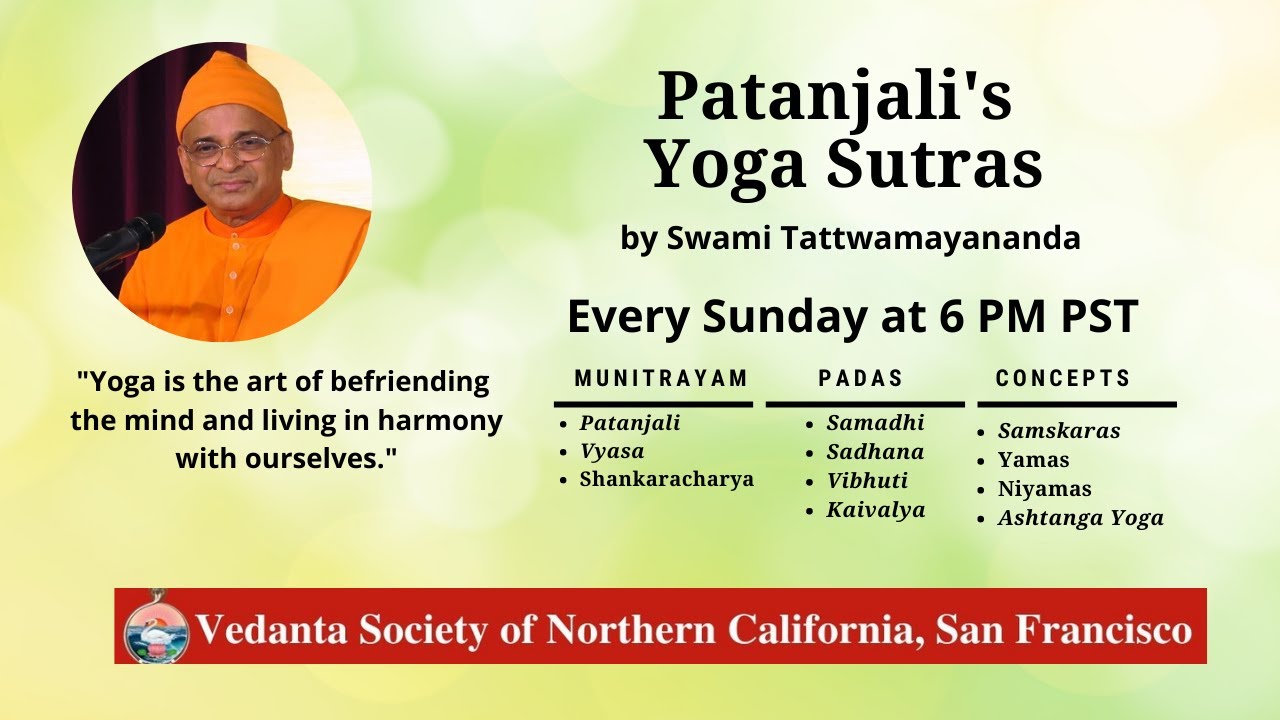
[Music] so we will continue our discussion uh there are one or two verses that we normally chant at the beginning of any class on yoga sutra the first one is as i mentioned earlier is a tribute you may hear me chanting every day so it's better to every session so the main statement here is me i go down to the great sage patanjali who is the author of yoga sutras now the verse tells us something about what he did his contribution to different areas of knowledge he removed impurities of mind speech and body that's the
essence of this particular verse that is malam means impurity so by writing this yoga sutras he presented before as a mechanism a set of spiritual practices that will help us to remove the impurities of the mind that's what we discussed last time you know yoga chitta so this is the malam the impurity of mind pratish as i mentioned earlier emotions and feelings attitudes different different conflicting thought currents that emerge in our mind that frequently stand in the way of our spiritual life that creates conflicts that causes procrastinations postponing duties and obligations makes us makes it
impossible for us to face challenges ahead of us so these mental attitudes are the result of previous actions thoughts words and ideas that may emerge in the mind so they constitute the malam the impurity what is to be removed from the mind so yoga helps us to do that so it's an excellent it's a very wonderful set of practices that help us to retain our mental balance mental health is a science of mental health then vajam malam means the impurity of speech patanjali wrote the most magnificent domestic voluminous interpretative work on sanskrit language sense of
grammar syntax pronunciation that is phonetics raw study in fact it's called the mahabharatiyam we mean the great commentary that's literal translation the great commentary on on the original work that is the bible of censor grammars called panini sutras so that is the second contribution that patanjali made i mean to purify speech how to use language properly in such a way that it doesn't create any agitation in our mind or in the minds of the listeners so language and speech have a unique spiritual dimension it is not just a vehicle not an instrument for communication or
for just stating an idea it has got a higher purpose a higher dimension if if you are tell a word properly if you use language properly it brings in a kind of inner refinement in tranquility and peace and also to the listener so patanjali in fact created the most elaborate scientific work on sensor grammar in fact if you of course this is not within the scope of our discussion in fact the world that they mean the volumes of science grammatically treated is so huge and it it's just it is the scope of an entire lifetime
to study science grammar especially patanjali's mahabharashi it is considered to be a unique work of if you should be willing to spend your whole lifetime right from at least sixth or seventh year till maybe you die when you're 100 years it is practically there are in india there used to be no there are quite not too many but still there are those who dedicate the entire life just for its own sake so that's a second contribution he made you know again mala means impurity so the impurities of mind and something else he also wrote a
commentary on susrudas which is an important work in the indian school of medicine ayurveda so he devised plan a scheme he elaborate he elaborately devised a scientific plan to purify mind body and speech so this is one verse the second verse is a tribute to the the triple uh the trial of yoga tradition viverna so i go down to this holy trial this holy trial constituted three sages three said three great philosophers uh who uh who are the celebrated authorities and writers uh who are the great acharyas what do you call the great ancient masters
of yoga tradition first one is patanjali himself who wrote sutram padhanjali yoga sutras which he did of course to purified mind that is financially apart from his contribution to grammar and ayurveda he also wrote the sutras sutras has not the most significant work of patanjali some of you who may be studying yoga sutra yoga studios you may think that patanjali's greatest work is yoga sutra actually you'll be somewhat disappointed that is his most insignificant work that doesn't show the insignificance of that work that only shows the greatness of other works because his commentary on sudha
sutras and mahabharata which is supposed to be the greatest of his contributions the next great figure that comes in the tradition is vyasa today if you are discussing yoga sutras today we are if you are discussing yoga psychology yoga philosophy we are indebted to vyasa who wrote the first and the most elaborate commentary on yoga sutras so when we speak about yoga sutras as we did last time last time we discussed you know the modern big the five states of human mind we discussed in fact these ideas do not come from patanjali they were interpreted
properly by vyasa in his commentary it is vyasa who actually elaborated the psychological the philosophical the practical aspects of yoga sutra literature the third figure that comes in the succession of the holy trio in the path angela system is shankaracharya himself the greatest of indian philosophers the greatest of indian saints and philosophers and he wrote a vivar viva means actually it is a subcommentary on vyasa's commentary on yoga sutras so sutra in the context of yoga system vyasa vyasa's commentary and vivarna is a subcommentary uh of padhanjara system following the footsteps of vyasa's commentary so
this is this is what we have to keep in mind these two verses we will chant every time when we discuss the subject so i discuss this second sutra which is which is maybe the most important sutra in the in so i won't repeat again what i said earlier uh there are four chapters that this is the chronology the order of chapters in any printed work that you buy from any bookstore now in actual spiritual practice uh it should be slightly different the first is sadhana pada because it deals with practices the second should be
bhuti pada because it deals with the results the powers the consequences the effects of these practices the third is concentration samadhi that is the third stage and of course the fourth chapter is always the same the chapter that deals with emancipation or spiritual enlightenment but we will discuss uh in slightly differently because the first 14 sutras of samadhi deals with some of the important uh introductory ideas to yoga system for example this is a definition this is a definition of yoga what is got two meaning one is transcending secondly cessation how do we transcend first
we try to restrain control uh the negativity which it is constituted by ideas emotions and feelings that frequently stand in our way of our spiritual life not only spiritual life and that is something very important pathanjali system strictly speaking is not a spiritual classic don't be shocked when i make this statement because patanjali himself was not talking about god realization he's not speaking about realizing brahman akman or anything patanjali system is philosophically ali to sankhya system which is at best an agnostic system some people who call it even atheistic so it is very secular that
is an important point people should remember of many of the mantras that you may occur in yoga studios or elsewhere do not know about you but they're all very important because the those mantras contain very great ideas no doubt but patanjali system patanjali sutra doesn't ask you to go to temple or church or a synagogue or any place of worship and pray to some god sitting somewhere asking for prayers asking for solving your problems not at all it actually helps you to solve your problem yourself try to analyze your mind your thoughts your feelings your
ideas and you find that it is so secure it is it is not anti-spiritual what i mean to say it is not the religious in the conventional sense because religion has got a very bad name frequently that's religion is not responsible when we talk about religion we talk about a god some kind of a hulk huge muscular man with a big stick on his hands totally uncompromising absolutely not willing to listen to your your appeal you know he just do's and don'ts and he threatens you if you just don't listen to him and he um
he will promise paradise or what be still worse if you obey him now this sort of thing you don't find in patanjali's system that is something very interesting so yogasanas teach you to stand on your head but patanjali helps you to stand on your feet spiritually i mean it helps you to understand yourself to analyze your mind so this is the essence of yoga once we reach the niruta state and i mean use this fifth state of um fifth a the the most exalted state of mental condition that is nirdha state we have to remember
what i stated earlier to fully remember understand this in the introduction last session i mentioned the five states of human mind chipta state and muda state ship the state you you you are restless but you are somewhat dumb inactive and mood has stayed in muda state dumbness is more manifest in kripta state restlessness is more manifest but both are states of some kind of abnormality say murder state you are totally dumb but restless in kripta state you are restless and totally unstable in your mental condition the third stage is big shift state where you suddenly
get a lot of peace of mind again vyasas analysis a lot of peace of mind when you listen to yoga sutra lectures maybe when you pray when you meditate when you read a wonderful book when you do something in a very satisfactory manner you feel a great joy any kind of inner tranquility at peace but after some time this is gone again of course you may re regain and re-experience the same tranquility when you come to bed under society or you may be sitting at church or a synagogue or any place of worship for the
matter you feel the same joy but again you get back to your home when you are in the factory when you are in the workplace when you are facing the daily challenges and obligations again mind forgets the spiritual values that you enjoyed in the talk and again mind goes back to previous state so it's like a pendulum as i mentioned it moves from one end of the slope to the other end they called vikkshiptam state big ship the fourth state is when mine gets concentrated it is no more wave it is no more wavering it
is no more shaking it is steady and stable there is concentration there is a focus of all virtues in one direction and when you have you when you are concentrated on something completely you feel a great relaxation that's because you are not aware of any conflicting thought currents because there is one-sidedness that is the sharp end of a of an instrument is called is a grammys and sharp end of maybe of of a sphere aegon is one so it's not blunt it is sharp one-sided one pointed that is agagra state the fifth state is what
is indicated here near the third state in the state you are not not you not not not only you are not troubled by your burdees but you are in such a state of mind tranquility that varies can no longer trouble you disturb you they are in the neruda state it means you have they are ceased to exist but you have transcended uh the state of being disturbed by prutis so in the coming sutras you find it's like it's like seeds which are burnt or cooked now if you have got seeds and if the soil is
fertile you plant a seed it becomes a a plant a tree but suppose you you fry the seed or you cook the seed and then you put in the soil it doesn't become a plant it doesn't become a tree because it's ability to evolve further or to manifest again uh as cease to exist so all the virtues and vasanas and some scars in our mind become uh become like cooked or burnt seeds it's called patanjali uses the term that means fully burnt a seed that is fully burned so that is called yoghurt so the purpose
of yoga is to reach that state of cessation of vasanas and some which are disturbing you now when i use the word all waves all over this cease to exist we should remember when when we when we do a practice well um can be broadly called a spiritual practice because spirituality in the higher sense it goes beyond uh the idea of a god the idea of a religion so in that broader sense patanjali yoga sutra literature can be called spiritual literature in a very broad sense so when you talk about going beyond uh beyond the
fifties uh we are actually implying we are going beyond or disturbing or all negativity now what are the negativities which comes next so that third sutra will help you to understand the i mean the more elaborate implications of the second sutra tada mean then when you reach a point experience the person all of us in a way called testas not in the vedantic sense the word drastica has an entirely different meaning in vedanta philosophy and without philosophy please don't associate the two here all of us just to survive means our true nature what is our
true nature our true nature is that we are not disturbed actually these impurities of the mind that uh pada delhi talks about in yoga malam means patanjali wrote yoga sutras to remove impurities these impurities are not a natural uh natural aspect of our mind they are foreign bodies they are like alien so and in the case of a disturbed mind that disturbing aspect is something alien that that's something foreign in fact healthy mindedness is a natural state anything that makes it unhealthy is ailing is pouring just as you know when we get something alien something
that is not that is something foreign to our body's nature then we fall sick when something disturbs our mind we become anxious we become worried we become unnecessarily without any reason we become anxious that worry that cause of worry is not our true nature it is alien to our true nature and you should be understood we are actually getting back to our own true nature that is samskaras etc then what happens you know we actually come back to our own spiritual home we actually re regain our true mental condition that is the implication here now
in this context when does it happen when will this go away now how do prathis emerge the mind well if you spend just 10 minutes watching the internet the tv listener the the visual image which is becomes an audio which is an audio aspect also you hear something and you see something and our mind identifies with what we see and here and actually we are we are creating an entirely different alien world in our mind when we watch something which catches our eye which infatuates our mind and when our mind is trapped when our mind
is caught by the influence of what we see and then you find after some time what we saw what we heard and what we felt what we thought when we saw those images on the computer screen will come back to your mind the computer you have closed this could happen uh even after several years whatever we consciously experience at the audiovisual level and also at the level of other senses of perception like the sense of touch sense or smell sense of taste all these will create everything and when gurus are created they come back to
us that's why when you read a very when you just watch a thriller and go to meditate next after immediately what will happen you know you feel a great pull to come out of the meditation room you you feel a great force is dragging you away from the seat on which you're sitting there so many thoughts conflicting thoughts can come now this need not be an experience that we have heard recently patanjali system tells you and that is very important to remember certain memories certain impressions certain experiences that emerge in our mental world may be
coming from previous life cycles so apparently system buddhi like buddhism that mainstream hinduism they all believe in the principle of reincarnation what we call rebirth and the law of karma so when you get when a memory everything comes to your mind emerges in the mind it is very concrete when you see it it should be coming from the present life but when the same birthday takes the form of an abstract idea then without form then it's coming from previous life so this is of course this is this is the this is a principle that buddhism
also has articulated elaborately different buddhists and all that you know began about this well not these textbooks you find so uh impressions and feelings and pratis that emerge the mind that that do not have any physical aspect about it they are coming from previous life cycles when they have visible form and concrete visible a gross dimension then they are coming from this life if you have if you have had an experience when you are when you are children you may regain that experience when they come back to your mind along along with that impression the
visual form and what you heard maybe 40 years back you may hear again not with the external ears but at the mental level mentally we can hear and that's a very important thing to remember when you listen to a music in the morning and you didn't write down in the evening you recite it when you recite again you are hearing again what the musician music teacher taught you in the morning when you hear it again again when you explain a sight a visual experience that had that you had in the morning you're actually living again
through that experience in the evening and this could happen even after several years so that is it from this life so virtues is a very important subject in vedanta virtues become samskaras so many virtues they together become a tendency and samskaras become vasanas is an aptitude a child a child may have a tendency in drawing for singing one explanation could be that his father or mother is a music teacher then it is obvious but suppose a child in a family which had absolutely no musical um musical tradition and didn't live in the neighborhood of musicians
and never listened to any music it could happen a child becomes a prodigy in music some kind of obsession of social interest that means the child is bringing with that with her with him or with her uh certain some previous life cycles it is again a manifestation of vasanas this is an important term to understand to enter the world of patanjali yoga sutras for this constitute the effect of the effect that is retained a mental mental system even after the experience is over samskara is a tendency vasana it becomes an aptitude sangalpa means thought currents
again following the same samskaras and single pass and you read you repeat that action again see again so when you repeated action more with these identical things are created so it becomes a a circle now of course here uh potentially as as has he has analyzed uh the way this creates problems in our mind so he talks he talks about uh nine um obstacles which i mentioned the last time but so i won't repeat again antarayas called so uh these can create stumbling blocks in the mental world when we are able to stop this virtues
when we are able to restrain this with ease when we are able to transcend this with these then what happens you know then we come back to our true nature our surupa so that is the beginning of the third sutra we should remember that very well okay now the fourth sutra tells us now uh suppose you don't try to understand this and you don't try to practice you don't try to do the yoga practice to restrain this for this what happens you know you identify yourself with everything you see you hear you touch you smell
and you taste all the five senses of the mind will dragged sorry all the five senses of a personality will drag the mind towards their respective sense objects all the time that there is a interesting analogy in the in in the uh well-known work called shankaracharya so it says how we identify ourselves with every sense object and every sense experience and how it creates problems so this is you know it is relatively and indirectly work on with and says he gives the example how mind is tracked how the mind is dragged by since objects and
how we lose our true identity and he gives the example of five members from the animal world animal kingdom kuranga madang padang kamina so firstly example the deer the deers in ancient days they used to hide in now also of course they hide in bushes so maybe in the caves and the hunter will play some kind of a primitive musical instrument and here in this music the deer will come out and it will be shot by an arrow an archer will kill that deer and so what happens you know the sense of hearing becomes the
trap for the deer now in the case of elephant elephants they move in groups in hertz and they touch each other from youtube protection and so they are not very careful about the part they are walking and then they may fall in a pit and they're trapped they're enslaved they may be killed so their sense of touch because they touch each other because the death trap for the elephant now padang padagam is some tiny insects that amends may be in this may be more true in the tropical countries you know so you start blazing fire
to kill to attract this insects and so that they will die so seeing this blazing fire the the sense of sight draws these molds towards the blazing fire and they are killed and burnt then mean i mean fish sense of taste they eat the bait and then kill and then eat and of course then uh bring some sort of tiny insects or creatures that move about in the flower garden enjoying the smell of flowers and they are again caught and killed by other animals or creatures so sense of sight sense of hearing sense of taste
sense of smell sense of touch all the five senses of perception become dead traps then shangradhara exclaims in the case of human beings you know what happens every moment we are trapped our mind is trapped by the five senses in the case of animals they are primitive by nature so only one sense is prominent that's enough to lead them to their death but in the case of human beings these millions of these birthdays are getting stirred up in the mental world mental system so in the in the definition great commendators like uh others they insist
that chittam doesn't mean mind alone it means the memory system it means the sense of identity it also means our speculative faculty all these are implied in the word chittam so the mental world as a whole is implied by the word chittam so millions of this virtis are getting stored now we cannot uh take one after another we cannot do that it's just like a lake it's like a lake the different layers of dust dirt field and so on there is a pure water on the surface of the lake if you want to clean up
the lake you have to take a big poll and then you have to stare and remove the death but in that process a lot of terrible things dust and dirt and filth and bacteria will emerge and you have to remove them from the lake that's why when we sit for meditation immediately the mind gets disturbed when you're watching the tv when you're watching calm a comic program a comedy there's no problem you're watching football or you're watching sports mind is very peaceful the moment you try to meditate immediately mind rewards because meditation is an attempt
in fact to purify the lake they are taking a big fall and immediately mind feels this agitation so pathetic device has devised a very interesting very psychologically very perfect very scientific plan to clean up our mind not one after another in fact something very interesting i can give one example i mean the scientific the rational approach of patanjali that that we can see for example he says suppose a person is obsessive you know obsessive psychosis is obsessed with the idea of making money and he he may have trillions of dollars still uh he wants to
make more money you heard of the story a poor man got a pressure so he was walking near the tree and there was a ghost living on the tree and he the poor innocent man you know he just sat under the tree and prayed who may be here let him listen i want a lot of money so the ghost living on that tree came down and he offered to this poor man i shall give you a few few just full of gold coins 10 15 20 you know this is the stories coming in so many
different versions so i shall give you so many chests full of gold coins seven or ten or maybe you take home and he was very happy and immediately he found in front of him so many chest full of gold coins one chest was almost full so if you can somehow put a few more gold coins it will be complete so nine chests were full the tenth one would be full if you can somehow collect 10 more coins and didn't be full so this man took the whole treasure to his home from that time onwards he
directed all his efforts and energies to make enough gold coins to fill that chest this man was employed by the king in the court so the king was watching he would have been happy to give him a pay a pay rise you know but what happened you know the king did not know that this fellow was trapped by the ghost so slowly he became very weak because he was starving he was saving money by starving but denying food to his own children he neglected his own health care because he wanted to collect five more coins
so that the tenth chest will be full and eventually she became so poor that either he he began starving and he began begging in the streets how the story goes so what happens is kind of obsession now patanjali makes an interesting point pradeep akshay bhavana means when you are caught and trapped by any such obsessive feeling which frequently happens you know when you think about the dangers of greed how uh how tragic was the fate of many people who who were greedy who spend their whole life time to collect money and wealth what a tragedy
if you go on thinking of this you know then the virtues that force you to go after money and wealth the greed will be reduced so every obsessive every virti has a counter with you can neutralize the negative effect of every negativity i am just giving one example and of course he gives a lot of examples of bias and by iraqi sense of renunciation and repeated practice of certain disciplines that you discuss in the coming sessions if you don't try to restrain the protease then what happens you know every passing object every passing experience will
become a trap will become a will become will ensnare us so that's why either yoga as mean kali bhojana means a very interesting kind of justice quoting one you know bhoja bhoja wrote the film book means otherwise if you don't practice yoga if you don't try to practice your teeth what happens you know what happens you become totally identified with every single every passing idea every minute every passing idea every experience contains in it this trap once we understand this what happens you know we are able to avoid that trap in the yoga system the
question arises what's the use of learning yoga sutras if a person really listens to yoga sutra lectures and understands and asks it properly i can assure you whenever whenever there is some kind of an anxiety problem a problem of anxiety irrational anxiety worrier complained sometimes you know people feel everything is coming to dead end you don't know what to do how to move if you remember many of these ideas in yoga sutras that you will understand this is the nature of human mind once you understand that this is the nature of human mind then you
won't be frightened by this i agree the example of driving and traffic problem when you drive and when you know 10 miles ahead there's a traffic delay then and when you reach that point then you are not shocked oh we will handle that so once we understand this is how mind works this is how gurus operates then this virtues this agitating protease and samskaras will have will be in a lesser problem won't be able to disturb our mind we know this is the nature of human mind of course now we will have interactions you are
most welcome to ask questions um will be very helpful for understanding some of the practical implications of many of these ideas yes so i have a question regarding dream experiences as they relate to british right in in some other classes you have mentioned that you cannot have a dream that is untied to a real experience right which is manifesting in some way so so in a way we could say that dreams also tell us a little bit about our real personality but we have both desirable and undesirable dreams yeah so what is your advice on
how we should approach our dream experiences yeah you know we prepare the ground for our dreams dreams are nothing but re-expressions we are reliving reliving re-experiencing what we are experiencing waking state not actually but differently more subtle mental level so uh to feel i mentioned this earlier to feed our mind with more and more positivities that's one way to have i mean to avoid unpleasant dreams this better way to put it so how do we generate with these that's what for the jelly system insists on that is the value of learning patanjali system [Music] you
see he i did i gave this example my three karuna mudita ube you know this is a sutra that begins like this you know uh punya putnam you know uh so you can have peace of chitta mind for mental tranquility we should exercise certain disciplines now uh he gives the example of everybody's everyday life you meet or you experience different types of persons and events in our everyday life some people are extremely good some people are also good but they are not able to help us in some ways and some events are very promising very
desirable some experiences some events that we witness may not be very helpful so you find a variety of events in persons and situations every person encounters in everyday life now there paganjali says my tree so there are people who are more or less like you interested in spiritual life interested in the spiritual disciplines which potentially talks about you know so you should try to associate with those persons when you associate with people who are spiritual seekers like us it's not that i'm a spiritual seeker no you should not be juicy or exclusive no that's not
what is meant by that it is simple common sense it's simple common sense i don't mean to say you should you should be hierarchical or you should you you you should you should uh categorize people you should be judgmental not at all that's not what i'm talking about a simple common sense that we all want to practice so that we will be able to live a peaceful life and others also will be able to do a peaceful life that's what the implication so uh try to associate with people whose association will help you in your
spiritual life so this is my three karuna means sympathy means friendship so patanjali's language is very brief so by three karuna this is how he puts the language karuna means sympathy suppose there are people in your office or many place they they asking questions you good within the society you go to any holy spirit or place and do you know any of these things and that person may not have had any any access any idea of any of these ideas that you have already experienced so you should not look down upon him you should have
a very sympathetic friendly attitude towards you that is called you know karuna mudidha he means suddenly you may come across somebody who is much more advanced you should be happy if we can be happy when we find people who are ahead of us if you can appreciate qualities in others that we don't have ourselves then those qualities will not naturally develop in our mind what we admire in others those qualities you find slowly we will develop that's fine you know small children uh in their homes you know children who are interested in soccer or football
any they will get some pictures or photos of the heroes of that particular game they will have on the table now that they may they may be aspiring to become a sportsman themselves so what we admire in others that we become if we can admire great and good qualities in other people we should be happy that's a literal meaning means we should be happy we should have we should be happy we should appreciate and we should not have any negative feeling or jealousy or envy when we find people who are superior to us who are
in every way more qualified not that we should we we should be submissive or anything but we're naturally broad-minded appreciation of goodness good qualities in other people you know there are people whose association could actually cast doubts in your mind can shake your own convictions can make you skeptical cynical that's a very dangerous thing actually there are many people whose association can pour cold water on your own mind already you may be interested in some spiritual ideas you may be practicing something you may have developed great interest in certain things suppose you associate with certain
people uh you should not hate them but you should keep mentally you should keep some distance it's called filtering mechanism you every day you can live with them but in your mind you should say well i i'm okay but i have a different idea so that helps you to devote to evolve to develop a filtering mechanism so that you will be affected by by wrong association with people who can have a disturbing influence on you now in fact patanjali has exhausted all possible categories of people associations and events in this suit it's very interesting those
who are like us and those who are not as advanced as me as us and those are more advanced and those who are neither advanced nor not advanced you can say but if you talk to them for some time you start thinking well after all why should i worry about this yoga supra veda and spirituality why should i suddenly if you are a beginner you are more likely to be impacted influenced by negative ideas so you should not fight enquire with them at the same time you should not be very friendly with them so keep
a distance not physically maybe sometimes you know every day we may have to deal with such people you can't fight with them and you can't keep away from them physically of course but mentally you should have a defensive mechanism in your mind now this is this is they see how rational it is this is very interesting uh that is the system is so scientific and so rational and so psychological the intent yeah i should completely complete the concept of samskaras is a unique contribution of patanjali's system to the world modern psychology doesn't have anything uh
comparable to the concept of some stars as expounded by vyasa in his commentary this is very unique explanation if you correctly understand you find you know it could be a very sound logical explanation for obsessive psychosis and for multiple personalities problems and also certain problems like you know these these delusions of grant here or can be it can be explained in the light of these vyasas concept of samskaras yeah swamiji this is all very rational something somebody can you hear me yeah yeah so it's already rational and logical but sometimes with logic and they're saying
we still um don't go ahead then we feel at that time of prayer of prayer to what whatever you wish that still gives us a lot of shoulders but you know totally discounting god no no no no remember uh i'm i'm happy that you you just you took up this subject i'm happy so i i get it i get an opportunity to clarify the points you know if you study as tango yoga yamaniyama etc you know god is not denied what i wanted to say emphasized was uh frequently people do have a wrong feeling that
patanjali system is some kind of a religious thing it is religious it is part of hindu heritage hindu tradition no doubt about it but what i mean to say in many ways it is so secular because patanjali himself foreign system itself is not is totally different from any devotional philosophy at the same time prior meditation resignation to god that is also one way to experience chitta prasada vented purity if you can you know property is come then i will try to explain that sutra deals with bhakti yoga karma yoga and tiana yoga these three yogas
are employed in the is totally different from whatever you hear kriya yoga is is a is a is a important is a stepping stone to spiritual life for any person who believes in god in any religious tradition kriya yoga is the adored entrance into spiritual life and that's the first sutra of the sadhana we will discuss the subject so prayer meditation prapati saranac characteristics of true surrender to god that idea also comes in the in the exposition of uh kriya yoga and also in the sutra is assigning everything to god that's the meaning we'll come
to that thank you for raising me thank you okay there's a question from uh youtube yeah um so this is from subhash javarani says how are ganesha and vaisha connected to our samskaras okay it comes into south nepal we'll take up that the subject is coming but anyway i mentioned you know are examples of places raga and dwish are examples of places so the sutra is pleasure this is sutra in this afternoon now uh raga there are two opposites two sides of the same coin uh extreme obsessive attraction for something is raga and equally obsessive
hatred or aversion to something is division at the empirical level just like you know a coin we cannot exist only with only one side so every expression of raga has his opposite division at the at the empirical level so these are again the results of prutis more or less modern psych psychiatry and psychology agree with this point you know some inexplicable or imaginary feeling of hatred towards somebody do or something to have some kind of an experience which observes you which a person may be aware of this is totally ridiculous still wants to get out
of it but cannot get out of it that is actually dues and then raga it has two aspects one is infatuation the other one is addiction both are implied in the raga infatuation means you people who have a special liking for certain food certain things like that and then they have a liking but they know it's not so good they want to get out of it still they cannot get out of it there is a element of helplessness in it it is also one aspect of gaga both these are explained in the coming sutras you
find when we take up the sutra we will discuss the subject swamiji my name is aarti just i have some thoughts are crossing my mind so we have learnt like four sutras right so i was like how do i apply or like you know kind of practice this uh is there like uh how and i'm just thinking how to apply every day or you know as we progress um yeah any any ideas yeah as as we proceed further you know there are 195 sutras and some sutras are very very elaborate will take several days to
explain these are relatively simple because these are all definitions more or less these are definitions first fourteen sotras more or less are symbols in fact we will come back to them again when we take off samadhi by the proper after fourteen sutras of samadhi we'll be actually beginning with southern that's a natural way but anyway i should mention so once you understand the the mystery of human mind especially then you'll be able to able to explain some of your own thought currents so some of the disturbing thought currents become less disturbing once you understand the
psychological rational explanation behind it that is one advantage understanding human mind the yoga way is a great help for remaining mentally healthy all the time you you if you develop a second personality see the one personality the what you are right now then another personality emerges well equipped with these new ideas so you'll be able to analyze your own mind and when anger hatred likes and dislikes or anxieties and worries when these emerge in our mind if we know some of the yoga sutra teachings you'll be able to get we'll be able to look at
them analyze them understand them and react to them and escape the negative impact of any of this that's an advantage of yoga so as we proceed further you will get a clear picture of how to apply this you know mental life thank you thank you swamiji this is mark um i have a question from our last session yeah um you were talking about or you gave an example of uh the witness or being a witness and you said that an actor in a play cannot witness his own performance but the audience can and i wrote
to you about this and you said you were describing the degree of attachment attained [Music] after realizing the state mentioned in the third sutra of the samadhi yeah so um could you elaborate on what exactly the connection is between the the the witness and that uh that sutra yeah yeah you know uh the word the sanskrit word for witness will be defined by a great vedanta see you you are aware of it but you are not involved in it so just like drama you know you are you are witnessing the drama on the stage so
you are aware of what is going on the stage but you are not an actor you are not involved in it now like that if we can observe our own mind when he becomes angry anxious worried then you find the anger the worry the anxiety will go down that's called you're objectifying you are objectifying your own emotions and you so to objectify you have to detach yourself from your emotions but what do you know pathanjali says if you don't practice then you are not able to objectify yourself you identify with it you and anger become
one you and anxiety become one you and worry become one that's what happens either otherwise if you don't study if you don't apply the yoga sutra method will be able to remain ourself at the state of weakness and our own real nature so you are able to detach yourself from your ankle then anger becomes less less disturbing you can happen see in ordinary life sometimes we come across people who are very mature very mature not necessarily educated people education frequently makes people less mature unfortunately the kind of education unfortunately that'd be fine today because lot
of pressure lot of anxiety a lot of drugs also because to reduce the pressure so it creates lot of problem i'm not going to those details what happened you know a different kind of maturity when you become really adult in your attitude behavior pattern sector when you find certain people oh you're anxious don't worry it will come away you find people talking like that this common sense wisdom sometimes you find people who are not necessarily with phds or anything but people with cause better common sense a more major outlook towards life a more uh developed
attitude towards world and life as a whole if you talk to them i have this problem that problem you may say oh it is part of life it's okay fine actually they are applying the same mechanism partly because they are trying to objectify they are detached they are asking you to detach yourself is part of life means again you are de-identifying instead of identifying you are de-identifying you are detaching yourself from your anger and you find it's gone down this happens a child who a little child who cries coming from the field and is a
he he is beaten by his another child you know and the mother consults oh this mario your children this natural for your children your planes happen the child you know he's happy now he's his worry is gone fear is gone so like that you find a maturity this kind of pure common sense what i'm talking about in fact that's what happens when you study yoga sutra the pure raw common sense that we all have but frequently in the education modern education modern ways of life suppress our natural instinctive common sense which we are born with
so yoga sutra helps you to bring it out [Music] i think the analysis is like that of a psychiatrist the whole world you are you're also a doctor you're you're also a doctor very happy to have a doctor in the audience that's fine you can make your contribution in the course of this like swamiji basically to summarize what you said so if you are angry you kind of step back why am i angry you know there is no need and like that you just step back and think about it and then the angle goes away
is that what kind of you're suggesting right yeah it happens in our everyday life you know if you take a pill a medicine for the anger then along with that your ability to become angry is gone so a damage is done to your mental system but when somebody tells you there's no point in getting angry for every little things is part of life this happens to everyone there your mind is not damaged that's so so anyway it's a very unique system uh patanjali system is so unique and so the you know that's why i mentioned
to you uh it is not necessarily what you call a religious text it is part of hindu spiritual heritage no doubt it is one of the uh not the theistic systems of philosophy but it has got such a wider higher appeal and much greater possibilities than um just a book on devotion i don't mean to say devotion is less or if we don't imply that but i mean people sometimes uh a bit reluctant to take seriously anything that you call a religious text that is that is the problem of our times not the problem of
religion as before you know okay right side yeah yes there's one more question from youtube yeah from meena yes so you can overcome fears by practicing yoga does it work through more relaxation of mind and understanding the nature of fear and reasoning yes we will come to the the yema niyama [Music] we'll discuss the subject again so if a person practices learners or nervous then naturally it's a stage by stage step-by-step practice of disciplines again what happens you know we all may become angry but we will be able to become aware of the fact that
we are becoming angry when we when we become angry and also when we are aware of the fact that we are becoming angry then our anger will not be so it will not be so disturbing we we become worried but we also become aware of the fact we are becoming worried and that that that also implies that there's no point in getting worried that common sense comes then worry become less so this applies to worries problems fears and all that when we discuss this and the image dealing with ashtanga yoga these things will come so
we shall conclude thank you for the questions because your questions helped me to explain more of what i have just touched just briefly discuss lately thank you um foreign [Music]