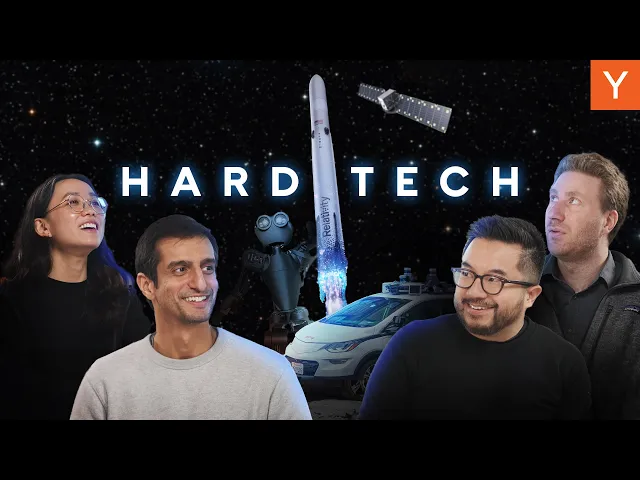
you actually can make some significant progress with like half a million dollars in 3 months the best hardtech Founders do have very high Clarity of vision around the future for hardtech companies you have all this tactical risk you don't know if you're going to be able to mine asteroids but you have no Market risk right like if you can if you can mine asteroids it's going to be freaking huge I think this is a call to action for a lot of the very hardcore Engineers that this is your chance to build something huge and and
to really change the world literally so this is the kind of energy we need in society solving some of the biggest problems that face [Music] Humanity welcome back to another episode of the light cone you probably know why combinator for a lot of our software Investments like stripe Airbnb or coinbase but it turns out YC has a lot of wins not just in the electrons world where you're slinging bits around some of our best companies have actually been incredible at slinging atoms so I'm curious what's some of the advice you give to the hardtech companies
in a YC batch like in particular how is it different the Milestones they need to hit during the three months and what metrics they might present on demoday well one of the obvious things is they won't be able to build a rocket let's say in time so they won't have actual Revenue so one of the things we tell them is they still have to show some form of commercial attraction it won't be necessarily actually selling and getting Revenue in the bank but it's a different kind of form I think we talked a lot about demonstrating
that the customers that ultimately they will sell to want this and typically a form of a Loi that is actually significant with actual values with actually legit logos I've definitely found Loi like letters of intent at something where everybody knows they're obviously not the same as actually signing up a customer but for the software companies if a software a company says oh we got a customer on an Loi for a $1,000 Mr contract like that's not going to be impressive but if you can get an Loi for like a $100 million contract that is actually
quite impressive the way that people tend to get this wrong out there in the world is they they're building some hearttech thing and they're they're like oh well I need like $20 million to build my thing and then they look at YC and they're like well YC invests half a million dollar well that's not enough like I can't do YC like how would this make sense at all and one of the interesting things that I've learned from working here is that actually YC works extremely well for hearttech companies and that for every hearttech company no
matter how crazy the thing you're working on whether it's a supersonic jet or inventing fusion power there's always like some small part that you can peel off that is like the very initial state age that you actually can make some significant progress with like half a million dollars in 3 months like always yeah my experience and I feel this is familiar with hardtech companies is that they start YC and they always come in with this the essential pitch is we need to raise like there's no way we can make this company work unless we raise
like $50 million and so like hard can you tell me how to raise $50 million this week introduce me to to some VCS who are going to give me my $50 million I like to Ling is always no that's your first office hour the first off show me the money yes basically it's like no like you're not going to be able to raise like $50 million off the bat you are going to have to think like a software company actually like how can we like do this cheaply quickly and show something on demo day and
I just find it's always actually at the start it's a bit of a like fight honestly to get them to think that way and then in the second half of the batch is when they finally get some Insight cuz we've just been like pounding on them to think fast cheap less money like and then they something clicks and then they actually have like a plan for the second half the batch and the remarkable thing I found is actually how well it works that once they make that mental switch and they realize that they can do
something in three months then they go do that and then they have it's not just an idea anymore they've got something real and they can go to investors who maybe didn't want to fund them before YC and now all of a sudden like people just want to put money into this thing because they've actually like it's actually like going someplace the weird inversion for hearttech I think is uh it's not about why the why is often there's a problem and it's sort of obvious and then the why now even is often kind of obvious where
there's some cost curve there's some bomb costs that changed the build of materials got cheaper there's some breakthrough and so the actual question is not why now or why it's actually why you and I think that that's that links up to what you're saying which is if you can show that it's you and it might be Lois um in hard tech and especially the people who might spend a lot of money on atoms they tend to be um a little bit more uh diligent about only signing Lois with people who are for real but as
much as the LOI I think the other piece is um they actually need to build a plan and demonstrate the cost actually makes sense and have that whole financial viability aspect of it and I think the other thing is actually besides Loi is proving that they can actually make it because a lot of things like the why to answer the Yu can you show me a kernel of truth of the idea that you actually can build so besides Loi the second thing is um a technical Milestone and of course you can't build the whole the
whole plane let's say yeah rocket or build the giant um decarbonization container thing but maybe do it on a small scale maybe if you were aiming to capture at some point I don't know 700 metric tons of carbon maybe just do it like one or 100 seven grams yeah or seven grams right demonstrate that you can actually do and know the science and can actually build it yeah I have a trick for helping the hardtech founders present this to investors that I stole from one of our software companies so um let's start with the software
company it was brex so bre's demo Day presentation was uh a lot about showing how they were able to move really quickly on like getting a banking deal and sort of the regulatory aspects of starting like a fintech back then right and as I remember it their presentation had like a timeline of here's how long it takes like the um a regular company to like get the banking deal and go live with like a real credit card um which charge card um and then they were like and we did it in like 3 months whereas
like the actual time was like 12 months so I tell hardtech Founders to think about it as like what's like the timeline to build your product for like a regular company like maybe it's 12 months and with cost as well like would it cost like a regular hardware company 50 million bucks and 12 months to get to like this proof of concept stage and prove that you were able to do it in like 3 months for 500k and like that visual I find is always like effective for answering the Yu question actually oh okay there
must be something special about this founder if they're able to do this like with less money and much faster the cool thing is that if people can build that habit during YC it doesn't just help them raise money during demo day but it actually creates a habit that then changes the operating Cadence that they work at forever and a lot of their best hardtech companies they still have that way of operating which is they're constantly pushing do things faster and cheaper than anyone thinks is possible should we talk about some examples of companies have gone
through YC and done this successfully yeah and I think for each of these the idea is we're going to talk about where they are now and then we're going to talk about what they were able to do during the three months of YC yeah that's cool yeah let's do it so I thought it'd be fun to start with boom boom is a company that we funded in the winter 16 batch and they are building a supersonic jet supersonic passenger jet to replace the Concord because this is a very strange area in which humans have gone
backwards in terms of technological progress like young people watching this might not realize but like regular people used to regularly fly supersonic from New York City to London in like two hours at like mock 2 point something and then we stopped doing that because the Concord was discontinued and Blake the founder of Boom he just thought that this was unacceptable I remember when boom was in the batch they had this crazy idea to build a super Sonic passenger jet which it cost literally billions of dollars to do um and so like the question would be
how could you possibly make any progress on this insane idea with three months and a few hundred, he did two things during the batch he tried to drisk the technology and he tried to drisk the commercial interest and you might think that it's inevitable that there would be commercial interest in this cuz like supersonic Jets of course everybody wants a super sonic jet but the thing is you can't sell a Super Sonic directly to people you have to sell it to Airlines which means this is only viable if an airline actually wants to buy the
thing and there was legitimate question as to whether Airlines which are capital constrainted and risk averse would actually want to take a bet on a crazy new technology like this that' be very expensive and so the way Blake deris it during the batch is he basically spent the batch trying to get an airline to make an early bet on boom and at the very end just a few days before demo day he finally was able to get introduced to Richard Branson from Virgin Airlines and Richard Branson gave him a $100 million Loi to buy the
first boom planes yeah and that was absolutely critical to his ability to raise money because he showed that you know the dep pocketed customers that would ultimately have to place a bet on this were were excited enough to sign an Loi like that so Jared where's boom today so the really crazy thing is 8 years after they went through the YC batch with their like Styrofoam scale model they've literally built a supersonic Jet and it just took its first flight last week and it worked and wow for those of us at YC whove been like
part of the Boom story since the very beginning with like the styr foam scale model and everything seeing them actually build and fly a supersonic jet was just like an unreal like otherworldly experience that they actually pulled it off that's it's so cool so you can just literally think things in your brain yeah and then manifest them in reality Gary do you want to talk about one of YC's first earliest and most successful heart ATT companies this company called Cruz yeah of course so uh Kyle from Cruz of course was one of the early co-founders
at Justin TV which became twitch famously he was the guy who figured out the GPRS and Edge modems uh in a backpack so Justin KH could wear the little camera on his head day Kyle worked on the hardest technical problems of uh twitch which is with a lot of the video streaming and encoding where he made it so efficient and to this day twitch runs their own video servers is what made them profitable too yeah so that was like the key thing that he unlocked and just for a bit of a background he's like this
technical genius basically oh definitely poath it turns out I remember interviewing him for YC uh the interview room was uh Sam Alman myself and Jeff Rolston uh incidentally the subsequent presidents of YC which was kind of funny um and I remember it was a very short interview um he came in and said well I worked on the MIT autonomous car team I really like that and I think that it's possible for us to make a commercial version of this he left the room it was a great interview and we looked at each other and said
well we have to do it cuz it's Kyle but uh it's probably a research project and we our laptops and went to lunch and of course it became the biggest fastest liquid exit of uh almost any y combinator company at the time so how much was it sold for uh almost a billion dollars which was really wild and and just how long after you interviewed him uh I mean it was a matter of few years few years like two years maybe from interview to a billion dollar X pretty amazing was even more than any other
company at YC at that time even the software companies because companies like Dropbox Airbnb hadn't exit until later after the after their acquisition right yeah and I think one of the things that's kind of lost to the sands of time now that you can literally walk down any Street in San Francisco and there are self-driving cars is that this was not something at the time that people thought was even commercially viable it was sort of locked away we knew about uh you know the Google X project for uh self-driving cars that would end up becoming
whmo but it took uh again like someone with an idea in their head deciding you know what I'm going to work on this thing you can actually manifest things that uh frankly are on their path to remaking every city in the world and we're still you know in the early Innings of that at some level do you remember what Kyle had at the start of YC uh he had a a control system for an Audi S4 which was fortuitous cuz I was driving an Audi S4 at the time too and um I think think to
the commercial point we actually this was uh a little bit during the era of the kickstarter campaign so uh that was actually what helped him raise his seed ground was uh getting commercial validation that you know we didn't need to build a full self-driving car on day one we're going to build a highway Adas just assisted driving uh as a retrofit for Audi S4s okay and that was sort of the initial thing that during YC he did um but of course once he got those resources and he ended up raising a series a he could
expand his vision significantly um what did he pitch on demo day like it was actually I believe the uh retrofit kit um for Audi's it actually that was smart because like if you if you had pitched full self-driving it would might have been hard to raise money because like people would have been like well how are you going to get the10 billion that you need to actually make this real and so the fact that he had a shorter term path the commercialization on like a normal amount of venture dollars was actually like a really good
was like a really good way to to bootstrap the like the big long-term ambitious idea and so was the pitch that they'll take these like assisted driving kits and sell them to Audi gets no I think sell them to individual Audi owners yeah so I remember putting down my credit card uh for one of these things I I didn't end up getting one but if you visit the Mountain View Campus of Y combinator there is actually one of the original retrofit cars oh interesting and so I think that that really illustrates exactly uh you know
commercial validation with uh you know basically fantastic why now and then they proved to the world like you know the Yu and two different types of commercial validation interesting like boom was like we're going to convince a huge Airline and it probably seemed quite scary right up until demo day on whether they were going to get anything or not and then Cruz is like we're not going to sell to Ali we're just going to go directly to IND idual who want this which was probably like much more more like a bite-sized chunk approach that's what
it takes to sort of create some basically create a new industry from scratch another way hardtech companies are viable is they're going after a known commercial space but doing it a lot cheaper than the current incumbents and for example launching satellites to space cost like billions of dollars because there's like these giant satellites that take multi years to assemble tell us a bit about um astranis and they they had a technical Innovation as well yeah a lot of people don't realize but YC has actually funded some of the most successful space companies in the world
and one of the first ones we did with this was this company called astris and astonis builds telecommunication satellites and their core Insight was that you could make satellites a lot cheaper if instead of making a few big satellites that did everything you made a lot of small satellites that just did a few things it's kind of like when commodity servers replaced main frames it's basically the same concept as for satellites and they were in the in the winter 16 batch the same batch as boom actually their goal for the batch was to build a
fully functioning satellite that they could put into space in three months which is like to hardest point about like typical timelines like the typical timeline to build even a demo satellite is years and they were like we're going to build it in 3 months and then we're going to launch it into space because by that time SpaceX was offering space flights for small caros and so you could actually book basically a one-way ticket on a SpaceX rocket for like not that much money for like a small cubat and so their demo Day photo you can
actually see the satellite that they built during the three months of YC that's Ryan holding it up they actually launched it after the batch they actually did yeah the cool thing about Astron is that telecommunication satellites are actually a really good business like it's actually like super profitable and so from pretty early on they were able to generate a like real revenue from customers and actually make money putting satellites into space and they now actually have several satellites in space over our heads and um a really cool like chapter of the story is that they
they actually are in like the Astron offic is just across the street from the YC office and it's not just like some headquarters place where like they they like designed the plans for the satellites they actually manufacture the satellites across the street from our office and we can actually see it from our set right here it's right there um and so I love to take the founders in the current batch on a tour of the astrona office across the street and show them that you can go from your demo day cubat to like a satellite
Factory in a few years that's a the cool thing about space is um you know partially because of SpaceX and a lot because of the massive increase in launch capability there's just this ecosystem now uh kind of like astris is a great example of it that now that you can get to space there are all these things that you can actually do in space that are very valuable and there's a really crazy one that you funded Gary when you were at initialized called Astro Forge I I love to hear about that one Astro Forge is
really interesting because they have a pretty scary huge ambition which is literally to be able to fly um a satellite to an asteroid uh some of these asteroids have something like 15,000 times more concentrated precious metals like Platinum than on the earth uh and then they're actually using robotics to um refine The Ore directly on the asteroid uh and then take that asteroid and fly it back and the funniest thing about it is you don't actually have to land it you could just fly the asteroids straight into the desert and then mine out of the
crater and you know potentially mine hundreds of millions of dollars or billions of dollars worth of precious metals so are they going to try to bring the whole asteroid back to Earth or just like a little chunk of the asteroid just the precious metal itself just the precious metal okay they're early in their Voyage but I just really love extremely ambitious people I always talk about especially right now because we're prepping people for demo day um the best pitch is relatively small simple ideas when you put them together and you zoom out like that's actually
a really big story that's totally achievable and so I feel like asttr Forge you know is uh one of those examples as an investor like how do you think about the risk of investing in a company like that there a software company it's sort of you know right can you get customers what's your sales plan going to be but mining precious metals on an asteroid in space and bringing it back safely how do you think about the risk I think some of it is all they have to do in the shorter term is actually fly
to an asteroid and come back um and ideally it would be great if they could prove that they had picked they were able to pick an asteroid that actually had precious metals in high concentration uh and there's a weird interesting um regulatory uh aspect to it too in that um I believe the United States has actually uh spoke into this saying if you land on an asteroid you actually confer ownership rights to it so there are many ways to monetize and um I think that that speaks to what you were saying earlier we want sort
of achievable tranches that are not outrageous you don't have to do self-driving cars on day one you don't have to actually fly back a billion dollars worth of platinum on day one you have to show that there is a clear path to build the tech to get there so relativity space was also in the winter 16 batch amazingly we actually had3 billion aerospace companies in the same batch isn't that wild yeah um wow winter 16 that was a special time and I I I think the the reason is what Gary was saying which is like
this Confluence of factors like 2016 turned out to be an amazing time to be starting an aerospace company um and relativity space they make 3D printed Rockets and the founders were super young they were like 23 is years old when they started it basically their demo day goal was to prove that they could 3D print a rocket engine um not one that you could actually take into space that's impossible but just like a scale model to prove that the thing was like feasible technically and I remember Jordan him walking around demod day carrying this like
rocket engine and it was small but it was a real rocket engine had all the injectors it had the right nozzle design like it was actually a thing that you could like fire up and would produce thrust it is such a wacky idea who would have thought that it is possible to 3D print a rocket to space because there's so much of the tolerance with with heat dissipation and energy and to get everything at the right manufacturing very like super high precision and the cool thing is they actually did it in March of last year
they actually launched a fullscale rocket that was almost entirely 3D printed it's the first time anyone's ever done that wow that's so cool so talked a bunch about aerospace companies uh another area we've invested a bunch in is climate um and energy companies di I think you worked with hard Aerospace right oh no that was gustaff that worked with it ah okay so he worked with uh hard Aerospace which is a winter 19 batch company what they're trying to build are fully electrical planes and that sounds doable but it has not been done part of
it is that the batteries in Planes are too heavy and don't have enough range and what they figure out is that a lot of regional flights are The Sweet Spot because actually today with regular planes fuel based planes uh Regional flights actually losing money and they're subsidized by the government and what they figure out is they're going after the market and during the batch they signed a bunch of uh Lo with a lot of airlines because this is actually a burning problem for Airlines they're actually losing money in all these flights and the other interesting
thing on the why for them they're actually located in Sweden and Sweden and Nordic countries are one of the most Progressive countries in the world there's a goal for them to fully Electrify all flights by regulation by 2040 which is like a huge thing talking to the why now and making the pain even bigger what they achieved is actually to this uh it's been four years later they actually built a version of it they even have a test pilot wow that's a big plane yeah it's a I think it's a 19 seater wow their first
their first plane is going to be a 19 seater so they actually have a built models for it already that's that's pretty cool to see right and the other cool thing about Hardware companies as they progress you need a lot of funding to get this going and VC funding is not going to be enough you have to get customers to pay you for it so they actually got purchase orders from United Air Canada and other Regional Airlines locally as well as uh government grants Remora is a very interesting company it is another of these wacky
ideas that is trying to retrofit semi-trucks to be carbon neutral to sequester all the carbon while they're moving which sounds like wild so how do you do that with a truck because uh truck emissions in the US is about 3% of the total emissions the US emits close to Six Million ton per year and they could capture a make a huge dent so the way they went about it was first principal Paul was very interested in working in climate and he studied and looked at all the emissions in the US and the top one was
Transportation then he found this thesis from Christina who is the world expert and published this PhD in 2019 on mobile carbon capture for heavy duty Vehicles it was like the only thesis in the world and he basically got in touch with her and convinced her to be his co-founder wow and it is a wacky that there's nothing built like this in the world you see now where they are they actually built it you see these giant tanks that's actually capturing right now 80% of um of what gets exhausted in a in a truck now cound
is this other company sort of like Remora so cound is basically retrofitting cargo ships to reduce CO2 emissions and they're the only solution today that's possible and the other thing to why now there's actually regulations that came up that they're forcing cargo ships to meet carbon goals as well the cool thing about them during the batch I work with them in Winter 22 is um they were able to close a bunch of Lois with ship owners which is really hard industry to break in and now after the batch they actually just had their first pilot
here as you can see they did their first this is them on an actual cargo ship yeah just this year an actual containership well last year actually W so this is the kind of energy we need in society you know if you are if you're a top you know 150 IQ or above person who wins math olympiads and things like that instead of going and optimizing ads at Facebook why don't you go work on something like this yeah solving some of the biggest problems at face Humanity which is uh pretty important for people watching to
know um to whom much is given much is expected so uh Jared we talked a lot about Hardware type of companies what about um chemistry so I see is funed this this company called solugen that I worked with in summer 16 and I think solugen is one of the coolest companies I've ever had the experience of working with and what they do is they make industrial chemicals they started with the smallest possible scale that you could imagine making these chemicals at and then they just scaled up in like successively larger and larger scales until they
ended up where they are now with this like massive chemicals plant in Houston and I remember when they applied to YC what they literally had was a beaker like this big and they had made like one Beaker full of hydrogen peroxide just to prove that they could do it just to prove that the thing worked at all and then their demo day goal was basically to go from like a tabletop scale to a garage scale and they literally took over their garage I think it was in like Mountain View and they built this like garage
scale production platform where they were able to make like gallons of hydrogen peroxide and one of the coolest things about solugen is unlike a lot of the earlier chemicals companies that were Venture funded that tried to raise a huge amounts of money a huge amount of money before selling anything the Cogen Founders started selling their product during the YC batch so when they were making like a few gallons of hydrogen peroxide they would literally go out and they would sell it and so they were Revenue generating literally from day one and they never sold the
product at a loss they always figured out some way to sell like small quantities where they were at least not losing money on the actual thing that they were making and as a result of that they've actually been really Capital efficient for such for a company like this and today they have a really healthy Revenue generating business that like makes sense as if you don't look at it as some like sci-fi startup it's just like it's a thing that actually makes a lot of money that's awesome I actually have a couple of companies in this
current YC batch that I wanted to talk about because build off some of the lessons that we we've just been discussing about all these companies right so the first one is K scale labs and so K scale the vision is to build consumer humanoid robots very cool and Optimus for the rest of us yeah basically and you can like all kinds of ideas around this like maybe in the future we'll all have a robot that's like cleaning our house or it's I want one does all of your chores for you right what's interesting about it
is it follows the pattern we discussed earlier of where um Ben the founder came in and said I have to raise like a huge amount of money and then there's a competitor in the space figure which has just closed this huge um round of funding because the founder is um one of like he started successful companies before and he's probably just like a natural fundraiser and very well connected right and the first few office hours were all about you cannot like you have to think like a software company like how can we build this company
and prove stuff out without raising like a $100 million series a it took a while to figure out what that would actually be and eventually like about halfway through the batch we found it and the answer is like what K scale really wants to do what they're really excited about is building a new Foundation model for perception in robots and this is what the founder Ben had worked on at Tesla actually so he in Optimus yeah Optimus he put the first perception model into the Optimus at Tesla um but in order to build the best
model you also need it running in real Hardware right like you need actual robots out there that you're Gathering data back from to improve the model and so the idea he came up with is they're going to build the first 10 of these human robots themselves so it's pretty low scale um and they'll run their um models in those but they're going to open source the Hardware Designs and what they found is that there's a lot of excitement amongst the engineering community to build their own humanoid robots people just need the design and so you
open source the designs you build a community of people who already want like the howto kit on building a humanoid robot and all of those robots will run K scale's Foundation model on them and this is sort of like the plan for how do you get to like see it's like crowdsourcing the costs to build them that's a very clever hack yeah I think so right and it is a work in progress and we'll see how it plays out but what we do have really strong early signs of and people want this um like Hacker
News is a pretty common thing like people talk about hey I really wish I knew had to build like my own prototype my own humanoid robot and soon they'll be able to if you look at um early interviews with Steve Jobs and Steve wnc they talk about how they never wanted to start a company they just were selling breadboards and plans and the apple one was a bag of Chip hobbyist is actually very similar to this yeah and explicitly Steve has gone on the record saying like we never wanted to start a company we were
just sick of building these things for our friends so we thought we needed to start a company and so it sounds like Homebrew Computer Club again but for robotics this is exactly that it is exactly the same pattern and Diana canest it's the same sort of founder profile like somebody who is just very enthusiastic about this technology and what it can do for the world and like I feel like the the help we've been able to provide is how do you funnel that excitement into like a a path that shows commercial viability Within 3 months
another example would be astrome mechanica it's another company's in current in the current YC batch and so they've create actual real Tech breakthrough they' built an electric engine that is Efficient Electric jet engine that's efficient at every speed which is um incredibly hard to build right because if you think of uh current jet engines for every speed it's a totally different set of optimizations like you have different amounts of air coming in and out you have like different compressors um you need to build you just you can you make a fundamental trade-off to be efficient
at any specific fee so it's an electric jet so is the idea that it's going to power fully electric Jets yes yes and no like the actual like the thing that's exciting about astrome mechanica is if you have an engine that's efficient at every speed um you can use it to power different types of aircraft so you could have like um a subsonic airra craft that's just much faster um than a traditional jet engine aircraft or you could also use it to power potentially like a supersonic aircraft all with the same engine right so like
the actual plan the big picture vision for astrome mechanica is to replace Boeing um and to be like the next Boeing with like the engine as the core of it and seems like we might need a next Boeing so timing is good yeah it's time it's it's definitely timely with with the news right um but they they did a lot of simulations right and software to be able to really prove that they can run this engine in multiple speed which is like a huge technical accomplishment I asked Ian the founder on that like on the
how have they been able to think like software company just move very quickly on the technical front and he said one of his key insights was that you want to innovate on as few things as possible in the hardware to you want to try and buy as much off-the-shelf Hardware as possible and just pick the one or two things that you actually really want to innovate on and like put all of your energy into those but have as much like offthe shelf components as you possibly can and then on the commercial side what they've done
is like they you have this big Vision right like we want to compete with Boeing we've got this like brand new engine that could be used for like a thousand different potential things but instead of trying to build for example a commercial aircraft right now they're focusing on one very specific use case which is just launching payloads into orbit so if you have this engine that's efficient at every speed you can launch things into space um far more efficiently and cheap and so they're going to focus on just that they've already signed up Lois um
uh for quite a lot of money and use that to like fund their future plans right which is sort of it's like the Tesla strategy where it's like you start with the Roadster and you use that to fund the development of Like the Model S and use that to fund the model the development of the model three I think the cool thing about a lot of the founders we highlighted I think they've been building a lot the tech on these products in their head for a long time I think the thing that stands out to
me a lot of times is reading a lot of these applications for the founders they're actually super well thought out and a lot of the science and engineering it is exactly as it plays out as the company year one year two year three even for astranis just reading their application it is what they have built right now they do the six panel design and it is what they have and I was thinking seabound the design of doing carbon capture with calcium looping it is what they've done at a large scale and that's the cool thing
is I think a lot of the risk here is actually more how do you take that first step and I think you said something cool was that secretly a lot of Hardware companies actually think like software companies yeah I do think that the best hardtech Founders do have um very high Clarity of vision around the future and I think where we help them a lot is on the sort of the the compressing the timelines and like think about things in a more commercial like how can you prove that people will pay for this but the
actual like the they live in the future already somewhat like they already know where they want to get to and I think that is probably different to many software companies where you can have a fuzzier vision of the future and iterate and figure it out as you go along whereas with hard tech companies like you kind of you often have the vision of the future in your head and it's just proving that you can get there before you run out of money I think that's the thing is like can you build the road is like
what is the first step the second step and I think the first one is also very daunting because you have this super clear image of what the future looks like with how your company changes the world because a lot of these companies we talked about when they succeed they're going to be huge and they're probably going to be a lot bigger than our software companies too they're going after massive Industries like energy one of the top expenditures in economic GDP Index right yep as straight forward I me we talking about Astro Forge G that the
thought R through my mind is like as investors and to some extent as Founders you're thinking of the expected value of your company right like you know there's like there's a very small chance of it succeeding but like hopefully the outcome of it succeed is quite big but when you think of a company like Astro Forge like okay like the odds of like being able to successfully like bring back minded precious metal from space seems pretty low but if you do that you own the whole asteroid you like that company could be absolutely gig gantic
so the expected value ends up actually being like really high like that could be one of the most valuable companies on the planet if it actually works and then zooming out like that's sort of um the job of every hardtech founder period is that uh in aggregate the amount of risk might be this much and then we're saying that day one you don't have to take on this much risk you need to take on this much to show that you could take on this much to show that you could take on this much and so
it really is about how do you break down the problem which is itself uh great Engineers are very good at decomposing problems to begin with yeah if you are skilled like if you have the skills to build like real things um to really go out at a startup you want to think as big as you possibly can like don't make the tea making robot build the thing that goes into space and brings back precious metals right like that then you can actually have a shot at the expected value works out and building one of the
most valuable companies and it makes the risk worth it I think interesting thing that I've noticed looking at the YC portfolio data is that even though there's this reputation that hardtech companies are really risky when we look at it in terms of our success rates funding these companies it's actually about the same our success rate is actually about the same and I think for space companies it's actually higher than other segments of our portfolio like space companies is like one of the highest performing segments of YC and I think the reason is that it's just
two different kinds of risk for hard tech companies you have all this technical risk you don't know if you're going to be able to mine asteroids but you have no Market risk right like if you can if you can mine asteroids it's going to be freaking huge the asteroids are there they've got like Platinum the only question is whether you can get it it's like a machine that turns lead into gold exactly yes that will be valuable our software companies they may have no techical risk like of course you can build a website but they
have all this Market risk nobody knows if you want if people want this website at all and there's often a lot more competition and so it turns out when you like add those two things or like when you compare those two things it actually turns out to be kind of a wash because is these two variables on our saying or make something that people want the want is already clear the want is already clear yeah and all of the r is stacked up on the make can you make it and I think this is a
call to action for a lot of the very hardcore engineers that this is your chance to build something huge and to really change the world literally because these are atoms and huge industries that you can go after solving climate creating a lot more efficient chemicals going after being interplanetary species into this whole vision of space it's like so many cool things that are also very inspiring I think the other cool thing about Founders like this when you talk to them they generally have this level of excitement is they really believe in it and they're very
good storytellers to really convince not just like investors at the beginning but later on like they have to have a very hardcore technical experts like Blake right he didn't come from Blake from boom didn't come from Aerospace but he has this level of enthusiasm and Clarity that he was able to convince really legit experts to join him and the ability to recruit tell the story is a huge superpower that Founders here need to have I think Blake is actually a really powerful example of this because um boom is actually Blake's second company and he started
both kinds of companies so his second company is Boom the supersonic jet company and his first company was basically a Groupon clone it was this like social buying site when like Groupon clones and social buying sites were were all the rage so it's like a quintessential typical stupy kind of startup and so he's had both experiences and he came and he spoke at a YC dinner and he sort of contrasted what it was like to run both a super typical startup and a super out there insanely ambitious hard tech company and I'll never forget what
he said at the dinner is really stuck with me what he said is you might think that running boom was much harder than running the social buying site and actually it wasn't um cuz like with the social buying site it was really easy to like get the thing live like you can build a version of like a like a V1 of that in like a week and you can launch it so it's really easy to like build a thing and launch but then what now you need to hire great employees and convince them to join
and like nobody wants no like great it's really hard to convince great Engineers to work at like the seventh social buying site um is really hard to convince investors or users or anyone to care about your site because it's just like not that interesting and so everything after launching is actually like really hard and with boom is the opposite like it's super hard to actually build a suic jet but if you just tell people that that's what you want to try doing like the world will like rally to the cause and like investors and employees
and partners and the press and like everybody wants to talk about it and everybody wants to help you and for all those examples that we highlighted that is the case like for seabound likewise like the two Founders are like young women out of college and they were able to really assemble a team of Hardcore industrial engineers to really pull it off because what they're going after is a very Mission oriented critical is like really solving the climate crisis and going after the shipping industry it's like no other companies that are solving climate are trying to
touch that industry because it's so hard to sell to but they've been able to do it and not just the employees are taking a chance on them but also the shipping owners these owners are signing the pilots the Lois for them because they really take this bet on the founders I zooming out in general like another Tailwind for the whole hearttech um uh startups it's just like the cost of prototyping things is coming down over time there's a good chance that I feel like with AI being able to run simulations and just abstracting away some
of like maybe even like the middleware involved in building robots for example all trending in favor of it becoming easier to do things like with less money and in like faster time scales yeah the platforms really seem to build on themselves which is what actually like space if you think about space before that's probably what's happening there right I think if you zoom back like five six seven years we wouldn't have predicted that space would be the area that the um big hard tech like winds would be in and like you can speculate that what's
going on is like SpaceX set the scene for hey you can you can build a company in the space there's a bunch of engineering Talent that works there for a bit and leaves as is the case with like our portfolio companies um that Talent starts companies Builds on just like everything that's come before like there's probably another vertical out there in hardtech um that's going to be like the next space it just possibly robotics probably robotics robotics is like would be my guess and Nvidia at its market cap with virtually unlimited access to Capital is
probably one of the biggest accelerants to compute and then as a result like that sort of robotic future yeah what a time to be alive this is a a piece of advice Paul Graham would give um way back in YC where it's sort of when you're fundraising some people are natural fundraisers and some people aren't and if you're not sure which bucket you're in you're not a natural fundraiser right so I got of feel like one of these things is there is clearly an like Elon Musk path to building one of these huge companies which
is being a fantastic fundraiser who is able to attract like you know hundreds of millions of dollars and go out and build Tesla and SpaceX but like there is if you're not Elon mask there is also a path to doing that it just requires what we've been talking about here it's like thinking like a software company and I actually think a consequence of that is like the people you want to surround yourself with may actually be software people and like people or at least like investors who will push you in the right directions because I
think it's another thing I see with Founders is hey like the advice they want to here is yes of course you need to raise like $50 million and I can teach you how to do that like the advice we give them is no you have to go through the pain of figuring out how to do it with like $3 million not $50 million right and I think that can be that that's a right Playbook if you're not Elon um which is most people and then at the same time that teaches a discipline that sets people
up to actually run businesses that are real businesses and not money raising exercise is yep well we're almost out of time but I hope that all of the examples we talked about today give you the great Builder out there the sense that you don't have to be a multi-time billionaire you don't have to have all these exits already you don't have to be an Elon Musk you just have to be smart and you can surround yourself with really smart people who will help you figure out the rest so with that we'll see you next [Music]
time [Music] n