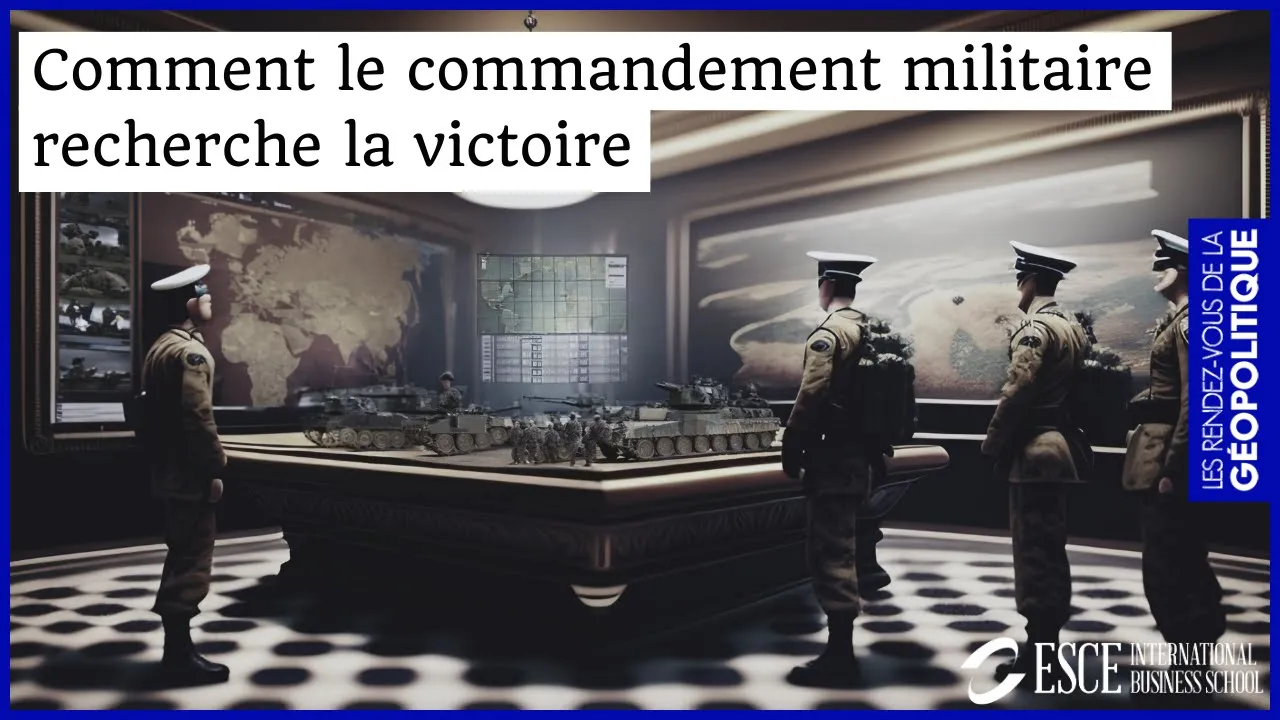
An understanding of how military command seeks victory. That's what we'll be exploring today at Rendez-vous de la Géopolitique with Fabrice Ravel. To a certain extent, today’s session is a continuation of current events, since we have all been drawn to military logic and terminology.
Previous Rendez-vous de la Géopolitique sessions have touched upon military factors in the 21st century, so this session on military command is simply a natural extension of this. We'll delve a bit deeper into understanding our topic on military command by first looking at concepts linked to the notion of military command, to truly grasp not only what is at stake today and in the future, but also gauge what constitutes a good or bad command. Hello Fabrice.
Hello Olivier. Hello everyone. Those who follow our Rendez-vous de la Géopolitique regularly will have already heard two familiar-sounding concepts: strategy and tactics.
It might therefore be worth rethinking the two, to see what distinguishes one from the other, before going further into what the military command is all about. We've relatively distanced ourselves from military logics, particularly in the West when the Cold War came to an end and the impression was that war was something that would detach itself from geopolitics. Yet we can understand military commands and military logic as a whole by first addressing a certain number of parameters.
These parameters obviously include tactics and strategy, which is somewhat paradoxical, since these terms are used a great deal, including in fields of operation that have nothing remotely to do with the military. Yet we rarely stop to define what these terms really mean. Yet they should be understood so we can truly appreciate how military commanders pursue victory.
The difficulty obviously arises when, as you can imagine, we come up against a slew of definitions for these terms, tactics and strategy. I think it would be a waste of time and energy to go into the details of each definition, or even contrasting and comparing them. I suggest taking a fairly holistic approach and looking at the 2 axes that, a priori, characterise them the most.
In fact, the first axis that characterises the relationship of tactics or strategy is really a difference in terms of operations, both geographically, in terms of the numbers involved and the corresponding time or space of execution. Tactics are more likely to be considered for a relatively limited time or duration, in a relatively circumscribed geographical area and with a fairly small numbers of personnel. We have clearly understood that this notion of tactics as we are setting it up, on the contrary, we have a long-term strategy with large numbers of people and a much more complex logic.
Through this explanation of the terms tactics and strategy, we've covered the two main logics we need to understand. This is essential, since it naturally leads us to two terms: "battle" and "war". It is well known that Napoleon, and this is another emblematic example we also covered in a specific session, won dozens of battles, some of which are considered among his most glorious.
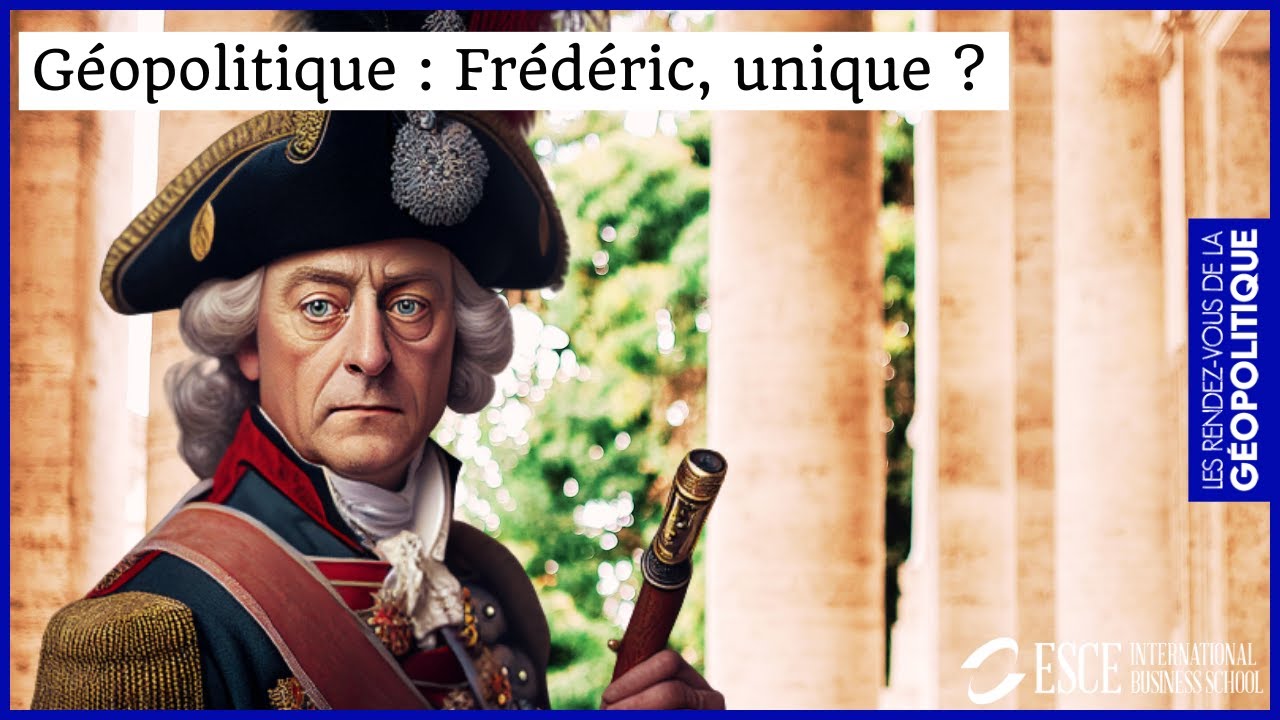
Austerlitz on 2 December 1805 comes to mind, yet he would ultimately lose the war. In our more recent session on Frederick II (Frederick the Great or the Unique) we saw how he won battles, but he also lost battles and it was not enough for him to win the war. Finally, we should say, last but not least, as the old saying goes, Alexander the Great is perhaps singular and also particular because we realise when we study him, we also devoted a session to him, that he managed to combine victories over battles and victories over wars.
We thus have two dimensions that are part of logics with different fields of application. However, there's a risk that, obviously, by saying this, which I must point out straight away, one would almost tend to discredit the tactic a little by saying "OK, but. .
. It's thus much less important, so we should stay focused only on the strategy. That would be a big mistake, because obviously, if you accumulate too many defeats at the tactical level, you end up creating an opposing dynamic.
On the other hand, if we're able to rack up tactical victories, we can create a dynamic that will inevitably have consequences on a higher level, also bringing about a strategic dynamic. Perhaps the difficulty lies in knowing how to articulate or combine these two terms. And there is perhaps a third term in the mix, one that's operational or operative, and whose primary purpose, perhaps, would be to combine tactics and strategy.
On top of our two usual terms, tactics and strategy, we'll thus add this third one, rendering a third dimension, a third layer of complexity in this understanding of military command, namely the term operative, which is less well known than the term operational, but perhaps it's worth coming back to this distinction as well. Yes, it's all the more essential because of two combined difficulties. The first: as we'll see, the term "operative" comes rather, though not innately from French, but rather imported through another language that is clearly Russian.
We already have translation problems. We also have something else, it seems to me, that I will try to explain to our audience. I think it's fair to say that we can make three different interpretations.
It's thus necessary to explain what is really meant by the term operational or operative and what reality it is supposed to cover. I personally try to put the first definition under the term operational control. For a quick explanation of what it is all about, One term that comes to mind in association with operational control is logistics.
We can see the necessity to master military materials, weapons and ammunition, but also to be able to provide supplies and to control large areas. Moreover, this operational control has, in my opinion, three aspects or three logics that also come together and allow us to be less pejorative about this term than we tend to be. Because let's be clear, when we talk about military issues, we would have relatively noble dimensions, tactics and strategy, and then something that would be rather discredited, namely logistics, in other words, the means that must be put in place, though we might have the impression that it is less important.
That's a serious mistake, because if we look closely at this operational control, firstly, there is the need to control supply lines, overcome distances, control large spaces and be able to bring weapons, troops and ammunition. where needed. Another quite interesting point that I should mention here, and on which Paul Kennedy addressed in a book we have already discussed together, notably in a session on tanks, goes hand-in-hand with The Engineers of Victory.
On page 184 in particular, he discusses aircraft radii of action. It's very interesting because we can see that here we find a technical solution to a military problem, I'm tempted to say, since it's a question of trying to accompany the strategic bombers as they bomb Germany in an attempt to reduce its means of production. There are also some parameters linked to logistics: to ensure that these bombers are less vulnerable or that they can achieve their objectives, they should be protected by fighters.
However, the allies faced a particular difficulty for a very long time. Their fighters did not have sufficient range. Until the P51 Mustang, whose operational range, as the military uses this term, covers about 1,200 kilometres with its auxiliary tanks.
This means that the P51 Mustang has over twice the range of the Spitfire. This suddenly opened up opportunities to carry out operations because now the equipment meets the requirements as they are positioned by the technical issues. The second approach will be technical.
The third approach covers the capacity for industrial production, to produce materials in quantities that will ultimately enable us to gain the upper hand over, and even crush our adversary. It's quite interesting to explain that one of the main explanations for the Western allies' victory over Germany is that while the German armies had a superior tactical mastery or a tactical ascendancy, in the end, this tactical ascendancy was surpassed thanks to the large-scale production of materials that enabled an ascendancy of these economies, particularly the American ones, helping to usher in the allied victory. That would be for the first, I'm inclined to say, interpretation: operational control.
We can refer to the second as operative art. This is something very different. This concept comes from Benoist Bihan and Jean Lopez, authors of 'Conduire la guerre, entretiens sur l'art opératif' (Waging War, Interviews on the Operative Art).
Here we see that they start by totally disagreeing with an interpretation that we'll have to return to, in other words, that the operative art would be an intermediate level between strategy and tactics. They also call this a major misunderstanding. In fact, operative art is a term that comes from Russian, notably in the writings of a Russian general between the two World Wars, Alexander Svetchin, who pointed out that in fact tactics and strategy lead us to two independent logics.
That means that they are subject to either a local reality or a reality of large groups, leading to a need to try to coordinate the two dynamics. Otherwise, this sometimes explains the inability of the military command to achieve victory. There is a disconnect between the tactical and strategic dimensions.
In this regard, operative art is the logic that, for senior officers, means succeeding in apprehending the battle or local victories in order to serve a large group strategy, though they do not do that spontaneously. To summarise or simplify the author's thinking a little, that in fact, more than locations, there are corresponding dynamics. Because at the tactical level, we are reacting to an immediate or nearby adversary, and facing events as they unfold, whereas at the staff level, we are rather in reaction which would be a priori and that there would only be a need to combine the two to be sure that we can be effective and also achieve victory.
Otherwise, it would be practically two approaches remaining too independent and, ultimately keep us from combining them and achieving victory. This third interpretation, which I like to call the operational dimension, because one could point out to our two previous authors that they are certainly right. The book is fascinating because, first of all, it leads us to think a lot for ourselves and it is quite dense in references.
These two aspects are interesting to note and the authors thus deserve extra credit and merit. However, we shouldn't be too restrictive in our approach, because even if the operative art exists as they describe it, this does not preclude an intermediate dimension between tactics and strategy. Simply because it is what the military used to call the theatre of operations.
There is an intermediate zone where we are no longer totally local, where the number of personnel is no longer reduced, but where we are not yet on a major country-to-country scale. This would be an interpretation that would bring an operational dimension that would be intermediate between tactics and strategy. Let's perhaps take an example to explain the logic we are using.
If we take the Normandy landings of 6 June 1944, we can understand the fighting at Sainte Mère l'Église, with an assault on the bridge at Bénouville, the famous Pegasus Bridge depicted in the film The Longest Day. There is also the landing on Omaha Beach. These battles are part of a tactical dimension.
The operational dimension would encompass all the landing operations. On the other hand, whether it is more appropriate to land in Normandy, Pas de Calais or Italy, as they did in the summer of '43, in a diversionary operation, or in 1915 in the Dardanelles Straits, as the First Lord of the Admiralty, Winston Churchill, was anxious to do in an attempt to find a weak point in the central empires. This would be more of a strategic dimension.
I find this example interesting because we can see that, in reality, we have to coordinate three dimensions. One that is tactical, another operational, and the third strategic. Yes, since for the sake of the demonstration, we should isolate each dimension.
Yet the important thing is to be able to combine them for victory. The degree of complexity in setting up this chain of command is crystal clear. We can even ask ourselves if we're looking at a very vertical hierarchical authority with a truly pyramidal structure of an army.
Yes, it's what one would naturally expect because obviously, it's the framework of our initial topic, in the military profession, and we naturally expect that with the discipline we expect from it, we have a sort of authority or hierarchy that is very pyramidal. Obviously, the efficiency of the search for victory will lead to a logic that is radically contrary to the one we might first expect. This is quite interesting because, I almost want to ask: what is the state of mind or approach of the command?
To understand what all the major states have arrived at today, we should take up a logic which, in particular, German officers thought about in the second half of the 19th century and early 20th century. We can explain this with one concept: Auftragstaktik. One explanation of Auftragstaktik comes from Pierre-Yves Hénin's book on the Schlieffen plan 'Un mois de guerre, deux siècles de controverse' (One month of war, two centuries of controversy).
It means mission-specific tactics. Thus, 'one tactic per mission' should be construed as purposely giving lots of autonomy to ground troops and how they're managed, because they have to be able to use all the opportunities available to them to try to optimise or reinforce the dynamics. In fact, we realised, and so did the German chiefs of staff in the 19th and 20th centuries, that far from having a chain of command which was very psycho-rigid to say things clearly, it was necessary to leave a lot of autonomy, (I find this very interesting in terms of management), if you'll allow me, extreme autonomy, because the army, with such a reputation for discipline, ultimately exercises authority emphasising the promotion of significant autonomy to be more efficient.
That's very interesting. Two examples corroborate what we are saying, two examples that are part of an antinomy. The first is that, with the benefit of hindsight, we see the major fault in the Treaty of Versailles.
Because in fact, in the clauses of the Treaty of Versailles, there is one of the most famous clauses, in particular. . .
This treaty ended the First World War. I'll put it in context very quickly, it slapped very severe conditions on a defeated Germany. One of them is linked to the Reichswehr, the German army as it was set up for the Weimar Republic.
The treaty limited the number of soldiers to 100,000, and also put a prohibition on conscription or national service. In fact, we can see that the underlying idea was to make Germany lose its military tradition, which, a priori, was not necessarily unintelligent, we might be tempted to say in hindsight. To lose a military tradition and experience of the army for most citizens.
But in fact, we realise from the explanation of the Auftragstaktik that we are forming a hyper-specialised, hyper-professional corps, because in reality, moreover, all non-commissioned officers and soldiers enlisted for 12 years, while officers stayed for 25 years. That is clearly a hyper-rigorous or hyper-strict selection, if I may use that term, which meant that the Reichwehr would become the nucleus of the future Germany as it was set up, and unfortunately of the Wehrmacht in 1935. The corps of non-commissioned officers is very important to consider, if we want to achieve autonomy in the field, since it needs to be done professionally.
It cannot be done without mastery. There is a second example which is antinomic, yet we can see that one area of improvement or major problems faced by the Russian army in the war in Ukraine since February 2022 is the lack of non-commissioned officers on the ground who are unable to accompany the troops, which leads to a certain number of setbacks for the Russian army as we know it. So, in fact, we can see that in addition, there is also a philosophy of the chain of command which is important to bear in mind, but we will have to try to control to avoid dispersion.
That's right. In other words, there's a need to give autonomy, yet also maintain control over this autonomy. Everything happens at the level of coordination between the different levels of command.
From a tactical point of view, in other words, at the downstream level, we can ask ourselves the question of the result or outcome of this autonomy, does it not risk threatening the cohesion of the whole? This is a major risk because, obviously, we can spontaneously imagine that with such autonomy, each troop or officer in the field will take initiatives that are completely uncorrelated or without any coherence with the neighbouring troops. This first aspect is thus important to point out, as you mention, they are downstream, and that is the ability to at least have an identical referent, an identical habit.
This identical referent or identical habit is the doctrine or the body of doctrine, namely, how they are trained to use some material, which has been thought out in advance. We have equipment at our disposal, but our officer corps or our troops must all be used to using this equipment in the same way so that, despite the fact that we have a large degree of autonomy, we can at least find our way around the method as we set it up. This is not new, because these questions of doctrine were taken up by the generals quite early on, with regard to the infantry, for example, particularly with the development of increasingly modern weapons with a capacity, obviously, first semi-automatic and then automatic weapons, to have more and more projectiles.
The question was raised as to whether one should continue to advance in groups, which was necessary in the past for cavalry charges, or if troops should disperse to prevent sustaining too many losses, just as Frederick II, in the 18th century, was wondering whether it was necessary to give priority to what was called shock or fire, which is attacking the opposing troops, or whether it was necessary to stay away from it in order to give priority to shooting at them. There is clearly a lot of logic and thinking going on, and it's far from neutral because today, in 2023, we're still in such a perspective. With a closer look, doctrinal debates are important, for instance, on drones.
It is clear that they've become increasingly important on the battlefield since they were first launched in the early 21st century. This thinking will certainly be followed up with something that will disrupt armaments in the field. Namely artificial intelligence, which will pose a key question for military commands.
To what extent are we finally allowing AI to act on its own? At what point or until when do we allow ourselves to implement a human decision? Doctrine is thus very important to ensure cohesion, but it's not enough.
Here, the logic is downstream and tactical. If we examine the strategy side, that is, we come upstream. This also raises the question of cohesion and coordination between the different levels of command.
What gives us, from a strategic point of view, the information from the field? How do the general officers deal with what is happening? There is a second necessity here, which means a need to provide a framework, I should say.
The doctrine enables a certain reflex of use. There is a second need for autonomy to be effective without spreading resources too thinly, namely that it should be relatively supervised. There is one term that must be borne in mind, which is staff.
It is the job of the staff to be able to coordinate all these actions so that each of them, although independent and autonomous, can serve the overall general dynamic. It's important to understand that, first of all, it has to be the staff, which is not the case for all of them, as they vary greatly; believe me, based on the period, political systems and even different military experiences, but there is a need for a corps of general officers who are in the field. That means, albeit not necessarily war veterans, officers who train regularly in simulations known as Wargames by definition, which are done with computers to put it bluntly, but who go into the field to better perceive the geographical differences, the logic of troop movements so that they are not surprised, so that the order, quite simply, is coherent in relation to where they take place.
This is very important. And then, on the planning of a certain number of operations which must be thought of as scenarios even before international events occur. Here we already have a whole set of logics that staff deal with.
Likewise interesting is that there are two points that need to be clarified that seem to me to be truly fundamental. The first is: what is real autonomy or freedom or power of this staff? Because there are two examples that are also a bit paradoxical.
The German Imperial General Staff from 1871 until 1918 had very extensive autonomy. Moreover, it was so extensive that it often overflowed, which is another question about political power, because we remember that the German general staff practically imposed the start of the war against France in 1914, because the Schlieffen plan, which we can see clearly in the work by Pierre-Yves Hénin, in particular pages 9 through 21, which deals with general staff, who actually forced politicians to engage in war, since "military operations as as they were conceived through the Schlieffen plan required to fight France quickly in three weeks to then turn against Russia". So there is almost, we'll say, a political authority.
If we look at the great imperial staff as MrVachée shows it well in a book he wrote about Napoleon, we can see that we are dealing with a staff that I would be tempted to call a recording, because in reality, it is the emperor who gives all his directives, whether they are tactical or strategic, and his senior officers are there only to apply them in an operational manner. Therefore, when we study a country or an army, we must examine what the degree of autonomy of the general staff is, and we should remember that it also serves to check local initiatives. There is one last aspect that we must bear in mind.
It's very important, yet often underestimated: what could be the civilisational, cultural, historical or organisational weight of a country on how its staff reasons? I'd like to mention Michel Crozier and Erhard Friedberg in a well-known work in sociology, right Olivier? Actors and Systems.
They delve deep, particularly in a chapter on the Cuban missile crisis, into what we could call a weight, a sort of cultural determinism, we'll say, on strategic choice. To corroborate this aspect, a book by Bruno Colson shows the cultural weight on American strategy. It's quite interesting to read.
I think there are two logics, both doctrine and staff, which, along with the autonomy of field officers, are part of what a military command must put in place to strive for victory. This is perhaps the moment to synthesise and try to learn from everything that has been said to understand how the military command will seek this victory. The elements that a military command must put in place, as we have just tried to explain and synthesise them, because obviously, I think that our entire audience understands, this would call for tons of additional explanations.
Firstly, three different dimensions should be fully understood and mastered: Tactical, operational and strategic. Then, mainly through the operative art, we should not oppose these three dimensions, but combine them so that each one is capable of bringing a dynamic that leads us to victory. In order to reinforce this dynamic, there must be autonomy for the management and officers in the field.
And that this autonomy, if it is to be effective and not completely disorganised, must be framed on the one hand by a very clear body of doctrine and by a staff that frames all its logic. An overview of all military operations over the centuries will show us that we are not dealing with a perfect science and that there have been many setbacks and victories that we were supposed to win and that we ended up losing, if I may use that expression. That's a first nuance.
We could point out that all of these elements let us compensate for numerical and logistical inferiority, and we are all the more urged to do so because we are spurred on by this situation, which seems to be desperate, or also, perhaps, simply to assemble in the most efficient way possible the means that are at our disposal, but which, in any case, we can see are by their very nature or essence, always inadequate, because the means are never completely unlimited. It should also be noted that all these elements may come up against friction. These frictions obviously originate from the thoughts of the opposing army, because we always tend to forget this parameter, but we come up against another will.
Friction can also be caused by impromptu or unexpected events on the ground. It might be more difficult to put them in place because we're immersed in a fog of war that prevents us from fully perceiving the information that is necessary for all these elements to be put in place and, in addition, this "strategos", to use the ancient Greek term, or leader of armies, must not only have complete control over his elements, but he must also surprise his adversary and, above all, he must perhaps have a dimension of genius that lets him gain the upper hand over his opponent. Friction, the fog of war, military genius.
Clearly, to go further on the ability to win a victory through military command, it will be necessary to study one of the greatest strategists in the history of geopolitics. I believe that our regular followers will have understood or grasped the subliminal message here. We will therefore examine this great, albeit unnamed strategist.
Thank you Fabrice. Thank you. We've come to the end of this session of Rendez-vous de la Géopolitique.
Thank you everyone for watching.
![[UKRAINE / RUSSIE] 3 scénarios pour la fin du conflit](https://img.youtube.com/vi/-lNRa0o5cyU/maxresdefault.jpg)
![L'art de la guerre et du commandement ? Loïc Finaz [EN DIRECT]](https://img.youtube.com/vi/7LHX_hMsFcA/maxresdefault.jpg)