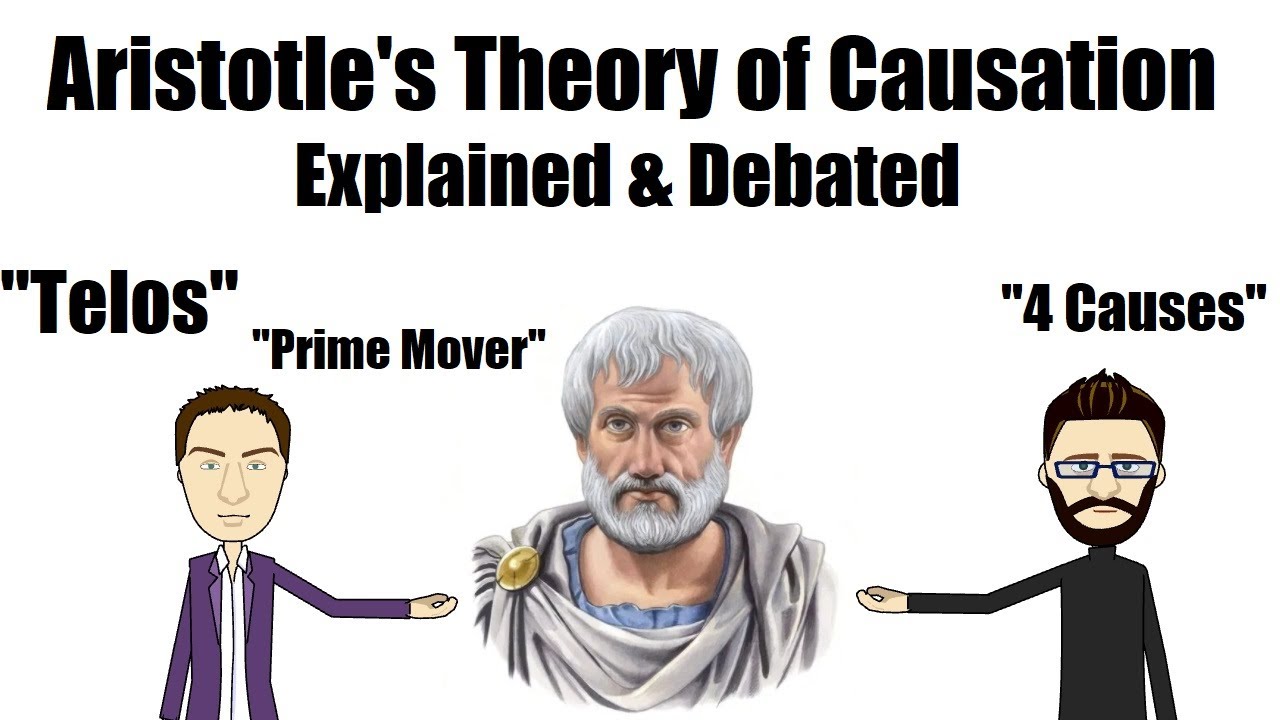
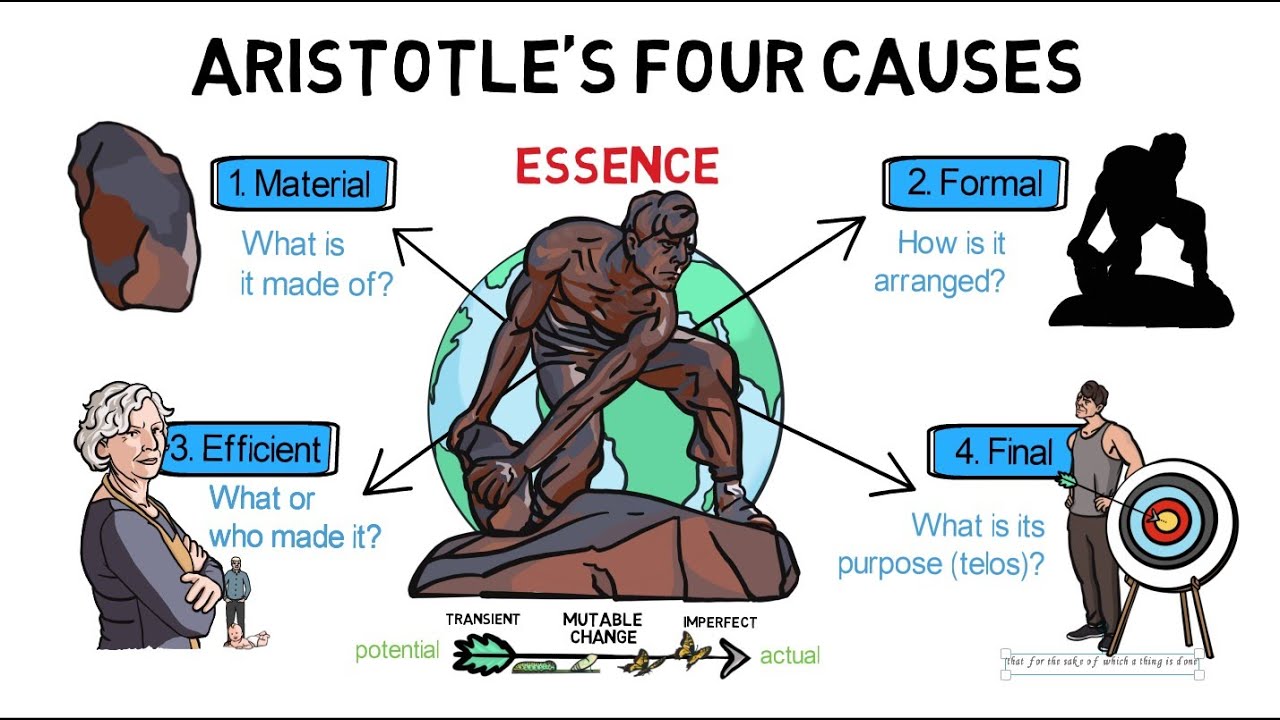
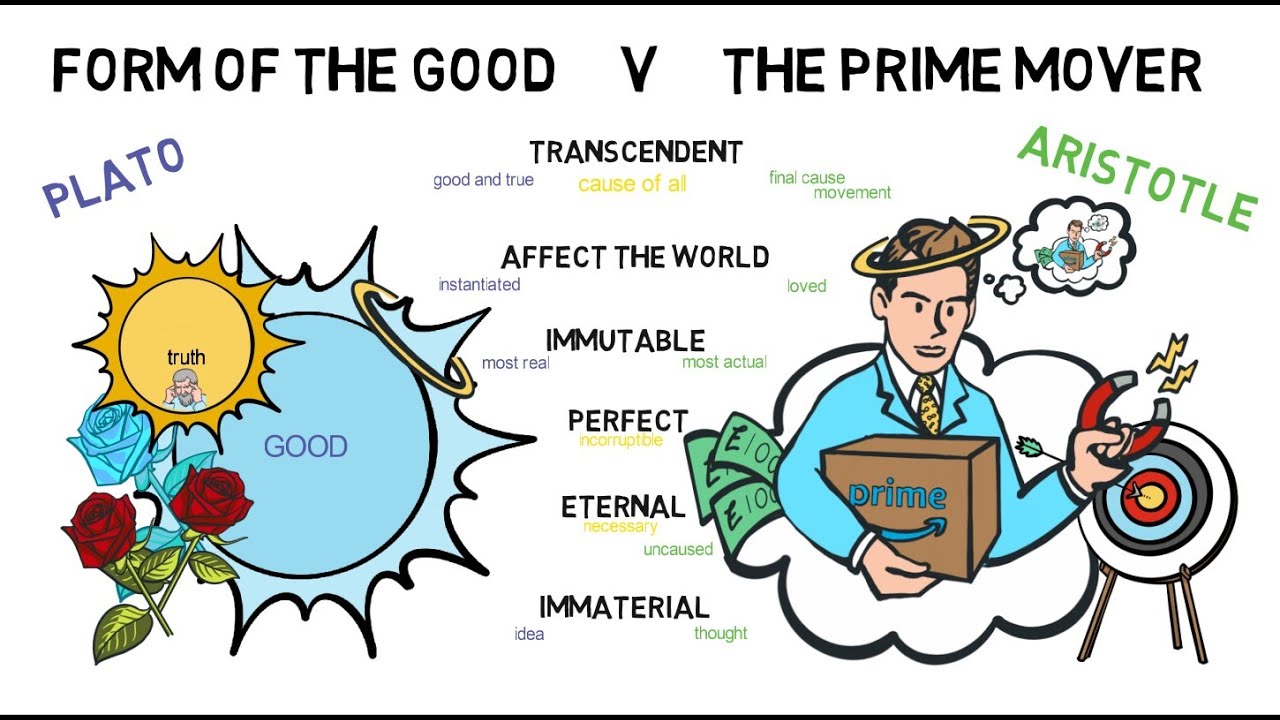
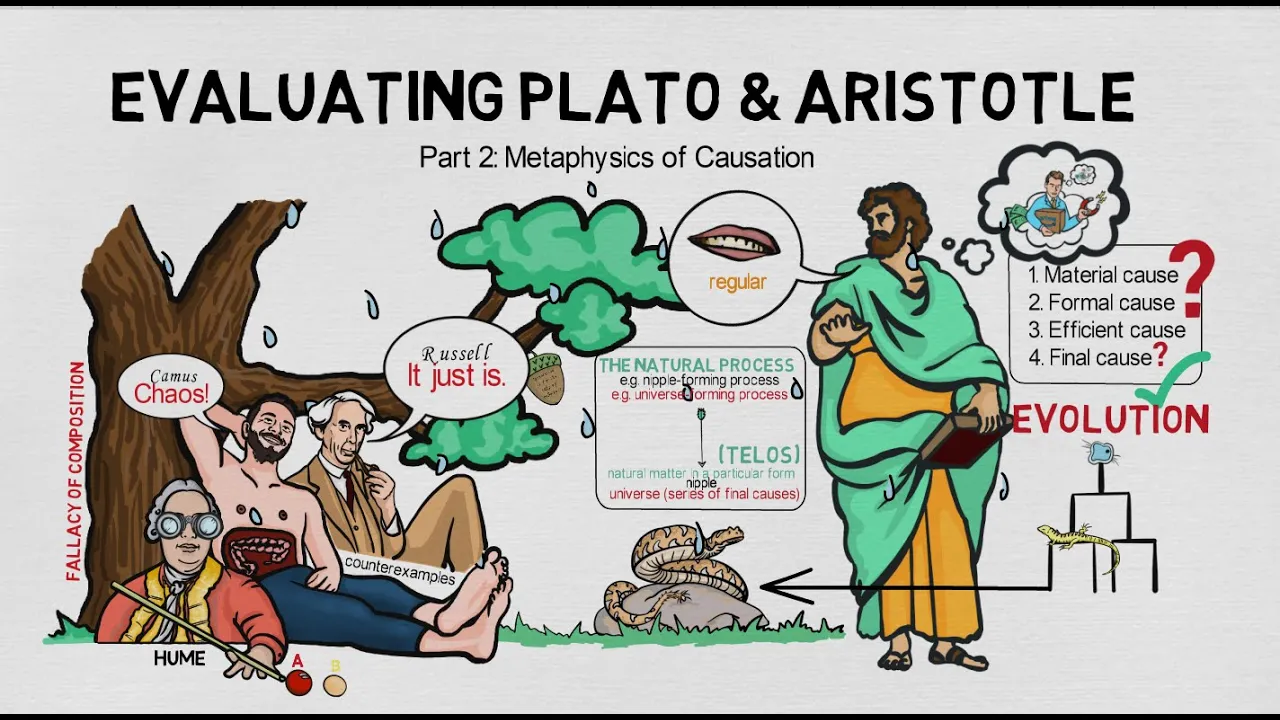
this is the second video evaluating Plato and Aristotle theories and in this video we will be focusing on the metaphysics of causation Aristotle explains the essence or nature of things using the idea of causation most objects and events seem to fit the four causal explanations suggested by Aristotle the material cause the formal cause the efficient cause and the final course Aristotle's unmoved prime mover provides an ultimate final cause for everything causing and setting everything in motion and gives an explanation for the series of causes existing as a whole however Aristotle's claimed that natural things have
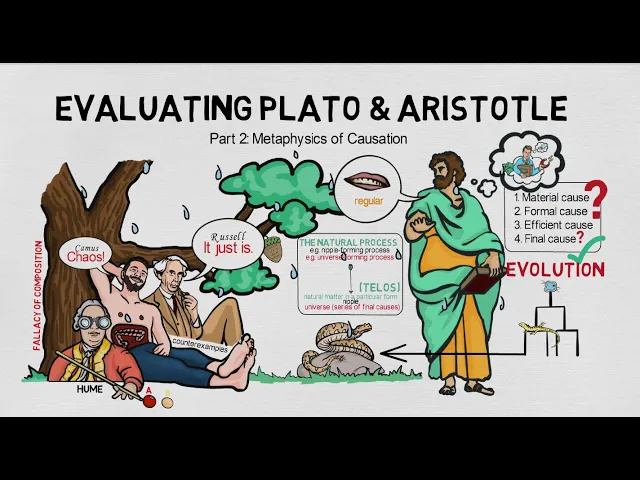
a final cause and ender a purpose is much disputed counter examples can be offered of natural things that don't seem to have a purpose things like male nipples or the appendix in answer to this some interpret Aristotle to have meant that the end or final cause or the teen loss is actually just the natural object itself so whatever natural product lies at the end of the natural process that caused it or the means of production that brought it about is the end or the Telos in other words the efficient cause the natural processes work the
material course the natural matter into a particular form such as the male nipple and this formed material is the end or the Telos of the process the final cause in this sense Aristotle said the form is the end the form must be what things are for so he's conflating almost the formal and the final causes there this makes sense when we think about something like a tree the purpose of a developing seed or a potential tree is to become a tree there is no way to explain the efficient cause of something without referring at the
same time to its final cause so you can't talk about house building without talking about the end product of a house in the process that is the efficient cause of rain could be described as rain making the end being the production of rain before we looked at the causes of a bronze statue and so Aristotle talks about of the efficient cause not being necessarily the artifice of the maker of the statue but the actual process of making the statue statue making is the efficient cause the statue making process and that the end the end of
that process is the statute say the tea loss could be described as a statue itself Aristotle says that generation is for the sake of substance growth is for the sake of whatever is growing however this seems to leave open the possibility that the universe could be its own final cause with possibly no need for an external prime mover Albert Camus a French philosopher argued that the universe is not purposeful but chaotic so he's undermining the whole claim of Aristotle that the universe has a final cause a tool or has any final causes within it Cammi
claimed that human beings determine the purposes of things depending on what they want to achieve there is no objective purpose of things they just are so perhaps as Bertrand Russell argued the universe is just there and that's it there is no final cause in other words however Aristotle argued that accepting this would be ignoring the predictable regular way things occur and we'll touch on this more when we look at the teleological arguments for the existence of God for example Aristotle claims it can't be chaotic or random that human mouths regularly and predictably produce teeth arranged
in a particular way front teeth Aristotle says grow sharp and suitable for tearing the food and the molars grow broad and useful for grinding the food and this is always the case in human mouths it is the consistency of these occurrences of order that suggests that they are more than just chance there is a final cause there a purpose evolutionary theory offers an explanation for how natural things can appear regularly and predictably to work for a tea loss or a final cause when in fact they have none the process of natural selection in which things
are badly suited to surviving in their environment die means that only things that survive are those things that happen to be well-suited to survival and these things then pass on these traits to the next generation David Hume argued that even if everything in the universe has a final cause it would be wrong to suppose that the whole universe has a final cause he argued that even if something is shown to be true of the parts of the thing we can't assume that the same will be true for the whole and this is known as the
fallacy of composition David Hume also argued that as an empiricist it is possible to be skeptical about the idea of causation altogether he argued that we cannot observe causation directly with our senses all we can observe is that two events a and B occur consistently together due to their constant conjunction we believe that event a will always be followed by event B but this is not necessarily true for example looking at a billiard game we observe one ball moving towards another but we can only predict that the second ball will move based on similar passive
experiences called Humes copy' principle so this gives us reason to be skeptical about the idea of causation altogether which would undermine Aristotle's theory this video has been brought to you by jest education thank you for watching and please subscribe to find out more