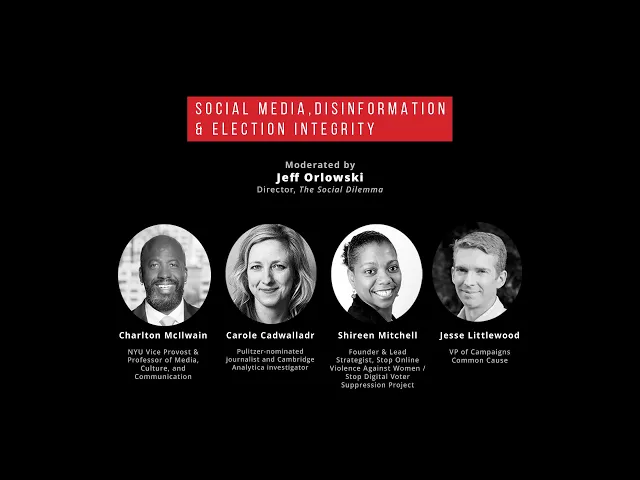
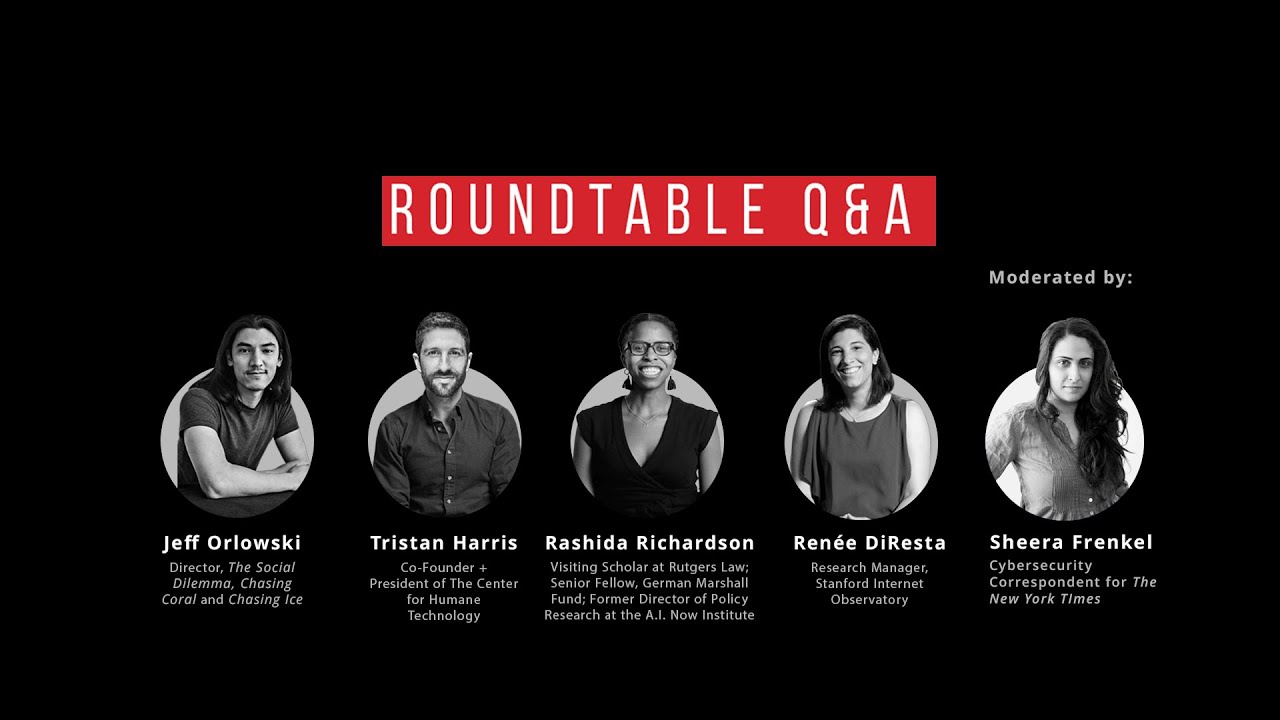
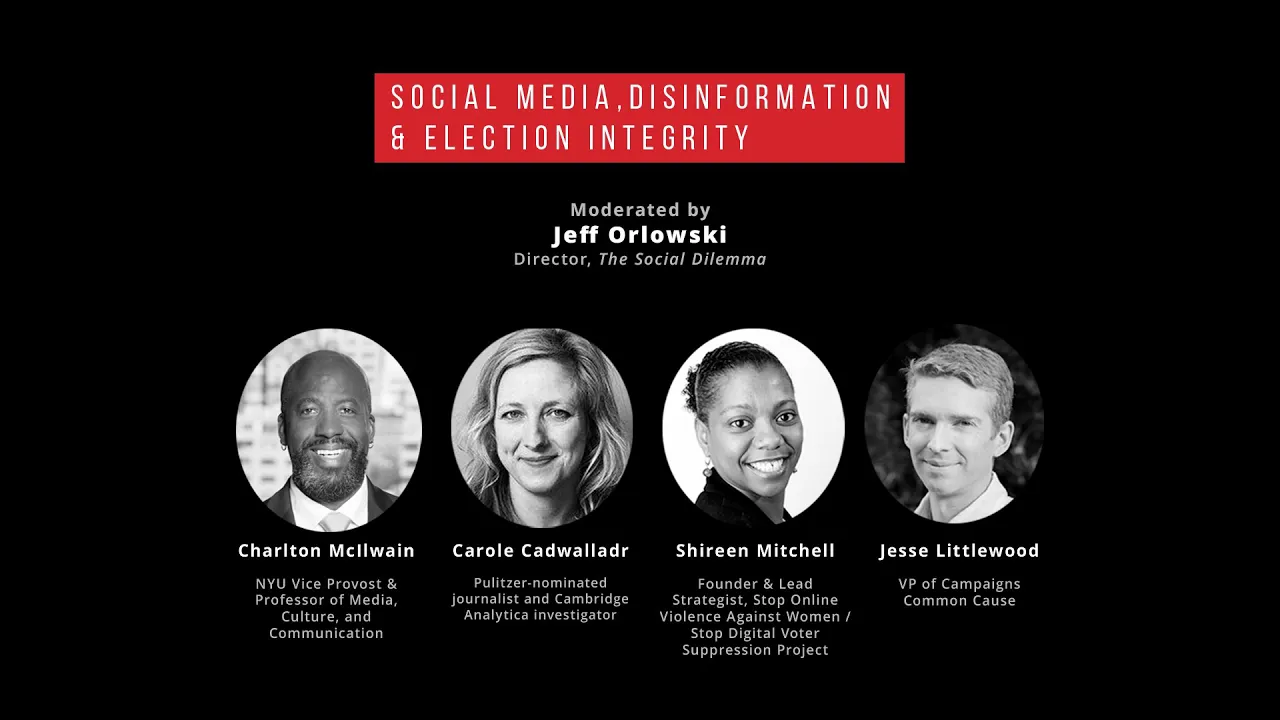
[Music] hello everybody thank you so much for being here with us today my name is jeff warlowski i'm the director of the social dilemma and thrilled to be serving as moderator for today's conversation um this event today is the third event that we've done with our social dilemma virtual tour a way for us to continue the conversation beyond the scope of the themes and issues that we brought up in the film and to expand that conversation with our community uh i am here today in a gloomy manhattan the ancestral land of the lenape people uh
wanted to honor and voice gratitude to the land and the people who have stewarded it throughout generations um and grateful to be here uh with this uh amazing group of people for today's conversation how technology platforms are amplifying disinformation and the threat that they pose to the integrity of our elections and the health of democracy um so i'm excited to bring on today's panelists i'll introduce them all as i come on uh we have with us charlton mcelwain the nyu vice provost and professor of media culture and communications author of the new book black software
the internet and racial justice from the afronet to black lives matter we have with us um carol cadwallader the pulitzer prize nominated journalist um at the guardian and investigator of the cambridge analytica scandal sharon mitchell is with us today founder and lead strategist of stop online violence against women and the stop digital voter suppression project and jesse littlewood is here the vp of campaigns at common cause um just to kick off the conversation i wanted to offer just a little bit of high-level framing for all of us um this is a project uh that we
started in 2017 to make the social dilemma itself and it was a pretty quick realization for many of the people on our team just how complex the set of issues were that we were trying to dive into and i think we've gone from an industry that was you know in years past there was a tech industry based in silicon valley that made silicon chips and kind of gave birth to this internet and technological era and now we've shifted all the way to we live in a society where countless different industries can use technology can use
machine learning algorithms and we're seeing the scale and scope with which different aspects of this issue can affect our lives for today's conversation we're really wanting to focus in on kind of the immediate conversation at hand with our upcoming election not just with the election next week but elections as a whole and the uh the frame in which the misinformation and disinformation that we see on these platforms is affecting all of us in society so i wanted to just open up from a broad frame um and pass the mic to everybody and just uh have
a chance to both introduce yourself and to talk through what you see as the biggest issue that we're facing with right now with regards to disinformation um and the impact on elections and i think we'll just go through the order on the screen so charlton carroll shireen and jesse we'll pass it off to each of you charlton perfect thank you um i want to start off by making really two points that i think helped to put this phenomenon in a historical context even though we're talking about the present moment but i want to take us
back uh to raise two points really to say first that you know government and technology company collusion to disenfranchise and otherwise sport black people's full participation in the democratic process particularly by perfecting the production and distribution of miss and disinformation goes back more than 50 years and so time doesn't permit me to connect all those dots but one example i delve into in my recent book that you mentioned black software involves a company called cymomatics and just as an example cymomatics got its start using computer-based predictive modeling during the 1960 election parlayed that into numerous
contracts with the cia to develop propaganda campaigns in vietnam in the mid 60s and then redeployed those same tactics during the work of the kerner commission in 1967 and eight to understand how to mitigate the threat of black violence across the country and so what i'm getting at is that cymomatics sought to deeply map and understand black community communication networks understand where the nodes of trust and obligation existed understand how both true and false information flowed and circulated from these trusted nodes out into the community and so this is precisely the kind of networks we
see being exploited today and the practices being enabled by these digital platforms over at least the last two election cycles and particularly to suppress black votes uh and in this election specifically the vote turnout of black women um and the second point i will make quickly is to say this that uh this history suggests to me that these platforms as well as our government and regulators did and should have expected what we are seeing today the fact that they have not and have not done more to stem the tide makes them not only complicit but
responsible for nothing short of the most egregious displays of voter suppression that we've seen in modern history so i think that's where we're at and that's where we've come from and my point is this is not our first rodeo we've been working at and perfecting this for a great long time awesome thanks charlton um carol over to you your your big thoughts on what's keeping you up at night and where do you see the problems here thanks so much jeff that was completely fascinating thank you charlton for that um that was just really interesting new
stuff that i didn't know about actually but and jeff thanks very much for having me here today and doing this panel and it's been so amazing that the social dilemma is kind of like opened up this conversation and the thing that's keeping me up at night i think you know even though i'm in sitting in london is just that this election in the u.s you're blaze away from it now we know that facebook is already playing an absolutely pivotal role in subverting this election um in ways that charlton talks about also in the ways that
it's allowing this complete missing disinformation around mail-in voting um it's it so terrifies me that i've been spending my time organizing something called the real facebook oversight board because the fact of the matter is there is no oversight on facebook at all and there is no way of um of curbing its behavior in any way and so that's why we've set up shireen is is a member of it also and it's just essentially just trying to bring public and press pressure to bear in these critical days when we know that every decision that facebook makes
could have real real world consequential impact and we know that it's sort of that get taken by you know one man who has overall control of this company and that i find absolutely terrifying thanks carol shireen to you yeah so um i i'm so glad that that history lesson happened because i was gonna say a little bit about that like this is not new in the context of of where we are in um in america because targeting black voters has been a historical framework um and we need to own up to that i think that
what's different in the things that i'm worried about is to see that with with the documentation that has come out and the the the expose that we've discovered how that data was used by actual domestic political campaign should be the things that we are more concerned about moving forward and even though we're getting most of this information just before the election my hope is and my concern is we're going to look at this and dismiss it moving forward no matter what the outcome of the election is going to be um but but what i was
so taken aback by was to watch how many people uh were participating in trying to deter the black vote um and it was coming not from for not just foreign but but clear actors in in this country and somehow um the message to so many black voters is that their vote is not important yet we have state level targeting of our vote of our votes um with um what's happening now with the ballot boxes because of covet the way covet is being weaponized with disinformation targeting my community um the way in which that's being used
to tell people to deter people from voting and how they should or should not be voting the way in which that that language is being used to say that our election election integrity is an issue and only all we should be doing is trying to make sure we're making things easier for people to vote instead of harder and how we're allowing these the the the disinformation the digital suppression which we work which we work on diligently um to try to stop um is is that is that we still don't see enough actions being taken to
see this as something serious um if they're overwhelming coming from black voters then they're going to go after every other will that they can get if they can be successful at this so we have seen an uptick in other groups that have been targeted native community asian community latino and latinx communities um that this is something that that has become sort of an american staple to be using this so much so that as i am a part of this old face real facebook oversight board we were monitoring the tech hearing yesterday that was days away
from from the elections where we have politicians basically trying to uh get these tech companies to make it possible for disinformation to be allowed on their platforms that's what that hearing was about was to was to um brow being the tech you know the tech executives by the way they do need to be browbeat about certain things let me just make sure i'm clear about that but not about um um them stopping and and shutting down the spigot on disinformation that's the one thing that we should not be doing and um and unfortunately watching politicians
uh hold hearings to make it possible for them to do exactly that and that somehow freedom of speech is the weapon of choice when our voices which is why we have unrest in this country right now is because people are unheard and the unheard have unrest and it shows up in these aspects and instead of seeing that as something that should be done about it they're being called and with disinformation campaigns they're being targeted as if they're the real problem and not the people who are targeting them and that includes the politicians targeting their vote
and that includes those who are coming out trying to intimidate them who are being told to come out and intimidate them who are organizing on these platforms to intimidate voters who are going out to exercise their right to vote um and so to me what i look at this an overarching perspective is how how there has to be so much disdain for other people's right to vote uh to the extent that we will accept this and not do anything about this and not hold these uh poems accountable as well as politicians awesome thank you shireen
um and jesse over to you so uh let me first by saying thank you for uh this amazing opportunity to learn and listen and participate with some real experts in the field and i'll be the first to join the chorus in remembering that the history of challenges to democracy especially as related to technology or computational propaganda follow a history of voter suppression that's taken place in the united states that's often targeted at communities of color and the work that common cause has participated in through our election protection nonpartisan voter protection work including monitoring the social
media conversation for miss and disinformation that could disenfranchise voters follows a trend of tactics and actions that bad actors have used for decades offline incorrect information about how you can participate in the election misleading statements or attempts to undermine people's faith in the integrity of the electoral process what's new and what keeps me up at night is one that the social media ecosystems have created such an ability to rapidly spread that kind of miss and disinformation at almost zero cost and that's both the domestic and foreign bad actors why not flood the zone with crap
as steve bannon might say or try uh to put different tactics out there if you can get a little bit of a change in people's uh perceptions or people's um actual behavior when it comes to voting two the some of the content that we continue to see in our miss and disinformation monitoring isn't actual problems but the creation of a perception of a problem that comes with the voting and election system so these kinds of perception hacks are cheap and easy to create you don't need deep fake software and you don't need to go to
a huge expense to create something that looks like impropriety or something could be funny with the electoral system when in reality it's actually above board and oftentimes election workers or election officials doing their jobs correctly and then i think third the challenge that we see through the actual impact of miss and disinformation which is so far this election cycle been largely about mail and balloting but now will continue to be about other things including the results of the election when we get past november 3rd there's a process by which a cottage industry of for-profit and
partisan operatives um are using individual pieces of uh news or examples and trying to create a broader false narrative about it the the issue that we see is that it doesn't just maintain itself within a certain filter bubble or partisan ecosystem but it ends up getting out into the news feeds of many more people across the country and then we ourselves share that content to our own communities sometimes presenting it as a helpful hint or a tip for example a narrative about mail and balloting that was found by the side of the road in wisconsin
ended up being amplified by right-wing media sources but then in our monitoring we saw individuals repeating that same claim on the platform next door without noting where they learned about it from the kicker of that story is that there were no mail-in ballots found in in a bunch of mail that was found by the side of the road so the ability of creating a false narrative that then gets laundered through people's individual news consumption and spread back out that's new and that is certainly challenging to our ability to have a democracy where there's an informed
electorate and one where both uh parties and candidates are rooting for voters to be involved instead of saying uh staying to the sidelines awesome thank you jesse uh i love everything that everybody brought to the table here i'm gonna try to go into uh many aspects of this conversation and try to get as much as we can during this time um but i themes around suppressing black votes i want to come back to the real facebook oversight board as you mentioned carol um and the senate hearing this week as well just i think is uh
interesting for us to jump into if we have time um but i'd love to kick things off just um uh in terms of what we've learned from the past elections and other research that's been done shireen and charlton i'm curious if you can speak more to for some that might be new to the subject and coming into how voter suppression exists in the digital world um if there are any specific examples you can offer to help uh help the public understand what we're seeing that's unique on the uh at this time on these platforms um
shirin over to you first yeah absolutely i mean that's one of the things we've been tracking as as a matter of fact um when um two at least two weeks before kamala announced her presidential run we saw disinformation already spreading about her um that disinformation is still in existence now that she's vp but it was clear even before her announcements came out that they were already trying to dismantle her presidential campaign and in some ways i i feel strongly that part of the reasons um was a impact of the reason why she um got out
before we got to the first primary was because the level of disinformation that was um targeting her in her campaign um much of it was focused on her um identity um which is you know in what i call the birtherism 2.0 phase um we saw this type of behavior also on on local and local races uh questioning other people's civilian citizenship so their right to uh uh even run for office which we saw run constantly with kamala um the other things that i want to make sure that from a historical framework in terms of what
we see now that's connected to what was going on in 2016 is that you know there's this conversation there's different groups using this terminology but this was something that was seated by russia in 2016 that both candidates are the same when we saw this still happening even now in 2020 we saw this happening before there was even a democratic nominee so the disinformation was already in the ether um out there to be weaponized and to be used it looks like we're having some technical connection concerns there with shireen um i can't hear you on my
end uh we'll just keep moving on in charlton um do you have any thoughts to add to this yeah and i think um shireen was headed in the right direction in identifying you know the clear examples of what's been transpiring both on the 2016 election but up into the president the one that i keep coming back to in the president election is that display of what um uh scholars and researchers have now started to call digital blackface and that was this uh campaign uh on facebook and other networks that sought to uh build trust and
so here were people who were not uh african-american who uh put on the persona of african americans and built over a period of time trust with black voters black women voters in particular and then ultimately over a period of time of building that trust of constant messaging and communication between uh folks that you thought you knew uh folks that people thought were people like them um black folks etc then came the messaging about well what about kamala and is she really different than uh joe joe biden during that uh primary time during uh the election
is there really a reason to vote for her all of these messages that sought to drive a wedge between black voters and among black voters and part of that was about the gender split and all of it was very much in line with and consistent with what we know about the electorate who goes to vote in what volumes that turn out and one thing that was clear about the specific targeting in this instance is we know that black women are the most loyal voters for democratic party candidates um they turn out in higher volumes than
any other demographic within the african-american community and so this was a specific targeted attempt to draw on pre-existing networks of trust to then erode and shave off some of that vote percentage amongst both african-american women but then drive a wedge between african-american women and men in ways that would help suppress uh excitement about the candidates excitement about kamala harris excitement about joe biden um and the prospect of voting uh itself and so these are some of the things that are real examples are targeted examples examples that show uh the the care uh the deliberateness um
the the energy spent into cultivating uh these things that's happened over a number of years and hopefully shereen's back to to come back in on this conversation awesome trina if you want to just pick we lost the last little bit of what you were saying there oh my goodness technology i apologize everybody uh this is the one thing we're talking about um and i and i heard charlton talk a little bit about um um that uh about the way in which black women are targeted and that's one of the reasons why what i was talking
about in terms of kamala why it was so important to even track what was happening to her specifically because when we started to see what was happening to her we knew that that was going to continue and we are still seeing some parts of that going into 2020 where now her indian heritage is being used in applications like what's happened and things that um that's uh that in comparison were aspects that were so focused on her identity um so in um the division in between uh east asian or other aspects of asian heritage is now
being used to tell people not to go vote for biden or harris we're seeing that type of disinformation as well um but when we were talking about the black vote what we saw with these exposes which is really important was the way that that data was used in detail to target black voters not just through social media in general but in ways in which they were going to get their personal data to use that as weaponization and the examples i want to use that i said before about both the same i've used i've said this
before because people tell me that there's no impact about disinformation and i've said over and over again there is and the reasons that there are and the examples i share is what happened in 2016 with michigan we know as we just said about the history of trying to stop people black people from voting there are always poll taxes there's aspects that we've seen with moving polling places we're looking at now the way they're trying to target black um um ballot boxes or how the um vote by mail um but that that people made it to
the polls got to the ballot box and didn't vote top of the ticket in michigan alone 90k people did not vote top of the ticket in in in in detroit it was 70k people a predominantly black environment i.e urban environment and he won that one state by 11k and what i see now that was both the same messaging campaign disinformation campaign by by russia that has been used domestically in various ways i've seen it come from different groups of people though where the target still is to say both candidates are the same to deter black
voters from electing anyone from either party and i think it's important that people understand that it morphs and has changed we have way more domestic actors than foreign actors and that's something that we need to address but things like telling people um now with covet giving people the wrong information about how to vote by mail right for telling people that uh how they should um vote in their on their on their absentee ballot when in essence all we want them to do is vote and send it in and make sure they sign it um but
giving um each state has different um regulations but we've seen different ways which we saw back in 2016 where images were going out telling people they could text their vote we're now seeing other aspects of what what they're telling people they can and cannot do um in terms of how the um exercise their absentee balance and also trying to discredit the the balloting system as well so we've seen a broad swath of this and i just want to make sure that people understand it's still going on and we haven't seen any um you know legal
actions or even regulations to kind of stop this from the platforms as well as from officials that are participating in this um a lot of what you're hinting at here and we're getting to are the different ways in which disinformation are appearing on different platforms migrating from platform to platform jesse as you were getting out just a second ago you were talking about perception hacks and um this is something that has been really top of mind for me around our information ecosystem how we as a society get our information at scale in countless different ways
and how these social media and search platforms now have in many ways fundamentally shifted and disrupted the information ecosystem as a whole to go to uh some of the conversation that shreem was referencing in terms of the senate hearings from yesterday uh so much of the conversation seemed to be about how do we clamp down on content moderation and i'm wondering if we're having the right conversation there or not like we um there's a stat that we have in the social dilemma that lies falsehood spread six times faster than the truth on twitter and if
we have information ecosystems and these platforms that are spreading lies faster than truth is the idea of content moderation just a like a you know an endless catching up that we will never ever get to the root cause so i'm curious jesse maybe we'll start with you and then carol you can jump in right afterwards um curious your thoughts on uh are we asking the right question around um around content moderation uh the way these systems are designed they're they're based on the section 230 i'm throwing a bunch of things at you but section 230
and this notion that these platforms um can just allow anything to be published and they don't have to take responsibility are you concerned about our ability to hamper down on disinformation itself so i think it's been shown pretty clearly that there is a challenge in the platform's ability to respond to disinformation and that's been shown through the coronavirus pandemic as well as the challenges we've had in disinformation targeted towards the process of voting in elections now i think the conversation about content moderation is one that puts us in a reactive frame and that's a challenge
i think the conversation uh should be focused a bit more on the challenge of algorithmic amplification and what happens when you're able to not only um produce content on a platform but have that content show up in front of other folks who may not have asked for it in the first place and see how it transmits and goes around very very quickly part of that challenge is because we know that bad actors will manipulate those systems and again the examples we've already heard of of foreign powers like russia in 2016 coming to attack our democracy
through using you know the power of amplification of content and gaming that the systems are one but you know just a couple months ago turning point usa was sanctioned by facebook for creating a troll farm of domestic teenagers in phoenix arizona who were putting out disinformation around the voting and elections process so we haven't learned enough certainly from the 2016 example to prevent this from appearing on platforms today and it's also a real challenge to think that all of this is happening from a foreign power i think that if we're serious about solving the problems
of miss and disinformation on the platforms you have to look at the business model and about how the amplification is core to that and you also have to look at the role that we play as consumers and producers ourselves as a publisher ourselves on these platforms we also need to understand the responsibility we have to validate sources and to make sure that we aren't accidentally spreading this or disinformation and instead lead um our uh community towards more trusted sources of information carol do you have any thoughts you'd like to add to that lots and lots
of different thoughts about it so much interesting being brought up but i suppose i mean one of the things which strikes me about it is that it a lot of the time we talk about politics or you know we discuss what's going on in the election etc we're having these conversations in what feels like a public space we feel that we're having these you know conversations openly with our friends with our neighbors with random strangers but we're having them on facebook or on twitter or on instagram and these aren't public spaces these are private spaces
they're private companies and actually to go to the thing that jesse was talking about is that there it's we feel that we're sort of swimming around in this sort of you know very transparent medium where we can see what's going on and actually we can't see what's going on at all we're sort of we're swimming around in what essentially is toxic sewage in that that is the nature of these of these platforms they are riddled with this kind of toxic lies and propaganda stuff planted by foreign states or you know domestic bad actors and we
the one of the most sort of i think the most difficult thing to get over to people and for people to understand and i include myself in that is that this is you don't know what you're seeing you don't know who is planting this you don't know who these accounts are i mean i thought the thing that charlton was saying about digital blackface and the lengths that uh people are going to there was absolutely fascinating but it just you know i i think very early on when i started looking at this there was a um
danish defense analyst who i spoke to and i said to him what do you say to people when they say well it's all well and good but you know i it's nothing to do with me and i'm not you know i don't you know it's it's all you know i can see that there might be stuff going on but in my world where i'm just you know exchanging puppy photos with my family i really don't think that's an issue and he was just sort of like if you you know if you think that you are
not being targeted you probably are the target in a way and it's like this is you know he was just sort of like good luck with it if you think that this doesn't affect you because it affects all of us and um you know it's it is just i find sort of this astonishing thing to think about which is that the idea that we are swapping you know our way of communicating with families and friends is also the exact medium by which a foreign nation state is looking to undermine our democracy now that's it's such
a massive thing to try and get your head around and we have we've got this fundamental i think kind of cognitive dissonance about it because it is too big to grasp and it's too big to grasp when it's the thing on our phones that we're looking at and that's the thing also which is going to affect the outcome of this election the these are really really big concepts and that have taken over our lives in just a you know a space of just a very very few years and so it is kind of we're really
on the sort of nursery slopes i think of of even starting to see this let alone understand it let alone do anything about legislating uh to protect our to protect ourselves because you know at the moment we are totally totally unprotected and i think that's what is the most worrying thing i'll let somebody else yes um charlton do you want to add something or yeah just just a small point of to your question about content moderation and to underscore the things that carol mentioned and destiny as well as as shireen that you know as long
as content moderation is held up as an example we're always going to be chasing our tail as it were things change so rapidly we're locked out and these are not transparent platforms or systems so i think absolutely those are not answers and i think we have to look for answers in much more systemic and structural ways when we think about the questions that carol just mentioned about legislation about regulation um shireen made the point that the conversation amongst public officials is tipping towards that first amendment and censorship and i think that goes to show uh
that we have to disrupt the very business models in which these things operate and see these companies and platforms differently they are a huge becoming huge part of our democratic and electoral infrastructure and they deserve then to be regulated that way we should demand that kind of transparency and those are the kinds of things that you can't get from uh from content moderation which i think uh you know colleagues of mine like sarah sarah roberts who wrote the book behind the screens and give insight into the world of content moderation not only are we put
behind but we put certain people at risk by exposing them to certain kinds of content day in and day out and those are typically the usual suspects in terms of people of color and people who are poor and etc so i just wanted to chime in on that to say a hearty um you know content moderation is not the answer yeah there's also a great film called uh the cleaners that is about content moderation through the social platforms as well um shout out for that movie um uh we were just talking through um and i
wanted to bring it back to uh the business model points that both jessie and and charlton were bringing up um one of the things that we saw when working on this project some people referenced this as a climate change of culture and that was a phrase that really hit me i think as many know our past works with chasing ice and chasing coral were all about climate change and the different consequences to different ecosystems that we see as a result of this one systemic practice and uh the reference is here to this business model this
attention seeking advertising micro targeting business model is one of the things that we always felt was like the core that is driving all of these different consequences that we're seeing in different parts of our society um i wanted to pivot us um with that in mind to so what do we do about this right so this huge huge challenge around solutions and what i'm curious about is um uh very much a if you had a magic wand and you could do anything at the legislative level or at the level of code within a company um
what would you wish to change like what what are the things that are top of your mind in terms of these are the first steps in terms of solutions um charlton if we can start with you then we'll we'll go around the circle yeah what what comes first to mind really to me is uh something like the voting rights act which of course uh we have been eroding um its uh impact and its position which in within our legislative framework for uh years down with uh huge uh kind of whittling away recently with the uh
exclusion of whole sections that prop up our ability and the government's ability uh to confront uh states and bad actors who want to suppress uh votes who want to make it difficult particularly for people of color to vote so i think one of our starts really has to be thinking about this not simply from a technology standpoint thinking about it not just as a problem about technology and what technology exists and gets used for these purposes but to think much more fundamentally about a uh institutional uh type of practice and treat it uh as such
and i think we start with where can we protect our basic right of enfranchisement our basic protection to the ballot box and that should be our focus and we should fold in these questions about platforms and technologies within that and i think the more we stay on the turf of this is a tech company or even this is an advertising company and we're going to deal with them as such these things stay divorced from and disconnected from the real issue around voting rights which i think is what is central to this conversation awesome um carol
if you could uh wave a magic wand and implement legislation or change some code what's uh what would your wishes be i find these questions really hard to answer because i'm not a policy person but i was just thinking about it then i was thinking what would i like one thing i would really like is i would like individuals to be held accountable so directors senior executives to be held responsible for what happens on their platform so i am you know i i find it impossible to to believe that the united nations found that facebook
played a determining role in a genocide tens of thousands of rohingya in myanmar were killed and there was a determining factor was the inciting posts on facebook now facebook has never been held to account for that it's never faced any consequences and and so it's just you know it's it's it's there there's been no accounting and and similarly for the 2016 election in america it is unbelievable to me that you know this years of research by painstaking investigation by the fbi and by the senate intelligence committee have you know got chapter and verse on how
russia attacked america using facebook using facebook's own tools and there has been no consequence at all to that and so this is why we're in this position days away from another election and who knows what's going to happen this time and the same thing for exactly the thing that charlton and um shireen spoke you know so movingly about the fact that facebook's own tools are used to deprive uh black and minority communities of their vote and again has faced no consequences and so that is happening all over again so i i just you know it's
only i think until individuals are held to account for this stuff that we're actually going to see any kind of real change right they they have the privileges of a publisher without any of the responsibilities of a publisher and they fall in this weird zone and seem to get away with a lot jesse to you if you could change legislation or or code well i think my first step would be to put charlton and carol in charge of the regulatory uh tools to be able to bring these platforms to bear i think that would putting
you know not only the real facebook oversight board but make it uh the oversight board that facebook is accountable to um and in a proactive uh perspective instead of the way that i understand it works which is as a reactive review of past decisions so in other words i think the platforms right now aren't playing to win in terms of solving the issues that they've been confronted with and they've used the changes to advertising systems or press releases that claim their content moderation system have removed so many challenging or uh misinformation posts as a way
of getting away from the kind of accountability that carol spoke to i think a simpler step so maybe my magic wand is less powerful in this scenario would be to have transparent policies that are enforced consistently across different communities and across different use cases the platforms have previously claimed that publishing those kinds of rules would allow bad actors to game them and manipulate them certainly hasn't stopped gaming of their system currently and it doesn't really fit with the kind of challenges we have today where with a robust civil society group a network of organizations we
could actually play a stronger role if the platforms were more clear and consistent on how they plan on enforcing not just disinformation and misinformation policies but hate speech or ways that they enable the mobilization of hate groups or groups on their platform i'm curious uh i i want to hop over to you carol about the the real facebook oversight board um i'm curious how this came about um and what the hopes and intentions of this group are also why facebook in particular uh not the inclusion of twitter but what are you hoping for this organization
and this group to be able to um to apply pressure how so well so um i mean essentially it was a kind of it was a sort of desperate measure essentially the real facebook oversight board and it came out of some conversations we had with the members of the stop hate for profit coalition who when the black lives matter um protests erupted um you know there was this sort of overwhelming disgust really at facebook refusing to take down trump's post um when the shooting starts the losing starts and they say you have this you know
the platform just totally failing to enforce its own policies and um this very troubling relationship really with um trump and the white house and and and so so it was it was we had conversations with them and it was just this thought of that of trying to create something which brings people together and amplifies the voices of these experts and academics and civil rights leaders who you know who who can see very clearly what is going on and have been articulating these problems but are not being heard and you know the thing about facebook is
it it spends an enormous amount of money on comms and pr and you know crisis comms and lobbyists and you know it gets its talking points out you know that is all and but there is there was no sort of organized central point for the people who have been saying this is really harmful it's really disturbing and particularly in this context around elections i mean that's very much been where my focus is and i come out of it i mean the reason why facebook is because facebook three billion people around the world use facebook's products
it plays an absolutely pivotal role in every single election in every country in the world and there's absolutely no means whatsoever to hold it to account and for me partic for me in particular this vet there's a couple of really key moments and one of them was that mark zuckerberg repeatedly refused to come to britain to answer questions to our parliaments and then what happened is nine different parliaments in nine different countries banded together and asked him to come and answer these questions about disinformation and fake news and he refused to come to any of
them and so i think it was just this sort of realizing that you know facebook is more powerful than our own nation's parliaments that there is not a single body you know not a single um government or law enforcement agency or regulator who kind of had any oversight or power over it and and really what do you do with that and that's a this is this is it's a fundamental sort of philosophical existential problem which we have to reckon with and so the real facebook oversight board is just it's really about creating amplifying the voices
of these of these experts and trying to bring pressure to bear because the only thing that we've ever seen facebook or any of these tech companies respond to is public pressure so that's the that's the sort of the lever that we're looking to exert absolutely um we have just a few minutes left as we wrap up today's time and what i was hoping to get from everybody as kind of a closing thought is what brings you hope right now what is giving you that sense of um uh inspiration and continuation that's allowing you to keep
doing the work and keep your own motivation uh in in these trying times jesse over over to you if you want to kick things off so what brings me hope is seeing how many uh americans are participating not only in the process of our election through voting we've had just historic levels of early voting uh happen in these past few days gearing up to the november third election but also participating in ways that up both on social media and off can help others participate in our democracy so our election protection coalition works to train and
recruit individuals who want to volunteer to be non-partisan election protection volunteers and either they're there at the polling place helping voters understand what their options are or they're answering a hotline with legal questions or they're part of a team that i help run which is scouring social media for miss and disinformation around voting in elections that could disenfranchise folks or have them under undermine their faith in the integrity of the election and we've seen an outpouring this year like never before in 2016 and 2018 we recruited about 5 000 volunteers across our program we already
have over 40 000 volunteers this year people are stepping up like ever before and this social media monitoring program to combat disinformation around elections and voting has just made a huge impact we've already identified over 5 000 pieces of disinformation that the platform that we've reported to the platforms and we've also helped track a bunch of key narratives that we think are the most damaging ones and use that in combination with our voting rights experts to create positive content that we ask members of the public to share we've also seen more elections officials like secretary
of secretaries of state offices lean into the challenges of online disinformation around voting in elections and really play a key role in pushing back on those so there is a big movement afoot and building now to continue to build power to not only ensure that everyone who's eligible can vote but also that we are identifying and understanding the problems of social media when it comes to disinformation and building the power it'll take to hold them accountable awesome thank you jesse um charlton what uh what's bringing you hope these days what would uh motivates you for
this work yeah and i'm hopeful it's not usually a adjective that people associate with me but i think if anything it's doubling down on what jesse mentioned it's um it's seeing not necessarily the long lines but seeing people willing to stand in those lines to get their opportunity to vote to do that early to say i'm not going to take any chances i'm going to make sure i show up and that my vote is counted i remember hearing yesterday a statistic i think that was from texas about um senior african americans going out to vote
in record numbers and so seeing that kind of participation seeing folks who are basically saying look i'll be damned if you stand in my way from this fundamental right and i don't care about the misinformation the disinformation the folks that are trying to thwart my will and my rights i'm gonna make sure to do what it is i can't do to participate um so i love that uh and that's what uh motivates me um i am uh not not uh fortunately with or unfortunately with uh common cause but i also am signed up to uh
do voter protection um and been going through some trainings and hearing that you know there are 1600 people on a on a zoom getting trained and getting ready to go out and so i think that unprecedented unprecedented levels of folks and outpouring just saying look i want to be involved in this democracy in ways that we have not and my hope is that this carries over this election is going to come next week it's going to be over and two years they're going to be another one in four years another and so my hope is
that this energy this momentum continues uh to really make for the groundswell movement that we need to make the kinds of changes that we need to make in this country absolutely i guess my question should have been um do you have any hope and if so but uh carol uh over to you what what is is there anything that is bringing you hope these days or what keeps you motivated for the work that you do um well actually i have to say is i was so stunned when you told me yesterday jeff that 38 million
people had watched the social dilemma around the world that does give me hope because i just sort of think what you know it's amazing that there's that interest in this subject and that and that then and you know there's been an increase in knowledge that now people have around the subject and i think the fact that also as well the fact that particularly in the us context that people are understanding the role that the platforms play in politics and in our elections is really really key and my real hope about that is that we understand
that this isn't just one election you know this is it's really pivotal it's really consequential what's happening in america now right now but you know four days after five days after the uh us election there's another election in myanmar i mean this is happening in all elections all across the world but these are american companies and they only pay any attention to american media and so there's this like real thing i feel which is that we need this allyship we need the we need the american public the american media to really grasp these subjects so
that it can also the rest of the world has got some sort of voice some outlet really for forgetting these changes that they also need and i think that has that is happening i think you know i think faced with this really really you know critical moment in american history that people have woken up to that and they can see how in other places the way that this plays out in places like india and sri lanka and brazil and the way that we know that the platforms have been used in really really harmful anti-democratic ways
that you know we now have to do something about that really so there is a bit of hope there i think thank you so much carol for those thoughts um uh we unfortunately have lost our connection with shireen so we won't be able to hear her her closing thoughts right now but just wanted to voice uh gratitude for her uh joining today and just as we wrap up um we'll be uh sharing a slide on the screen in just a little bit around different calls to action with all the different groups and organizations from which
you heard from today with the facebook real oversight board there's a campaign to tell facebook to do your job by ensuring that their platform does not undermine elections or incite violence you can volunteer with jesse and the common cause election protection coalition um shireen and her organization has a grassroots effort to collect real-life experiences of digital voter suppression and you can deepen your understanding of the democracy dilemma by exploring charlton's work at the center for critical race and digital studies um our team from the social dilemma just wanted to say thank you to all of
the panelists and to all of you joining in tuning in today for this conversation there are more resources on our website thesocialdilemma.com um so you can get uh tuned in to the next stop on our virtual tour and the events that we'll be hosting uh where you can also sign up to host your own event with the social dilemma and you can register to receive tools resources bonus clips like the one you saw today so thank you all so much for joining and thank you very much have a great day [Music] [Music] you