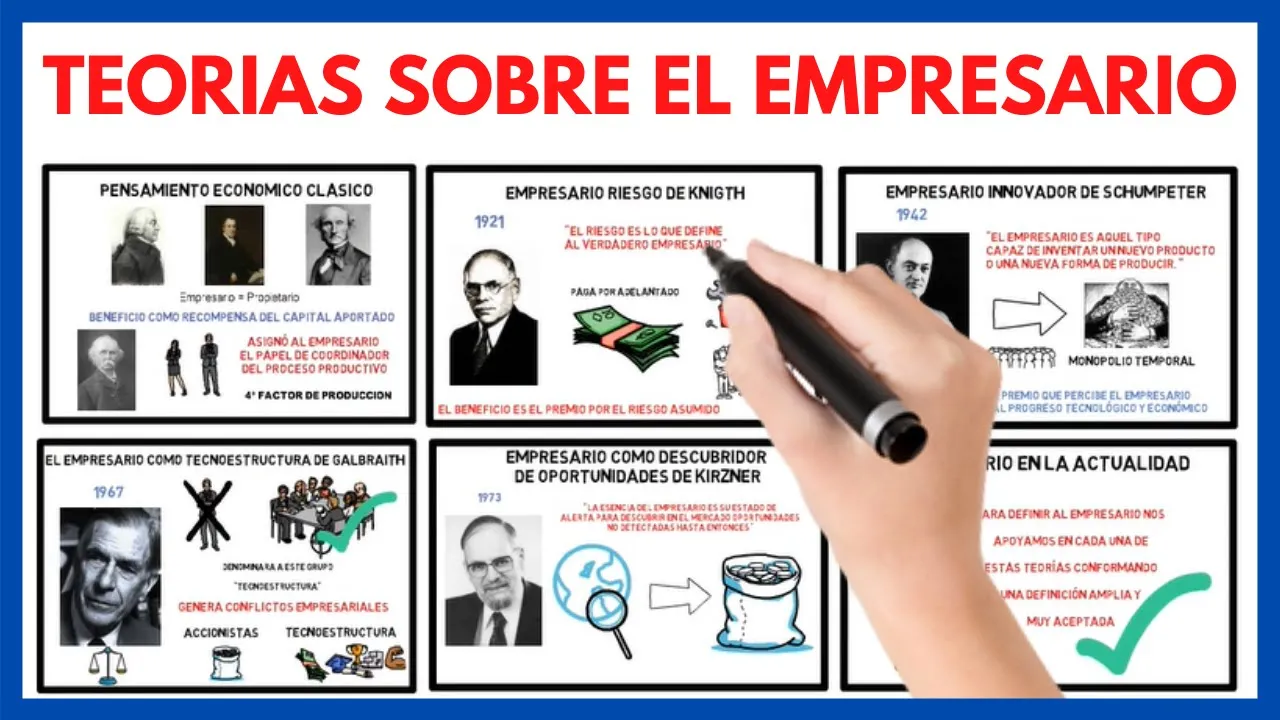
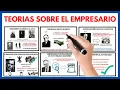
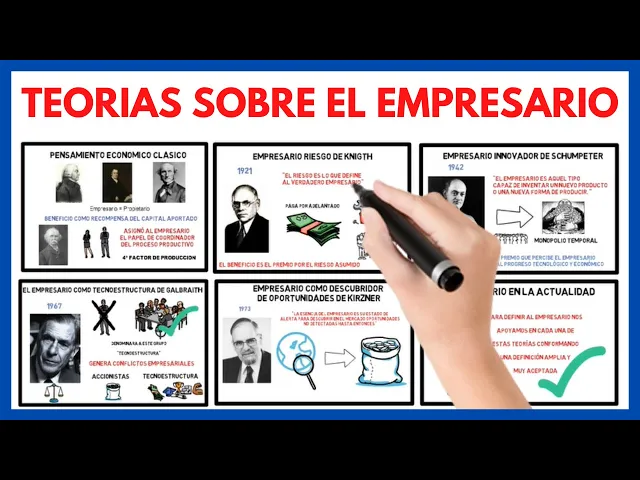
welcome once again to home economics today we will continue with the free course on business economics in this chapter we will talk about the theories of the entrepreneur traditionally the entrepreneur was considered as the person who gave life to the company he coordinated and He directed the production process, risking his capital in this ancient definition, it can be seen that the figures of the entrepreneur and the owner of the company are identified, that is, they are the same person, however today especially in large companies the owner is the partner Capitalist, that is, is a person who risks his capital by investing in that company and the businessman is the one who runs the company, that is, they are two totally different people, but this is why, to find out this, you have to take a walk in time and discover the different theoretical contributions that have been shaping the figure of the entrepreneur until now these theoretical contributions are the s are known as the five theories about the entrepreneur first the entrepreneur in classical economic thought as we said at the beginning of the video for a long time to classical economists like adam smith david ricardo and john stuart mill the entrepreneur was both the person that contributed the capital, that is, he was the owner of the business as the person who was in charge of running the business. If we understand this, we can deduce that the benefit was considered at that time the reward for the capital contributed, however all this changed when the economist Alfred Marshall At the end of the 19th century, he differentiated the figure of the entrepreneur from that of the capitalist, thus dividing his functions. This differentiation was key since it makes a fundamental contribution to the economy by assigning the entrepreneur the unique function of coordinating the production process.
fourth factor of production together with land, labor and capital, therefore from the end of the 19th century the entrepreneur is no longer considered as a person who contributes capital reserving that function to the owner or owners of the business, secondly we would find the knight venture entrepreneur theory that was born in 1921 when knight publishes His book entitled Risk, Uncertainty and Profit, where he assures that it is the risk that defines the true employer. See if you look closely at the employer when hiring the production factors such as the workers, the machinery and paying in advance the costs of the company to manufacture a product or carry out a service running the risk of not being able to recover the investment and thus lose all his money in the event that the business does not go well, so for him the essence of the entrepreneur lies in the uncertainty that he has about the consequences of their decisions thus justifying the benefit of the entrepreneur as the prize or reward for the risk borne in third ugar emerges the innovative entrepreneur from schumpeter thus adding another characteristic of the entrepreneur this author in 1942 considers that being an entrepreneur was synonymous with being innovative, that is, the entrepreneur is the type capable of inventing a new product or a new way of producing in this way by inventing That new product or that new way of producing the entrepreneur would achieve a temporary monopoly situation in the market , giving rise to extraordinary profits , however, for the poor entrepreneur and for the good of the consumers, this does not happen forever since with the passage of time Other companies would imitate this innovation, thus causing a decrease in profits and lowering the cost of this invention, being more accessible to ordinary people, in short, for this author, the benefit is justified as the prize or reward that the businessman receives for his contribution to progress. technological and economic that has given society as the fourth theory and bringing us closer to the f In the end we meet the entrepreneur as galbraith's technostructure, the economist Galbraith back in 1967 realizes that today's large companies are so complex that they cannot be run by a single person since either he is a genius who does not come from this world or he would end Literally crazy, being so complex, they require a collegiate management that integrates professional experts in different areas, that is, a company must have economists, lawyers, engineers, etc.
, this group being the businessman itself, Galbraith will call this group technostructure, constituting a new center of power within The company, however, this technostructure presents problems since it will have different future interests than the shareholders, arising within the company a series of conflicts in the business objectives, on the one hand, the shareholders who are the owners of the company who only invest capital will to pursue the obtaining of the greatest benefits of their investment is to say to obtain the maximum profitability of the contributed capital while on the other hand the managers when carrying out more complex activities than just investing money will pursue much broader objectives that go beyond the economic such as personal objectives among which those of labor security are found to enjoy a certain power or a certain prestige in the company, therefore the solution will be found in achieving a balance between the two parties in order to achieve the sustainability of the company in the long term, finally, the fifth theory He talks about the entrepreneur as a discoverer of opportunities for Kirzner in 1973 Kirzner will emphasize that the essence of the entrepreneur is his alertness to discover in the market opportunities not detected until then, that is, he is always on the lookout for new ways to enter new markets to sell etc.
![THEORIES OF BUSINESS 🏨 [EASY EXPLANATION] Business economics 08#.](https://img.youtube.com/vi/H_iLziUTI2M/maxresdefault.jpg)

![Limited Partnership 🏢 [Simple and Joint Stock] | Business Economics 18#.](https://img.youtube.com/vi/SpFiU0hce8I/maxresdefault.jpg)
![Cooperative Societies + [Types] 🟡 | Business Economics 22#.](https://img.youtube.com/vi/w5B9cPEaEss/maxresdefault.jpg)
![WHAT are the FUNCTIONAL AREAS of a COMPANY? + [FUNCTIONS] | Business economics 05#](https://img.youtube.com/vi/kyLpGyWr7lY/maxresdefault.jpg)
![The BASIC COMPONENTS of a BUSINESS [EXPLANATION] | Business Economics 06#](https://img.youtube.com/vi/jHzB9Mg8jpk/maxresdefault.jpg)
![Limited Liability Company + [advantages and disadvantages] 🏢 | Business Economics 19#.](https://img.youtube.com/vi/0F9d5FI2Gw4/maxresdefault.jpg)
![Sociedad Anónima + [ADVANTAGES and DISADVANTAGES] 👨💼👩💼 | Business Economics 20#.](https://img.youtube.com/vi/nuH0k015Rs0/maxresdefault.jpg)