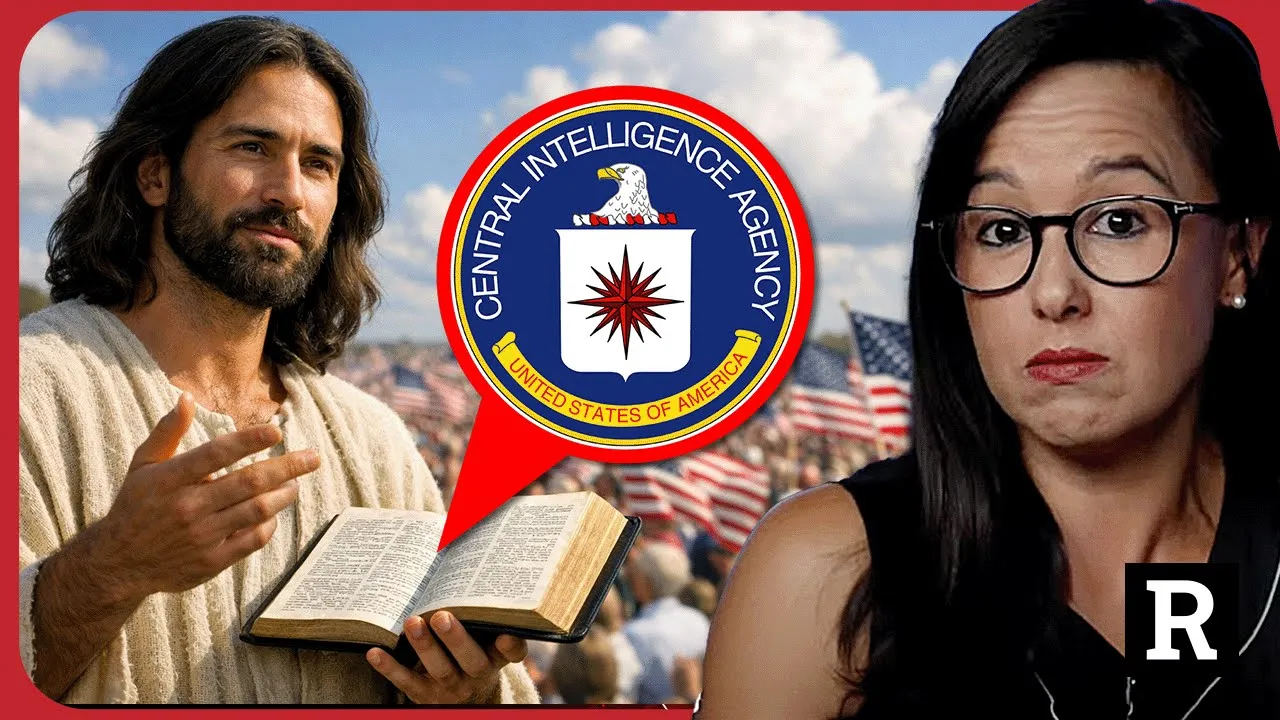
I wanted to talk to Jay Dyer, our guest today, because he has a really interesting perspective on the perversion of Christianity in modern-day society, specifically politics and entertainment. And I think those things are more important than ever. I think we're all understanding that there's hidden messages behind everything, but we're not sure what to lob on to. And we see these moments of I see cultural waves. And you know, I think we all are right to be skeptical, especially in the wake of the Charlie Kirk death. You know, we saw this megaurch event, which was his
memorial, but who's gaining power behind that? I'm just very interested in this sort of Christian revival and what might be right or wrong behind it. So, that's why I thought Jay Dyer was an interesting guest today. He joins us for the first time on Redacted. Thank you so much for joining me. >> Thank you, Natalie. Glad to be here. Um, I've been watching your interviews with uh my good friend uh Jim Jotra, so I'm honored to be here as well. >> Yeah. So, I mean, he also is an Orthodox. I met him at a Ron
Paul event and he has a lot to say about not just politics but also culture. I am sort of new to orthodoxy and I guess if we talk about it at this moment that we come to right now where the United States government has unconditional support for Israel and it's selling a lot of people are selling this through the lens of Christianity and so that's made a lot of us sort of peel the onion of Christianity and think where'd that come from and who's gaining power and now in the fall of 2025 we had the
death of Charlie Kirk which created this new wave of non-denominational Christians, but what do they stand for? And so that's why I wanted to talk to you because you've had this journey of studying Christianity and have landed in Orthodox and you can see these messages that are sort of perverted in our culture politically and through the entertainment industry. So I'm going to let you just take it. Can you sort of paint me a picture of where you've been and how you see that played out today? Yeah, I can speak to this because I was raised
Baptist and in the Baptist church in America in America, especially the Southern Baptist circles, dispensationalism or Christian Zionism is pretty much the norm. Um, it's not a dogma per se, but I think most Southern Baptist churches hold to this, especially coming out of areas like Dallas Theological Seminary, which is a classical dispensational hub. And I would say about 100 100 plus years ago, you had people in the circles of Samuel Unterm who's the famous US Zionist. And he really pushed for the Scofield study bible and through certain clubs that he was a member of to
recruit people into these clubs, people like CI Scofield himself, who was kind of a a notorious con man, he created a study bible with not much of a a pedigree himself for having any academic uh research or background. And the study bible became very popular right around the time of the founding of the uh well what would become the balf for decl the balf for declaration in the nation state of Israel in 1948. Back in 1917 when Balf for Declaration came out, uh there was this sort of coordinated push between Oxford University in the UK
printing the Scofield study Bible and the push for that in the US through these circles and these clubs and um that's why it became so popular is is a lot of money was behind it, a lot of promotion and prior to that most Protestant churches are what's called classical Protestant Reformation Churches like Methodists, Lutheran Presbyterians they didn't have this Zionist view. Zionism is a very new movement especially uh even even in the late 1800s it was being discussed by Moses has in his book Roman Jerusalem I think it's 1865 text he's one of the first
to say we need this movement to you know reclaim uh from Arab states and from the sultan this land of Israel and he eventually got the nation uh the support of the British Empire. So, long story short, uh there was a geopolitical motivation behind the push for American Protestant churches to adopt evangelical Zionism. It didn't really catch on in the mainline Protestant churches, but fundamentalist churches really latched on to it because they were they were duped by this study Bible. And now it's pretty much I would say most Southern Baptists, most evangelicals kind of just
default to this. But it took many many decades to get them into this mindset. So, it's one of the clearest ways to understand um the subversion of the church through geopolitical uh motivations. And more recently, I would say if you go back to the 1970s, you had the Jesus people movement that a lot of the boomers were duped into. And that was through things like the late great planet earth from how Lindsay uh people associated with Campus Crusade for Christ. And there's a great book by uh Effleam Ingall who's kind of a geopolitical analyst. He
wrote a book called Lost Heggeimon which describes the present day of the last few decades uh subversion of evangelical groups through the Pentagon military-industrial complex. I don't know if you remember Coney 2012 but that was one of the first incidents that occurred where I started noticing why is the why are these evangelical entities campus crusade for Christ etc. why are they pushing for this geopolitical, you know, motivation or or movement of Africa at the behest of the Pentagon? And the more I studied into that, the more I started to notice whether it's the the evangelical
Zionist dispensational stuff about the end times in Israel or whether it's the front for things like Africs overseas to couch it and taking out this dictator. A lot of the evangelical stuff is is tied to the hip with the Pentagon, the CIA, etc. All the way back to the moral majority with Jerry Fwell. >> Right. I think a lot of us I'll just tell you who you're talking to. So you know it you know I think we should we should not assume that anyone watching this understands dispensationalist so u because that was relatively new to
me and I think that a lot of us >> I was raised a Jehovah's Witness so that's my understanding of the Bible I'm not that any longer but that is how I know the Bible and Jehovah's Witnesses very much do not believe in world governments they believe that there's nothing nothing that stands above God and that you should never put your allegiance in world governments. And so we have seen Christian churches pledge their allegiance to Israel going flat against the the Bible, whatever Bible you use. No Bible says only this government is fine. And so
that makes a lot of us curious. And that sent me back to my Christian Bible asking questions, which I think is a good thing, right? But then I see now this this non-denominational wave that that caught popularity in the wake of Charlie Kirk's death. And I'm like, who's gaining power from this, right? Who what's not right here? And I can't make heads or tails of it. So I want somebody more studied than me to guide me. And maybe other people feel that way, too. >> Yes. So, dispensationalism is an ideology about the end times and
ultimately all of history that comes out of the Plymouth Brethren Movement uh in the late 1800s in the UK. They were a split off of the Anglican Church, the Church of England, and they followed a guy named John Nelson Darby who kind of charted out all of this uh prophecy that he had thought he had figured out from the Bible that all of history is divided up into these sections or these sort of disperate segments and that God in these different dispensations deals with mankind in a different way. Eventually, it led him to conclude that
there's two separate covenants. one for the gentile church, the believers throughout history who are Gentiles and a separate covenant for the nation state of Israel. And you can begin to see why again since the British Empire had its motivations to support the nation state of Israel, particularly amongst the Royal Society elites, the Clyden set, etc., or the Rothschilds um they would be very amenable to promoting this ideology which told all the fundamentalist Christians in the west and the evangelicals that you need to get behind this nation state of Israel because it's a fulfillment of prophecy
if it's if it's established. So, it's really kind of a bait and switch thing. But, uh, more specifically, the end times theories that you think about like in terms of, uh, you know, Tim Lehee's Left Behind series, Nick Cage in that movie Left Behind, that's all dispensational ideology. So, you would have, uh, pastors like John Haggy would be kind of the face of this uh, for for today. Um, but it's been around for about 120 years, 130 years. And um that's part of the uh push amongst evangelicals, entities like Kufi, which is the John Hegy
Christians United for Israel Institute. Um that whole ideology is about the fact that you must support anything the nation state of Israel does. And if you don't, you're spitting in the face of God and you're, you know, touching the apple of his eye because Israel is the apple of his eye. Well, the historical tradition of all churches prior to the last 100 years of dispensationalism, we understand that the church is the new Israel. So, the church is the fulfillment of what Israel was a type. So, the the promises to Abraham and to Israel are fulfilled
in the Christian church. They're not promises to a socialist nation state based around atheistic and cobalistic principles. So and that is when you read him bitesman and when you read the Herzel and Moses Hess who are the founders of modern Zionism I mean they didn't they believed in like pantheism and and Hegelianism they weren't Christians or I mean excuse me they weren't orthodox Jewish believers they had very heterodox views and much much more into politics than they were religion. So, it just doesn't make any sense. If you even if you believe the Bible, why would
an atheist nation state based around socialism be the fulfillment of God's prophecies and promises to the to the Jews of the Old Testament? So, so many things don't add up, but that's what dispensational dispensationalism is, is a sort of uh defaulting to trusting um you know, anything that Israel does is part of divine pro providence and prophecy. This episode is brought to you by Rumble Premium, the home of free speech and exclusive content from the videos that matter. With Rumble Premium, you get adfree viewing, access to exclusive shows, and premium features across the platform. We're
talking about Steven Crowder's Mug Club, Tim Pool's Timcast, Russell Brand's Raw Commentary, and of course, Redacted. Uh, plus tons of other bold creators that you won't find anywhere else. Whether it's breaking news, real talk, or the content that challenges the narrative, Rumble Premium puts you in the front row. Support creators who actually say what they mean in a place that they can say it and mean what they say. Go to rumble.com/premium/redacted to join today. One more time, that's rumble.com/premium/redacted because truth should not come with a filter. I wonder what you thought of the char Charlie
Kirk memorial. In a lot of ways, I found it very sincere, but they were doing on the spot conversions. Stand up if you'd like to accept Jesus for the first time in your life. And I see now, three months past that event, how those people now will be in a drag net of dispensational Christians. And so, I'm not saying that was purposeful. I don't have any proof, but it feels very much like that handed power to a lot of politics that I don't think is ordained by the Bible. This is my gut reaction. Would you
like to respond to that? >> Yeah, I would agree with that assessment. Um, you know, I don't think that God in the state or enemies or anything like that. I think if you read Romans 12 or if you go back to the book of Genesis, God established the state uh to have uh the authority to punish evildoers. But that doesn't make the state god. And that's why so many times the state has tried to be God and has persecuted religious believers um throughout the last 2,000 years of the church. But in in regard to specifically
things like uh the Charlie Kirk memorial and the the sort of evangelical entities connected to that, the problems are that it's connected to the Calvary Chapel. It's connected to things that were created by people from the CIA. If you look into Chuck Smith, if you look into Paul Kaine, if you look into these characters that are kind of [clears throat] Lonnie Frisbee that are the the the beginning of the the Calvary Chapel denomination, they all come out of CIA and military intelligence type stuff. Some of them came out eventually as being frauds and they were
exposed as homosexual and channeling aliens. I mean, it's just crazy stuff. >> Wait, really? Can you tell me more about that? This is something that you know. I think most look into characters like Paul Kaine and Lonnie Frisbee. Um Lonnie Frisbee I think if I'm going from memory here was the one that was um one of the early uh Calvary Chapel guys who claimed to be able to speak uh you know multiple languages and he had these miraculous powers. He was a prophet and all this stuff and then it turned out he was just a
gay dude and there was another guy named Yeah, there was another I mean he wasn't a prophet so shocker. Uh there was Paul Kane is another guy who worked with the CIA trying to do stuff related to the Stanford Research Project >> if I recall. I'm going for memory here. Um but you can look up these guys. Most of the stuff is pretty easily accessible. Um >> well, you don't have to give us all of it, but the trail is important, right? I want to follow that trail. >> Yeah. And not everybody Yeah. Not everybody
that's part of TPSUA faith, which is a separate, there's TPSA and there's like TPSA faith, which is the sort of evangelical franchise churches associated with it. Many of those people are part of what's called the New Apostolic Reformation. And they think that they're prophets. They think they're apostles. Uh so there's a lot of charismatic kind of weirdness going on. And and most of them, as we said, are dispensationalists, Christian Zionists. And you're exactly right that the so people funneling into these groups are going to be put into that mindset which ultimately has a geopolitical agenda
has nothing really to do with with Christianity. The people I'm sure are sincere. So I'm not doubting the people's sincerity. >> I think so too. >> But the movements and the the franchise and that's the thing with the Calvary Chapel for example is a big it's like it's like a business. So it's not a church. It's more like a corporate you know franchise like Subway or something. Um, so yeah, you could there's another great thing to look at that is it's more focused on the realm of Catholicism, but it's the same principle. It's called the
doctrinal warfare program. >> And there's a Roman Catholic guy who wrote a great book on it. Uh, his name is David Wimhof, and it's called John Courtney Murray, Time Life Magazine, and the American Proposition. and he's a Catholic lawyer that wrote about a 800page book on this doctrinal warfare program that CD Jackson and Henry Loose of Time magazine came up with during the Cold War to co-opt American churches. So, it's not just Catholic. That book focuses on Catholic, but it's also evangelical, uh, Orthodox, you name it. The idea was, why don't we turn the churches
into a form of soft power and that will be a very powerful engine during the cold war? And they even discussed Billy Graham kind of being one of these uh you know tools of uh social engineering during the cold war because he could turn a lot of people to to faith away from you know Soviet atheism. So um those are examples of people figuring out you know even in the cold war and this is a declassified program you can look up it's been declassified it's not a conspiracy theory. Um >> yeah the religion is a
perfect tool not just for soft power but also for um I mean even at times using missionaries as spies. So you mentioned you know things like Jehovah's Witnesses and things like that. Um Russia for example has banned Scientology and Jehovah's Witness >> uh uh missionary proitizing work >> because of the instances of those groups being used for espionage. So, and I'm not saying that's just those >> No, this is a classic >> Yeah, it's a it's a classic thing to use missionaries and and and people like that for for reconnaissance for for espionage. Absolutely. >>
Is there intelligence that Jehovah's Witnesses have been infiltrated to be used by as foreign spies? >> Yeah. >> Okay. This is really good. >> I mean, I'm saying that's the mo that's part of the reason why Russia would ban them. It's not the only It's not the only reason, but it's one of the reasons. the same with Scientology and and Mormonism as well. Um, but it's not just those groups. I mean, sure there there's a long history of of evangelical churches being used for espionage, too. So, um, >> there's been books some great books on
that over the years. Like I said, Lost Him discusses it somewhat. Um, there's a book called I Will Be Done about Rockefeller using um Baptist and Episcopal missionary evangelical missionaries in Latin and South America for private uh corporate espionage. So yeah, this is a whole other rabbit trail to go down, but it's an in it's a window into something that I think you're hitting on, Natalie, that most people just don't know about this. Like they don't know that churches >> are seen by the state as a tool of soft power primarily. So I'm not saying
they're all spies. I'm just saying religious groups can be a great cover or a great tool of soft power. >> And that's a tale as old as time. I mean, we know that the the Crusades were really a political expansion movement sanctioned by the Catholic Church. That's that's pretty clear right now. So, it's it it's always been even though our constitution allows for separation of church and state, the church still exists, which is a ripe power center for the government to exploit whether it wants to be or not. And we can talk about intention another
time. Recently we had a a Christian pastor on redacted explaining this movement to us and and he said that ev evangelicals are really sold the idea of American patriotism and that's why they're so >> and and I don't think I really understood that. How is that done when you are supposed to again I mean Jehovah Witnesses don't even vote. That's how much they keep neutral in world governments because it's important to them. And so how how are other Christian faiths taught patriotism when the Bible does not? Well, I might disagree with you there because I
do think that there's nothing wrong with being a patriot or supporting our nation state or having borders. If you look at Hebrews 11, for example, Paul holds up as examples of faith people from the Old Testament who defended Israel and defended their borders. He even says they expelled the foreigners and that's a model. >> Maybe my question was misguided then. I think I what I'm asking is like like governmental loyalty. So obviously yes patriot limitations something different. Yeah. Yeah. So, so like for example in the first three centuries of the Christian church um when the
Roman Empire turned against Christianity heavily uh and started persecuting it the they would make it mandatory that you worship Caesar or that you pay divine obeisance to the im image of the emperor and there were many people who were killed the martyrs of the first three centuries because they wouldn't admit that Caesar was God. So uh there's limitations or it's sometimes it's called spheres of authority right so the the state has a legitimate element or degree of authority but when he oversteps that we as Christians or as orthodox we have the duty to obey the
higher authority. So if God has given limitations to the state that they can't go beyond certain bounds for example the state can't come in and tell the church what to do. Uh when it does that it's overstepped its bounds and this this church has a duty to oppose the state. If the state comes in and says, "Uh, you have to worship me as God." Well, I have a duty to follow the ten commandments, which tells me that that's above the state, the state telling me to worship it as God, right? That's a lower authority violating
a higher authority. So, um, yeah, but I think that you're absolutely spot on with figuring out that evangelicalism is very very, uh, prone to worshiping the American government as a kind of de facto voice of God. Uh, and so anything especially going back to, you know, post 911. I remember when I was young, I was in my 20s back then, uh, when that when that happened. I was right around age 20 when 911 happened. And I remember the patriotism and the worship of the American state was just everywhere and you couldn't question it. I started
questioning 9/11 right after it happened. And I remember I was ostracized. Family members were mad, you know, but I was doubting the narrative. And it's because I didn't put the state as God. I didn't put, you know, Americanism as uh, you know, one of my religious principles. I have no problem criticizing, you know, the the American nation, the the American foreign policy and uh even our enlightenment principles. So, I think you're spot on that a lot of people are sort of inculcated, especially in American evangelical churches to kind of almost de facto think that, you
know, whatever America does is God. That's what Jesus wants. You know what I mean? >> Especially in in evangelicalism. Absolutely. >> So, >> so they they play on patriotism. They they play on >> Yeah. I think what I what I'm so curious about now, which I've again never seen before, we see the rise of Catholicism right now, for whatever reason, we see the rise of non-denominational Christianity. And a lot of that, as sincere as those conversions may be, are giving rise to certain power structures that we should ask questions about. Now, as I become interested
and and again, I'm coming to you as someone who studied the Bible from the Jehovah's Witness lens, left Christianity for a while, and then comes back to it now and says, "What is this? What is Christian Zionism? What is this evangelical uh patriotism that's leading to a war rhetoric? What what is this? And I want to know again." So, I I'm I'm coming back around and trying to figure it out. And then a lot of the political discussion is well Catholicism has always been the enemy of communism. They've always been fighting against that. And so
they are the original Christian warriors. And then you go beyond that. There's another layer. Well, actually Orthodox is the straightest line from Jesus Christ. And so every time there's this like hill to climb, I'm like, "Oh, there's the power structure. Oh, there's the power structure. So, that's why I'm so curious to talk to someone who has gone through this and arrived at orthodoxy. So, I'm going to let you respond to that. That's not really a question, but it's a it's a journey. >> It was. Yeah. I mean, I was, like I said, started Baptist and
then I spent most of my 20s in the Roman Catholic world. I was Catholic for almost 10 years. And uh for me there was just a lot of problems with the prevatican 2 and postvatican 2 theology because there's such a stark change and whole [snorts] premise of you know Catholicism is that it's the one true faith. It doesn't change. The dogmas don't change. They don't evolve. And yet here we have especially after Vatican 2 the dogmas evolving to be very you know stark contrast between what we see in the middle ages for example popes urban
II calling a crusade and then now the popes can pray in the mosque towards Mecca. So which one is it? What what's the real authentic Catholicism? Is it Mother Teresa praying uh in Buddhist temples or is it you know uh calling a crusade against the Muslims to free the holy land? I mean th that's such a stark contrast to me that I it was just so hard to try to make that work. And so what I ended up doing uh was just sort of focusing on the church fathers and the Christianity of the first thousand
years and how the Bible came to be. You know who put the canon of scripture together and uh you know as you can see this is all the church fathers here back behind me. That's uh what kind of eventually put me in in the direction of orthodox Christianity. So I came to believe and be convinced that the the form of Christianity that's prevalent in the first thousand years isn't the papal one, it's the Orthodox one. So that's long story short, that's where it took me. But I think you're hitting on other geopolitical factors here that
are relevant because for example the papacy nowadays kind of is positioning itself to be not just the head of the Catholic world and communion but there's a real push for a world religion for a false kind of union of all the religions under the papacy. For example, they created an Abu Dhabi faith center recently with Vatican approval and support where Muslims, Christians, and Jews are all gathering together to sort of have this common generic worship of some generic god. And you know, if you look at the first thousand years of Christianity, that's absolutely antithetical to
the whole ethos of what Christianity is. So for me, those are key indicators and signs that you know, the Vatican has really gone off in this Davos World Economic Forum direction. In fact, the previous pope had the same mentor as Claus Schwab. So, that to me is a is a huge uh you know, red flag. >> Yeah. I recently finished the book in God's name about the murder of Pope John Paul I. >> Oh, that's Yeah, that's classic. Yeah. >> And I'm convinced that he was murdered. I don't think And >> yeah, it gets into
the P2 Lodge and Operation Gladadio. >> Yes, absolutely. and the power it was really that that is a proof positive of the deep states infiltration of this power structure and the the changes that Jo that John Paul the first wanted to make were then thrown in the garbage >> Vatican bank y >> and yes and the the his successors were business as usual >> if not worse um and I don't know you know I'm not exactly sure what to do with that maybe you're ahead of me Well, you're spot on to look at Gladio there.
I mean, Gladadio is yet another one of these operations where you have uh going all the way back to the early OSS guys. You have William Colby, you have uh Cord Meyer, you have people like um um [clears throat] Angleton, all these people being involved >> in setting up relationships with the CIA and the Vatican whereby the Vatican would get money to sort of win some of these elections when the communists were getting more and more popular in Italy. And the trade-off was that the CIA would have access to and support from the Vatican and
also use the Vatican bank. And so Gladadio becomes this sort of model of you know concentric circles of scams of shell companies within shell companies. You have the Bank of Dembrosia which I'm sure you uh noticed in that book. one of the big banks that collapsed. And according to if you read Paul Williams' book on Gladio, who's himself a Catholic, he notes that this intertwining of the CIA and the the Vatican bank and the and the papacy was so disastrous because it really ended up putting the Vatican into or under the thumb of the CIA.
>> Yeah. >> That that's why you have during especially during the Cold War and I understand that doesn't make communism good. I'm a pro- atheist, pro- socialist, but the point is that when you link yourself like this, you end up getting a new master. And I think that's why the Vatican has been so on board with all the new world order, you know, Davos globalist stuff is that they've been in bed with, you know, the CIA and these entities for and and the CIA is really just the front for the Rockefellers if you if you
ask me. Um, a lot of the people in the circles of the Rockefellers. I'm right now I'm reading a Burton Hersh's book and lecturing through that called the old boys and that's just about the founding uh members and the oligarchical elite of the of the OSS and CIA. They're all really just frontmen for the Rockefellers. Bill Donovan, uh Alan Dulles, you know, all these people working from from for banks then go and found this, you know, uh intelligence apparatus. But they they're connected obviously to the Vatican. And and I'm glad you mentioned Gladadio because you
have essentially the subversion of not just the Vatican but also Italy. Italian politics ended up being subverted according to Paul Williams because >> from the working class it >> they stole the working classes money. Yeah. They stole their uh pensions >> when the Bank of Deio collapsed. They lost all their money. Um but GL Italy was being run basically by Kissinger through Liiogi of the PT lodge. And according to Paul Williams, he argues that uh it was the same model of kind of an Epstein style operation where they basically compromised most of the Italian cardinals
and politicians through the bongabonga parties that Sylvio Burleskone is famous for. It was it's the same stuff that Epstein was doing. And the story of the death of John Paul the first, it reads like a spy novel. He he went to bed. He had asked for all these people's resignations that he suspected were in bed with the mafia. Went to bed that night. Did healthy dude did not wake up the next day. And when he was found by his the nun that took care of him, one of the most important suspects came in, took all
his medication, took his slippers, took his glasses, took everything. And then that those evidential bits were never found again and the Vatican insisted that he could not have an autopsy. >> Yeah. They covered it up. Yeah. >> Yeah. It and people who were not who didn't even live in the Vatican were there at 5 in the morning. The Hurst was called before his body was even discovered. It's it it's undeniable that there were power structures who benefited from putting someone else in his place. I am so interested in your work because I've never seen someone
who sees the subversion of propaganda as a religious practice but I think that it is and I don't think that we understood this and now I see almost every sort of spiritual movement and I and I asked myself who benefits there and what's the real spirituality behind that that's required of us. I was thinking as I was preparing for this for instance Oprah's movement this like non-denominational faithbased movement this uh Joseph Campbell that we're all in the same spiritual journey but there's nobody who can lead it there's no church center there's nothing that this led
to the witch movement in the early 2020s I think that you know I followed that for a long time like yeah not the church it's all it's all individual who benefits there what What do you think of this? >> Well, that fits perfectly with the Americanist ethos, right? Americanism is all about individualism. And so, it makes sense that you would get uh an individualized or radically atomized individualistic spirituality out of that. Um, you know, Joseph Campbell is really just kind of cribbing from Carl Young. She's watered down Carl Young type archetypal stuff. Uh, so, you
know, it's it's a mix. And I think that big name influencers like that or or moguls I guess you could say with Oprah uh you know they've long had a fixation with spirituality and sort of tailoring that to their largely women audience and I think so I think it marketable from a marketing perspective would play well with her audience being largely women. Uh what they would gravitate towards would be something like that. But I think ultimately uh they're really just fraudulent sort of copies out of you know Freemasonry that kind of stuff. Joseph Campbell's big
on Freemasonry. So um they're just it's kind of creating and tailoring your own religion. You know, if you look at somebody like Alistister Crowley, uh the famous Satanist of the last century when he who worked for British intelligence, by the way, when he um created his system of it's almost like a grad school for creating religious cults, when you go through the degrees of his cult, uh you get to the top and sort of the end of it is you've learned now how to create your own religion. So for example, Elron Huard, he went through
that structure and when he came out of it, he creates Scientology. Um, speaking of witch stuff, uh, Gerald Gardner went through Crowley's structure and when he came out, he created modern wickah. So modern wickah is not ancient. It's created by this, you know, greasy old dude that wanted to spank naked women's butts in the out in the woods. And that's exactly what he did. like so he created his own little cult where he could have a bunch of nude nude women around um >> for the full moon ceremony. I think that exactly I think that
people like Oprah uh have figured out that religion is just from a practical perspective a very good grift >> but also Oprah you know it's very connected to a lot of these elite people you know look at the John of God stuff if you remember that >> I don't know what that is >> oh so John of God was that guy that was doing like breeding and he was a a faith healer but he was a con man um and Oprah did a lot of specials on him and his you know powerful mystical practices is
and how he could heal pe heal people and then it got busted. It was a big human trafficking operation. So they tried to scrub that. >> I guess >> his name was John of God. You can look it up. >> Okay. I guess what I saw it as like, oh, you're creating anarchists. That's what this movement has done. People who hate their government, who hate, you know, they think everything's racist. They think they're the only I I didn't understand that until I saw shirts at Target that said spiritual gangster. And I was like, [laughter] "Oh,
I get it." >> Well, it's funny you said that because I did a podcast recently on Joseph Conrad's novel Secret Agent, which is one of the first British intelligence novels. Uh, well, it's one of the first novels about British intelligence or intelligence operations in the modern world, >> modern modern English lit. There was an older one about the revolutionary period. I forget the name of it, but uh it's the second one about, you know, espionage. And in that book, uh, the the anarchist group, the anarchist collective, is essentially a cutout fake group that's run by
counter intelligence. So, I think I think you're on the right track. >> Okay. So, what you've done in your life's work is take a lot of movements and you're able to see who the power structures are. And in doing all of this for your whole life, you've landed on orthodoxy as what you think is the truth. And I'm I'm just so fascinated and I don't I could talk to you about this all day, but maybe can you come back because I feel like this is a game of Jeopardy. Like I can >> I can name
anything and you can say, "Well, here is here are the dark webs behind it." >> And that's it's super fun. you I mean I've seen you do it with other movies, other TV shows and things like that. Um but maybe tell me how do you how do you know where to land then when it seems like there's always a bad guy behind the bad guy in these well-intentioned movements? >> I mean I guess yeah I guess you're you're expressing kind of one of the unending struggle. I guess everybody will struggle at times with you know
any any movement having corrupts people amongst the members >> and I think with Christianity with orthodox Christianity ultimately you know it's decentralized so it doesn't have a pope it doesn't have a Vatican and I think that's one firewall that it has going to protect protect against the sort of total institutional corruption uh and but I mean really you know you can never escape institutional corruption totally um you know fallen human beings are always going to be doing human things. So, but I think that's one one reason why orthodoxy is somewhat immune to being totally uh
taken over. Um, but it's not just decentralized. It also has kind of a you know a global um it has a global communion aspect to it. Uh even though there is a little bit of a hierarchy with bishops, but there's no superbishop like the pope. So, but yeah, I mean uh there's a lot of reasons why. I mean, I think my own background, my own life, a lot of that I think led me to where I'm at. I won't spend a whole lot of time on all that. But beyond that, I would say what we
also do on my channel and on my material is like I don't just cover, you know, religious topics. We do a lot of stuff. So, I I write comedy for Sam Hyde show. I host Alex Young show most Fridays for the last 5 years. Um, we do a lot of talks where we lecture through Global Elite Books. So, we've done about 70 of those in the last 10 years. Um, and then we also cover film, film symbolism. My three books cover, you know, symbolism and film. Um, and then I do have some, you know, religious
debates. We've debated a lot of the top Muslims and atheists and all that. So, it's all of those things I think combined together to kind of for me try to get a picture of what's really going on in the world. And that's what we're after. Like I'm after like how does the world really work? Not I don't want to be duped. I don't want to fall into >> Yeah. >> you know, tricks and scams and propaganda. I want to know how the world really works. And that's what led me down the rabbit hole of religion
and uh geopolitics and espionage because that's really what makes the world go wrong. >> Yeah. Well, because people who are seeking seek for the right reasons and the wrong people will come in and subvert that. >> Exactly. >> Because it's because it's innocent. It's it's an innocent search, I think, and a well-intentioned search. And so do do orthodox believe, excuse the um fundamental question or the elementary question, um that something can save us from these dark forces that are subverting our political and religious lives. >> Um yeah, Orthodox Christianity believes that Christ is the second
person of the godhead. So he is the the second person of the trinity and that he came on earth to not just teach us moral examples but also to ontologically save us to change our very being. And so we participate uh in the divine liturgy which is our worship service which was kind of typified in the Old Testament with the temple and the sacrifice and the the liturgy there. We have a new testament liturgy that's kind of the fulfillment of that. So we believe that, you know, weekly feeding on Christ in the Eucharist and participating
in the sacraments, we think that there's a real, you know, communion with God there and that that does actually save us and prepare us for the future escaton or the future resurrection. So we think that there's a spiritual battle going on. It's not ultimately just human power structures and machinations of, you know, intelligence agencies and government stooges. It's also a spiritual battle with, you know, the demonic realm and the angelic realm. So, we're caught in between that battle. Uh, and, uh, we think that, you know, Orthodox Christianity is sort of the >> the the means
by which one wins that battle, >> right? I think that anyone who follows modern politics understands that there is a demonic force at work. >> Exactly. and that you're not just battling, you know, partisan politics, that there's something demonic about it that's co-opted and and I think we don't know what to do with that. Um, what Jehovah Witnesses would say is that it's going to take a clean slate. And that's what Armageddon is, that something will come, the believers versus the non-believers will be parsed out. And that is what the new system will be. That
we just have to start over. that there's and so what you're saying is that you think that well what what would you say to that? [laughter] I don't I don't want to summarize for you. >> Well, I would say there is an eventual end times and so ultimately in this world in this life not everything will be rectified. >> Okay. >> Um but also I think that we even within this life you know we can still have uh spiritual blessings and spiritual healing. All those things are re reality still within this life. we don't have
to wait for everything at the end of the world or whatever. Um, and also I think you know if you look at groups like Jehovah's Witnesses and I don't mean this in any kind of personal offense to you. I'm not insulting you but you know if you look at just I just want to ask the questions and get get somewhere that makes me feel like we're doing good work because we can't just subvert to the demons. Well, the reason I bring up if you look at uh uh the after Charles TA Russell, you had uh
Judge what's his face who was the next guy and >> yeah and he created Beth Serum because he thought the end of the world was coming and so a lot of those groups kind of like the dis >> I don't know about the death serum. They they did think that the world was coming to an end. >> Beth Serum was the house that he built for David when David and these people were going to come back. It's called Beth Serum. It's I think it's in San Diego. Um, and I'm saying that a lot of groups
have these sort of predictions of when the end of the world would come. >> Yes. >> You see the same thing with um Howal Lindsay, he wrote a book called 1988 where he said the end of the world, the rapture was coming in 1988. So, one of the indicators I think of like fake groups is they will have these sort of predictions of when it's going to happen and then when it doesn't happen, well, let's retool it and we'll revise it. We'll say that, you know, well, we we didn't get this detail right or whatever.
So the the sensationalism of sort of end time stuff I think is is not that useful for the practical living of being active in the world and just putting everything off towards the end of the world. Like we're we're in the world. We're supposed to be active in the world. We're supposed to engage in these activities. And so I just think that a lot of the end time stuff ends up being uh a tool that not just dispensationalists or Christian Zionists can use, but also if you're the state and you want people inactive and controlled,
well, you give them an ideology that, you know, you're not supposed to be involved. It also can be comforting though when you see things that are so dark and you think that the deep state power is so insurmountable that you think I sometimes feel like this like will the aliens just fix this? We can't fix it, you know, >> and there's comfort there that I don't think you can turn your nose up at. Well, I mean, yeah, you can make that argument, I guess, but also I think we have duties, you know, that we're called
to. So, >> right, it's sort of it puts it beyond myself. Like, I can't do it. It's too dark. It's too, you know, and sometimes sometimes I want to. Sometimes I want to think that the aliens can do it because we cannot. [gasps] >> Yeah. Well, if you ever seen that there's a great documentary that relates to that called Mirage Men. Have you heard of that? >> Yes, I have. But I haven't seen it. >> You should watch that. It's pretty fascinating on that topic. But um >> yeah, again I think you know Armageddon end
time stuff, it's not that I don't think there isn't in times. I just think that it's another way to sort of engineer and utilize through social engineering and psychological warfare techniques to make people inactive to make them catatonic to make them sort of blackpilled or whatever. Um and but again in our in our day most of that is really just toolled towards unfetter unfettering support for the nation state of Israel. So that's that's really where it's focused nowadays. >> Right. So [gasps] I could talk to you all day. I think um you know your books
are a great place, your channel uh you know I I guess I would like a reading list to know where to go or where do you think people should start to ask questions when you feel maybe this call to Jesus as we saw happen around the Charlie Kirk assassination? And then how how do you know that there's some kind of power structure that's manipulating your sincere desire to find truth? Yeah. Um, unfortunately there's no easy answers to those questions. And the other thing too is when it comes to religious engineering, um, as some people call
it, or soft power type stuff, there's not a whole lot that's actually been written on the religious side of it. So there's a lot of stuff, you know, where people dealing with history of the CIA and history of the MSAD or this kind of stuff, but there's not a whole lot of stuff dealing with um how American religious institutions are utilized and co-opted. So uh one good book that just always pops into my head that's a little more readable than David Wimhof's 800page book is F. William Ingall's great book, Lost Hedgeimon. He has a great
book called Full Spectrum Dominance. Both of those books touch on uh this subject. Um, but I would say also, you know, people can outside of just books, like people can go, you know, check out an Orthodox church if they want to and see if they like it. Orthodox liturgy. Um, but my books cover film symbolism and archetypal analysis type stuff like Yungian type stuff in Hollywood. >> Yeah. >> But what I do in my books is also >> the occult the occult representation in Hollywood where we don't we wouldn't otherwise know it. I mean, we
know it when it's like The Exorcist, but where does it come in when we don't know it? >> Did you know The Exorcist was writ? >> No, I didn't. >> William Peter Blatty that wrote that, he did uh psychological warfare for the CIA in Vietnam. So, that script was written with the sort of understanding of how to terrorize people. I'm not saying there's not demons, but I'm saying that even even that's kind of a fascinating story. I put that in in my third book. But um >> yeah, >> long story short is that when I
in the books I kind of list a lot of of reading suggested reading type stuff. So but we cover a lot of classics on my channel like tragedy and hope is a classic from Carol Quigley. We cover Bersinsk's texts. Um we cover Kissinger stuff, Rockefeller books, history of the Rothschilds. Like all those kind of formative geopolitical stuff is is good to read. Um but yeah. >> Amazing. Okay. Well, I don't know how to wrap this up. I feel like we could take any one of these things and pull the thread. And maybe we should do
that another day and I'll just sort of meditate on which ones I think or maybe uh in the chat if you want to, you know, go down one of these rabbit holes specifically, we can do that. But I'm so glad to know you and know more about your work and you're Yes. Uh Jim Dress is the one because I like I said, I'm a seeker. Um and I I thought that my work was political and then the more that you study politics the more you cannot avoid the spiritual. So I am sucked back in and
and my way of seeking is to >> pick up the pebbles that are on my trail like Hansel and Gretle type stories like this book okay I'll read it and now what do I know and then this book and I'll you know that's that's all I can do. So, you are my pedal and I picked you up and now I need to keep going. So, thank you. I hope you'll come back on Redacted. Uh Jay Dyer has been our guest. You can find more about him at jaysanalysis.com. Uh it's been a pleasure. >> Absolutely. It
was a great conversation. You had you had really good questions. >> Oh, thanks. [laughter] All right. We'll we'll talk again another time. All right.


![SCOTT RITTER - Best of Marathon [PART TWO]](https://img.youtube.com/vi/fSLQU8DWSHA/mqdefault.jpg)