Thanks to Simply Safe for sponsoring this video. More on them later. Hey, 42 here.
Let's take a moment to stop and think about what's happening right now. Here I stand, illuminated by dramatic lighting, ready to deliver a hopefully fascinating story to viewers across the world. There you sit, quite possibly thousands of miles away, watching and listening to an Englishman embraces and a mustache.
Quite apart from sounding a little odd, this situation is nothing short of a miracle. It isn't so long ago that what we're doing right here, communicating by video across time and space was the stuff of science fiction. If you'd whipped out a smartphone in the 18th century and loaded up the latest 42 video, I probably wouldn't look any different, but you would probably have been burnt at the stake.
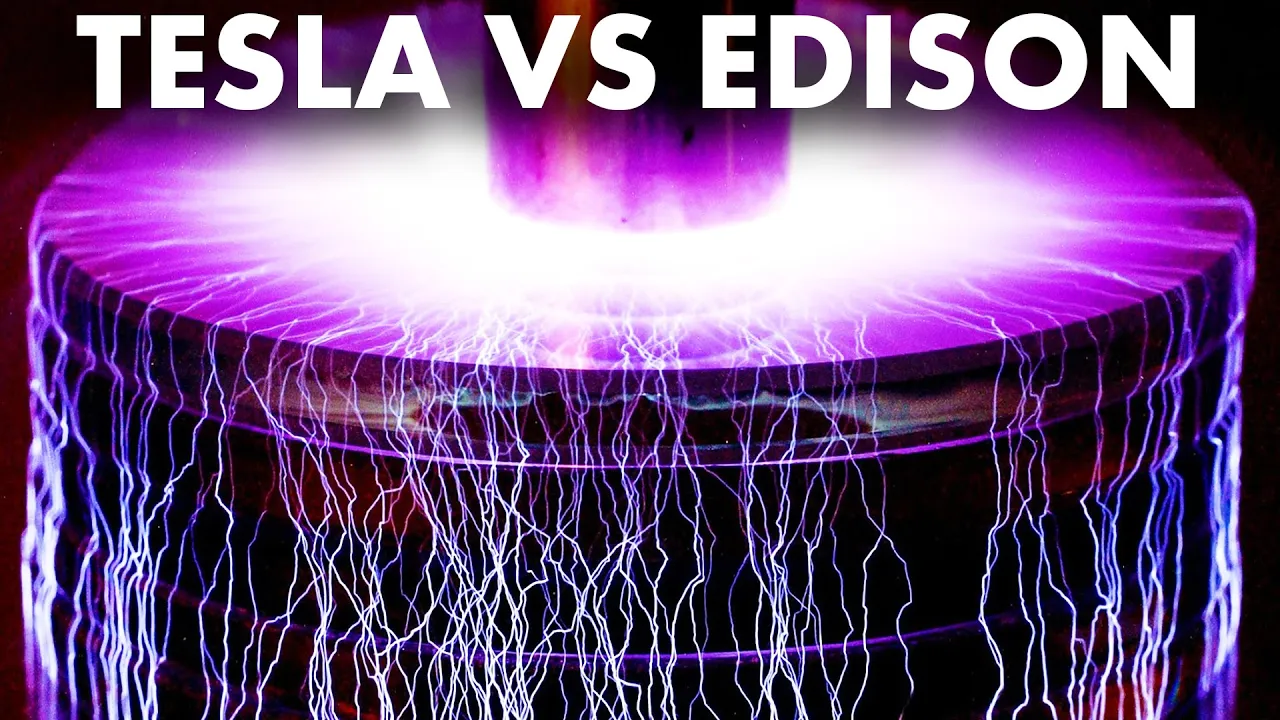
Today, we take the technology we use for granted. And most of us never even consider that none of these gizmos and gadgets would exist without two heavyweight inventors and the feud that drove them to brilliance and madness. We're talking about one of the greatest contests in history.
A story filled with genius, money, power, and AC/DC. No, not the rock band. So without further ado, let's get ready to rumble.
In the red corner, we have Thomas Alva Edison, darling of American folklore, master innovator, business mogul, owner of more than a thousand patents, and founder of the company that would later become General Electric. And in the blue corner is Nicola Tesla, eccentric and slightly overhyped genius, considered by some to be the father of world electricity and a really big fan of pigeons. Arguments among science geeks over which of these men was the greatest inventor tends to end in broken bunom burners and insults in Cllingon.
But such trivial nerd-on-nerd conflict pales in comparison to the venomous rivalry that defined Tesla and Edison's relationship. Edison was born in 1847 and rose from humble beginnings in the American Midwest. From an early age, he showed an entrepreneurial spirit, selling sweets, newspapers, and randomly vegetables on trains running between his hometown of Port Huron and Detroit.
He wasn't one for academics though. He attended regular school for a grand total of 3 months before switching to homeschooling. And he didn't bother with higher education at all.
As a teenager, he almost burnt down a train after setting up a mobile chemistry lab in the baggage cart. He also installed a printing press with which he published the Grand Trunk Herald, the first newspaper to be printed on a train. You know, the usual kid stuff.
He got his first big break after saving a three-year-old from being pancaked by a train. The incident landed him a job as a telegraph operator. At 22, the sale of his first major invention, the quadruplex telegraph, earned him enough money to leave the trains behind and become a full-time inventor.
His reputation began to grow, and just before his 30th birthday, he founded a research lab in an area called Menllo Park. It grew to employ 20 to 30 machinists, physicists, chemists, all theists. Basically, this team of ass is dance.
See what I did there? Was prolific and the lab became known as the invention factory. Some say this was Edison's real gift, improving other people's designs and working out how to make lots of money off them.
Before long, he became known as the wizard of Menllo Park, though by all accounts, he was shitty Quidditch. Some of the creations that flowed from the factory included an improved version of cement, the alkaline battery, the first example of a movie camera, and the phonograph, a precursor to the record player. The first words ever recorded on the phonograph were from the nursery rhyme, Mary had a little lamb.
Which is funny because Edison's first wife's name was Mary. Luckily for him, Freud was only just starting out at this time. Edison also created the concrete house, which turned out to be one of his few fails.
You might be wondering what's wrong with a concrete house. Concrete is a common building material after all. But in Edison's version, everything was made out of concrete.
The building, the furniture, even the piano. Yeah, good luck pivoting a concrete piano round a bend in the stairs. He may have been a great inventor, but he had the interior design instincts of a Neanderl.
Edison is of course most famous for his creation of the first commercially viable incandescent light bulb in 1879. And like a lot of his inventions, Edison didn't actually come up with the idea at all. But let's give the man his dues here.
He did perfect it. And if you ask me, Edison gets way too much negative press for a man of his achievement. The first incandescent bulb had actually been developed in England almost 40 years earlier by Carl Marx impersonator, Joseph Swan.
But just like Marx's ideas, Swan's bulb was dangerous and burned out after a few minutes. Edison took up the challenge. According to legend, he tried 10,000 types of filament before getting it right.
And around 12 months later, he launched the world's first public display of electric lighting. The year was 1879. Thomas Edison was a superstar and a national hero.
But he was soon to meet the man who would threaten everything. It was the legacy of Edison and Tesla that enables the amazing technology of today's sponsor. There's little in life more valuable than your safety.
And Simply Safe is an incredibly effective and reliable home security system that will secure your home fast. Like a lot of people, I've had home security scares in the past. And for me, Simply Safe offers peace of mind and a good night's sleep.
Simply Safe professionally monitors my home 24/7, so I can go away confident that if anything happens to my home, the police will be called. I love my Simplysafe kit. It has sensors to cover every window, room, and door.
Plus great extras like water sensors, temperature sensors, and HD cameras. There's even a panic button. Want to add a smart video doorbell to your home security system?
Simply Safe have you covered. You can even get a smart lock that not only keeps out intruders, it automatically locks your door if you forget to do so. I was blown away by how easy it was to install, the self- adhesive sensors can be attached anywhere in seconds.
And in just 30 minutes, my system was fully functional. I especially love the key fob that allows me to instantly arm. Please exit now and disarm my system.
Alarm off with the push of a button, please visit simplysafe. com/42. To learn more, link in the description below.
Nicola Tesla was born in presentday Croatia in 1856. He grew up the son of an orthodox priest and unlike Edison went to school like a good little boy. Also unlike Edison, he wasn't much of a tinker type inventor.
Instead, it was his unique imagination that set him apart. Tesla had an idetic memory, which meant he could very precisely recall images and objects, and could accurately visualize intricate 3D objects, memorize entire books, and never forget where he'd left his car keys. He could also speak eight languages.
And most importantly of all, the man had serious mustache game. Just saying. By 19, he was a star electrical engineering student.
But behind the scenes, an obsessive personality had started to reveal itself. He was notorious for only sleeping two or three hours at night and working almost every waking minute, a habit that would continue throughout his life. This predigious work ethic led his professors to write to his father warning that if Tesla remained in school, he would surely die from overwork.
It was around this time Tesla became consumed by the idea of creating an electric motor that ran on alternating current AC which he believed would be superior to the direct current DC electrical systems that were more common at the time. In simple terms, the difference between AC and DC is in how they flow. DC flows steadily in one direction whilst AC oscillates back and forth.
As for why Tesla favored AC, well, we'll get into that later. In spite of the promise he had shown, just 5 years later, Tesla was a mess. His obsession with the AC/DC problem had led to a nervous breakdown.
But not before he'd become a gambling addict, lost all his tuition money, and dropped out of university. His fall from grace was so complete, his friends believed him to have drowned in the nearby Myrrh River. probably concerned he would eventually end up on a street corner, licking his elbow and writing his name in his own feces, two of Tesla's uncles arranged for their now deranged nephew to move to Prague, where he was to continue studying at Charles Ferdinand University.
But things didn't quite work out. For starters, he couldn't read or write check. Hadn't studied the required subjects to enroll and turned up after admissions had closed.
A show all around then. His new life over before it had begun. Tesla ended up in Budapest instead.
And it was there that one day whilst walking through a park reciting poetry with a friend, as you do, he had a vision. In the dirt, Tesla drew an image of the AC electric motor that years later would define his career. Next up for the man with permanently itchy feet was Paris, where Tesla found himself installing incandescent lighting for, wait for it, the Continental Edison Company.
In 1884, he was transferred to the United States, arriving with nothing in his pocket but four cents and a letter to Thomas Edison from a mutual contact. It read, "My dear Edison, I know two great men, and you are one of them. The other is this young man.
" Edison agreed to meet Tesla, but it wasn't long before he wished he hadn't. When Tesla stepped off the boat in New York Harbor, the America he entered was in the middle of a great industrial expansion. Edison's recently developed commercial light bulb was a part of this boom and promised to light homes across the nation.
The only slight snag was there was no way to actually light the bulbs. Large scale electricity production didn't exist yet. Edison's solution was direct current DC, which he imagined would be wired into every home, office, and factory in the country.
But the DC generators Edison had built were horribly unreliable and broke down all the time. At the time, there was no way to make DC electricity travel over long distances, at least not economically. So for Edison's system to work, there would basically need to be a power station on every block in New York City.
Instead of a fire hydrant and a nutcase, following their initial meeting, Edison gave Tesla his first proper assignment to sort out the storm of issues that was plaguing the DC generators dotted around the city. According to Tesla, Edison even offered him a $50,000 bonus if he could fix the failing machinery. Applying his trademark approach of sleep deprivation mixed with batshit crazy, Tesla solved the conundrum, and within weeks, Edison had a fully functional supply of DC electricity production.
However, when Tesla approached Edison for his $50,000 award, Edison refused, telling Tesla it had been a joke and that he had misunderstood the American sense of humor. Not surprisingly, that didn't go down too well. Tesla and Edison parted ways.
Though Edison had secured the valuable first mover advantage by bringing his electricity production network and light bulb design to the market first. His DC power system was pretty limited, having a useful transmission range of less than a mile from the source, so DC electricity was only really economically viable in highdensity urban areas, leaving more spread out populations in the dark. Literally.
One man who recognized this major drawback early on was George Westinghouse. Successful entrepreneur, inventor, and big believer in AC power. Westinghouse and his engineers knew that alternating current electricity could transmit power much more economically over long distances than direct current.
Without getting too tangled up in the science here, AC electricity networks had one major advantage over DC. They could leverage the power of components called transformers, which allow voltage to be stepped up, increased for longd distance transmission, which greatly increases efficiency by reducing energy loss, and then stepped down again, decreased to the correct voltage for use in homes and offices. meaning AC networks needed far fewer power plants than DC networks.
In practical terms, this meant AC networks were much cheaper to build. Having said that, Westernhouse didn't have quite the financial clout of Edison and the financial investment to build an AC network would still be huge. More importantly, a completely integrated AC network would require some form of AC motor.
By now, it was 1887 and by happy coincidence, right across town, Nicola Tesla had just filed a patent for his first AC electric motor. After turning his back on Edison 3 years prior, Tesla had done what anyone in his position would have done. He'd gone to dig ditches to earn a bit of cash.
But after securing funding to continue his research, Tesla had finally managed to create and patent the AC generator he'd drawn in the dirt in Budapest all those years before. I feel it's important to quickly address a common misconception here. It's widely disseminated that Tesla invented the first AC motor and even the concept of alternating current itself.
He did neither. He simply played a significant part in spreading it throughout the US. You can see on this timeline how he pops up at the back end of the history of AC.
French tinkerer Hippolit Pixie created the first working model of an AC generator in 1832 based on principles previously laid out by Michael Faraday. Westinghouse after seeing Tesla speaking about his AC generator at a seminar bought patents for the equivalent of $5 million in today's money. With Tesla on his side and a bankload of cash he'd made in the railroad industry, Westinghouse took on the Edison Electric Light Company in what was to be a major power struggle, both figuratively and literally.
And this is where things started to get messy. Determined to beat his arch rival, Westinghouse underbid Edison for electricity contracts, even going so far as to build new power stations below cost price. Edison was appalled by these tactics and retaliated in what can only be described as an unconventional fashion.
He started electrocuting animals. As we've seen, the advantage of AC electricity was that it could be stepped up for long range transmission at much higher voltages and stepped down again at its destination for safe usage. To put that in real terms, in the UK today, electricity from a regular power outlet is at 230 volts, but national grid power lines transmit electricity at 400,000 volts.
And it was in this high voltage transmission that Edison saw a golden opportunity to embark on a smear campaign. In the early stages of the AC network's implementation, there were inevitable accidents with many linemen being electrocuted, according to some sources. As far as Edison was concerned, transmitting electricity at such high voltages was downright dangerous.
To demonstrate his point, Edison arranged for demonstrations at his laboratory in West Orange, New Jersey, in which stray dogs and other unfortunate beasts were electrocuted using Westernhouse electric AC equipment. And these shocking tactics didn't end there. Around this time, a man called Harold Brown appeared on the scene, an electrical engineer by trade.
Brown began lobbying against the use of AC electricity in the nation's networks, claiming, as Edison did, that it was dangerous. The use of electricity for capital punishment happened to be on the US government's agenda at this time, and Brown was called in as a consultant in the investigation. Unsurprisingly, he advocated AC electricity as the best way to power the electric chair, claiming it was far deadlier than its DC counterpart.
When asked to help supply the necessary equipment for the chair, he set about trying to track down a Westinghouse AC generator to ensure the company would forever be linked with capital punishment and therefore danger of death. When William Kemler, a convicted murderer, became the first man ever to receive the electric chair, the Edison marketing squad made sure it was an AC generator that delivered the fatal charge. In an attempt to take things one step further, one of Edison's lawyers even tried to put a name to this new method of execution.
If he'd had his way, convicts who met their maker in the electric chair would not have been electrocuted to death. They would have been Westinghoused. It would later transpire that Brown, posing as an independent consultant, was actually on Edison's payroll and that his campaign against AC electricity had been designed purely to smear Westinghouse.
Wow, what a shock. Whilst Edison and Co were pissing about with publicity stunts, Tesla and Westinghouse were trying to take over the world. In 1893, visitors to the World's Columbian Exposition in Chicago had their minds blown, witnessing just shy of 100,000 incandescent lamps powered by AC electricity.
At the same time, Tesla was working on new contracts to supply power across New York State, whilst Westinghouse secured the bid to build a giant hydroelect electric power plant in Niagara Falls. The result? Well, by the turn of the 20th century, the race to light up America was effectively over.
AC power had triumphed as the energy source of the future, and Tesla had secured his spot as one of the fathers of modern electricity. The story might have ended there with Tesla disgustingly rich and Edison sitting at home electrocuting kittens, but history had more in store for this pair. Tesla may have been a technological and scientific genius, but when it came to money, he was one bulb short of a lighthouse.
Despite owning the patents to the most valuable inventions since the telephone, George Westinghouse was financially crippled by his efforts to win the war of currents. He begged Tesla to release him from the royalties he owed the inventor for licensing his patents. In appreciation of Wessonous's fair treatment of him over the years, Tesla agreed and tore up the royalty contracts.
It was the equivalent of finding out he'd won the lottery, then tearing up the winning ticket and wiping his ass with the pieces. Tesla said goodbye to the millions already owed to him in royalties and billions that were to acrewue in the future. But he kept inventing with his most significant creation being the Tesla coil.
Although like the AC generator, this is another one he nicked. This time from Irishman Mr Nicholas Callen who invented the first induction coil in 1836. Tesla's iteration however like Edison's light bulb was one of the first to be commercially viable.
These coils would go on to be an important component in early radio transmitters. And no Tesla didn't invent that one either. The first radio communications device was patented in England in 1896 by Golierro Maronei.
Tesla filed his radio patents a year later in the US. But with the help of financial investors who included Thomas Edison, Maronei was able to send the first radio signal from England to Newland in 1901, effectively defeating any hopes Tesla may have had of owning radio technology. He challenged Maronei in court, claiming the Italian had infringed his Tesla coil patents.
But the court found in favor of Maronei. That decision would be overturned 40 years later after Tesla's death where Maronei unwisely decided to sue the US government. But the damage had been done.
Tesla suffered another nervous breakdown and declined into a world of obsessivempulsive cray cray. He became obsessed with the number three, was terrified of germs, and insisted there must be 18 napkins at his table at every meal. He developed a violent aversion to pearl earrings and round things in general, and he developed a habit of circling a building three times before entering.
Tesla also became infatuated with pigeons and one white pigeon in particular. He said he loved this pigeon as a man loves a woman and claimed that one night she visited him to tell him she was dying. Apparently, she had two powerful beams of light burning out of her eyes.
And when she died in his arms, he knew that his life's work was over. Sounds legit. Tesla and Edison never resolved their differences.
It's rumored they were both in line to receive the 1915 Nobel Prize in Physics, but that it never happened because neither of them was willing to share the prize with the other. Some claim Edison refused just to ensure Tesla couldn't get access to the $20,000 prize money. Tesla passed away alone and penniless in 1943 at the age of 86.
though his legacy has received plenty of recognition in recent years. By the end of his life, he was widely considered a crackpot. Edison, on the other hand, died 12 years before at the age of 84, an American folk hero and one of the most respected technologists in the world.
When Edison died, Tesla was the only one to submit a negative opinion of him to the New York Times, essentially calling him dirty and stupid. It was a fittingly petty end to one of the biggest fights in history, but a fight we should be grateful for nonetheless. Thank you for watching.